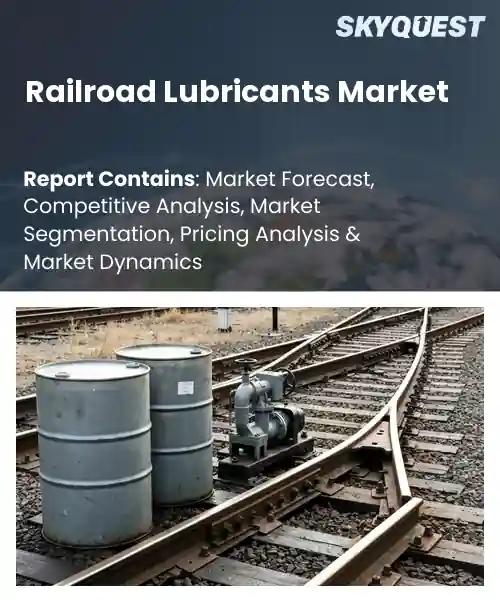
Railroad Lubricants Market
Report ID: SQMIG20U2028
Report ID: SQMIG20U2028
[email protected]
USA +1 351-333-4748
Report ID:
SQMIG20U2028 |
Region:
Global |
Published Date: February, 2026
Pages:
157
|Tables:
114
|Figures:
77


Global Railroad Lubricants Market size was valued at USD 6.3 Billion in 2024 and is poised to grow from USD 7.55 Billion in 2025 to USD 32.26 Billion by 2033, growing at a CAGR of 19.9% during the forecast period (2026-2033).
Demand for advanced formulations within freight rail operations is the key trend driving the global railroad lubricants sector. The growth in demand has pushed manufacturers of railroad lubricants to manufacture and distribute a range of products: greases, oils, and specialty formulations used in axleboxes, gearboxes, wheel-rail interfaces, and electrical contacts. Lubrication is essential for fuel efficiency, component wear rate, and service intervals and can therefore influence how long a piece of rolling stock can operate before requiring servicing. The railroad lubricants sector has changed over the years since its inception; for example, as more railroads operated heavy-haul freight fleets and higher-speed corridors required higher service intervals.
Building on operators quest for availability and cost reduction, the most influential factor is technology driven innovation in lubricant chemistry and delivery systems, which creates measurable performance gains. As rail operators deploy onboard sensors and condition monitoring, lubricants that reduce friction and extend service intervals directly lower downtime and spare parts consumption, so fleets in Europe and North America realize fewer axlebox failures and longer wheel life. Simultaneously stricter environmental rules cause a shift toward biodegradable and low VOC formulations, opening opportunities for specialty suppliers to partner with OEMs and maintenance depots to offer integrated product and service packages globally.
How is IoT Improving Predictive Maintenance in the Railroad Lubricants Market?
IoT is raising the reliability of railroad lubrication by linking sensors on pumps, dispensers and bearings to cloud analytics and maintenance systems. Key aspects include real time lubricant condition sensing, grease flow monitoring and automated centralized lubrication that replace calendar based schedules with condition based actions. Solutions that reduce manual relubrication and unexpected downtime, while improving the life of components are driving the development of the market. The vendors are providing an example of IoT enabled pumps and grease flow sensors that provide ongoing data to feed analytics and digital twin models to allow users to optimise use of lubricants and to support maintenance planning. This trend makes supply chains greener and maintenance work more predictable.
Market snapshot - 2026-2033
Global Market Size
USD 6.3 Billion
Largest Segment
Greases
Fastest Growth
Greases
Growth Rate
19.9% CAGR
To get more insights on this market click here to Request a Free Sample Report
The railroad lubricants market is segmented by lubricant types, application areas, formulations, end users and region. Based on lubricant types, the market is segmented into Greases and Oils. Based on application areas, the market is segmented into Freight Trains and Passenger Trains. Based on formulations, the market is segmented into Bio-based Formulations and Conventional Formulations. Based on end users, the market is segmented into Railway Operators, Maintenance Service Providers and Others. Based on region, the market is segmented into North America, Europe, Asia Pacific, Latin America and Middle East & Africa.
Based on the global railroad lubricants market forecast, bio-based Formulations segment dominates because increasing regulatory and customer emphasis on lifecycle environmental impact has shifted procurement toward renewable, low-toxicity lubricants that align with corporate sustainability goals. Increasing supplier investment in biodegradable chemistries and performing compatibility testing on new equipment helps protect new equipment and promote technical acceptance of new technologies and thus will support procurement preferences. Improving the environmental position on these products reduces the risk of disposal and supports the corporation’s ability to report on the environment.
However, Conventional Formulations are emerging as the most rapidly expanding area due to cost-effective production, proven field performance, and continuous incremental improvements that enhance compatibility with existing rolling stock. With a well-defined system already in place, suppliers will have the ability to rapidly grow volume and enhance their ability to offer post-sale services, which in turn will increase revenue potential from existing customers and create new opportunities for product placement.
Maintenance Service Providers segment dominates because centralized lubrication planning, predictive maintenance practices, and specialized application expertise generate consistent demand for tailored lubricant solutions across fleets. Their services and products work together to help operators reduce their total downtime and lifecycle costs by combining product supply with services such as condition monitoring, relubrication scheduling and contamination control. Their technical influence on specifications and purchasing consolidates supplier relationships and drives standardized lubricant portfolios across the maintenance ecosystem.
However, Railway Operators are the fastest growing area as operators increasingly internalize lubrication strategies to optimize asset availability and reduce outsourced spend. Faster spec updates and trial deployments of specialized products occur due to investment in standardization of procurement through internal reliability team investments and by working directly with formulators; thus creating an increased demand for Specialized Products, Training Services and increased supplier relationships thereby accelerating the market’s opportunity.
To get detailed segments analysis, Request a Free Sample Report
As per the global railroad lubricants market analysis, Asia Pacific commands the industry through a combination of extensive rail infrastructure, concentrated manufacturing capability, and a strong supply chain ecosystem. Rail operators are working closely with their local manufacturers and the OEMs to create customised formulations for specific operational and climate conditions. The regulatory emphasis on long-life equipment and high-efficiency machines is supporting the use of specialty lubricants.
The investment being made to electrify railroads and build new high-speed rail networks will further increase the demand for long-lasting, low-friction lubricants. Due to the regional sourcing advantages and the economies of scale for production, the regional lubricant manufacturers will be able to quickly introduce new products to the marketplace, while their close proximity to their raw material suppliers will ensure that they are able to maintain a reliable supply and competitive pricing.
Japan Railroad Lubricants Market
Railroad Lubricants Market in Japan reflects high expectations for performance and durability across dense commuter and high-speed corridors. Original Equipment Manufacturers (OEMs) are working together with lubricant companies to develop custom formulas to reduce noise and prevent wear. An emphasis on proactive maintenance is encouraging the use of specialty products that have been proven to have long lifespans. Strong domestic manufacturing capabilities allow quick testing of new products and a consistent supply of lubricants to help operators choose more technologically advanced, high-quality lubrication products.
South Korea Railroad Lubricants Market
Railroad Lubricants Market in South Korea is shaped by urban mass transit and strategic freight corridors that require resilient lubrication under varied operating conditions. Interest in improved energy efficiency through low-friction products has led to increased interest in research to reduce noise and more quickly establish partnerships by linking domestic manufacturers with rail operators for the design of formulations based on life cycle costs. Strong testing infrastructure and local processing capabilities support timely product validation and dependable supply for network maintenance programs and environmental performance goals.
Europe is experiencing rapid expansion in the railroad lubricants market due to a combination of modernization programs, a strong focus on sustainability, and integrated supply networks across national borders. Working collaboratively, rail operators, original equipment manufacturers (OEMs) and specialty chemical suppliers are accelerating the adoption of low-emission, long-life formulations. Severe maintenance structures will support the transition to premium and condition monitoring compatible products due to their cost-saving potential throughout the entire lifecycle.
The increase in cross-border freight flows and investment in mixed-traffic corridors also expands the range of applications for lubricants. Initiatives aimed at regional standardisation, coupled with an increased focus on research development activity, are enabling quicker product qualification and market acceptance, making Europe a dynamic and innovative region for railway lubrication solutions and resilience.
Germany Railroad Lubricants Market
Railroad Lubricants Market in Germany is anchored by a mature rail sector and strong engineering capabilities that demand high-performance lubrication for heavy freight and mixed-traffic operations. Working together with the chemical suppliers helps the component makers create custom formulations that have reduced wear rates and long service intervals. With a focus on an asset management program, components are manufactured in a condition monitoring compatible way. A testing and certification infrastructure enables efficient product qualification and broad seamless integration across domestic and cross-border networks.
United Kingdom Railroad Lubricants Market
Railroad Lubricants Market in United Kingdom is emerging as operators pursue modernization and sustainable maintenance that favor low-emission, long-life lubricants. The collaboration of infrastructure managers, operators and specialist suppliers creates support for pilot projects with condition based lubricants that are compatible with predictive maintenance platforms. A strong focus on the resilience of the network and a positive passenger experience has led to solutions that are designed to not only reduce noise but also provide extended component life and reduced costs.
France Railroad Lubricants Market
Railroad Lubricants Market in France shows strong adoption driven by network renewal, mobility projects, and emphasis on environmental performance that favors advanced lubrication technologies. National operators, organizations and specialty businesses working together faster than ever before are able to create trials on low-friction and bio-degradable formulations. The continued emphasis on shorter maintenance windows and increasing fleet availability will support the greater use of premium lubricants designed for use with condition monitoring.
North America is strengthening its role in the railroad lubricants market through strategic investment in infrastructure maintenance, technological modernization, and closer collaboration between operators and specialty lubricants manufacturers. Improved domestic production capacity and supplier network responsiveness to operator demand support development of locally manufactured products. Developing bio-degradable and lower-emission lubricants as part of an overall environmental/safety priority is driving new formulations; while a regulatory/procurement framework will widen the field of qualified new chemical formulations.
Industry partnerships between different industries with joint pilot projects facilitate field-testing of new product innovations and their conversion into scalable solutions, while simultaneously enhancing the competitiveness of the region in relation to railroad lubrication throughout the world. The focus on reliability in both heavy-haul freight corridors and passenger rail networks is creating a need for high-performance, low-maintenance lubricants.
United States Railroad Lubricants Market
Railroad Lubricants Market in United States is shaped by extensive freight operations and varied climates that demand robust, low-maintenance lubrication. Through a partnership between large carriers and manufacturers, new products have developed through advanced research. These products are designed to withstand the heavy load imposed by multiple trailers and extend the service life of each product. The increasing use of condition monitoring leads to more manufacturers producing long-term, sensor-compatible products. Domestic production and logistics networks provide fast delivery and tailored assistance through the entire lifecycle of the products used by operators.
Canada Railroad Lubricants Market
Railroad Lubricants Market in Canada reflects cold-climate performance priorities that prompt demand for formulations that maintain viscosity and protective film under severe conditions. Partnerships between regional operators and specialty suppliers emphasize field-proven solutions and efficient maintenance cycles. Local blending and distribution capability support timely response to remote operating environments. Focus on sustainability and quieter operations encourages testing of low-friction and biodegradable lubricants, with emphasis on reliability and reduced maintenance disruption.
To know more about the market opportunities by region and country, click here to
Buy The Complete Report
Expansion of Rail Freight Networks
Technological Advances In Lubricants
Stringent Environmental Regulations
High Switching Costs For Operators
Request Free Customization of this report to help us to meet your business objectives.
Competition in the global railroad lubricants market outlook is driven by demand for integrated friction management and on-track diagnostics, intensifying competition around solution bundles and services. Recent M&A and partnership moves show incumbents buying system knowhow, for example RS Clare acquired Igralub to add trainborne application and monitoring capability, and L.B. Foster extended its strategic partnership with FUCHS to co-brand lubricants and delivery systems while startups push sensor and measurement innovation such as Rivelin Rail and Flox Intelligence.
Predictive Maintenance Adoption
Sustainable Bio Based Formulations
SkyQuest’s ABIRAW (Advanced Business Intelligence, Research & Analysis Wing) is our Business Information Services team that Collects, Collates, Correlates, and Analyses the Data collected by means of Primary Exploratory Research backed by robust Secondary Desk research.
As per SkyQuest analysis, the global railroad lubricants industry is driven primarily by operators’ need to improve asset availability and reduce lifecycle costs, supported by technology-driven innovation in lubricant chemistry and delivery systems that enable longer service intervals and condition-based maintenance. A major restraint is increasingly stringent environmental regulations that raise reformulation and compliance costs and can delay product qualification. Asia Pacific dominates the market owing to large rail networks, local manufacturing and supply chain advantages, while maintenance service providers lead in demand because centralized lubrication planning, predictive maintenance expertise and service contracts create steady, high-value procurement. These dynamics favor suppliers offering integrated product and digital services.
| Report Metric | Details |
|---|---|
| Market size value in 2024 | USD 6.3 Billion |
| Market size value in 2033 | USD 32.26 Billion |
| Growth Rate | 19.9% |
| Base year | 2024 |
| Forecast period | 2026-2033 |
| Forecast Unit (Value) | USD Billion |
| Segments covered |
|
| Regions covered | North America (US, Canada), Europe (Germany, France, United Kingdom, Italy, Spain, Rest of Europe), Asia Pacific (China, India, Japan, Rest of Asia-Pacific), Latin America (Brazil, Rest of Latin America), Middle East & Africa (South Africa, GCC Countries, Rest of MEA) |
| Companies covered | |
| Customization scope | Free report customization with purchase. Customization includes:-
|
To get a free trial access to our platform which is a one stop solution for all your data requirements for quicker decision making. This platform allows you to compare markets, competitors who are prominent in the market, and mega trends that are influencing the dynamics in the market. Also, get access to detailed SkyQuest exclusive matrix.
Table Of Content
Executive Summary
Market overview
Parent Market Analysis
Market overview
Market size
KEY MARKET INSIGHTS
COVID IMPACT
MARKET DYNAMICS & OUTLOOK
Market Size by Region
KEY COMPANY PROFILES
Methodology
For the Railroad Lubricants Market, our research methodology involved a mixture of primary and secondary data sources. Key steps involved in the research process are listed below:
1. Information Procurement: This stage involved the procurement of Market data or related information via primary and secondary sources. The various secondary sources used included various company websites, annual reports, trade databases, and paid databases such as Hoover's, Bloomberg Business, Factiva, and Avention. Our team did 45 primary interactions Globally which included several stakeholders such as manufacturers, customers, key opinion leaders, etc. Overall, information procurement was one of the most extensive stages in our research process.
2. Information Analysis: This step involved triangulation of data through bottom-up and top-down approaches to estimate and validate the total size and future estimate of the Railroad Lubricants Market.
3. Report Formulation: The final step entailed the placement of data points in appropriate Market spaces in an attempt to deduce viable conclusions.
4. Validation & Publishing: Validation is the most important step in the process. Validation & re-validation via an intricately designed process helped us finalize data points to be used for final calculations. The final Market estimates and forecasts were then aligned and sent to our panel of industry experts for validation of data. Once the validation was done the report was sent to our Quality Assurance team to ensure adherence to style guides, consistency & design.
Analyst Support
Customization Options
With the given market data, our dedicated team of analysts can offer you the following customization options are available for the Railroad Lubricants Market:
Product Analysis: Product matrix, which offers a detailed comparison of the product portfolio of companies.
Regional Analysis: Further analysis of the Railroad Lubricants Market for additional countries.
Competitive Analysis: Detailed analysis and profiling of additional Market players & comparative analysis of competitive products.
Go to Market Strategy: Find the high-growth channels to invest your marketing efforts and increase your customer base.
Innovation Mapping: Identify racial solutions and innovation, connected to deep ecosystems of innovators, start-ups, academics, and strategic partners.
Category Intelligence: Customized intelligence that is relevant to their supply Markets will enable them to make smarter sourcing decisions and improve their category management.
Public Company Transcript Analysis: To improve the investment performance by generating new alpha and making better-informed decisions.
Social Media Listening: To analyze the conversations and trends happening not just around your brand, but around your industry as a whole, and use those insights to make better Marketing decisions.
REQUEST FOR SAMPLE
 REQUEST FREE CUSTOMIZATION
Global Railroad Lubricants Market size was valued at USD 6.3 Billion in 2024 and is poised to grow from USD 7.55 Billion in 2025 to USD 32.26 Billion by 2033, growing at a CAGR of 19.9% during the forecast period (2026-2033).
ExxonMobil, Chevron, Shell, BP, TotalEnergies, Lubrication Engineers, Klüber Lubrication, Mobil Delvac, Fuchs Petrolub, Castrol, Chevron Lubricants, CRC Industries, Afton Chemical, Dow Chemical Company, Chevron Oronite, Timken, RSC Bio Solutions, Bel-Ray, Schaeffer Manufacturing, ConocoPhillips
The key driver of the Railroad Lubricants Market is the expansion of railway infrastructure and increasing rail freight and passenger transportation worldwide. Growing demand for efficient rail operations, reduced friction and wear between rail wheels and tracks, and the need to lower maintenance costs are significantly driving the adoption of advanced railroad lubrication solutions.
A key market trend in the Railroad Lubricants Market is the growing adoption of environmentally friendly and high-performance bio-based lubricants. Railway operators are increasingly using advanced lubrication systems and sustainable formulations to reduce track wear, minimize noise, improve energy efficiency, and comply with environmental regulations.
North America accounted for the largest share in the Railroad Lubricants Market, driven by its extensive rail network, high freight transportation volumes, strong investment in rail infrastructure maintenance, and the presence of major railway operators in the United States and Canada.


Want to customize this report? This report can be personalized according to your needs. Our analysts and industry experts will work directly with you to understand your requirements and provide you with customized data in a short amount of time. We offer $1000 worth of FREE customization at the time of purchase.
Feedback From Our Clients


 USA (+1) 351-333-4748

