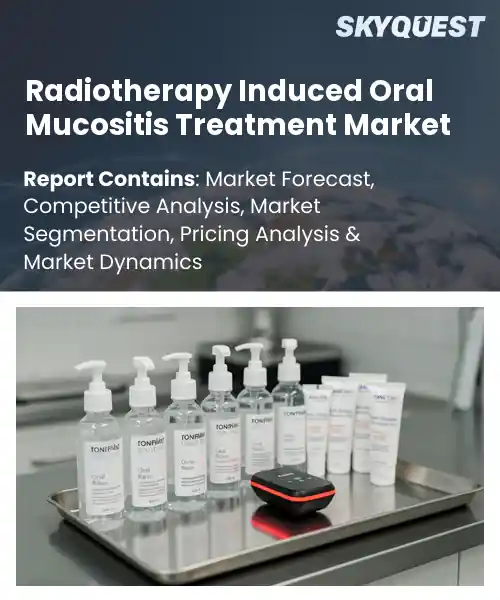
Radiotherapy Induced Oral Mucositis Treatment Market
Report ID: SQMIG35I2989
Report ID: SQMIG35I2989
[email protected]
USA +1 351-333-4748
Report ID:
SQMIG35I2989 |
Region:
Global |
Published Date: June, 2026
Pages:
157
|Tables:
115
|Figures:
77


Global Radiotherapy Induced Oral Mucositis Treatment Market size was valued at USD 682.5 Million in 2024 and is poised to grow from USD 731.84 Million in 2025 to USD 1285.4 Million by 2033, growing at a CAGR of 7.23% during the forecast period (2026-2033).
Integration of support care pathways into worldwide healthcare systems is one of the fastest and most sustained expansions driving radiotherapy induced oral mucositis treatment market growth. By applying risk-stratified protocols, which match the intensity of radiation doses with oral microbiome composition; matching genetic risk profiles with specific interventions to all clinical decisions, Mucositis incidence is decreased significantly and recovery times for patients are reduced greatly. These measurable results lead to higher hospital reimbursement incentives, which in turn leads to a broader formula for both private and public payors. Recently, a major European oncology network added combined low-level laser therapy and a wash for Benzydamine into their standard support care bundle, resulting in a reduction of 35% in severe mucositis rates; and as a result of this success was able to obtain substantial reimbursement from the appropriate paying entity for the bundle.
This success, both clinically and financially, has motivated the manufacturers of these two products to strategically fund large-scale confirmatory trials, and to aggressively expand their product lines through next-generation formulations; while concurrently reaching into previously unserved markets such as pediatric oncology and growing outpatient related to radiotherapy. Because of this, we will likely see rapid growth in the adoption of supportive care pathways in both public and private health systems around the world, creating and reinforcing a cycle of continual innovation and commercial investment, and continued expansion of access for patients today.
How is AI Improving Treatment Outcomes In The Radiotherapy Induced Oral Mucositis Market?
Oral mucositis care as a result of radiation therapy is being altered due to advances in artificial intelligence by allowing providers to detect symptoms early on, provide individualized doses of therapy, and prevent symptoms. By utilizing machine learning algorithms, healthcare providers are able to analyze patient technology, medical imaging, and treatment parameters to predict the risk of mucosal injury before the patient actually experiences any; therefore creating opportunities for medical professionals to change the radiation plan prior to experiencing any damage. Additionally, real-time monitoring applications are utilized to collect oral health data on patients being treated with radiation, which in turn provide data for AI models to develop tailored mouth-care regimens and identify complications earlier, allowing timely intervention.
Such tools are able to decrease the incidence of severe ulceration from oral mucositis and decrease the duration of recovery from oral mucositis, while improving overall quality of life and allowing oncology clinical staff to perform clinical work flows more efficiently and support evidence-based decision-making throughout oncology centers. Multiple companies now have integrated patient-reported outcomes and radiation treatment to develop a personalized approach to preventive medication and improve time to response and increase efficacy of all treatment provided.
Market snapshot - (2026-2033)
Global Market Size
USD 682.5 Million
Largest Segment
Mouthwashes & Rinses
Fastest Growth
Low-Level Laser Therapy (LLLT)
Growth Rate
7.23% CAGR
To get more insights on this market click here to Request a Free Sample Report
Global radiotherapy induced oral mucositis treatment market is segmented by treatment, severity, distribution, end-user and region. Based on treatment, the market is segmented into Palifermin (Kepivance), Mouthwashes & Rinses, Low-Level Laser Therapy (LLLT) and Cryotherapy. Based on severity, the market is segmented into Grade 1-2 (Mild-Moderate) and Grade 3-4 (Severe). Based on distribution, the market is segmented into Hospital Pharmacies and Specialty Pharmacies. Based on end-user, the market is segmented into Radiation Oncology Centers and Hospitals. Based on region, the market is segmented into North America, Europe, Asia Pacific, Latin America and Middle East & Africa.
The Palifermin segment of the global market leads due to its biological mechanism, which encourages cellular growth and repairs the mouth, resulting in less severe mucosal damage. Clinicians have confidence in the efficacy of Palifermin for the treatment of mucosal ulceration (aka mouth sores) associated with certain cancer therapies, thereby allowing patients to recover faster and have shorter hospitalization periods. As a result, clinicians are incorporating Palifermin into their routine use for prophylaxis and receiving reimbursement for its use, solidifying Palifermin's market dominance. Additionally, there are many ongoing clinical trials to evaluate Palifermin for additional uses in multiple types of cancers, thus increasing provider confidence and continuing to encourage use.
The mouthwashes & rinses segment of the global market is growing the fastest, as the number of patients is increasingly using over-the-counter mouthwash/rinse products due to their popularity and ease of use. New product innovations, including soothing formulations, and added antimicrobial ingredients within products, are appealing to both providers and patients and thus continue to help the mouthwashes/rinses segment grow rapidly and develop new revenue sources while enhancing the current therapeutic options in the oral cavity.
The specialty pharmacy segment dominates due to their centralized procurement, specialized handling, and dedicated patient support – all of which are vital for complex biologics and device-based therapies. Their ability to assist with insurance navigation and educate patients about therapy helps improve compliance and reduce gaps between treatments. Furthermore, specialty pharmacies integrate cold chain logistic systems and deliver personalized counseling to become the primary delivery channel for clinicians wanting dependable delivery of high value mucositis interventions. Specialty pharmacies form partnerships with the multidisciplinary healthcare community to streamline the care pathway.
In contrast, the pharmacy segment of hospitals has been the most rapidly growing segment because hospitals are expanding the services that they provide in house concerning their oncology program and bundling mucositis prophylactic therapy with other forms of care. Investment in pharmacy automation and real-time data systems that allow for faster fulfillment of orders will continue to drive innovations and improve efficiencies in hospital pharmacy practice in addition to speeding up adoption due to pharmacy formulary decisions that are made by the clinician. Hospital pharmacies will remain as a major driver of growth for this segment.
To get detailed segments analysis, Request a Free Sample Report
The North American Radiotherapy Induced Oral Mucositis Treatment Marketmarket has an advanced healthcare system where early intervention is prioritized and all-encompassing supportive care has been established. This has encouraged the use of advanced delivery systems and innovative therapeutics by creating a supportive reimbursement structure. As well, the area also contains many prominent research centres and biotech companies, which enables constant development of new products and their clinical trials. Integrated oncology networks promote more seamless multidisciplinary healthcare management (ie providing timely, in a coordinated fashion, access for patients to specialized therapies), which facilitates quicker access for patients requiring specialized mucositis therapies. A supportive regulatory framework enables speed of market-entry, which creates a continuing cycle of innovation, confidence in clinicians' treatment options, and benefit to patients, thereby reinforcing North America's leadership position in the treatment of radiotherapy-induced oral mucositis.
Collaboration among various types of organizations, academic research institutions, and NHS facilities are responsible for generating evidence to support the use of new therapies for the treatment of radiotherapy-induced oral mucositis. Large hospitals integrate the use of these new therapies into their standardised treatment protocols. Consequently, there are many ways for a patient to gain access to these new therapies through the supply chain.
The Radiotherapy Induced Oral Mucositis Treatment Market in Canada relies on a publicly funded health care system attempting to support equitable access to current technologies. Provincial health authorities typically work with manufacturers at an early stage to create greater need for cost-effective products. The presence of strong clinical networks, along with an enhanced focus on patient centred care, has further enhanced consistent use of supportive oral health care practices, ensuring that market growth within the overall framework of Canadian oncology remains stable.
The growth of Europe Radiotherapy Induced Oral Mucositis Treatment market is supported by coordinated government policies providing a higher quality of life for oncologic patients. The member states of the European Union have developed and implemented harmonized regulations governing product approval and accessibility across member states; this allows for quicker cross-border distribution of products. In addition, increased investment in clinical research provides substantial evidence for therapies’ effectiveness, leading to wider acceptance of available therapies. Health technology assessments will continue to emphasize the cost-effectiveness of mucosomal therapies, thereby encouraging their adoption by inclusion in national formularies. Also, increased awareness of the long-term impact of oral complications will result in more proactive prescribing by clinicians, thus fuelling market growth throughout Europe.
Radiotherapy Induced Oral Mucositis Treatment Market in Germany is anchored by a strong pharmaceutical landscape and well‑established oncology networks. Reimbursement mechanisms reward advanced supportive care, encouraging hospitals to incorporate new therapeutic options. Academic research institutions actively publish clinical outcomes, reinforcing clinician confidence and guiding evidence‑based protocols throughout the country.
Radiotherapy Induced Oral Mucositis Treatment Market in the United Kingdom experiences accelerated uptake driven by national health service initiatives that prioritize patient‑centred supportive care. Collaborative research programs across leading universities generate real‑world data, prompting rapid guideline updates. Emerging digital health platforms also facilitate early identification and management of mucositis, expanding treatment reach across diverse care settings.
Radiotherapy Induced Oral Mucositis Treatment Market in France is emerging as healthcare providers increasingly recognize the importance of oral health during cancer therapy. National oncology guidelines are gradually integrating mucositis management recommendations, prompting early adoption in major cancer centers. Growing partnerships between biotech firms and research hospitals support ongoing clinical evaluations, positioning France as a developing hub for innovative supportive care solutions.
Asia Pacific is strengthening its role through a convergence of expanding oncology services and heightened focus on patient quality of life. Governments are investing in modernizing cancer care infrastructure, enabling broader availability of specialized oral health interventions. Regional collaborations among academic institutions and industry accelerate knowledge sharing and accelerate product introductions. Cultural emphasis on holistic care drives clinicians to adopt comprehensive mucositis management strategies, while increasing awareness among patients spurs demand for effective therapies. This multifaceted advancement positions the region as a burgeoning market for innovative oral mucositis solutions.
Radiotherapy Induced Oral Mucositis Treatment Market in Japan benefits from a deeply integrated healthcare system that blends cutting‑edge technology with traditional patient care philosophies. National health policy encourages early supportive interventions, and leading cancer centers conduct rigorous clinical assessments that inform practice. Strong manufacturer presence further ensures a steady pipeline of novel therapeutic options tailored to local clinical needs.
Radiotherapy Induced Oral Mucositis Treatment Market in South Korea is driven by rapid modernization of oncology services and a proactive regulatory environment. Healthcare providers emphasize multidisciplinary treatment models that incorporate oral health specialists, fostering comprehensive patient management. Close collaboration between biotech innovators and university hospitals accelerates the translation of research into clinical practice, reinforcing market growth within the Korean cancer care landscape.
To know more about the market opportunities by region and country, click here to
Buy The Complete Report
Growing Clinical Awareness Of Mucositis
Advancements In Formulation Technologies
High Cost Of Novel Therapies
Regulatory Hurdles In Product Approval
Request Free Customization of this report to help us to meet your business objectives.
The radiotherapy‑induced oral mucositis market is shaped by intense competition among firms such as OncoZenge, EpicentRx and Prothex Pharma, each accelerating product pipelines to capture a growing patient base. Recent technology innovation exemplified by nano‑spray delivery research and strategic collaborations with clinical sites are driving differentiation and market entry for emerging players.
SkyQuest’s ABIRAW (Advanced Business Intelligence, Research & Analysis Wing) is our Business Information Services team that Collects, Collates, Correlates, and Analyses the Data collected by means of Primary Exploratory Research backed by robust Secondary Desk research.
As per SkyQuest analysis, the global radiotherapy‑induced oral mucositis market is being propelled primarily by growing clinical awareness of mucositis as a quality‑of‑life issue, prompting clinicians to adopt preventive therapies; a second driver is the rapid advancement of formulation technologies such as muco‑adhesive gels and nano‑sprays that enhance local efficacy and patient comfort. The market is constrained by the high cost of novel therapies, which limits uptake in cost‑sensitive settings. North America remains the dominant region due to mature reimbursement systems and strong research infrastructure, while the Palifermin (Kepivance) segment leads in share significantly owing to its proven epithelial‑regeneration benefits.
| Report Metric | Details |
|---|---|
| Market size value in 2024 | USD 682.5 Million |
| Market size value in 2033 | USD 1285.4 Million |
| Growth Rate | 7.23% |
| Base year | 2024 |
| Forecast period | (2026-2033) |
| Forecast Unit (Value) | USD Million |
| Segments covered |
|
| Regions covered | North America (US, Canada), Europe (Germany, France, United Kingdom, Italy, Spain, Rest of Europe), Asia Pacific (China, India, Japan, Rest of Asia-Pacific), Latin America (Brazil, Rest of Latin America), Middle East & Africa (South Africa, GCC Countries, Rest of MEA) |
| Companies covered |
|
| Customization scope | Free report customization with purchase. Customization includes:-
|
To get a free trial access to our platform which is a one stop solution for all your data requirements for quicker decision making. This platform allows you to compare markets, competitors who are prominent in the market, and mega trends that are influencing the dynamics in the market. Also, get access to detailed SkyQuest exclusive matrix.
Table Of Content
Executive Summary
Market overview
Parent Market Analysis
Market overview
Market size
KEY MARKET INSIGHTS
COVID IMPACT
MARKET DYNAMICS & OUTLOOK
Market Size by Region
KEY COMPANY PROFILES
Methodology
For the Radiotherapy Induced Oral Mucositis Treatment Market, our research methodology involved a mixture of primary and secondary data sources. Key steps involved in the research process are listed below:
1. Information Procurement: This stage involved the procurement of Market data or related information via primary and secondary sources. The various secondary sources used included various company websites, annual reports, trade databases, and paid databases such as Hoover's, Bloomberg Business, Factiva, and Avention. Our team did 45 primary interactions Globally which included several stakeholders such as manufacturers, customers, key opinion leaders, etc. Overall, information procurement was one of the most extensive stages in our research process.
2. Information Analysis: This step involved triangulation of data through bottom-up and top-down approaches to estimate and validate the total size and future estimate of the Radiotherapy Induced Oral Mucositis Treatment Market.
3. Report Formulation: The final step entailed the placement of data points in appropriate Market spaces in an attempt to deduce viable conclusions.
4. Validation & Publishing: Validation is the most important step in the process. Validation & re-validation via an intricately designed process helped us finalize data points to be used for final calculations. The final Market estimates and forecasts were then aligned and sent to our panel of industry experts for validation of data. Once the validation was done the report was sent to our Quality Assurance team to ensure adherence to style guides, consistency & design.
Analyst Support
Customization Options
With the given market data, our dedicated team of analysts can offer you the following customization options are available for the Radiotherapy Induced Oral Mucositis Treatment Market:
Product Analysis: Product matrix, which offers a detailed comparison of the product portfolio of companies.
Regional Analysis: Further analysis of the Radiotherapy Induced Oral Mucositis Treatment Market for additional countries.
Competitive Analysis: Detailed analysis and profiling of additional Market players & comparative analysis of competitive products.
Go to Market Strategy: Find the high-growth channels to invest your marketing efforts and increase your customer base.
Innovation Mapping: Identify racial solutions and innovation, connected to deep ecosystems of innovators, start-ups, academics, and strategic partners.
Category Intelligence: Customized intelligence that is relevant to their supply Markets will enable them to make smarter sourcing decisions and improve their category management.
Public Company Transcript Analysis: To improve the investment performance by generating new alpha and making better-informed decisions.
Social Media Listening: To analyze the conversations and trends happening not just around your brand, but around your industry as a whole, and use those insights to make better Marketing decisions.
REQUEST FOR SAMPLE
 REQUEST FREE CUSTOMIZATION
Global Radiotherapy Induced Oral Mucositis Treatment Market size was valued at USD 682.5 Million in 2024 and is poised to grow from USD 731.84 Million in 2025 to USD 1285.4 Million by 2033, growing at a CAGR of 7.23% during the forecast period (2026-2033).
The radiotherapy‑induced oral mucositis market is shaped by intense competition among firms such as OncoZenge, EpicentRx and Prothex Pharma, each accelerating product pipelines to capture a growing patient base. Recent technology innovation exemplified by nano‑spray delivery research and strategic collaborations with clinical sites are driving differentiation and market entry for emerging players. 'Swedish Orphan Biovitrum (Kepivance)', 'Bioxcel Therapeutics', 'Enzymatic Therapy', 'Aeterna Zentaris', 'GlaxoSmithKline', 'Pfizer Inc.', 'Biocon Biologics', 'Dr. Reddy's Laboratories', 'Sun Pharmaceutical', 'Integra LifeSciences', 'Colgate-Palmolive (Oral Care)', 'GUM (Sunstar Group)', '3M ESPE (Solventum)', 'BioAlliance Pharma', 'MedPharm Ltd.', 'Aminogen (Aminogen.com)', 'Salix Pharmaceuticals', 'Evofem Biosciences', 'Akeso Inc.', 'Nuo Therapeutics'
Clinicians increasingly recognize oral mucositis as a critical determinant of patient quality of life during radiotherapy, prompting proactive management strategies. This heightened awareness drives demand for specialized treatment options that can mitigate pain, reduce infection risk, and enable uninterrupted cancer therapy. As multidisciplinary care models integrate supportive oral health protocols, providers seek evidence‑based products to address mucosal inflammation, thereby expanding market uptake. The shift toward preventive and therapeutic interventions, supported by continuing medical education and clinical guideline updates, further accelerates adoption of approved mucositis therapeutics.
Integrated Care Pathways: The oncology community is increasingly adopting multidisciplinary treatment algorithms that embed oral mucositis prevention and management directly into radiotherapy protocols. By aligning radiation oncologists, dental specialists, nutritionists, and nursing staff around standardized assessment tools, early intervention becomes routine, reducing severity and accelerating patient recovery. This collaborative model encourages real‑time data sharing, supports evidence‑based adjustments, and fosters a patient‑centric experience that improves adherence to cancer therapy while mitigating mucosal complications and strengthens overall treatment outcomes across different clinical settings globally today.
Why does North America Dominate the Global Radiotherapy Induced Oral Mucositis Treatment Market? |@12


Want to customize this report? This report can be personalized according to your needs. Our analysts and industry experts will work directly with you to understand your requirements and provide you with customized data in a short amount of time. We offer $1000 worth of FREE customization at the time of purchase.
Feedback From Our Clients


 USA (+1) 351-333-4748

