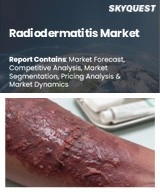
Radiodermatitis Market
Report ID: SQMIG35G2240
Report ID: SQMIG35G2240
[email protected]
USA +1 351-333-4748
Report ID:
SQMIG35G2240 |
Region:
Global |
Published Date: December, 2025
Pages:
157
|Tables:
72
|Figures:
66


Global Radiodermatitis Market size was valued at USD 470.91 Million in 2024 and is poised to grow from USD 490.22 Million in 2025 to USD 676.07 Million by 2033, growing at a CAGR of 4.1% during the forecast period (2026–2033).
The demand for radiodermatitis treatment products is more critical than ever before due to the urgency in addressing this negative consequence. Radiodermatitis, which includes erythema, dry desquamation, and moist desquamation, affects a substantial 95% of cancer patients undergoing radiation therapy. Notably, 85-95% of breast cancer patients receiving radiotherapy also experience varying degrees of radiodermatitis.
The COVID-19 pandemic initially disrupted the radiodermatitis market, particularly in the radiation oncology departments, as healthcare institutions prioritized COVID-19 patients. This led to a decline in weekly radiation sessions in 2020 compared to the same months in 2019. However, with the easing of lockdowns and restrictions in various regions and the implementation of safe cancer treatment measures by cancer institutes, growth opportunities have emerged for the market in the post-COVID-19 period.
Furthermore, the increasing prevalence of diabetes and obesity has contributed to the rising cases of cancer. The Centers for Disease Control estimates that there were 34.2 million cases of diabetes worldwide in 2018, and this number is expected to reach 1.2 billion by 2030. As a result, a larger population of patients is at higher risk of developing cancer, and their co-morbid conditions make them more susceptible to radiation-induced skin damage. This trend is anticipated to drive the market's growth during the forecast period.
US Radiodermatitis Market is poised to grow at a sustainable CAGR for the next forecast year.
Market snapshot - 2026-2033
Global Market Size
USD 452.36 million
Largest Segment
Retail Pharmacies
Fastest Growth
Retail Pharmacies
Growth Rate
4.1% CAGR
To get more insights on this market click here to Request a Free Sample Report
Global Radiodermatitis Market is segmented by Product, Distribution Channel and region. Based on Product, the market is segmented into Topical, Oral Drugs and Dressings. Based on Distribution Channel, the market is segmented into Hospital Pharmacies, Retail Pharmacies and Online Pharmacies. Based on region, the market is segmented into North America, Europe, Asia Pacific, Latin America and Middle East & Africa.
In 2022, the topical product segment emerged as the dominant player in the market, accounting for a substantial share of nearly 71.3%. This significant portion can be attributed to the numerous advantages offered by topical products. These benefits, which have driven their widespread acceptance in previous years, include ease of use, accessibility, and cost-efficiency. Moreover, topical products reduce the risk of microbiological transmission and protect the skin from abrasive substances. Key items within this category include topical antibiotics, hydrophilic lotions, and corticosteroids. Among these, corticosteroids, known for their efficacy in treating inflammatory skin disorders, have been widely adopted for radiodermatitis treatment, contributing to the segment's dominance.
Dressings are expected to achieve a moderate growth rate in the upcoming years, primarily due to the wide variety of products available in the market. These dressings include foam-based, hydrogel & hydrocolloid, silicone-coated, silver-leaf dressings, and others. Dressings have been proven effective in treating various grades of radiation burns, which is expected to drive their adoption in the coming years. Hydrogel and hydrocolloid dressings, in particular, are gaining popularity due to their quick healing properties, minimal discomfort, and high level of protection against infection and bacterial growth. The accessibility of a diverse range of dressing options, each catering to specific patient needs, is anticipated to further expand growth opportunities in this market segment.
In 2022, retail pharmacies emerged as the leading distribution channel segment, holding a significant share of 39.3%. The dominance of retail stores can be attributed to their high accessibility and cost-effectiveness. Drug cost reimbursement schemes encourage patients to rely on retail pharmacies, contributing to market growth by increasing affordability.
Online pharmacies are expected to experience exponential growth rates during the projection period due to several advantages they offer. For customers who prefer not to purchase medications from retail or hospital pharmacies, online pharmacies provide added convenience. Additionally, the rising prevalence of chronic diseases has created a demand-supply gap for essential pharmaceuticals, further driving the demand for online pharmacies.
By offering easy order procurement and tracking for customers, online pharmacies enhance convenience. Moreover, their associated supply chain management (SCM) streamlines the distribution process by eliminating some intermediaries, leading to reduced drug prices. This cost-effectiveness and convenience drive more customers to opt for online medicine purchases, contributing to the growth of this distribution channel in the market.
To get detailed segments analysis, Request a Free Sample Report
In 2022, Asia Pacific dominated the market, accounting for 46.0% of the total market share. This significant share can be attributed to the increasing number of cancer patients in the region, driving the demand for radiodermatitis treatments. Moreover, key businesses in the region have engaged in substantial collaborations to expand their product range, further bolstering their market presence. Renowned pharmaceutical firms in the region actively promote their products, contributing to higher end-user adoption rates. Favorable government initiatives that support research activities and the increasing outsourcing by industrialized economies also act as key growth drivers for the Asia Pacific market.
North America held the second-largest share of the market. This market's growth is primarily driven by the substantial research and development investments made by global players, aiming to achieve a competitive edge in the market. Additionally, the region's high disposable income and advanced healthcare infrastructure create significant growth opportunities in the radiodermatitis market.
To know more about the market opportunities by region and country, click here to
Buy The Complete Report
Growing Adoption of Radiation Therapy
Side Effects and Adverse Reactions
Request Free Customization of this report to help us to meet your business objectives.
The reports highlight significant developments in the radiodermatitis market, encompassing both organic and inorganic growth strategies. Companies in the global radiodermatitis market are employing organic growth strategies such as product launches, approvals, patents, and events to expand their presence during the forecast period. In parallel, inorganic growth strategies such as acquisitions, partnerships, and collaborations have facilitated business expansion and increased customer base. Radiodermatitis market players are expected to find lucrative growth opportunities in the global market due to the rising demand. Below is a list of companies actively involved in the radiodermatitis market.
SkyQuest's ABIRAW (Advanced Business Intelligence, Research & Analysis Wing) is our Business Information Product types team that Collects, Collates, Correlates, and Analyzes the Data collected by means of Primary Exploratory Research backed by robust Secondary Desk research.
According to our global Radiodermatitis Market analysis, the increasing prevalence of cancer and the widespread adoption of radiation therapy as a treatment option. Advanced treatment options, favorable reimbursement policies, and growing awareness among healthcare professionals are driving market expansion. Technological advancements in radiation therapy and strategic collaborations among key players are further contributing to market growth. Additionally, the expansion of healthcare infrastructure in emerging markets is enhancing the accessibility of radiodermatitis treatments, leading to promising opportunities in the industry. This report is being written to illustrate the market opportunity by region and by segments, indicating opportunity areas for the vendors to tap upon. To estimate the opportunity, it was very important to understand the current market scenario and the way it will grow in future. Production and consumption patterns are being carefully compared to forecast the market. Other factors considered to forecast the market are the growth of the adjacent market, revenue growth of the key market vendors, scenario-based analysis, and market segment growth.
| Report Metric | Details |
|---|---|
| Market size value in 2024 | USD 470.91 Million |
| Market size value in 2033 | USD 676.07 Million |
| Growth Rate | 4.1% |
| Base year | 2024 |
| Forecast period | 2026-2033 |
| Forecast Unit (Value) | USD Million |
| Segments covered |
|
| Regions covered | North America (US, Canada), Europe (Germany, France, United Kingdom, Italy, Spain, Rest of Europe), Asia Pacific (China, India, Japan, Rest of Asia-Pacific), Latin America (Brazil, Rest of Latin America), Middle East & Africa (South Africa, GCC Countries, Rest of MEA) |
| Companies covered |
|
| Customization scope | Free report customization with purchase. Customization includes:-
|
To get a free trial access to our platform which is a one stop solution for all your data requirements for quicker decision making. This platform allows you to compare markets, competitors who are prominent in the market, and mega trends that are influencing the dynamics in the market. Also, get access to detailed SkyQuest exclusive matrix.
Table Of Content
Executive Summary
Market overview
Parent Market Analysis
Market overview
Market size
KEY MARKET INSIGHTS
COVID IMPACT
MARKET DYNAMICS & OUTLOOK
Market Size by Region
KEY COMPANY PROFILES
Methodology
For the Radiodermatitis Market, our research methodology involved a mixture of primary and secondary data sources. Key steps involved in the research process are listed below:
1. Information Procurement: This stage involved the procurement of Market data or related information via primary and secondary sources. The various secondary sources used included various company websites, annual reports, trade databases, and paid databases such as Hoover's, Bloomberg Business, Factiva, and Avention. Our team did 45 primary interactions Globally which included several stakeholders such as manufacturers, customers, key opinion leaders, etc. Overall, information procurement was one of the most extensive stages in our research process.
2. Information Analysis: This step involved triangulation of data through bottom-up and top-down approaches to estimate and validate the total size and future estimate of the Radiodermatitis Market.
3. Report Formulation: The final step entailed the placement of data points in appropriate Market spaces in an attempt to deduce viable conclusions.
4. Validation & Publishing: Validation is the most important step in the process. Validation & re-validation via an intricately designed process helped us finalize data points to be used for final calculations. The final Market estimates and forecasts were then aligned and sent to our panel of industry experts for validation of data. Once the validation was done the report was sent to our Quality Assurance team to ensure adherence to style guides, consistency & design.
Analyst Support
Customization Options
With the given market data, our dedicated team of analysts can offer you the following customization options are available for the Radiodermatitis Market:
Product Analysis: Product matrix, which offers a detailed comparison of the product portfolio of companies.
Regional Analysis: Further analysis of the Radiodermatitis Market for additional countries.
Competitive Analysis: Detailed analysis and profiling of additional Market players & comparative analysis of competitive products.
Go to Market Strategy: Find the high-growth channels to invest your marketing efforts and increase your customer base.
Innovation Mapping: Identify racial solutions and innovation, connected to deep ecosystems of innovators, start-ups, academics, and strategic partners.
Category Intelligence: Customized intelligence that is relevant to their supply Markets will enable them to make smarter sourcing decisions and improve their category management.
Public Company Transcript Analysis: To improve the investment performance by generating new alpha and making better-informed decisions.
Social Media Listening: To analyze the conversations and trends happening not just around your brand, but around your industry as a whole, and use those insights to make better Marketing decisions.
REQUEST FOR SAMPLE
 REQUEST FREE CUSTOMIZATION
Global Radiodermatitis Market size was valued at USD 470.91 Million in 2024 and is poised to grow from USD 490.22 Million in 2025 to USD 676.07 Million by 2033, growing at a CAGR of 4.1% during the forecast period (2026–2033).
The reports highlight significant developments in the radiodermatitis market, encompassing both organic and inorganic growth strategies. Companies in the global radiodermatitis market are employing organic growth strategies such as product launches, approvals, patents, and events to expand their presence during the forecast period. In parallel, inorganic growth strategies such as acquisitions, partnerships, and collaborations have facilitated business expansion and increased customer base. Radiodermatitis market players are expected to find lucrative growth opportunities in the global market due to the rising demand. Below is a list of companies actively involved in the radiodermatitis market. '3M Company (United States) ', 'Smith & Nephew plc (United Kingdom) ', 'Investor AB (Mölnlycke Health Care AB) (Sweden) ', 'BMG Pharma S.p.A. (Italy) ', 'Stratpharma Inc. (Switzerland) ', 'Bausch Health Companies Inc. (Canada) ', 'Bayer AG (Germany) ', 'Paul Hartmann AG (Germany) ', 'KeraNetics, Inc. (United States) ', 'Charles River Laboratories (United States) ', 'The Jackson Laboratory (United States) ', 'InterMed S.A. (Greece) ', 'AceTech (South Korea) ', 'KCI Licensing Inc. (Acelity) (United States) ', 'Derma Sciences Inc. (Integra LifeSciences) (United States) ', 'Ligand Pharmaceuticals Inc. (Apeiron Biologics) (United States) ', 'Lutris Pharma Ltd. (Israel) ', 'GlaxoSmithKline plc (United Kingdom) ', 'ConvaTec Group plc (United Kingdom) ', 'Viatris Inc (United States) '
The increasing adoption of radiation therapy for cancer treatment contributes to the higher incidence of radiodermatitis cases. As radiation therapy becomes more widely used, the demand for radiodermatitis treatments also increases
Increasing Adoption of Advanced Treatment Options: The market is witnessing a growing adoption of advanced treatment options for radiodermatitis. Topical products, dressings, and other innovative therapies are gaining popularity due to their effectiveness in managing radiation-induced skin damage.
In 2022, Asia Pacific dominated the market, accounting for 46.0% of the total market share. This significant share can be attributed to the increasing number of cancer patients in the region, driving the demand for radiodermatitis treatments. Moreover, key businesses in the region have engaged in substantial collaborations to expand their product range, further bolstering their market presence. Renowned pharmaceutical firms in the region actively promote their products, contributing to higher end-user adoption rates. Favorable government initiatives that support research activities and the increasing outsourcing by industrialized economies also act as key growth drivers for the Asia Pacific market.


Want to customize this report? This report can be personalized according to your needs. Our analysts and industry experts will work directly with you to understand your requirements and provide you with customized data in a short amount of time. We offer $1000 worth of FREE customization at the time of purchase.
Feedback From Our Clients


 USA (+1) 351-333-4748

