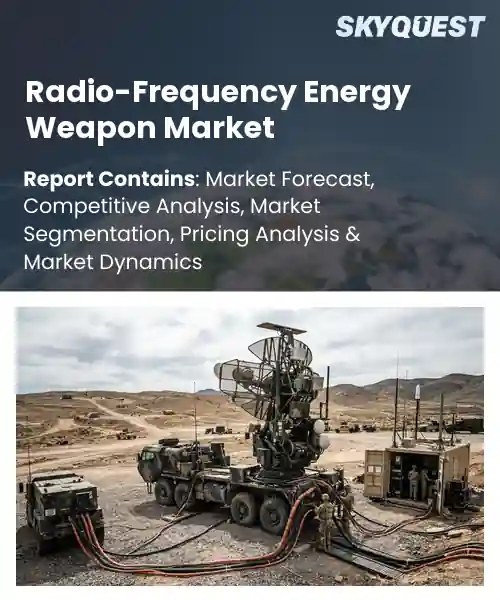
Radio-Frequency Energy Weapon Market
Report ID: SQMIG20A2928
Report ID: SQMIG20A2928
[email protected]
USA +1 351-333-4748
Report ID:
SQMIG20A2928 |
Region:
Global |
Published Date: September, 2026
Pages:
157
|Tables:
119
|Figures:
77


Global Radio-Frequency Energy Weapon Market size was valued at USD 1.85 Billion in 2024 and is poised to grow from USD 2.19 Billion in 2025 to USD 8.34 Billion by 2033, growing at a CAGR of 18.2% during the forecast period (2026-2033).
The global radio‑frequency (RF) energy weapon market comprises systems that emit directed electromagnetic pulses to disable electronic equipment, disrupt communications, or incapacitate personnel without lethal force. Its significance stems from the growing demand for non‑kinetic, precision‑strike capabilities that reduce collateral damage in both military and law‑enforcement contexts. Historically, the market emerged from Cold‑War research on electromagnetic pulse (EMP) weapons, progressed through the 1990s with the U.S. Navy’s AN/SLQ‑32 radar‑jamming suite, and accelerated after 2010 as commercial high‑power RF generators became affordable. These milestones illustrate how advances in amplifiers and miniaturization have transformed a niche concept into a viable defense segment. The primary growth catalyst now lies in the integration of RF energy weapons into autonomous platforms, because commanders seek rapid, low‑signature responses to swarming drones and electronic‑warfare threats. When a UAV detects an incoming hostile swarm, an onboard high‑power RF emitter can instantly overload the adversary’s flight‑control circuits, neutralizing multiple targets without expending missiles. This capability fuels demand from defense contractors developing unmanned combat air vehicles and from border‑security agencies deploying fixed RF deterrents along critical infrastructure. Consequently, investment in solid‑state power modules and AI‑driven targeting algorithms is expanding, creating a lucrative opportunity for semiconductor manufacturers and software firms alike.
How is AI-driven automation influencing the development of radio-frequency energy weapons?
AI driven automation is reshaping how radio frequency energy weapons are conceived, built and fielded. Machine learning models now analyze electromagnetic signatures to suggest optimal frequency bands while robotic test rigs run thousands of cycles without human intervention. This speeds prototype iteration and cuts material waste. Integrated AI also manages real time beam steering allowing weapons to adapt to moving targets and evolving countermeasures. Defense firms are embedding these capabilities into next generation systems creating a market that values flexibility and rapid response. As governments seek non lethal options for crowd control and electronic denial the demand for smarter RF solutions expands.Lockheed Martin, April 2024, unveiled an AI enabled RF weapon prototype that autonomously adjusts frequency and power to maintain effectiveness against adaptive threats. This development showcases the market shift toward intelligent systems that can self tune and respond in real time, boosting operational efficiency and supporting broader adoption across defense and security sectors.
Market snapshot - (2026-2033)
Global Market Size
USD 1.85 Billion
Largest Segment
High-Power Microwave Systems
Fastest Growth
Other RF Energy Systems
Growth Rate
18.2% CAGR
To get more insights on this market click here to Request a Free Sample Report
Global radio-frequency energy weapon market is segmented by technology, platform, application, end user and region. Based on technology, the market is segmented into High-Power Microwave Systems, Radio-Frequency Directed-Energy Systems and Other RF Energy Systems. Based on platform, the market is segmented into Ground-Based Systems, Airborne Systems, Naval Systems and Vehicle-Mounted Systems. Based on application, the market is segmented into Counter-Electronics, Counter-Drone Systems, Electronic Warfare and Other Defense Applications. Based on end user, the market is segmented into Military, Defense Agencies and Homeland Security. Based on region, the market is segmented into North America, Europe, Asia Pacific, Latin America and Middle East & Africa.
High-Power Microwave Systems segment dominates because they provide immediate, high‑intensity electromagnetic bursts that can disable electronics without kinetic impact, aligning directly with modern defense doctrines seeking non‑lethal yet decisive effects. Their maturity, proven field trials, and compatibility with existing power‑generation platforms foster confidence among procurement officers, driving sustained investment. Consequently, manufacturers focus resources on scaling production and integrating advanced waveform control, reinforcing their market leadership.
However, Radio-Frequency Directed-Energy Systems segment is witnessing the strongest growth momentum as miniaturization breakthroughs enable integration onto airborne platforms, expanding tactical scenarios. This flexibility attracts R&D funding and creates new procurement pipelines, accelerating market expansion and opening opportunities for novel counter‑drone and electronic attack solutions.
Ground-Based Systems segment leads because they benefit from stable power supplies and large antenna arrays, delivering the highest energy outputs for area denial and infrastructure protection. Their fixed deployment permits extensive testing, integration with existing command‑and‑control networks, and continuous upgrades, making them the preferred choice for long‑term strategic installations. This reliability drives consistent procurement cycles and reinforces their leadership position.
Meanwhile, Vehicle-Mounted Systems segment emerges as the fastest expanding area as military mobility doctrines prioritize agile, on‑the‑move electronic attack capabilities. Advances in compact power modules and ruggedized emitters enable installation on a variety of ground vehicles, attracting investment from rapid‑reaction units and creating new market niches that accelerate overall sector growth.
To get detailed segments analysis, Request a Free Sample Report
North America leads the Radio-Frequency Energy Weapon market through a combination of deep technological expertise, robust defense ecosystems, and proactive government policies. The United States hosts a concentration of premier research institutions and defense contractors that continuously push the boundaries of directed-energy systems. Close collaboration between military agencies and private innovators accelerates prototype development and field testing. Canada contributes complementary capabilities in advanced materials and electronic engineering, reinforcing the regional supply chain. A regulatory framework that encourages experimentation while ensuring safety fosters rapid iteration. Moreover, the presence of extensive testing ranges and a skilled workforce enables seamless transition from concept to operational deployment, cementing North America’s position as the market’s dominant hub. The region also benefits from strong intellectual‑property protections that attract global partners seeking collaborative development.
United States Radio-Frequency Energy Weapon Market
Radio-Frequency Energy Weapon Market in the United States is anchored by a mature defense industrial base and extensive research funding. Leading aerospace firms and startups collaborate closely with military research labs to refine system efficiency and integration. The presence of testing facilities accelerates validation cycles, while a skilled engineering talent pool drives innovation in power management and antenna design. This ecosystem sustains a pipeline of advanced solutions ready for operational adoption.
Canada Radio-Frequency Energy Weapon Market
Radio-Frequency Energy Weapon Market in Canada benefits from a collaborative research environment and strong expertise in electronic materials. Government‑funded institutes partner with defense firms to explore novel power‑source concepts and compact antenna architectures. The country’s emphasis on sustainable engineering drives the integration of energy‑efficient components, while proximity to U.S. testing ranges facilitates cross‑border validation. These factors combine to position Canada as a valuable contributor to the broader North American ecosystem.
Europe’s Radio-Frequency Energy Weapon market is expanding swiftly due to coordinated defense initiatives, substantial research investment, and a focus on next‑generation non‑lethal technologies. Multinational collaborations across the continent enable shared expertise in high‑power microwave generation and precision targeting. The European Union’s strategic programs provide funding that bridges the gap between laboratory prototypes and fieldable systems, while national defense agencies prioritize integration of directed‑energy solutions into existing platforms. A mature electronics manufacturing sector, especially in Germany and the United Kingdom, supplies critical components and drives cost‑effective scaling. Additionally, harmonized regulatory standards across member states simplify certification processes, encouraging both domestic and foreign firms to establish a presence in the European market. The emphasis on interoperability with NATO forces further accelerates adoption across allied nations.
Germany Radio-Frequency Energy Weapon Market
Radio-Frequency Energy Weapon Market in Germany is characterized by a robust defense manufacturing base and leading research universities that specialize in high‑power electronics. Close ties between federal defense agencies and industrial conglomerates foster rapid prototyping and system integration. German firms excel in precision engineering of antenna arrays and thermal management solutions, ensuring reliable performance under demanding conditions. Government incentives encourage domestic production, positioning Germany as the continent’s primary hub for advanced directed‑energy capabilities.
United Kingdom Radio-Frequency Energy Weapon Market
Radio-Frequency Energy Weapon Market in the United Kingdom is propelled by aggressive government procurement programs and a vibrant startup ecosystem focused on directed‑energy innovation. Leading defense contractors collaborate with university research centers to accelerate the transition from concept to operational trials. The UK’s expertise in microwave engineering and signal processing enhances system efficiency, while favorable export policies attract international partnerships. This dynamic environment underpins the United Kingdom’s rapid ascent as a key growth market within Europe.
France Radio-Frequency Energy Weapon Market
Radio-Frequency Energy Weapon Market in France is emerging through strategic investments in defense research and a growing emphasis on non‑lethal capabilities. French defense laboratories partner with aerospace firms to explore compact RF generators and modular antenna solutions. The nation’s strong tradition in electronic warfare provides a solid foundation for integrating directed‑energy systems into existing platforms. As regulatory frameworks evolve to support innovative testing, France is poised to become a notable contributor to Europe’s overall market development.
Asia Pacific is solidifying its role in the Radio‑Frequency Energy Weapon arena through a blend of cutting‑edge electronics expertise, strategic defense priorities, and collaborative innovation networks. Japan leverages its world‑class semiconductor and antenna design capabilities to develop high‑efficiency RF generators suited for maritime and urban security applications. South Korea complements this with rapid prototyping facilities and a strong emphasis on miniaturized power‑source technologies, enabling deployment on a variety of platforms. Both nations benefit from government‑backed research programs that bridge academic breakthroughs with industrial production, fostering a swift transition from laboratory concepts to fieldable systems. Regional partnerships and joint exercises further enhance interoperability, positioning Asia Pacific as a dynamic hub for next‑generation directed‑energy solutions. The focus on integrating these weapons with autonomous platforms also drives regional competitiveness.
Japan Radio-Frequency Energy Weapon Market
Radio-Frequency Energy Weapon Market in Japan is driven by its world‑renowned expertise in high‑frequency electronics and precision manufacturing. Japanese defense firms collaborate closely with university research centers to create compact, high‑power RF modules optimized for naval and law‑enforcement use. The nation’s emphasis on reliability and safety ensures rigorous testing protocols, while government initiatives provide funding for rapid technology transfer. These factors collectively position Japan as a leading innovator in the Asia Pacific directed‑energy landscape.
South Korea Radio-Frequency Energy Weapon Market
Radio-Frequency Energy Weapon Market in South Korea benefits from a fast‑moving electronics sector and strong government support for defense modernization. Korean companies excel in developing lightweight power‑amplifier architectures and advanced thermal‑management solutions, enabling integration onto mobile platforms. Collaborative programs between military research institutes and private firms accelerate prototype validation and scale‑up. The strategic focus on export‑ready technologies also encourages international partnerships, reinforcing South Korea’s emerging status as a key contributor to the regional market.
To know more about the market opportunities by region and country, click here to
Buy The Complete Report
Rising Defense Budgets Globally
Technological Advances In Energy Generation
Stringent International Export Controls
High Development And Integration Costs
Request Free Customization of this report to help us to meet your business objectives.
The competitive landscape is shaped by major defense contractors accelerating high‑power microwave programs while targeting emerging threats; Raytheon’s acquisition of a niche HPM firm and Lockheed Martin’s partnership with BAE Systems to co‑develop adaptive RF‑energy modules illustrate how consolidation and joint R&D are driving market momentum, with technology innovation and rapid prototyping becoming decisive differentiators.
Top Player’s Company Profile
Recent Developments
SkyQuest’s ABIRAW (Advanced Business Intelligence, Research & Analysis Wing) is our Business Information Services team that Collects, Collates, Correlates, and Analyses the Data collected by means of Primary Exploratory Research backed by robust Secondary Desk research. As per SkyQuest analysis the global RF energy weapon market is set to expand rapidly driven primarily by rising defense budgets that fund advanced directed‑energy programs, while breakthroughs in high‑efficiency power electronics provide a second catalyst enabling compact high‑output emitters for autonomous platforms. The High‑Power Microwave Systems segment leads the market because of its proven ability to deliver decisive non‑kinetic effects, and North America remains the dominant region thanks to deep R&D ecosystems and major defense contractors. However stringent international export controls act as a restraint, slowing adoption in some jurisdictions and adding compliance costs for suppliers throughout the supply chain globally.
| Report Metric | Details |
|---|---|
| Market size value in 2024 | USD 1.85 Billion |
| Market size value in 2033 | USD 8.34 Billion |
| Growth Rate | 18.2% |
| Base year | 2024 |
| Forecast period | (2026-2033) |
| Forecast Unit (Value) | USD Billion |
| Segments covered |
|
| Regions covered | North America (US, Canada), Europe (Germany, France, United Kingdom, Italy, Spain, Rest of Europe), Asia Pacific (China, India, Japan, Rest of Asia-Pacific), Latin America (Brazil, Rest of Latin America), Middle East & Africa (South Africa, GCC Countries, Rest of MEA) |
| Companies covered |
|
| Customization scope | Free report customization with purchase. Customization includes:-
|
To get a free trial access to our platform which is a one stop solution for all your data requirements for quicker decision making. This platform allows you to compare markets, competitors who are prominent in the market, and mega trends that are influencing the dynamics in the market. Also, get access to detailed SkyQuest exclusive matrix.
Table Of Content
Executive Summary
Market overview
Parent Market Analysis
Market overview
Market size
KEY MARKET INSIGHTS
COVID IMPACT
MARKET DYNAMICS & OUTLOOK
Market Size by Region
KEY COMPANY PROFILES
Methodology
For the Radio-Frequency Energy Weapon Market, our research methodology involved a mixture of primary and secondary data sources. Key steps involved in the research process are listed below:
1. Information Procurement: This stage involved the procurement of Market data or related information via primary and secondary sources. The various secondary sources used included various company websites, annual reports, trade databases, and paid databases such as Hoover's, Bloomberg Business, Factiva, and Avention. Our team did 45 primary interactions Globally which included several stakeholders such as manufacturers, customers, key opinion leaders, etc. Overall, information procurement was one of the most extensive stages in our research process.
2. Information Analysis: This step involved triangulation of data through bottom-up and top-down approaches to estimate and validate the total size and future estimate of the Radio-Frequency Energy Weapon Market.
3. Report Formulation: The final step entailed the placement of data points in appropriate Market spaces in an attempt to deduce viable conclusions.
4. Validation & Publishing: Validation is the most important step in the process. Validation & re-validation via an intricately designed process helped us finalize data points to be used for final calculations. The final Market estimates and forecasts were then aligned and sent to our panel of industry experts for validation of data. Once the validation was done the report was sent to our Quality Assurance team to ensure adherence to style guides, consistency & design.
Analyst Support
Customization Options
With the given market data, our dedicated team of analysts can offer you the following customization options are available for the Radio-Frequency Energy Weapon Market:
Product Analysis: Product matrix, which offers a detailed comparison of the product portfolio of companies.
Regional Analysis: Further analysis of the Radio-Frequency Energy Weapon Market for additional countries.
Competitive Analysis: Detailed analysis and profiling of additional Market players & comparative analysis of competitive products.
Go to Market Strategy: Find the high-growth channels to invest your marketing efforts and increase your customer base.
Innovation Mapping: Identify racial solutions and innovation, connected to deep ecosystems of innovators, start-ups, academics, and strategic partners.
Category Intelligence: Customized intelligence that is relevant to their supply Markets will enable them to make smarter sourcing decisions and improve their category management.
Public Company Transcript Analysis: To improve the investment performance by generating new alpha and making better-informed decisions.
Social Media Listening: To analyze the conversations and trends happening not just around your brand, but around your industry as a whole, and use those insights to make better Marketing decisions.
REQUEST FOR SAMPLE
 REQUEST FREE CUSTOMIZATION


Want to customize this report? This report can be personalized according to your needs. Our analysts and industry experts will work directly with you to understand your requirements and provide you with customized data in a short amount of time. We offer $1000 worth of FREE customization at the time of purchase.
Feedback From Our Clients


 USA (+1) 351-333-4748

