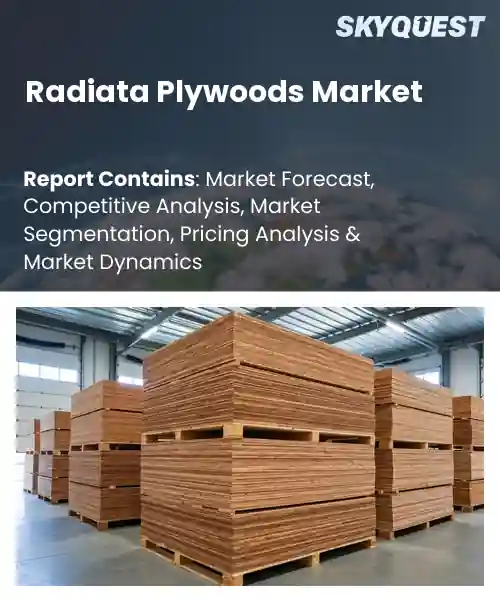
Radiata Plywoods Market
Report ID: SQMIG20C2190
Report ID: SQMIG20C2190
[email protected]
USA +1 351-333-4748
Report ID:
SQMIG20C2190 |
Region:
Global |
Published Date: March, 2026
Pages:
157
|Tables:
96
|Figures:
76


Global Radiata Plywoods Market size was valued at USD 12.00 Billion in 2024 and is poised to grow from USD 13.32 Billion in 2025 to USD 30.69 Billion by 2033, growing at a CAGR of 11.0% during the forecast period (2026-2033).
The growth of construction and furniture production has increased the demand for a versatile and reasonably priced panel product, making radiata plywood an ideal choice. Radiata plywood-which is mainly created from quickly growing Pino radiata timber-accommodates both structural use and decorative applications by providing a combination of strength, stability, and appearance. The transition to timber grown in plantations instead of hardwood lumber as a primary source of raw materials over the previous 30 years has provided consistent quality and stable and well-integrated supply chains. The country’s government policy changes to an environmental standard on how they want to see timber grown and sold, and particularly the use of Forest Stewardship Council (FSC) certification to source timber, has helped to strengthen this type of product. Furthermore, the rising amount of exports to Asia has led to increased industry consolidation and investment in new technologies.
Manufacturers are creating more high-value products with the help of radiata, which allows for a greater variety of products such as modular housing panels, concrete formwork, and custom-built furniture. As the demand for certified products due to green building requirements and corporate purchasing policies continues to grow, the demand for radiata will continue to increase as it is highly traceable. Thus, creating more large-scale contracts and stable export sales from New Zealand and Chile. Advancements in drying, laminating, and adhesive technology have drastically minimized defects and improved the integrity of radiata panels, which has led architects and fabricators to incorporate these materials into mid-rise timber structures.
How is Automation Enhancing Production Efficiency in the Radiata Plywoods Market?
Automation is reshaping the radiata plywoods market by integrating machine vision, automated veneer peeling, automated layup and digital process control to raise throughput and consistency. Key aspects include automated grading, real time analytics and predictive maintenance that reduce downtime and convert log variability into predictable panel quality. The current market sees mills adopting analyzer equipped layup and patching stations to cut rework and raw material waste. Given tight margins and labor constraints, these technologies help stabilize output, improve surface quality and support sustainable use of plantation Radiata through better yield and less scrap.
Raute February 2026, the company reported resilient results and emphasized deployment of analyzer equipped R7 and R5 series lines that automate grading, layup and pressing. That automation supports Radiata plywood efficiency by reducing manual interventions, lowering defect rates, and enabling steadier continuous production.
Market snapshot - (2026-2033)
Global Market Size
USD 12.0 Billion
Largest Segment
Structural Plywood
Fastest Growth
Film Faced Plywood
Growth Rate
11.0% CAGR
To get more insights on this market click here to Request a Free Sample Report
Global radiata plywoods market is segmented by product type, thickness, end use industry and region. Based on product type, the market is segmented into structural plywood, decorative plywood, marine plywood, film faced plywood, and others. Based on thickness, the market is segmented into Below 5mm, 5mm to 10mm, 10mm to 15mm, 15mm to 20mm, and above 20mm. Based on end use industry, the market is segmented into construction, furniture, automotive, packaging, and others. Based on region, the market is segmented into North America, Europe, Asia Pacific, Latin America, and Middle East & Africa.
The structural plywood segment has the highest demand among radiata plywood products because this type of plywood serves the primary purpose of being structural and meets the minimum performance requirements of both primary construction and industrial applications. The engineered strengths; consistent bending abilities; holding power; compatibility with all conventional framing practices; and fasteners, make it the preferred choice by both builders and specifiers. Additionally, the existence of dependable supply chains; methods for the processing of plywood; and contractor familiarity with the product result in consistent demand, which is necessary to maintain the economies of scale essential for manufacturers.
As per radiata plywoods market forecast, film faced plywood is rapidly expanding as demand for durable reusable concrete formwork and industrial flooring increases. The smooth coatings of film faced plywood resistant abrasion and moisture, extending the life of the product in tough environments and providing a lower life cycle cost. New advancements in resin technology and introduction of thinner, lighter weight cores are enabling manufacturers to provide film faced plywood for an unlimited number of applications, resulting in new products being brought to the market and new business opportunities.
As per radiata plywoods market outlook, the 10mm to 15mm segment dominates the radiata plywoods market due to the optimal balance of stiffness and ease of working with the material; meeting both functional and aesthetic requirements for applications such as furniture, cabinetry and interior panels. This thickness provides dimensional stability and is compatible with standard methods of joinery, finishing, and machining. The result is a simplification of the manufacturing process and reduction of handling complexity. As a result, OEMs and fabricators have adopted this thickness range widely, thus motivating suppliers to place a greater focus on consistent production and surface finish quality for this thickness range.
As per radiata plywoods market analysis, below 4mm segment is the fastest growing as a result of new design trends that favour lightweight, flexible construction and layered laminated products, which have resulted in increased demand for thin, flexible panels. Additionally, advancements in adhesive technology and veneer processing have allowed for the production of thinner cores without compromising surface integrity, creating new product innovation and opportunities in overlays, transport interiors and compact furniture.
To get detailed segments analysis, Request a Free Sample Report
The Asia Pacific region's strength lies in the availability of raw materials, integrated supply chains, and a developed manufacturing base that provide scale and cost efficiencies. The high demand for construction, furniture, and interior applications across multiple domestic markets results in continual demand for these products, leading to continual innovation of products to cater to the regional preferences. The export-driven production centers enjoy competitive logistics and established trading links, making it easy to distribute goods rapidly to other regions in demand. Investment in processing technology and quality assurance is critical to this industry and is therefore included in many plans.
The radiata plywoods market in Japan has favourable processing capability, high domestic demand for quality panels, and an emphasis on precision manufacturing that produces panels primarily utilized in premium applications. Strong partnerships between architects and manufacturers have encouraged the use of radiata plywood in many niche projects, and the logistics systems and ports enable both import and export of product relative to the demands of the market.
The radiata plywoods market in South Korea is also a robust sector that has been driven by the country's industrial capabilities and a focus on producing consistent products. Manufacturers are focused on marrying performance with attractive finishes for furniture, joinery applications, and interior fit-outs, etc. and as such, there are strong connections to suppliers in order to have a consistent product. Manufacturers of radiata plywood are applying innovation to adhesive systems and surface finishing so that the products can be used in many different ways.
As per radiata plywoods industry analysis, a number of contributing factors have combined to create a larger demand for the use of engineered wood products in Europe as well as a move towards the adoption of sustainable building materials across Europe. These factors include increasing levels of renovation activity within urban areas, a higher preference among architects and specifiers for using engineered wood products, and an increased emphasis on responsible sourcing and lifecycle performance within regulatory frameworks. Manufacturers and distributors of engineered wood products are responding to this growth by differentiating their products, providing additional finishing options, and working with their customers to develop solutions that meet acoustic and fire performance requirements and resist moisture. Changes within the supply chain, such as diversifying supply sources to limit exposure to single points of failure, have provided manufacturers and suppliers with greater flexibility in delivering to their customers in a timelier manner.
Radiata plywood is used in applications with higher specification requirements and where quality assurance processes will withstand rigorous testing that match the requirements associated with building codes in Germany. Local manufacturers produce many engineered wood solutions that meet the needs of the increasing demand for prefabricated construction and prefabricated components for interior construction. Strong relationships between manufacturers and certification organizations further enhance the traceability and responsible sourcing of radiata plywood. The precision and quality manufacturing practices traditionally associated with radiata plywood products continue to generate high levels of demand through the continued production of consistent and high-performing radiata plywood products.
In the United Kingdom, the demand for radiata plywood is increasing due to a growing interest in sustainable products from architects and designers, as well as the increasing popularity of residential retrofitting and modular building. By closely collaborating with designers and contractors, the specification process is being accelerated, while the agile distribution networks and processing services support a growing variety of uses throughout the interiors, furniture, and small-scale construction sectors.
The French radiata plywoods market is also developing due to increasing interest from design studios and furniture manufacturers attempting to find versatile panels. Manufacturers are concentrating on decorative veneers, high-quality finishes, and the custom-cutting services that meet the demands of high-end interior design and fit-outs. The French market is also benefitting from increased emphasis on responsible sourcing and collaboration with local timber initiatives, which increases the market's credibility. Distribution centres and professional lumberyards allow designers to experiment, which promotes more extensive specifications and uses in innovative designs.
As per radiata plywoods market regional forecast, in North America, manufacturers are leveraging both domestic processing improvements and strategic sourcing, as well as focusing on developing application driven products, to enhance their competitive position. Manufacturers are providing enhanced value-added services, including finishing, sizing and technical service to meet the needs of the construction, furniture and specialty interiors sectors. There is an increasing interest from buyers and specifiers in sourcing certified materials and achieving lifecycle transparency throughout the total product chain. These interests lead to increased collaboration with supply chain partners and investments in traceability systems.
As per radiata plywoods market regional outlook, United States serves the construction, furniture and specialty millwork sectors. Domestic processors manufacture custom sizes, finishes and engineered assemblies for modular and retrofit buildings. Increasing specification of performance verified materials and traceable sourcing by architects and contractors creates an increased demand for products manufactured within these criteria. Distribution networks and port infrastructure provide support for supplies from both domestic and international sources. New advancements in glue and other treatment technologies have allowed new product developments to meet specific regional building specifications and to meet commercial fit-out specifications.
The radiata plywoods market trends in Canada is supported by an emphasis on responsible forest management and a regional manufacturing sector that emphasizes the sustainable sourcing of products. Processors are designing and producing radiata plywood panels that perform well in cold climates and can be used as heavy-duty interior products, while also providing finishing and custom size features that meet the requirements of contractors' expectations. Public procurement and private procurement will continue to require and give preference to the purchase of certified materials, creating a more detailed traceability record throughout the entire supply chain.
To know more about the market opportunities by region and country, click here to
Buy The Complete Report
Rising Demand in Construction Projects
Expansion of Engineered Wood Applications
Limited Plantation Maturation Cycles
Environmental Regulations Impacting Supply Chains
Request Free Customization of this report to help us to meet your business objectives.
The global radiata plywoods industry is driven by a competitive environment fueled by consolidation and vertical integration, as well as engineered wood lines, through which product differentiation is achieved. Large forest product companies procure plantation feedstock and provide value through joint ventures and acquisitions, while premium manufacturers and brands in regional markets are developing niche offerings for specification work in mass timber and cross laminated timber (CLT).
SkyQuest’s ABIRAW (Advanced Business Intelligence, Research & Analysis Wing) is our Business Information Services team that Collects, Collates, Correlates, and Analyses the Data collected by means of Primary Exploratory Research backed by robust Secondary Desk research.
As per SkyQuest analysis, the global radiata plywoods market is propelled primarily by growth in construction and furniture manufacturing as a key driver, supported by a second driver in the expansion of engineered wood applications that broaden use cases. The market faces a significant restraint in limited plantation maturation cycles which can constrain raw material availability. Asia Pacific remains the dominating region due to mature manufacturing, integrated supply chains and strong domestic demand, while Structural Plywood is the dominating segment because it meets core load bearing and performance requirements. These dynamics favour vertical integration, product differentiation and technology adoption to capture emerging mid-rise and modular construction opportunities. The market reflects a moderately fragmented structure, where a mix of international wood product manufacturers and regional producers account for the overall radiata plywoods market share. The market is witnessing a steady growth radiata plywoods market trend driven by rising demand for sustainable and cost-effective engineered wood products, increasing use in construction and furniture applications.
| Report Metric | Details |
|---|---|
| Market size value in 2024 | USD 12.0 Billion |
| Market size value in 2033 | USD 30.7 Billion |
| Growth Rate | 11.0% |
| Base year | 2024 |
| Forecast period | (2026-2033) |
| Forecast Unit (Value) | USD Billion |
| Segments covered |
|
| Regions covered | North America (US, Canada), Europe (Germany, France, United Kingdom, Italy, Spain, Rest of Europe), Asia Pacific (China, India, Japan, Rest of Asia-Pacific), Latin America (Brazil, Rest of Latin America), Middle East & Africa (South Africa, GCC Countries, Rest of MEA) |
| Companies covered |
|
| Customization scope | Free report customization with purchase. Customization includes:-
|
To get a free trial access to our platform which is a one stop solution for all your data requirements for quicker decision making. This platform allows you to compare markets, competitors who are prominent in the market, and mega trends that are influencing the dynamics in the market. Also, get access to detailed SkyQuest exclusive matrix.
Table Of Content
Executive Summary
Market overview
Parent Market Analysis
Market overview
Market size
KEY MARKET INSIGHTS
COVID IMPACT
MARKET DYNAMICS & OUTLOOK
Market Size by Region
KEY COMPANY PROFILES
Methodology
For the Radiata Plywoods Market, our research methodology involved a mixture of primary and secondary data sources. Key steps involved in the research process are listed below:
1. Information Procurement: This stage involved the procurement of Market data or related information via primary and secondary sources. The various secondary sources used included various company websites, annual reports, trade databases, and paid databases such as Hoover's, Bloomberg Business, Factiva, and Avention. Our team did 45 primary interactions Globally which included several stakeholders such as manufacturers, customers, key opinion leaders, etc. Overall, information procurement was one of the most extensive stages in our research process.
2. Information Analysis: This step involved triangulation of data through bottom-up and top-down approaches to estimate and validate the total size and future estimate of the Radiata Plywoods Market.
3. Report Formulation: The final step entailed the placement of data points in appropriate Market spaces in an attempt to deduce viable conclusions.
4. Validation & Publishing: Validation is the most important step in the process. Validation & re-validation via an intricately designed process helped us finalize data points to be used for final calculations. The final Market estimates and forecasts were then aligned and sent to our panel of industry experts for validation of data. Once the validation was done the report was sent to our Quality Assurance team to ensure adherence to style guides, consistency & design.
Analyst Support
Customization Options
With the given market data, our dedicated team of analysts can offer you the following customization options are available for the Radiata Plywoods Market:
Product Analysis: Product matrix, which offers a detailed comparison of the product portfolio of companies.
Regional Analysis: Further analysis of the Radiata Plywoods Market for additional countries.
Competitive Analysis: Detailed analysis and profiling of additional Market players & comparative analysis of competitive products.
Go to Market Strategy: Find the high-growth channels to invest your marketing efforts and increase your customer base.
Innovation Mapping: Identify racial solutions and innovation, connected to deep ecosystems of innovators, start-ups, academics, and strategic partners.
Category Intelligence: Customized intelligence that is relevant to their supply Markets will enable them to make smarter sourcing decisions and improve their category management.
Public Company Transcript Analysis: To improve the investment performance by generating new alpha and making better-informed decisions.
Social Media Listening: To analyze the conversations and trends happening not just around your brand, but around your industry as a whole, and use those insights to make better Marketing decisions.
REQUEST FOR SAMPLE
 REQUEST FREE CUSTOMIZATION
Global Radiata Plywoods Market size was valued at USD 12.0 Billion in 2024 and is poised to grow from USD 13.32 Billion in 2025 to USD 30.7 Billion by 2033, growing at a CAGR of 11.0% during the forecast period (2026-2033).
Competitive landscape in the global radiata plywood market is driven by consolidation, vertical integration and product differentiation through engineered wood lines. Major forest product groups secure plantation feedstock and add value through acquisitions and joint ventures while regional manufacturers and brands pursue specialised mass timber and PLT offerings to win specification work. Notable examples include large Chilean producers expanding panel capacity and Timberlink and Techlam moves into engineered radiata panels, alongside material innovation efforts by advanced materials startups. 'Carter Holt Harvey', 'Plyco', 'Arauco', 'Wespine Industries', 'Hume Building Products', 'Sodra', 'Bunnings', 'Southern Timber', 'Segezha Group', 'Melbourne Plywood', 'Advance Plywoods', 'Timber Products Company', 'Northland Plywood', 'Universal Forest Products', 'Atlantic Plywood', 'Plywood Industries', 'Roseburg', 'Aussie Plywood', 'Tilling Timber', 'Americana Plywood'
Rising demand for radiata plywood in construction projects is driving market growth as builders prefer its combination of strength, workability and consistent quality for structural and interior applications. This preference motivates manufacturers to expand production, optimize processing techniques and develop product variants tailored to building needs, which in turn reinforces supply chain investments and distribution networks. The clear alignment between construction sector requirements and radiata plywood properties encourages wider adoption across residential and commercial developments, supporting sustained demand expansion and industry focus on meeting builder specifications.
Sustainable Product Differentiation: Manufacturers and distributors are prioritizing environmentally responsible sourcing and certifications to meet procurement demands from architects, developers, and retail chains. Emphasis on lifecycle transparency, low-emission adhesives, and reclaimed timber blends enhances product positioning and allows premium pricing. Marketing focuses on traceability, third-party endorsements, and performance parity with traditional plywood. This shift encourages investments in plantation management, supplier partnerships, and product innovation to address conscious consumer preferences and institutional sustainability mandates across residential, commercial, and infrastructure projects and regulatory procurement criteria.
The Asia Pacific region's strength lies in the availability of raw materials, integrated supply chains, and a developed manufacturing base that provide scale and cost efficiencies.


Want to customize this report? This report can be personalized according to your needs. Our analysts and industry experts will work directly with you to understand your requirements and provide you with customized data in a short amount of time. We offer $1000 worth of FREE customization at the time of purchase.
Feedback From Our Clients


 USA (+1) 351-333-4748

