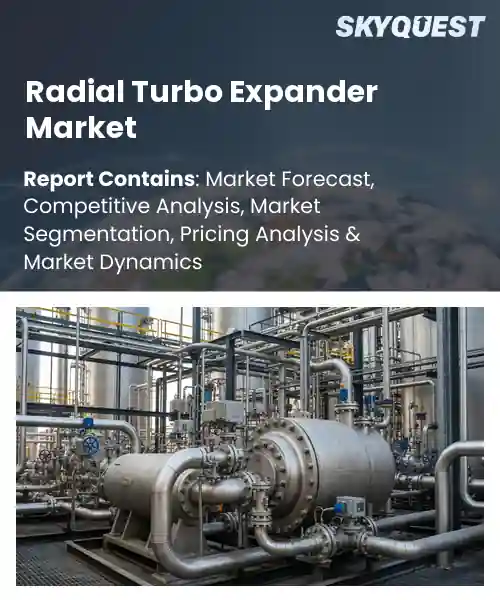
Radial Turbo Expander Market
Report ID: SQMIG20I3437
Report ID: SQMIG20I3437
[email protected]
USA +1 351-333-4748
Report ID:
SQMIG20I3437 |
Region:
Global |
Published Date: July, 2026
Pages:
157
|Tables:
146
|Figures:
78


Global Radial Turbo Expander Market size was valued at USD 612.8 Million in 2024 and is poised to grow from USD 645.89 Million in 2025 to USD 983.75 Million by 2033, growing at a CAGR of 5.4% during the forecast period (2026-2033).
The market for radial turbo expanders centers around machinery that utilizes the energy created by the expansion of gases in industrial processes. The significance of this technology derives from its potential to convert pressure differences into energy and use it for power generation or heating purposes, thus minimizing energy consumption and lowering emissions. Traditionally, the origin of the market dates back to the 1970s, as natural gas plants needed refrigeration to extract ethane; at that time, such devices were large and could only be used in oil fields. With the development of metallurgy, fluid dynamics, and controls over several decades, the machines became smaller, more reliable, and applicable to petrochemical, LNG, and renewable hydrogen industries. As a result, turbo expanders have become one of the main elements of energy systems. Furthermore, based on this development, the key growth factor is the increasing demand for energy solutions with low carbon emission in petrochemical and power industries.
The tightening of emissions caps by the government is causing the plants to use radial turbo expanders to collect waste heat and use it in combined generators to convert shaft power directly into megawatts of clean electricity. At the same time, the increased liquefaction of natural gas and hydrogen has resulted in the availability of high-pressure fluids suitable for expansion, which has encouraged the development of bigger capacity expanders with built-in sensors.
How is AI-driven Automation Impacting Efficiency in the Radial Turbo Expander Market?
Automation driven by AI has begun to transform the radial turbo expander industry by helping monitor performance, carry out predictive maintenance and optimize processes. Through the use of sensors, machine learning algorithms analyze real-time information to pick out any areas of inefficiency before it begins affecting productivity. Inlet conditions and speeds can be controlled automatically, minimizing downtime and ensuring a longer lifespan of components. Another feature of AI in radial turbo expanders is load matching, which ensures that plants can adapt to changes in demand without sacrificing efficiency. Digital twins have made it possible for engineers to virtually test design changes, speeding up the process and reducing costs.
Market snapshot - (2026-2033)
Global Market Size
USD 612.8 Million
Largest Segment
Single-Stage Turbo Expanders
Fastest Growth
Multi-Stage Turbo Expanders
Growth Rate
5.4% CAGR
To get more insights on this market click here to Request a Free Sample Report
Global radial turbo expander market is segmented by product type, application, power output, end user, bearing type, and region. Based on product type, the market is segmented into Single-Stage Turbo Expanders, and Multi-Stage Turbo Expanders. Based on application, the market is segmented into Natural Gas Processing, Air Separation, LNG Production, Petrochemical Processing, and Waste Heat Recovery. Based on power output, the market is segmented into Below 1 MW, 1–10 MW and Above 10 MW. Based on end user, the market is segmented into Oil & Gas, Chemical & Petrochemical, Industrial Gas and Power Generation. Based on bearing type, the market is segmented into Oil Bearings, Magnetic Bearings, and Gas Bearings. Based on region, the market is segmented into North America, Europe, Asia Pacific, Latin America and Middle East & Africa.
Single Stage Turbo Expanders category accounts for majority share as they offer compact size and high efficiency over various pressures, hence becoming the most popular type among many users. They are easier to maintain due to their simple design as compared to other types, hence making them suitable for OEMs and end-users who seek reliability without much complexity. Besides, their ruggedness allows for variable feed streams and hence makes it easier for the plants to adapt to any changes, hence eliminating the need for additional equipment.
Multi Stage Turbo Expanders category grows the fastest as manufacturers are working towards developing ways of handling higher pressure ratios and extracting more energy from large-scale cryogenic processes. The growing demand for ultra-low temperature processes is the driving factor behind this growth.
Natural Gas Processing segment dominates because it consistently requires large volumes of low‑temperature gas to meet dehydration and NGL extraction targets, creating a steady demand for efficient expansion technology. Radial turbo expanders provide precise temperature control and recover valuable mechanical power, aligning with cost‑reduction goals and regulatory pressures to lower emissions, thereby becoming integral to modern processing trains. Their reliability under continuous operation further enhances plant uptime, reinforcing their selection over alternative technologies.
On the other hand, Air Separation segment emerges as a high‑growth area as the push for green hydrogen and oxygen markets fuels demand for cryogenic separation. Radial turbo expanders enable efficient refrigeration cycles, and material advances reduce degradation, making them attractive for new and retrofitted facilities, thereby accelerating market expansion.
To get detailed segments analysis, Request a Free Sample Report
North America enjoys a leading role in the radial turbo expander industry thanks to the high level of incorporation of engineering expertise, petrochemical facilities, and natural gas processing systems in the region. North America features a well-developed network of research institutes and equipment producers that keep pushing efficiency and reliability improvements. Regulatory structures stimulate the use of energy recovery solutions; furthermore, an early adoption culture among industry actors fosters faster adoption rates. Investments in renewable energy and low carbon footprint solutions expand the number of application opportunities and contribute to a strong market environment. These factors collectively provide a competitive edge that maintains North American dominance in the global market. Another important aspect is the presence of large multinational energy companies with international supply chains.
Market dynamics for Radial Turbo Expander in the US are driven by a large number of centers for processing oil and gas, focused on energy efficiency and reduced emissions. The collaboration between the major vendors and their customers helps to develop special radial turbo expanders for high-pressure processes, whereas collaborations with academia lead to continuous improvement in performance. There are some policy incentives promoting waste-heat recovery, which favor the market development.
Radial Turbo Expander Market presence in Canada aligns with the country’s focus on sustainable resource development and the expansion of natural gas processing capacity. Collaborative initiatives between equipment suppliers and provincial energy entities emphasize reliability under cold climate conditions, driving design refinements. Environmental guidelines that promote carbon‑neutral operations further stimulate demand, while cross‑border technology exchange with neighboring United States accelerates adoption across petrochemical, renewable integration, and offshore processing projects.
In Europe, there is a fast-growing market for the radial turbo expanders due to the strict environmental regulations, developed energy infrastructure, and outstanding engineering capabilities. Carbon reduction and waste heat recovery incentives create a good business case for the radial turbo expander usage in the petrochemical, gas processing, and renewable industries. The cooperation between research institutions and companies allows quick technology transfer. Besides, a high number of specialized manufacturers will help in fast tailoring of expanders for particular applications. The market participants will be able to enjoy a corporate culture that cares about sustainability and efficient operation, which makes it possible to implement new expander technologies quickly into existing plants.
The German Radial Turbo Expander Market thrives on Germany's well-known excellence in engineering and strong chemical processing industry. Domestic suppliers use their knowledge of materials science to provide efficient expanders meeting all performance criteria. Collaboration with industrial consumers allows for customizing expanders used in gasification and green energy initiatives. Favorable energy recovery policies drive growth of the market in Germany, which is viewed as the gold standard for expander technology in Europe.
Radial Turbo Expander Market deployment in the United Kingdom is accelerating due to strong emphasis on low‑carbon industrial strategies and an adaptive energy services sector. Local engineering firms partner with offshore natural gas facilities to embed expander solutions that capture otherwise wasted thermal energy. Policy incentives that reward carbon‑neutral operations encourage retrofitting of legacy plants, while academic research centers contribute cutting‑edge simulation tools. This synergistic environment supports rapid adoption and positions the United Kingdom as a dynamic hub for next‑generation expander applications.
The Radial Turbo Expander Market in France is evolving as the use of renewable energy in industry becomes increasingly common. French companies specialize in creating products which can be easily integrated into existing gas processing plants without having to make any major changes to the plant infrastructure. Cooperation between energy clusters and research centers results in the creation of maintenance-free and efficient expanders for various applications. This helps strengthen France’s reputation as a source of innovations in Europe’s expander market.
Asia Pacific is strengthening its position in the market for radial turbo expanders due to a combination of fast-paced industrial development, investments in energy efficiency, and increasing efforts to switch to clean energy sources. Countries in the region are replacing their outdated facilities for gas processing while increasing the capacities of production of liquefied natural gas and renewable energy at the same time, thus generating a variety of opportunities for expanders' application. Local producers are boosting their manufacturing potential as well as employing digital monitoring systems for increasing reliability of their products. Networking programs connecting academic institutions with business help adopt new innovative designs faster. The combination of favorable policies, open markets, and technological expertise allows Asia Pacific to move from an import-oriented market to an active participant in expander innovation globally.
Radial Turbo Expander Market behavior in Japan depends on the advanced manufacturing industry and the huge petrochemical industry in the country. The Japanese suppliers tend to go for small and highly efficient machines in order to accommodate their limited space, and at the same time they work together with the utilities companies to harness waste heat from the regasification of the liquefied natural gas and electricity production.
The Radial Turbo Expander Market in South Korea is advantageous because of the high focus on industrial modernization and the active policy of carbon mitigation. Engineering companies in the region create expander models that work well in harmony with the growing market of liquefied natural gas production and offshore gas extraction in South Korea. Policy framework supports the installation of waste heat recovery systems and the modernization of old plants. Partnerships with international technology developers help implement new design elements very quickly and enhance the reputation of South Korea as an innovational expander market player.
To know more about the market opportunities by region and country, click here to
Buy The Complete Report
Increasing Demand for Energy Efficiency
Expansion of Renewable Energy Projects
High Initial Capital Expenditure
Complex Integration and Maintenance
Request Free Customization of this report to help us to meet your business objectives.
Recent M&A has witnessed a dominant turbine company purchase a niche expander firm, whereas strategic collaborations among equipment suppliers and green gas initiatives are fostering technology adoption. Innovation in high-efficiency rotor design and monitoring systems is making competition fierce and promoting market growth. These developments follow increased consumer demand for reduced carbon footprints in LNG production and petrochemical facilities.
Recent Developments in the Radio Turbo Expander Market
SkyQuest’s ABIRAW (Advanced Business Intelligence, Research & Analysis Wing) is our Business Information Services team that Collects, Collates, Correlates, and Analyses the Data collected by means of Primary Exploratory Research backed by robust Secondary Desk research.
As per SkyQuest analysis, the global radial turbo expander market is driven largely by rising demands for energy efficiency as firms look for ways to harness wasted energy and reduce emissions, while another key driver of this market is the rapid growth of renewable energy initiatives that need an efficient way of expanding. There is also a challenge faced by the market due to the costly capital investment required for the purchase and installation of the equipment. North America is the leading region due to the established gas processing facilities and engineering base, while single-stage turbo expanders are the most popular in the market segment due to their small size and lower costs.
| Report Metric | Details |
|---|---|
| Market size value in 2024 | USD 612.8 Million |
| Market size value in 2033 | USD 983.75 Million |
| Growth Rate | 5.4% |
| Base year | 2024 |
| Forecast period | (2026-2033) |
| Forecast Unit (Value) | USD Million |
| Segments covered |
|
| Regions covered | North America (US, Canada), Europe (Germany, France, United Kingdom, Italy, Spain, Rest of Europe), Asia Pacific (China, India, Japan, Rest of Asia-Pacific), Latin America (Brazil, Rest of Latin America), Middle East & Africa (South Africa, GCC Countries, Rest of MEA) |
| Companies covered |
|
| Customization scope | Free report customization with purchase. Customization includes:-
|
To get a free trial access to our platform which is a one stop solution for all your data requirements for quicker decision making. This platform allows you to compare markets, competitors who are prominent in the market, and mega trends that are influencing the dynamics in the market. Also, get access to detailed SkyQuest exclusive matrix.
Table Of Content
Executive Summary
Market overview
Parent Market Analysis
Market overview
Market size
KEY MARKET INSIGHTS
COVID IMPACT
MARKET DYNAMICS & OUTLOOK
Market Size by Region
KEY COMPANY PROFILES
Methodology
For the Radial Turbo Expander Market, our research methodology involved a mixture of primary and secondary data sources. Key steps involved in the research process are listed below:
1. Information Procurement: This stage involved the procurement of Market data or related information via primary and secondary sources. The various secondary sources used included various company websites, annual reports, trade databases, and paid databases such as Hoover's, Bloomberg Business, Factiva, and Avention. Our team did 45 primary interactions Globally which included several stakeholders such as manufacturers, customers, key opinion leaders, etc. Overall, information procurement was one of the most extensive stages in our research process.
2. Information Analysis: This step involved triangulation of data through bottom-up and top-down approaches to estimate and validate the total size and future estimate of the Radial Turbo Expander Market.
3. Report Formulation: The final step entailed the placement of data points in appropriate Market spaces in an attempt to deduce viable conclusions.
4. Validation & Publishing: Validation is the most important step in the process. Validation & re-validation via an intricately designed process helped us finalize data points to be used for final calculations. The final Market estimates and forecasts were then aligned and sent to our panel of industry experts for validation of data. Once the validation was done the report was sent to our Quality Assurance team to ensure adherence to style guides, consistency & design.
Analyst Support
Customization Options
With the given market data, our dedicated team of analysts can offer you the following customization options are available for the Radial Turbo Expander Market:
Product Analysis: Product matrix, which offers a detailed comparison of the product portfolio of companies.
Regional Analysis: Further analysis of the Radial Turbo Expander Market for additional countries.
Competitive Analysis: Detailed analysis and profiling of additional Market players & comparative analysis of competitive products.
Go to Market Strategy: Find the high-growth channels to invest your marketing efforts and increase your customer base.
Innovation Mapping: Identify racial solutions and innovation, connected to deep ecosystems of innovators, start-ups, academics, and strategic partners.
Category Intelligence: Customized intelligence that is relevant to their supply Markets will enable them to make smarter sourcing decisions and improve their category management.
Public Company Transcript Analysis: To improve the investment performance by generating new alpha and making better-informed decisions.
Social Media Listening: To analyze the conversations and trends happening not just around your brand, but around your industry as a whole, and use those insights to make better Marketing decisions.
REQUEST FOR SAMPLE
 REQUEST FREE CUSTOMIZATION
Global Radial Turbo Expander Market size was valued at USD 612.8 Million in 2024 and is poised to grow from USD 645.89 Million in 2025 to USD 983.75 Million by 2033, growing at a CAGR of 5.4% during the forecast period (2026-2033).
Recent M&A activity saw a leading turbine manufacturer acquire a niche expander specialist, while strategic partnerships between equipment suppliers and renewable gas projects accelerate tech integration. Continuous innovation in high‑efficiency rotor designs and digital monitoring platforms is intensifying competition and driving market expansion. These moves respond to rising demand for lower carbon footprints in LNG processing and petrochemical plants. 'Atlas Copco AB', 'Air Products and Chemicals, Inc.', 'L.A. Turbine Corporation', 'Baker Hughes Company', 'Ebara Elliott Energy', 'Cryostar SAS', 'Turbotec Products, Inc.', 'Ariel Corporation', 'Chart Industries, Inc.', 'Mitsubishi Heavy Industries, Ltd.', 'Siemens Energy AG', 'Howden Group Holdings Limited', 'MAN Energy Solutions SE', 'Ansaldo Energia S.p.A.', 'Air Liquide S.A.', 'Honeywell International Inc.', 'Cryogenic Industries, Inc.', 'Nikkiso Co., Ltd.', 'Atlas Copco Gas and Process', 'Rotoflow, An Air Products Business'
The growing emphasis on reducing energy consumption across industrial processes drives adoption of radial turbo expanders, which recover waste heat and improve thermodynamic efficiency. By converting high‑pressure gas into lower pressure while extracting usable energy, these devices enable plants to lower fuel usage and meet stringent environmental regulations. This capability aligns with corporate sustainability goals, encouraging manufacturers to integrate expanders into new and retrofitted systems. As a result, market participants experience heightened interest and investment, fostering product innovation and expanding application scopes worldwide.
Renewable Integration Acceleration: The rapid expansion of renewable power generation, particularly wind and solar, is driving operators to seek efficient waste‑heat recovery solutions. Radial turbo expanders, with their compact form factor and high efficiency at low suction pressures, are becoming preferred for converting low‑temperature geothermal and biomass streams into usable energy. This enables plants to boost overall cycle efficiency, reduce emissions, and meet stricter sustainability mandates, positioning the technology as a cornerstone of next‑generation integrated energy hubs and resilience for future stability globally.
Why does North America Dominate the Global Radial Turbo Expander Market? |@12


Want to customize this report? This report can be personalized according to your needs. Our analysts and industry experts will work directly with you to understand your requirements and provide you with customized data in a short amount of time. We offer $1000 worth of FREE customization at the time of purchase.
Feedback From Our Clients


 USA (+1) 351-333-4748

