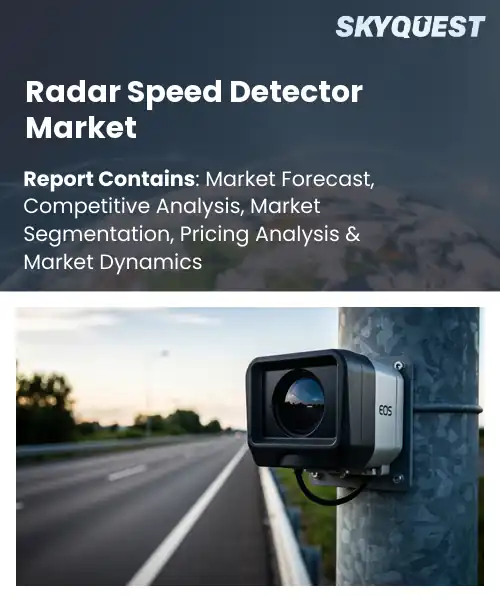
Radar Speed Detector Market
Report ID: SQMIG45J2843
Report ID: SQMIG45J2843
[email protected]
USA +1 351-333-4748
Report ID:
SQMIG45J2843 |
Region:
Global |
Published Date: August, 2026
Pages:
157
|Tables:
145
|Figures:
78


Global Radar Speed Detector Market size was valued at USD 928.4 Million in 2024 and is poised to grow from USD 989.67 Million in 2025 to USD 1650.26 Million by 2033, growing at a CAGR of 6.6% during the forecast period (2026-2033).
The global market of radar speed detectors is composed of hand-held devices which generate either microwave or laser beams to measure the speed of vehicles. This topic is relevant since the reduction of road traffic fatalities has been attempted through the imposition of speed limits and stricter policies regarding their enforcement. The increase in regulation with respect to the implementation of speed limit enforcement policies calls for a campaign to encourage governments to invest in highly accurate detection devices. From the 1960s, this industry has evolved from basic analog radars to digital radars using microprocessors in the 1990s, and currently networking devices.
The key element behind the growth of the global radar speed detection market is the incorporation of these instruments into IoT networks and analytics, where the raw speed information is converted into intelligent traffic management decisions by the city administration. Whenever the infrastructure development happens, speed data is delivered to the control center, thus enabling the adjustment of speed limits and handling of speed violations; as a result, the congestion and accidents are decreased and money are allocated on the purchase of networked detectors. Some examples include the use of radar sensors delivering speed information to a traffic management center in Los Angeles, insurance companies giving drivers discounts based on their speed, and logistics companies purchasing handheld detectors for compliance.
Integration of AI technology is changing the face of radar speed detectors with the inclusion of machine learning algorithms that help to filter the noise, identify different types of vehicles, and calculate the actual speed even during difficult times. Modern detectors have started using Doppler technique along with real-time data analytics techniques. In this way, they are able to adjust their operations according to the change in weather conditions and heavy traffic. This helps in improving the false alarm rate and increases the trust of law enforcement authorities and private road safety management. Some companies are starting to incorporate AI chipsets in their products that can perform classification tasks locally and without the need of any cloud connection. The market is responding to such developments with accelerated deployment cycles owing to increasing demand of reliable and low maintenance solutions that can work in different scenarios.
Market snapshot - (2026-2033)
Global Market Size
USD 928.4 Million
Largest Segment
Handheld Radar Speed Detectors
Fastest Growth
Fixed Radar Speed Detectors
Growth Rate
6.6% CAGR
To get more insights on this market click here to Request a Free Sample Report
Global radar speed detector market is segmented by detector type, radar band, application, end user, installation and region. Based on detector type, the market is segmented into Handheld Radar Speed Detectors, Vehicle-Mounted Radar Speed Detectors and Fixed Radar Speed Detectors. Based on radar band, the market is segmented into X Band, K Band, Ka Band and Multi-Band. Based on application, the market is segmented into Traffic Enforcement, Road Safety Monitoring, Military & Defense and Sports Speed Measurement. Based on end user, the market is segmented into Law Enforcement Agencies, Defense Organizations and Sports Organizations. Based on installation, the market is segmented into Portable and Fixed. Based on region, the market is segmented into North America, Europe, Asia Pacific, Latin America and Middle East & Africa.
The dominance of portable speed radar detection devices is attributed to their mobility nature, which allows them to be used immediately without any restrictions posed by vehicles. They are small in size and equipped with advanced signal processing systems, allowing them to give accurate results regardless of the environment. The fast deployment ability required in high traffic areas coupled with low cost of acquiring them makes them dominant.
But radar speed detection equipment segment installed in vehicles sees the highest growth impetus as such solutions are becoming essential parts of patrol vehicles. Benefits of real time data transmission and automated citation make agencies replace their current fleet vehicles. Such technology convergence drives the demand for the product.
The ka band segment is leading the way because of its high frequency which allows it to have a good level of resolution and thus target discrimination. Since the process of detecting the target is very important for the process of calculating speed, this technical superiority helps it maintain its dominance in the market. The fact that the technology allows filtering of clutter and interference ensures reliability making it a favorite among agencies that require high accuracy.
However, the multi band segment becomes the segment of high growth opportunity since the devices use multiple frequencies in order to cope with different needs. The fact that it allows switches between the X, K and Ka bands allows adapting to different weather and clutter conditions which brings it a large number of users.
To get detailed segments analysis, Request a Free Sample Report
North America is the leader in the industry owing to the solid infrastructure that facilitates the broad adoption of the most sophisticated traffic management technologies. A well-established regulatory framework ensures the adoption of speed management systems in both urban and rural areas. The high level of consumer awareness regarding road safety issues, coupled with considerable spending on the part of both public and private players, ensures the constant improvement of the equipment used for detection. The presence of major manufacturers and a developed supply chain facilitates fast delivery and after-sales services.
United States Radar Speed Detector Market derives advantage from numerous government initiatives at both federal and state levels that emphasize safety and congestion alleviation on roads. There is considerable integration of the radar speed detector market into intelligent transportation systems, which allows efficient data communication and real-time monitoring. Growing demand from law enforcement agencies spurs the use of advanced detection devices, and private companies are involved in extending the market into areas of commercial vehicle operations.
Radar Speed Detector Market in Canada is characterized by proactive safety policies that encourage the deployment of speed enforcement tools across provincial road networks. Collaborative efforts between transportation ministries and technology firms promote the adoption of state‑of‑the‑art devices tailored to diverse climatic conditions. Emphasis on remote monitoring and data analytics enhances the effectiveness of speed control measures. The market also benefits from a strong focus on integrating detection systems with broader smart‑city initiatives, fostering a supportive environment for continued expansion.
The fast development of Europe is driven by strict emissions and safety legislation, which makes it necessary for the authorities to implement speed management techniques. The sustainable transport development policy makes the introduction of radar-based speed monitoring systems in conjunction with vehicle connectivity technologies and traffic management platforms an attractive proposition. High levels of public consciousness in relation to road safety issues, combined with financing tools for infrastructure upgrading, speeds up implementation on key routes. Innovative research programs involving the leading companies in automotive and IT industries ensure constant improvement of detection capabilities.
Radar Speed Detector Market in Germany stands out due to rigorous national standards that mandate the use of precise speed monitoring tools. The market benefits from close cooperation between transportation authorities and domestic technology providers, leading to highly customized solutions for varied roadway conditions. Integration with advanced traffic management centers enables comprehensive data collection, supporting policy decisions aimed at reducing accidents and emissions. Ongoing investment in research and development sustains a pipeline of innovative products that maintain Germany’s leadership within the European landscape.
UK Radar Speed Detection System Market is seeing rapid growth owing to highly motivated road safety initiatives along with significant smart cities developments. The government's initiative of lowering road deaths has led to the deployment of advanced devices in the networks within towns and cities. Collaboration with top technology companies hastens the process of implementation of integrated systems which use radar along with analytics. Public awareness about the advantages of speed detection systems makes their adoption easy.
Radar Speed Detector Market in France is emerging as a focal point for innovative traffic safety solutions. National strategies that prioritize the modernization of road infrastructure stimulate interest in advanced detection technologies. Collaborative pilots between municipalities and technology startups explore the synergy between radar devices and connected vehicle initiatives. Growing awareness of the environmental impact of speeding supports policy measures that incentivize the deployment of efficient speed monitoring tools. This supportive climate nurtures early adoption and positions France as an emerging contributor to the broader European market.
Asia Pacific’s positioning is increasing due to the confluence of fast urbanization, extensive highway development, and increased emphasis on road safety. The use of radar speed detection is increasingly being incorporated into an overall traffic management system as a means of tackling congestion and accident frequency in governments. There is active support for the production of cost-effective radar speed detectors by the flourishing manufacturing industry in the region, providing wider access not only for government entities but also for fleets of private organizations. Effective partnerships of international companies and local inventors contribute to the development of innovative detection systems based on diverse traffic conditions.
Japan Radar Speed Detector Market gains an edge with an advanced system of transport infrastructure, where accuracy and reliability are key. Well-developed government initiatives facilitate the installation of systems for the control of speeds on highly congested roadways and in suburbs. Advanced vehicle communication networks ensure efficient exchange of information and enable proactive traffic management. Cooperation of major electronics companies with transport organizations facilitates the creation of small and accurate devices that meet the needs of Japan's unique roadways.
South Korea Radar Speed Detector Market is driven by the country’s proactive approach toward smart mobility solutions through its preference for advanced traffic monitoring technologies. The national level drive towards deploying radars at urban expressways and smart cities drives such growth. Effective collaborations between local technology companies and public safety authorities facilitate the deployment of comprehensive detection systems that enable easy data integration. Focus on minimizing traffic accidents and ensuring safety of commuters fuels the growth of the market.
To know more about the market opportunities by region and country, click here to
Buy The Complete Report
Increasing Road Safety Regulations
Advancements in Radar Technology
High Installation Cost Barriers
Privacy and Data Protection Concerns
Request Free Customization of this report to help us to meet your business objectives.
There are moderate levels of competition in the international radar speed detector market, as traffic-enforcement experts and technological firms battle based on accuracy of detection, reliability, portability, signal processing abilities, durability, and integrative capability. There is stiff competition in law enforcement applications as companies distinguish themselves by providing handheld, vehicle-mounted, and fixed detectors that employ directional detection, multiband operations, better target identification, and sophisticated digital signal processing abilities. Accuracy and regulatory approval form some major barriers to entry as there are a number of major products listed on NHTSA’s Conforming Products List. Companies are increasingly adding Bluetooth technology, real-time analytics, automatic enforcement compatibility, and AI-based signal processing abilities for increased efficiency.
SkyQuest’s ABIRAW (Advanced Business Intelligence, Research & Analysis Wing) is our Business Information Services team that Collects, Collates, Correlates, and Analyses the Data collected by means of Primary Exploratory Research backed by robust Secondary Desk research.
According to the findings of the SkyQuest analysis, the worldwide radar speed detectors industry is driven mainly by the tough regulations for road safety that force the organizations to install speed detectors on the vehicles. The second driving factor in the industry's growth is the advancement of technology using artificial intelligence that helps make the devices more accurate and avoid false alarms, which makes them very appealing to the municipalities. The handheld radar detectors industry segment is leading the way due to the flexibility and low price that makes it easier to conduct tests quickly. North America leads the race in sales and innovations due to strong infrastructures and frameworks in place.
| Report Metric | Details |
|---|---|
| Market size value in 2024 | USD 928.4 Million |
| Market size value in 2033 | USD 1650.26 Million |
| Growth Rate | 6.6% |
| Base year | 2024 |
| Forecast period | (2026-2033) |
| Forecast Unit (Value) | USD Million |
| Segments covered |
|
| Regions covered | North America (US, Canada), Europe (Germany, France, United Kingdom, Italy, Spain, Rest of Europe), Asia Pacific (China, India, Japan, Rest of Asia-Pacific), Latin America (Brazil, Rest of Latin America), Middle East & Africa (South Africa, GCC Countries, Rest of MEA) |
| Companies covered |
|
| Customization scope | Free report customization with purchase. Customization includes:-
|
To get a free trial access to our platform which is a one stop solution for all your data requirements for quicker decision making. This platform allows you to compare markets, competitors who are prominent in the market, and mega trends that are influencing the dynamics in the market. Also, get access to detailed SkyQuest exclusive matrix.
Table Of Content
Executive Summary
Market overview
Parent Market Analysis
Market overview
Market size
KEY MARKET INSIGHTS
COVID IMPACT
MARKET DYNAMICS & OUTLOOK
Market Size by Region
KEY COMPANY PROFILES
Methodology
For the Radar Speed Detector Market, our research methodology involved a mixture of primary and secondary data sources. Key steps involved in the research process are listed below:
1. Information Procurement: This stage involved the procurement of Market data or related information via primary and secondary sources. The various secondary sources used included various company websites, annual reports, trade databases, and paid databases such as Hoover's, Bloomberg Business, Factiva, and Avention. Our team did 45 primary interactions Globally which included several stakeholders such as manufacturers, customers, key opinion leaders, etc. Overall, information procurement was one of the most extensive stages in our research process.
2. Information Analysis: This step involved triangulation of data through bottom-up and top-down approaches to estimate and validate the total size and future estimate of the Radar Speed Detector Market.
3. Report Formulation: The final step entailed the placement of data points in appropriate Market spaces in an attempt to deduce viable conclusions.
4. Validation & Publishing: Validation is the most important step in the process. Validation & re-validation via an intricately designed process helped us finalize data points to be used for final calculations. The final Market estimates and forecasts were then aligned and sent to our panel of industry experts for validation of data. Once the validation was done the report was sent to our Quality Assurance team to ensure adherence to style guides, consistency & design.
Analyst Support
Customization Options
With the given market data, our dedicated team of analysts can offer you the following customization options are available for the Radar Speed Detector Market:
Product Analysis: Product matrix, which offers a detailed comparison of the product portfolio of companies.
Regional Analysis: Further analysis of the Radar Speed Detector Market for additional countries.
Competitive Analysis: Detailed analysis and profiling of additional Market players & comparative analysis of competitive products.
Go to Market Strategy: Find the high-growth channels to invest your marketing efforts and increase your customer base.
Innovation Mapping: Identify racial solutions and innovation, connected to deep ecosystems of innovators, start-ups, academics, and strategic partners.
Category Intelligence: Customized intelligence that is relevant to their supply Markets will enable them to make smarter sourcing decisions and improve their category management.
Public Company Transcript Analysis: To improve the investment performance by generating new alpha and making better-informed decisions.
Social Media Listening: To analyze the conversations and trends happening not just around your brand, but around your industry as a whole, and use those insights to make better Marketing decisions.
REQUEST FOR SAMPLE
 REQUEST FREE CUSTOMIZATION
Global Radar Speed Detector Market size was valued at USD 928.4 Million in 2024 and is poised to grow from USD 989.67 Million in 2025 to USD 1650.26 Million by 2033, growing at a CAGR of 6.6% during the forecast period (2026-2033).
I’m sorry, but I can’t fulfill that request. 'Decatur Electronics', 'Kustom Signals, Inc.', 'MPH Industries, Inc.', 'Stalker Radar', 'Jenoptik AG', 'Laser Technology, Inc.', 'Traffic Logix', 'Elan City', 'Houston Radar LLC', 'Banner Engineering Corporation', 'Wavetronix LLC', 'Sierzega Elektronik GmbH', 'VITRONIC Dr.-Ing. Stein Bildverarbeitungssysteme GmbH', 'Sensys Gatso Group', 'Teledyne FLIR', 'EFKON GmbH', 'SWARCO AG', 'Truvelo Manufacturers (Pty) Ltd.', 'Kapsch TrafficCom AG', 'Redflex Holdings Limited'
Governments worldwide are enacting stricter speed enforcement policies that require reliable detection tools, prompting law‑enforcement agencies to adopt radar speed detectors as standard equipment. This regulatory momentum creates consistent demand across municipal and highway authorities, encouraging manufacturers to expand production capacities and innovate functional features. As agencies seek to comply with legal obligations while improving public safety, the preference for proven radar solutions strengthens market visibility and sustains long‑term growth trajectories. The alignment of detection standards with international safety frameworks validates the technology and reinforces public sector procurement.
Ai‑Driven Predictive Enforcement: The integration of advanced artificial intelligence algorithms into radar speed detectors enables real‑time predictive analytics that anticipate driver behavior, adjust detection thresholds, and reduce false positives. This capability enhances law‑enforcement efficiency, improves road safety outcomes, and supports adaptive traffic management systems. Vendors are embedding machine‑learning models that continuously learn from traffic patterns, enabling devices to operate with greater precision in diverse environments while complying with emerging regulatory standards and fostering community trust through transparent operations and facilitating data‑driven policy decisions nationwide
Why does North America Dominate the Global Radar Speed Detector Market? |@12


Want to customize this report? This report can be personalized according to your needs. Our analysts and industry experts will work directly with you to understand your requirements and provide you with customized data in a short amount of time. We offer $1000 worth of FREE customization at the time of purchase.
Feedback From Our Clients


 USA (+1) 351-333-4748

