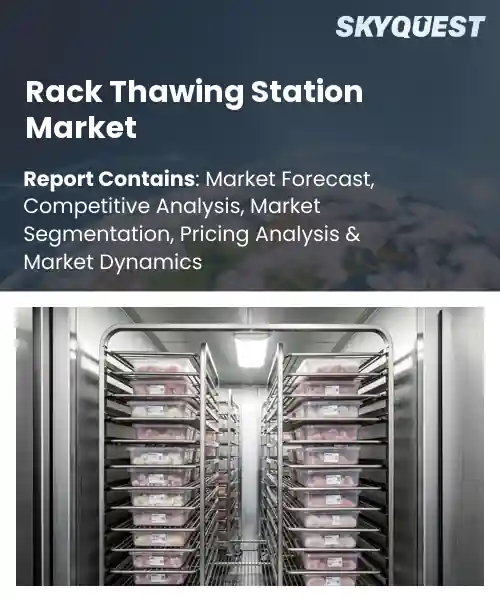
Rack Thawing Station Market
Report ID: SQMIG35J2667
Report ID: SQMIG35J2667
[email protected]
USA +1 351-333-4748
Report ID:
SQMIG35J2667 |
Region:
Global |
Published Date: July, 2026
Pages:
157
|Tables:
144
|Figures:
78


Global Rack Thawing Station Market size was valued at USD 238.6 Million in 2024 and is poised to grow from USD 253.39 Million in 2025 to USD 410.01 Million by 2033, growing at a CAGR of 6.2% during the forecast period (2026-2033).
The growth of demand for ready-to-cook items is fueling the rack thawing station industry because manufacturers need to thaw large amounts of ingredients within a short period while maintaining their quality. Retail companies like Walmart have made it necessary for suppliers to comply with uniform thawing procedures, resulting in the adoption of racks with 30 tons of capacity per shift, and reduction in man-hours by 25 percent. Incentives on energy usage further contribute to the trend, since new stations use recovered heat for water heating, saving costs and meeting carbon footprint reduction objectives. As a result, manufacturers collaborating with service companies create new business opportunities.
How is AI-driven Automation Enhancing Efficiency in the Rack Thawing Station Market?
The AI-driven automation is bringing changes into the rack thawing stations through integrating smart sensors that constantly measure temperature and humidity. Algorithms use such data to predict the thawing curves, and based on these predictions the machine automatically adjusts its settings. Such a process saves time, reduces variability of samples, and lowers electricity consumption. The laboratories get the benefit from the optimized workflow since this equipment can automatically calibrate itself and notify the operator in case of deviations. Additionally, the integration of AI allows tracking all thawing procedures and linking it to quality reports, which makes the audit process easier. With an increasing need for sample preparation, the AI integration becomes a crucial feature in this niche market.
Market snapshot - (2026-2033)
Global Market Size
USD 238.6 Million
Largest Segment
Automated Thawing Stations
Fastest Growth
Automated Thawing Stations
Growth Rate
6.2% CAGR
To get more insights on this market click here to Request a Free Sample Report
Global rack thawing station market is segmented by product type, sample type, application, end user, capacity and region. Based on product type, the market is segmented into Manual Thawing Stations and Automated Thawing Stations. Based on sample type, the market is segmented into Blood Products, Cell Therapy Products, Biological Samples and Reproductive Samples. Based on application, the market is segmented into Blood Banks, Cell & Gene Therapy, Research Laboratories and IVF Laboratories. Based on end user, the market is segmented into Hospitals, Biopharmaceutical Companies and Academic & Research Institutes. Based on capacity, the market is segmented into Single Rack and Multi-Rack. Based on region, the market is segmented into North America, Europe, Asia Pacific, Latin America and Middle East & Africa.
The dominant share of the manual thawing stations segment can be attributed to the importance of manual intervention and control over the thawing process by operators. The simplicity of manually regulated temperature regimes simplifies the training process for operators who can easily adjust to different products. The operator’s hands-on approach is in line with existing practices in some facilities, which increases trust in products. Therefore, users prefer manual stations to avoid risks.
Automated thawing stations are expected to experience the highest growth rates due to their ability to provide high efficiency with robotic technology and temperature regimes. Further developments of sensors and data analysis software increase the appeal of such systems among those organizations that are interested in automation.
Cell & Gene Therapy application is distinctive for its need for quick and effective thawing of extremely sensitive engineered cells which affect the effectiveness of the therapy itself. Need for strict control and tracing corresponds with special thawing stations featuring validation logs and alarms. Such an approach creates favorable conditions for preference during procurement, making cell & gene therapy application one of the main drivers of market activity.
However, laboratories become the main high growth segment due to growing use of rack thawing stations by laboratories conducting research on various biological samples. Need for reproducibility of protocols and financing of projects stimulates the demand; moreover, ability of modern stations to thaw various samples expands their popularity.
To get detailed segments analysis, Request a Free Sample Report
Leadership of North America is a result of the combination of mature cold chain logistics, early adoption of low temperature fuel handling, and regulation that fosters efficiency and safety. This region has a strong engineering base and a presence of reputable equipment providers who foster continuous innovations. Excellent collaboration between fuel suppliers, regulatory authorities, and research organizations creates a favorable ecosystem for the adoption of efficient thawing systems. At the same time, the focus on sustainable fuel options fits well with the capabilities of rack thawing stations.
U.S. Rack Thawing Station Market flourishes through a diversified industrial base that includes sectors of transportation, aviation, and renewable fuels distribution. Wide networks of coast-to-coast pipelines and a substantial fleet of fuel-requiring automobiles ensure the need for efficient thawing technology. Industrial players use advanced automation and real-time monitoring technologies for increasing their safety and efficiency. Research programs conducted in collaboration between the manufacturers and universities continuously improve the products. Another factor that ensures the development of the U.S. market is the presence of the environmentally-friendly regulation system.
Rack Thawing Station Market in Canada is shaped by a climate that demands resilient fuel handling across vast geographic regions. The market emphasizes robust design standards to withstand extreme cold while maintaining operational integrity. Partnerships between equipment suppliers and local fuel distributors ensure tailored solutions for remote and urban applications. A focus on renewable fuel integration aligns with national sustainability goals, driving interest in versatile thawing systems. Skilled engineering talent and supportive policy measures further reinforce Canada’s commitment to reliable and environmentally responsible rack thawing practices.
Europe’s fast-paced growth is characterized by very high emissions criteria and a general trend towards low-carbon fuels. There are many government incentives that facilitate the use of sophisticated thawing technology that enables renewable diesel and biodiesel transportation. Collaborative research in Europe facilitates the development of energy-efficient and space-saving rack thawing units designed to meet the requirements of busy logistics centers. The need for a quality product on the market increases due to the vast rail and road freight network in colder areas that requires constant fuel quality.
Rack Thawing Station Market in Germany benefits from a reputation for engineering precision and a mature industrial ecosystem. The market emphasizes high‑performance equipment that meets rigorous quality and safety standards. Close collaboration between manufacturers and automotive fuel providers ensures seamless integration of thawing solutions into existing infrastructure. A strong focus on renewable fuel adoption drives demand for flexible systems capable of handling diverse fuel blends. Germany’s commitment to sustainability and its extensive logistics network reinforce the dominant role of rack thawing technology within the national energy landscape.
UK Rack Thawing Station Market is witnessing rapid growth fueled by aggressive decarbonization objectives along with increasing adoption of renewable fuel projects. The market utilizes a unique approach of design which caters to the climate diversity in the UK as well as transport requirements. Collaboration between suppliers of equipment and fuel retailers is aiding quick deployment of advanced thawing stations at critical distribution centers. The use of technology-based solutions and remote monitoring fits into the emphasis on operational efficiency and safety in the United Kingdom.
Rack Thawing Station Market in France is emerging as a promising segment supported by national policies encouraging cleaner transportation fuels. The market emphasizes adaptable solutions that can be retrofitted into existing fuel depots and service stations. Collaborative efforts between French engineering firms and renewable fuel producers drive the development of compact, energy‑efficient thawing units. Growing awareness of climate objectives stimulates interest in technologies that ensure fuel reliability during colder periods. This emerging momentum establishes France as an important contributor to the broader European expansion of rack thawing stations.
The Asia Pacific region is reinforcing its standing due to the combination of manufacturing expertise, government backing, and growing requirements for dependable fuel handling in different climatic conditions. The region benefits from low-cost manufacturing while using modern automation and sensor technology for improved performance and reliability. Increasing logistics and fleet sizes in cold-sensitive regions generate a great need for more effective thawing methods. Focus on renewable fuels corresponds with the sustainability strategies used by the region, which fosters greater use of flexible rack thawing units.
The Market for Rack Thawing Stations in Japan is positively impacted by its technological manufacturing and engineering precision. It places importance on small yet effective machines that can be incorporated into fuel supply infrastructure in highly urbanized environments. Coordination with producers of renewable fuels guarantees that the products will be suitable for new blends of low-carbon fuels. Safety and environmental responsibility of Japan results in constant improvement of the equipment used in order to withstand various climatic conditions of the country.
South Korea Rack Thawing Station Market is driven by the fast pace of industrialization along with favorable government initiatives to promote fuel facilities in the country. The market concentrates on networked thawing technology that corresponds to the digitized nature of South Korea. Cooperation between leading equipment producers and large fuel suppliers ensures quick installation of equipment within the growing logistics network. Concern about renewable fuels and safety requirements determine the direction of development of multifunctional, highly efficient thawing stations. The described market becomes an important part of improving rack thawing technologies in Asia Pacific region.
To know more about the market opportunities by region and country, click here to
Buy The Complete Report
Expanding Cold Chain Infrastructure
Adoption of Automated Thawing Technology
High Initial Capital Expenditure
Regulatory Compliance Complexities
Request Free Customization of this report to help us to meet your business objectives.
Competitive pressure increases today with manufacturers striving for quick, power-efficient thawing process to reduce food waste and adhere to safety regulations. There is a rush of M&A activities involving IoT sensors vendors, joint ventures in logistics for offering thawing solutions as part of service packages, and application of AI-enabled temperature control algorithms – the key differentiators of product performance and ecosystem of services.
SkyQuest’s ABIRAW (Advanced Business Intelligence, Research & Analysis Wing) is our Business Information Services team that Collects, Collates, Correlates, and Analyses the Data collected by means of Primary Exploratory Research backed by robust Secondary Desk research.
As per SkyQuest analysis, the global rack thawing station market is experiencing a huge boost mainly from the swift development of the cold chain logistics facilities, thus providing continuous demands for thawing equipment. Secondly, there is an emerging trend of using automatic thawing systems which help to increase efficiency and minimize errors made by workers due to programmability and IoT technology. The North American market holds a strong position due to established logistics facilities, favorable regulatory environment, and engineering expertise. Regarding product types, the manual thawing station accounts for the biggest segment due to operators' preference for direct handling and ease of training. Nevertheless, the significant capital requirement serves as a major barrier.
| Report Metric | Details |
|---|---|
| Market size value in 2024 | USD 238.6 Million |
| Market size value in 2033 | USD 410.01 Million |
| Growth Rate | 6.2% |
| Base year | 2024 |
| Forecast period | (2026-2033) |
| Forecast Unit (Value) | USD Million |
| Segments covered |
|
| Regions covered | North America (US, Canada), Europe (Germany, France, United Kingdom, Italy, Spain, Rest of Europe), Asia Pacific (China, India, Japan, Rest of Asia-Pacific), Latin America (Brazil, Rest of Latin America), Middle East & Africa (South Africa, GCC Countries, Rest of MEA) |
| Companies covered |
|
| Customization scope | Free report customization with purchase. Customization includes:-
|
To get a free trial access to our platform which is a one stop solution for all your data requirements for quicker decision making. This platform allows you to compare markets, competitors who are prominent in the market, and mega trends that are influencing the dynamics in the market. Also, get access to detailed SkyQuest exclusive matrix.
Table Of Content
Executive Summary
Market overview
Parent Market Analysis
Market overview
Market size
KEY MARKET INSIGHTS
COVID IMPACT
MARKET DYNAMICS & OUTLOOK
Market Size by Region
KEY COMPANY PROFILES
Methodology
For the Rack Thawing Station Market, our research methodology involved a mixture of primary and secondary data sources. Key steps involved in the research process are listed below:
1. Information Procurement: This stage involved the procurement of Market data or related information via primary and secondary sources. The various secondary sources used included various company websites, annual reports, trade databases, and paid databases such as Hoover's, Bloomberg Business, Factiva, and Avention. Our team did 45 primary interactions Globally which included several stakeholders such as manufacturers, customers, key opinion leaders, etc. Overall, information procurement was one of the most extensive stages in our research process.
2. Information Analysis: This step involved triangulation of data through bottom-up and top-down approaches to estimate and validate the total size and future estimate of the Rack Thawing Station Market.
3. Report Formulation: The final step entailed the placement of data points in appropriate Market spaces in an attempt to deduce viable conclusions.
4. Validation & Publishing: Validation is the most important step in the process. Validation & re-validation via an intricately designed process helped us finalize data points to be used for final calculations. The final Market estimates and forecasts were then aligned and sent to our panel of industry experts for validation of data. Once the validation was done the report was sent to our Quality Assurance team to ensure adherence to style guides, consistency & design.
Analyst Support
Customization Options
With the given market data, our dedicated team of analysts can offer you the following customization options are available for the Rack Thawing Station Market:
Product Analysis: Product matrix, which offers a detailed comparison of the product portfolio of companies.
Regional Analysis: Further analysis of the Rack Thawing Station Market for additional countries.
Competitive Analysis: Detailed analysis and profiling of additional Market players & comparative analysis of competitive products.
Go to Market Strategy: Find the high-growth channels to invest your marketing efforts and increase your customer base.
Innovation Mapping: Identify racial solutions and innovation, connected to deep ecosystems of innovators, start-ups, academics, and strategic partners.
Category Intelligence: Customized intelligence that is relevant to their supply Markets will enable them to make smarter sourcing decisions and improve their category management.
Public Company Transcript Analysis: To improve the investment performance by generating new alpha and making better-informed decisions.
Social Media Listening: To analyze the conversations and trends happening not just around your brand, but around your industry as a whole, and use those insights to make better Marketing decisions.
REQUEST FOR SAMPLE
 REQUEST FREE CUSTOMIZATION
Global Rack Thawing Station Market size was valued at USD 238.6 Million in 2024 and is poised to grow from USD 253.39 Million in 2025 to USD 410.01 Million by 2033, growing at a CAGR of 6.2% during the forecast period (2026-2033).
Recent competition intensifies as manufacturers seek faster, energy‑efficient thawing to cut food waste and meet stricter safety standards. Companies are accelerating M&A of IoT sensor specialists, forging joint ventures with logistics providers to bundle thawing services, and deploying AI‑driven temperature‑control algorithms, all aimed at differentiating product performance and expanding service ecosystems. 'Thermo Fisher Scientific Inc.', 'Sartorius AG', 'Cytiva', 'BioLife Solutions, Inc.', 'Azenta, Inc.', 'Hamilton Company', 'Brooks Automation, Inc.', 'PHC Holdings Corporation', 'Eppendorf SE', 'B Medical Systems S.à r.l.', 'Haier Biomedical', 'Helmer Scientific Inc.', 'Custom Biogenic Systems, Inc.', 'Chart Industries, Inc.', 'Cryoport, Inc.', 'Air Liquide S.A.', 'Labcold Ltd.', 'Arctiko A/S', 'LabRepCo LLC', 'Cryotherm GmbH & Co. KG'
The expansion of cold‑chain infrastructure across emerging markets creates steady demand for rack thawing stations, as food processors require reliable equipment to maintain product quality during thawing, and logistics providers need scalable solutions to handle growing volumes of frozen goods; this encourages manufacturers to develop advanced, energy‑efficient designs that align with evolving supply‑chain standards and regulatory expectations, while the broader network of temperature‑controlled warehouses simplifies integration, reduces installation complexity, and supports adoption by small and medium enterprises seeking efficiency and lower product loss.
Renewable Power Integration: Customers are increasingly seeking rack thawing stations that can operate on renewable electricity, driven by corporate sustainability mandates and rising energy costs. Manufacturers are responding by offering models equipped with solar‑ready inverters, battery storage compatibility, and energy‑management software that optimizes load during off‑peak periods. This shift not only reduces carbon footprints but also enhances operational resilience, positioning vendors that prioritize clean‑energy readiness as preferred partners in a market where environmental stewardship is becoming a core procurement criterion for long‑term success.
Why does North America Dominate the Global Rack Thawing Station Market? |@12


Want to customize this report? This report can be personalized according to your needs. Our analysts and industry experts will work directly with you to understand your requirements and provide you with customized data in a short amount of time. We offer $1000 worth of FREE customization at the time of purchase.
Feedback From Our Clients


 USA (+1) 351-333-4748

