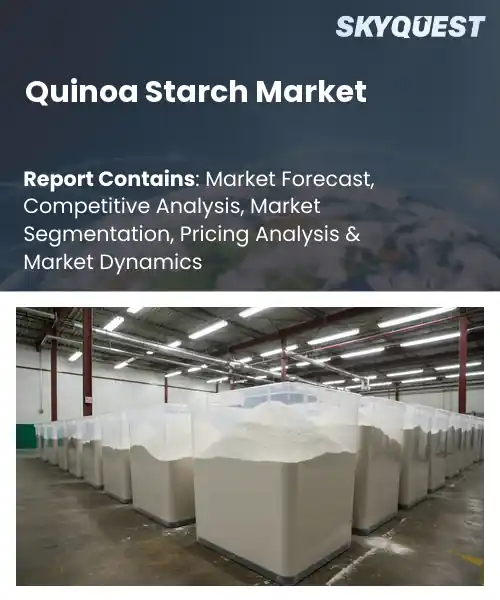
Quinoa Starch Market
Report ID: SQMIG30H2386
Report ID: SQMIG30H2386
[email protected]
USA +1 351-333-4748
Report ID:
SQMIG30H2386 |
Region:
Global |
Published Date: March, 2026
Pages:
157
|Tables:
200
|Figures:
80


Global Quinoa Starch Market size was valued at USD 1.20 Billion in 2024 and is poised to grow from USD 1.27 Billion in 2025 to USD 2.03 Billion by 2033, growing at a CAGR of 6.0% during the forecast period (2026-2033).
The quinoa starch market is rapidly evolving niche of the global starch industry driven primarily by rising demand for gluten-free clean-label ingredients. Quinoa starch comes from Quinoa grains, It is a great source of nutrients and has a neutral taste and a number of functional qualities. Because of the changing consumer preferences and regulatory pressures, food manufacturers and nutraceutical manufacturers want to use alternatives to wheat and corn starches, thereby increasing demand for alternative starches like quinoa starch.
Over the last 10 years, the cultivation of quinoa has spread beyond the traditional Andean regions, and supply chain investments have led to the construction of pilot plants in Europe and North America as well as blooming commercial scale and increasing availability of products containing it.
The key trend driving global quinoa starch sector growth is supply chain modernization because reliable processing and consistent quality enable broader industrial adoption. When processors invest in wet milling technologies, they reduce variability and create functional grades suitable for bakery, snack and pharmaceutical formulations which in turn Encourages selective adoption in premium and niche product segments. As adoption rises economies of scale, lower unit costs thereby expanding price-sensitive markets such as instant soups and gluten-free bread mixes. Additionally, certification systems and traceability programs build consumer trust which opens export opportunities for Andean farmers and encourages private investment in branded quinoa starch products.
How can Blockchain Improve Traceability in the Quinoa Starch Market?
Blockchain can strengthen traceability in the quinoa starch market by recording immutable origin and processing data across the value chain. Key aspects include provenance tagging at farm level, batch level quality certificates and audit trails that span transport and milling. Today the market faces fragmented sourcing, variable quality, and rising demand for sustainability credentials. Distributed ledgers combined with simple identifiers and IoT sensors let buyers verify sourcing and processing steps in real time. Examples include QR-coded traceability systems and smart contracts, which perform pay-out when quality metrics are achieved by members). Using these measures reduce fraudulent activity, expedite product recall operations, and assist with establishing a premium image for authenticity shareholders' residual profit margin oodles.
Market snapshot - 2026-2033
Global Market Size
USD 1.2 Billion
Largest Segment
White Quinoa
Fastest Growth
Mixed/Tricolor Quinoa
Growth Rate
6.0% CAGR
To get more insights on this market click here to Request a Free Sample Report
The quinoa starch market is segmented by source, purity level, form, application, functionality, end-user, distribution channel and region. Based on source, the market is segmented into white quinoa, red quinoa, black quinoa and mixed/tricolor quinoa. Based on purity level, the market is segmented into native quinoa starch and purified/isolated quinoa starch. Based on form, the market is segmented into powder, granules and gel. Based on application, the market is segmented into food & beverage, nutraceuticals, cosmetics & personal care and industrial.
Based on functionality, the market is segmented into thickening agent, stabilizer, binder, texturizer and fat replacer. Based on end-user, the market is segmented into household, commercial and industrial. Based on distribution channel, the market is segmented into direct and indirect. Based on region, the market is segmented into North America, Europe, Asia Pacific, Latin America and Middle East & Africa.
Based on the global quinoa starch market growth, white quinoa segment dominates because its milder flavor profile and consistent starch granule characteristics make it a preferred feedstock for broad food and industrial applications. Due to its consistent processing characteristics, it reduces the risk of unstandardized products, making formulation/remanufacturing easier. Because growers and manufacturers know each other well in the supply chain, this drives consistent adoption of the ingredients with steady demand for products where neutral flavor and consistent performance as a thickener and texturizer are critical.
However, red quinoa is emerging as the fastest growing source, driven by demand for differentiated sensory profiles. Its unique color and perceived high-end status are driving innovation in the development of new clean labeled niche foods & cosmetic products, motivating formulators to experiment with creative formulations and provide value added product to expand development of consumer niches and new price premium markets.
Purified/isolated quinoa starch segment stands out because its high purity and consistent composition enable formulators to predict functional performance reliably across diverse applications. Quinoa starches have lower variances in formulations and less variation with respect to regulatory requirements when the particle sizes are customized and the non-starch components are kept to a minimum. This increased reliability is appealing to nutraceutical and cosmetic developers who want to use standardized raw materials in order to encourage broader use of quinoa starches by the industry while at the same time creating a premium image in the quinoa starch marketplace.
Meanwhile, native quinoa starch is accelerating fastest growth as formulators favor minimally processed ingredients for clean label and cost-sensitive applications. Its perceived naturalness and lower processing requirements encourage use in mainstream food and industrial products, unlocking broader volume adoption and prompting innovation in ambient-stable formulations that expand end-user categories and manufacturing-scale opportunities.
To get detailed segments analysis, Request a Free Sample Report
As per the global quinoa starch market share, North America leads due to a robust integration of supply chain capability, advanced processing infrastructure, and strong demand from diversified end use sectors. The area enjoys a competitive advantage because manufacturers seek functionality in their ingredients and claim clean labels, which has allowed them to quickly adopt quinoa starch into food and non-food products. The existing research institutes and private sector investment provide assistance to manufacturers in developing formulations and testing products/applications.
The infrastructure for distribution and logistics makes it easy to find and receive raw materials, and consumers' interest in health and specialty ingredients continues to influence the acceptance of products by retailers and processors. Growers, processors and ingredient formulators working together to create consistent and traceable products provides the foundation of confidence in manufacturing quinoa products and will help facilitate the expansion of quinoa products into broader industrial markets.
United States Quinoa Starch Market
Quinoa starch market trends in the United States is characterized by large ingredient houses and ingredient formulators that emphasize functionality, purity, and scalability. Optimizing the particle size will lead to higher solubility; reduce the amount of non-starch matter in the formulation and reduce variability in the formulation. Additionally, it will lower the levels of regulation for the formulations to be used for high-value applications. These advantages will appeal to manufacturers of nutraceuticals and cosmetics who desire to have standardized product inputs which will in turn lead to greater industrial use of quinoa starch products, at a premium, in the marketplace.
Canada Quinoa Starch Market
Quinoa starch market in Canada reflects a focus on specialty crop development and value added processing within a quality oriented agricultural framework. Health food brands and artisanal food makers have begun to break into the market using local produce suppliers who focus on sustainable sourcing through contract manufacturing/co-packing arrangements that allow for new small innovators to enter the market, while working together with research centers and export-ready distribution channels to conduct test crops and improve products positioned as being able to provide premium grade quinoa starch products.
Based on global quinoa starch regional forecast, expansion in Europe is driven by evolving consumer preferences toward healthier and more transparent food ingredients, alongside strong retail demand for clean label and free from formulations. Regulatory emphasis on food safety, traceability, and sustainability encourages manufacturers to adopt alternative starch sources that can be credibly certified and sourced. Local innovation ecosystems and ingredient specialists enable tailored applications in bakery, confectionery, and specialty foods, while collaborations with global suppliers ensure steady raw material access.
Retail and food service experimentation, coupled with premiumization trends, support category growth. Investing strategically in logistics and processing within existing core markets will drive both market development and widespread market acceptance of new languages into other market sectors in Europe.
Germany Quinoa Starch Market
Quinoa starch market in Germany is guided by a strong food processing base and high standards for ingredient quality and traceability. Starches that have the ability to function consistently in baked goods, convenience foods and industrial applications are what manufacturers strive for. Manufacturers also prefer supplier partners who participate in research collaborations to support product application studies. Technical assistance from suppliers of ingredients is valuable to manufacturers; therefore, establishing long-term partnerships with starch suppliers will help ensure supply reliability and product quality in the challenging processing environment of the food industry.
United Kingdom Quinoa Starch Market
Quinoa starch market in the United Kingdom shows rapid uptake driven by trend sensitive retailers, dynamic start up activity, and a strong focus on plant based innovations. Food manufacturers and formulators rapidly trial new ingredients to support free from and clean label positioning, while e commerce and food service channels amplify successful launches. Ingredient suppliers invest in application support and co development to meet agile reformulation needs. The market environment favors novel textures and multifunctional ingredients that address evolving consumer expectations.
France Quinoa Starch Market
Quinoa starch market in France is emerging through the intersection of culinary tradition and premium health-oriented innovation. Artisanal bakers and specialty food producers are experimenting with quinoa starch to achieve unique textures and nutritional positioning in gourmet applications. Focusing on the origins of the product and its quality helps to place premiums on the sourcing of the ingredient while processors build expertise at the early level to provide a small to medium-scale supply. Market growth is supported by consumer interest in wholesome ingredients that complement traditional culinary practices.
As per global quinoa starch regional outlook, Asia Pacific is enhancing its role through targeted product development, rising consumer interest in healthful ingredients, and increasing collaboration with global suppliers. Manufacturers of regional foods use quinoa starch in a variety of local styles, mixing it with local grains to better satisfy consumers’ texture and flavor preferences. Manufacturers conduct application research and pilot-scale processing to develop new convenience foods, snack foods, and functional foods that appeal to regional tastes.
Retailers and distributors of ingredients add more quinoa-based products to their product lines while continuing to adapt their regulatory and quality standards to facilitate imports and safe domestic processing of quinoa. As urban areas grow in population, and as individuals change what they eat, more demand for innovative ingredients develops, leading to greater regional integration and sophistication of markets.
Japan Quinoa Starch Market
Quinoa starch market in Japan focuses on precision formulation and high expectations for ingredient performance and safety. Food Manufacturers Use Quinoa Starch in snacks, convenience food items, and specialty formulas in which texture control and shelf life are very important. Suppliers based on premium positioning and high-quality assurance guidelines are selected collaboratively with research institutions to develop product applications. The market values the innovation of a small batch and thorough documentation that meets rigorous domestic standards; in addition, the market is responding positively to consumer-driven expectations and quality.
South Korea Quinoa Starch Market
Quinoa starch market in South Korea is shaped by a trend driven food culture and rapid adoption of novel ingredients in snacks, bakery items, and ready to eat meals. Due to their ability to provide different types of products and health benefits, multi-functional starches are highly sought after by food manufacturers and ingredient developers. The combination of growing consumer awareness through retail and online shopping opportunities as well as innovative supplier partnerships will enable companies to develop new formulations more quickly than ever before.
To know more about the market opportunities by region and country, click here to
Buy The Complete Report
Rising Demand For Clean Label Ingredients
Expansion Into Food Processing Applications
Limited Raw Material Availability
Costly Processing And Scale Challenges
Request Free Customization of this report to help us to meet your business objectives.
Competitive intensity in the global quinoa starch market outlook is driven by ingredient firms and plant based challengers pursuing supply chain control, formulation differentiation and cleaner label functionalities; strategic moves include M&A and distribution partnerships to secure quinoa derived feedstock, exemplified by Above Food’s NorQuin acquisition and Ingredion’s commercial agreement for NorQuin flour. Innovation consortia such as the EU Quinnova project develop fractionation and starch extraction technologies.
Clean Label Demand Rise
Nonfood Application Expansion
SkyQuest’s ABIRAW (Advanced Business Intelligence, Research & Analysis Wing) is our Business Information Services team that Collects, Collates, Correlates, and Analyses the Data collected by means of Primary Exploratory Research backed by robust Secondary Desk research.
As per SkyQuest analysis, a key driver is rising consumer demand for clean label, gluten free ingredients that favors quinoa starch for its neutral flavor and perceived naturalness, while one restraint is limited raw material availability and processing scale that can raise costs and hinder consistent supply. North America is the largest marketplace driven by the presence of modern processing infrastructure, as well as strong demand for quinoa. Also, the leading quinoa type is White Quinoa due to its mild taste and readily predictable starch performance. A second driver is supplying chain modernization and investments in processing which improve consistency, lower unit costs, and enable broader adoption across food, nutraceutical and cosmetic applications.
| Report Metric | Details |
|---|---|
| Market size value in 2024 | USD 1.20 Billion |
| Market size value in 2033 | USD 2.03 Billion |
| Growth Rate | 6.0% |
| Base year | 2024 |
| Forecast period | 2026-2033 |
| Forecast Unit (Value) | USD Billion |
| Segments covered |
|
| Regions covered | North America (US, Canada), Europe (Germany, France, United Kingdom, Italy, Spain, Rest of Europe), Asia Pacific (China, India, Japan, Rest of Asia-Pacific), Latin America (Brazil, Rest of Latin America), Middle East & Africa (South Africa, GCC Countries, Rest of MEA) |
| Companies covered |
|
| Customization scope | Free report customization with purchase. Customization includes:-
|
To get a free trial access to our platform which is a one stop solution for all your data requirements for quicker decision making. This platform allows you to compare markets, competitors who are prominent in the market, and mega trends that are influencing the dynamics in the market. Also, get access to detailed SkyQuest exclusive matrix.
Table Of Content
Executive Summary
Market overview
Parent Market Analysis
Market overview
Market size
KEY MARKET INSIGHTS
COVID IMPACT
MARKET DYNAMICS & OUTLOOK
Market Size by Region
KEY COMPANY PROFILES
Methodology
For the Quinoa Starch Market, our research methodology involved a mixture of primary and secondary data sources. Key steps involved in the research process are listed below:
1. Information Procurement: This stage involved the procurement of Market data or related information via primary and secondary sources. The various secondary sources used included various company websites, annual reports, trade databases, and paid databases such as Hoover's, Bloomberg Business, Factiva, and Avention. Our team did 45 primary interactions Globally which included several stakeholders such as manufacturers, customers, key opinion leaders, etc. Overall, information procurement was one of the most extensive stages in our research process.
2. Information Analysis: This step involved triangulation of data through bottom-up and top-down approaches to estimate and validate the total size and future estimate of the Quinoa Starch Market.
3. Report Formulation: The final step entailed the placement of data points in appropriate Market spaces in an attempt to deduce viable conclusions.
4. Validation & Publishing: Validation is the most important step in the process. Validation & re-validation via an intricately designed process helped us finalize data points to be used for final calculations. The final Market estimates and forecasts were then aligned and sent to our panel of industry experts for validation of data. Once the validation was done the report was sent to our Quality Assurance team to ensure adherence to style guides, consistency & design.
Analyst Support
Customization Options
With the given market data, our dedicated team of analysts can offer you the following customization options are available for the Quinoa Starch Market:
Product Analysis: Product matrix, which offers a detailed comparison of the product portfolio of companies.
Regional Analysis: Further analysis of the Quinoa Starch Market for additional countries.
Competitive Analysis: Detailed analysis and profiling of additional Market players & comparative analysis of competitive products.
Go to Market Strategy: Find the high-growth channels to invest your marketing efforts and increase your customer base.
Innovation Mapping: Identify racial solutions and innovation, connected to deep ecosystems of innovators, start-ups, academics, and strategic partners.
Category Intelligence: Customized intelligence that is relevant to their supply Markets will enable them to make smarter sourcing decisions and improve their category management.
Public Company Transcript Analysis: To improve the investment performance by generating new alpha and making better-informed decisions.
Social Media Listening: To analyze the conversations and trends happening not just around your brand, but around your industry as a whole, and use those insights to make better Marketing decisions.
REQUEST FOR SAMPLE
 REQUEST FREE CUSTOMIZATION
Global Quinoa Starch Market size was valued at USD 1.2 Billion in 2024 and is poised to grow from USD 1.27 Billion in 2025 to USD 2.03 Billion by 2033, growing at a CAGR of 6.0% during the forecast period (2026-2033).
Key vendors in the Quinoa Starch market include major ingredient and starch manufacturers such as Ingredion Incorporated, Cargill, Incorporated, Tate & Lyle PLC, Roquette Frères, and Archer Daniels Midland Company (ADM), along with regional producers and specialty food ingredient suppliers focusing on gluten‑free and plant‑based starch solutions.
The key driver of the Quinoa Starch market is the rising demand for gluten-free, plant-based, and functional food ingredients. Increasing consumer preference for healthy, natural, and clean-label products in bakery, snacks, beverages, and processed foods is boosting the adoption of quinoa starch globally.
A key market trend in the Quinoa Starch market is the growing adoption of clean-label and gluten-free ingredients in food and beverage products. Additionally, innovations in plant-based and functional starch applications, along with increasing use in bakery, snacks, and beverages, are expanding market opportunities.
North America accounted for the largest share in the Quinoa Starch market, driven by high demand for gluten-free and plant-based foods, growing consumer awareness of healthy ingredients, and the strong presence of key starch and food ingredient manufacturers in the region.


Want to customize this report? This report can be personalized according to your needs. Our analysts and industry experts will work directly with you to understand your requirements and provide you with customized data in a short amount of time. We offer $1000 worth of FREE customization at the time of purchase.
Feedback From Our Clients


 USA (+1) 351-333-4748

