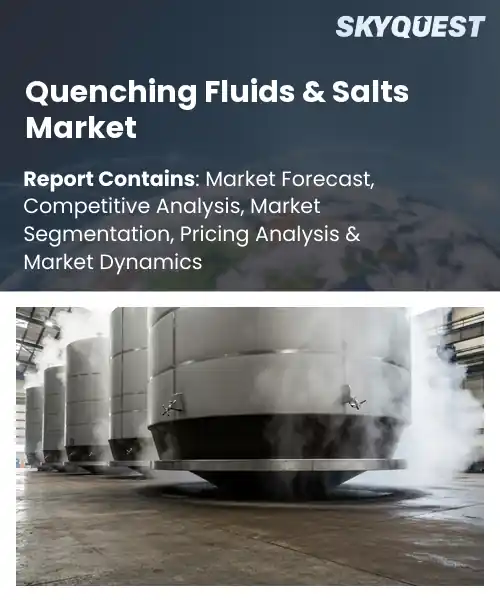
Quenching Fluids & Salts Market
Report ID: SQMIG15E3463
Report ID: SQMIG15E3463
[email protected]
USA +1 351-333-4748
Report ID:
SQMIG15E3463 |
Region:
Global |
Published Date: May, 2026
Pages:
157
|Tables:
121
|Figures:
72


Global Quenching Fluids & Salts Market size was valued at USD 1.52 Billion in 2024 and is poised to grow from USD 1.61 Billion in 2025 to USD 2.52 Billion by 2033, growing at a CAGR of 5.81% during the forecast period (2026-2033).
The main factor responsible for the growth of the quenching fluids and salts market is increasing demands for accuracy of heat treatment on the part of industries such as automotive, aerospace, and energy industries. Quenching fluids and salts include mineral and synthetic oils; water-miscible polymers; and salt in molten form, which are used to quickly cool down metals for setting up their microstructure and properties. The development of the quenching fluids and salts industry has evolved significantly over time from using only water and oil baths, due to developments in metallurgy as well as stricter environmental and safety regulations.
One of the major influences affecting the global market will be increased regulation on the environment, leading to the production of quenchants with reduced VOC content as well as the use of biodegradable oils and salts; compliance with these regulations will result in higher demands for more specialized products and services designed to conserve quenchant through recovery and recycling processes to reduce costs. Increased regulation will lead manufacturers and heat treating facilities to utilize closed loop processes and advanced monitoring technologies, resulting in longer bath life, enhanced processing capabilities, and consistent performance in high strength steel parts and additive-manufactured parts.
How is AI Optimizing Quality Control in the Quenching Fluids and Salts Market?
Machine learning enhances the quality management practices in the quenching fluids and salts industry by combining sensors with predictive algorithms and automation. The main features include online sensing of temperature and chemical characteristics, predictive analysis of cooling curves through machine learning models, and optimization of recipes using machine learning models to minimize variability and rework rates. At present, quenchants suppliers combine laboratory quenchometers with digital platform solutions to ensure efficient validation and reliable performance of quenchants in different industries. The practical examples are numerous from automated cooling curve analysis and digital formulations that help to increase the efficiency of product development processes. For example, Perstorp in April 2026 has partnered with Citrine Informatics to implement digital formulations into its practices.
Market snapshot - (2026-2033)
Global Market Size
USD 1.52 Billion
Largest Segment
Quenching Oils
Fastest Growth
Polymer Quenchants
Growth Rate
5.81% CAGR
To get more insights on this market click here to Request a Free Sample Report
Global quenching fluids & salts market is segmented by type, application, end-use industry, distribution and region. Based on type, the market is segmented into Quenching Oils, Polymer Quenchants, Quenching Salts and Gas Quenchants (Nitrogen, Helium). Based on application, the market is segmented into Through Hardening, Case Hardening, Martempering and Austempering. Based on end-use industry, the market is segmented into Automotive, Aerospace, Tool Manufacturing and Oil & Gas. Based on distribution, the market is segmented into Direct Sales, Distributors and Online. Based on region, the market is segmented into North America, Europe, Asia Pacific, Latin America and Middle East & Africa.
The Quenching Salts category leads due to their ability to provide extremely uniform cooling characteristics, which is essential in achieving reliable metallurgical changes for different types of alloys. These compounds are known for thermal stability, and therefore they help maintain the consistency of cooling baths throughout several applications. Also, the easy adjustment of quench rates and suitability for automation are factors contributing to the preference for salts.
Polymer Quenchants have proven to be the fastest-growing segment, owing to advances in formulations which make it possible to achieve customized cooling rates to suit modern health and environmental standards. Improved biodegradability, minimal fire hazard, as well as the capability of serving different alloy groups, makes this category more appealing than the rest.
Austempering segment is the dominating segment on account of the fact that the process requires accurate control of cooling rate and isothermal holding to guarantee the best toughness and dimensional stability. As a result, there is a need for fluids and salts that offer consistent thermal conductivity and known transition periods, motivating the development of specific formulations for creating repeatable bainite. Such preferences from the heat treatment companies contribute to the importance of austempering in terms of selecting quench media and services.
On the other side, the Martempering segment is serving as the fastest growing due to the need for decreased distortion and increased cycle integration in complex products. Increased usage in manufacturing precision tools motivates the development of quench media with fast but controlled cooling.
To get detailed segments analysis, Request a Free Sample Report
Asia Pacific emerges as a major player in the international quenching fluids and salts market owing to its abundance of industries and manufacturing capabilities along with its effective supply chain infrastructure which facilitates numerous heat treatments. Asia Pacific leads in automotive, foundry, and electronics manufacturing; therefore, there is continuous demand for efficient quenching media. Advanced formulation skills in metal manufacturing have facilitated the development of top-notch quenching fluid formulations suited to the local requirements. In addition, low-cost production and efficient supplier networks help to bring new products quickly into use. The synergy between material scientists and Original Equipment Manufacturers (OEMs) makes the development of application-specific quenching solutions easier. Furthermore, existing logistics channels help Asia Pacific emerge as the largest market for quenching fluids and salts.
Factors supporting growth of the Japanese Quenching Fluids & Salts Market is state-of-the-art metallurgical research, along with a high density of industries within the nation. The partnership between original equipment manufacturers and specialized producers contributes to the creation of innovative products. Strict adherence to high standards, process control and regulatory issues contribute significantly towards fostering innovation. Integration between research facilities and the industry expedites commercialization of technologies.
Market Dynamics for Quenching Fluids and Quenching Salts in South Korea are influenced by a vibrant business environment that promotes modern steel processing, electronics, and vehicle manufacturing. South Korean suppliers place special emphasis on customizing products for precise temperature management. Cooperation between research laboratories and experts in heat treatments allows quick adjustments in order to improve quenched fluid properties and handling capabilities.
The quick and sustained growth of the quenching fluids and salts market in Europe is largely attributed to a confluence of factors comprising mature manufacturing requirements, strict regulatory standards, and an inclination toward process optimization. Given that Europe has mature industries like the automotive, aerospace, and precision engineering sectors, the need for high-quality and reliable heat treatment services means that there is a corresponding demand for safer and more environmentally compliant quenching fluids and salts. The constant innovations carried out by chemical manufacturers through cooperation with heat treating specialists and the original equipment manufacturer sector have made this possible. An industry-wide focus on the efficient end of life management, reclamation, and minimizing the presence of hazardous materials has led to a trend toward developing more benign products.
German Market for Quenching Fluids & Salts has been bolstered by the presence of an extensive manufacturing infrastructure coupled with significant metal knowledge. Integration among machinery manufacturers, heat-treatment shops, and chemicals producers ensures that the market demands high-quality quenching products. The need for precision, productivity, and compliance encourages the use of engineered quenching fluids and salts which are reliable and safe.
United Kingdom Quenching Fluids & Salts Market comprises a niche for specialized heat-treatment service providers. The market has focused its attention towards providing aftermarket solutions and hence is poised to offer solutions for retrofitting and precision engineering applications. Manufacturers in the industry highlight their emphasis on product stewardship along with process compatibility, which results in the requirement for flexible quenching fluids.
France’s Quenching Fluids & Salts Market is witnessing an upsurge due to increased activities in the aerospace, defense, and precision engineering sectors. The focus on use of high-end alloys, coupled with unique heat-treatment methods, has created a need for customized quenching fluids and salts. Manufacturers are coming up with products that combine performance with environmental factors, whereasservice providers are ramping up their capabilities to process difficult components.
The North American region continues to build a strong foothold in the market of quenching fluids and salts through innovation, service-driven commercialization, and infrastructure modernization for heat treating operations. The involvement of experts in the development of chemical formulations, heat treaters, and OEM services networks helps develop formulas suited to use in heavy fabrication, tooling, and precision component manufacturing processes. The focus on improving the efficiency and safety of operations and compliance with regulations led to the reformulation and improvement of handling of quenchants. The investment made by aftermarket service providers contributes to increased lifecycle value of end-users' products. Cross-border cooperation between industries and research institutes ensures the rapid transfer of technology, whereas the increased interest in sustainable chemistry improves the regional supply picture.
Quenching Fluids & Salts Market in United States is bolstered by an ecosystem within various industries, including the automotive, aerospace, fabrications, and tooling industries. Activities in the aftermarket and fluid management industry create opportunities for the use of performance-driven quenching fluids. Quenching fluid manufacturers partner with heat treatment companies to formulate customized quenching fluids suited for challenging conditions.
Market for Quenching Liquids and Salts in Canada is generating revenue from application-specific usage in equipment, energy, and fabrication industries. The local suppliers, as well as heat treatment services, prefer strong yet easily manageable fluids that will be convenient to use for maintenance and operational needs. Awareness of environmental responsibility and responsible waste management leads to using eco-friendly chemistries. Joint effort of research organizations, suppliers, and industry participants helps in achieving customized solutions.
To know more about the market opportunities by region and country, click here to
Buy The Complete Report
Increasing Demand from Automotive
The growing demand for reliable heat treating in the manufacture of automobile components drives the growth of the market because of the rising consumption of quenching fluids and quenching salts that help ensure high standards in the process. The key priorities of automakers include the quality of metals as well as the production process itself, which leads to the acquisition of quenching solutions and creation of customized products. In turn, this results in increased market demands.
Expansion in Industrial Applications
Industrial applications such as heavy machinery manufacturing, aerospace maintenance, and machining involve the need for highly accurate heat treatment of components, leading to the continuous adoption of quenching fluids and salts that cater to specific metals and finishes. Manufacturers are increasingly focusing on achieving uniform results in their process, thus creating the need for partnerships between consumers and manufacturers that aim at improving the formulations and use of the quenching agents to achieve high-quality products.
Environmental Regulation Compliance Costs
Tough environmental norms and changing waste management norms make it complex for the manufacturer and consumer to comply with these standards; thus, restricting the growth of the market by increasing the cost of producing and managing quenching fluids and salts. The need to adhere to environmental standards makes the companies have to adopt stringent measures in their operations, such as installing an exhaust system and treating waste, making it difficult for small businesses to join the market.
Limited Recycling and Disposal Infrastructure
Inefficiency in terms of infrastructure for the proper recycling, regeneration, and safe disposal of the spent quenching fluids is a major constraint as well, resulting in the limitation of usage of certain chemicals and salts because of their proper handling after usage. Since many industries do not have access to advanced treatment facilities or proper recycling networks, there remains a reluctance among buyers of such products. As a result, the market cannot expand its range until better infrastructure is available.
Request Free Customization of this report to help us to meet your business objectives.
Competitiveness within the international quenching fluids and salts industry revolves around consolidation and technology differentiation, as illustrated by mergers that will alter the size of suppliers, as well as strategic alliances designed to obtain processing services; such mergers have been witnessed in terms of industrial fluids supplies, while machine suppliers and heat treatment service companies cooperate to extract salts and develop polymer quenchants.
Shift to Specialty Formulations: Manufacturers are shifting toward specialty quenching fluids and salts designed for specific alloy chemistries and component geometries to improve performance and limit post treatment variability. Growing demand for boron free, low foam and fast cooling formulations that reduce distortion is notable in precision engineering and aerospace markets. Suppliers are partnering with heat treaters to create tailored blends and provide technical services, enabling product differentiation and value sales. This emphasis on customization is driving stronger supplier relationships and wider adoption globally.
Integration with Heat Treatment Automation: Automation integration is increasing demand for quenching media that interface with inline monitoring, robotic handling and closed loop process controls to maintain consistent cooling profiles across throughput operations. Vendors are modifying formulations and packaging to accommodate automated dispensing, filtration and regeneration equipment, reducing manual steps, contamination risk. This convergence enhances component quality, shortens cycle times and simplifies traceability. Strategic collaborations among fluid suppliers, equipment makers and end users are producing turnkey solutions that ease implementation and create consumable revenue streams.
SkyQuest’s ABIRAW (Advanced Business Intelligence, Research & Analysis Wing) is our Business Information Services team that Collects, Collates, Correlates, and Analyses the Data collected by means ofPrimary Exploratory Research backed by robust Secondary Desk research.
As per SkyQuest analysis, the increasing requirement for accurate heating treatment in the automotive, aerospace, and energy industry is driving the usage of engineered oils, polymer-based quenchants, and salts that offer controlled levels of hardness and minimize distortion. The other major driver would be an increase in the number of industrial uses such as heavy machinery and tool making along with maintenance of renewable energy sources, resulting in the increased need for special types of quenching media. The environmental regulations along with lack of recycling facilities make the handling, processing, and disposal costly. The dominant region would be APAC on account of high industrialization and formulation capabilities, and the dominant segment would be Quenching Salts.
| Report Metric | Details |
|---|---|
| Market size value in 2024 | USD 1.52 Billion |
| Market size value in 2033 | USD 2.52 Billion |
| Growth Rate | 5.81% |
| Base year | 2024 |
| Forecast period | (2026-2033) |
| Forecast Unit (Value) | USD Billion |
| Segments covered |
|
| Regions covered | North America (US, Canada), Europe (Germany, France, United Kingdom, Italy, Spain, Rest of Europe), Asia Pacific (China, India, Japan, Rest of Asia-Pacific), Latin America (Brazil, Rest of Latin America), Middle East & Africa (South Africa, GCC Countries, Rest of MEA) |
| Companies covered |
|
| Customization scope | Free report customization with purchase. Customization includes:-
|
To get a free trial access to our platform which is a one stop solution for all your data requirements for quicker decision making. This platform allows you to compare markets, competitors who are prominent in the market, and mega trends that are influencing the dynamics in the market. Also, get access to detailed SkyQuest exclusive matrix.
Table Of Content
Executive Summary
Market overview
Parent Market Analysis
Market overview
Market size
KEY MARKET INSIGHTS
COVID IMPACT
MARKET DYNAMICS & OUTLOOK
Market Size by Region
KEY COMPANY PROFILES
Methodology
For the Quenching Fluids & Salts Market, our research methodology involved a mixture of primary and secondary data sources. Key steps involved in the research process are listed below:
1. Information Procurement: This stage involved the procurement of Market data or related information via primary and secondary sources. The various secondary sources used included various company websites, annual reports, trade databases, and paid databases such as Hoover's, Bloomberg Business, Factiva, and Avention. Our team did 45 primary interactions Globally which included several stakeholders such as manufacturers, customers, key opinion leaders, etc. Overall, information procurement was one of the most extensive stages in our research process.
2. Information Analysis: This step involved triangulation of data through bottom-up and top-down approaches to estimate and validate the total size and future estimate of the Quenching Fluids & Salts Market.
3. Report Formulation: The final step entailed the placement of data points in appropriate Market spaces in an attempt to deduce viable conclusions.
4. Validation & Publishing: Validation is the most important step in the process. Validation & re-validation via an intricately designed process helped us finalize data points to be used for final calculations. The final Market estimates and forecasts were then aligned and sent to our panel of industry experts for validation of data. Once the validation was done the report was sent to our Quality Assurance team to ensure adherence to style guides, consistency & design.
Analyst Support
Customization Options
With the given market data, our dedicated team of analysts can offer you the following customization options are available for the Quenching Fluids & Salts Market:
Product Analysis: Product matrix, which offers a detailed comparison of the product portfolio of companies.
Regional Analysis: Further analysis of the Quenching Fluids & Salts Market for additional countries.
Competitive Analysis: Detailed analysis and profiling of additional Market players & comparative analysis of competitive products.
Go to Market Strategy: Find the high-growth channels to invest your marketing efforts and increase your customer base.
Innovation Mapping: Identify racial solutions and innovation, connected to deep ecosystems of innovators, start-ups, academics, and strategic partners.
Category Intelligence: Customized intelligence that is relevant to their supply Markets will enable them to make smarter sourcing decisions and improve their category management.
Public Company Transcript Analysis: To improve the investment performance by generating new alpha and making better-informed decisions.
Social Media Listening: To analyze the conversations and trends happening not just around your brand, but around your industry as a whole, and use those insights to make better Marketing decisions.
REQUEST FOR SAMPLE
 REQUEST FREE CUSTOMIZATION
Global Quenching Fluids & Salts Market size was valued at USD 1.52 Billion in 2024 and is poised to grow from USD 1.61 Billion in 2025 to USD 2.52 Billion by 2033, growing at a CAGR of 5.81% during the forecast period (2026-2033).
Competition in the global quenching fluids and salts market centers on consolidation and technology differentiation, driven by mergers that reshape supplier scale and by tactical partnerships that secure process services; for example, major M&A reshuffled industrial fluids supply while equipment manufacturers and heat treat service providers collaborate on salt recovery and polymer quenchant development to reduce environmental cost and lock in industrial accounts. 'Quaker Houghton', 'Fuchs Petrolub', 'Total Energies', 'Chevron Corporation', 'Idemitsu Kosan', 'BASF SE', 'Clariant AG', 'Castrol (BP)', 'ExxonMobil', 'Park Thermal International', 'International Lubricants', 'Summit Quench (Thermoclad)', 'Riggs & Lombard', 'Texas Refinery Corp.', 'Metalworking Lubricants'
The expanding need for reliable heat treatment in vehicle component manufacturing fuels market growth by increasing consumption of specialized quenching fluids and salts. Automotive manufacturers prioritize consistent metallurgical properties and throughput, which encourages procurement of proven quenching media and development of tailored formulations. Suppliers respond by scaling capacity and offering application support, reinforcing adoption across production lines. This alignment of quality requirements, supplier capability, and production efficiency strengthens market demand for a broader range of quenching solutions and accelerates technology refinement.
Shift To Specialty Formulations: Manufacturers are shifting toward specialty quenching fluids and salts designed for specific alloy chemistries and component geometries to improve performance and limit post treatment variability. Growing demand for boron free, low foam and fast cooling formulations that reduce distortion is notable in precision engineering and aerospace markets. Suppliers are partnering with heat treaters to create tailored blends and provide technical services, enabling product differentiation and value sales. This emphasis on customization is driving stronger supplier relationships and wider adoption globally.
Why does Asia Pacific Dominate the Global Quenching Fluids & Salts Market? |@12


Want to customize this report? This report can be personalized according to your needs. Our analysts and industry experts will work directly with you to understand your requirements and provide you with customized data in a short amount of time. We offer $1000 worth of FREE customization at the time of purchase.
Feedback From Our Clients


 USA (+1) 351-333-4748

