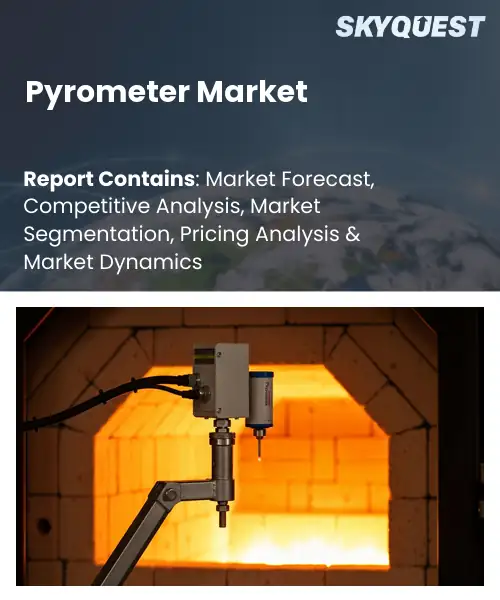
Pyrometer Market
Report ID: SQMIG45J2648
Report ID: SQMIG45J2648
[email protected]
USA +1 351-333-4748
Report ID:
SQMIG45J2648 |
Region:
Global |
Published Date: July, 2026
Pages:
157
|Tables:
118
|Figures:
77


Global Pyrometer Market size was valued at USD 470.78 Million in 2024 and is poised to grow from USD 514.19 Million in 2025 to USD 1041.21 Million by 2033, growing at a CAGR of 9.22% during the forecast period (2026-2033).
The global pyrometer market growth consists of manufacturers and suppliers of non-contact temperature measurement devices used across industrial sectors. Its importance is that it is possible to see extreme heat without physical intrusion thus avoiding equipment failure and assuring product quality. The market began to grow in the early 20th century when furnace operators required stable temperature readings, and early optical pyrometers were replaced by infrared and laser-based devices as semiconductor fabrication and aerospace programs required greater accuracy. This evolution has been accelerated post-2000s with the rise of automation and predictive maintenance making real time thermal data an indispensable asset for modern factories and for continuous improvement in energy efficiency goals.
The pyrometer market trends for pyrometers is mainly driven by the rising adoption of Industry 4.0 paradigms, in which connected sensors allow factories to convert thermal information into actionable intelligence. At a steel plant, infrared pyrometers are integrated into a centralized IoT platform that automatically triggers cooling cycles when temperature anomalies are detected, reducing scrap rates and increasing furnace life. This cause-effect relationship drives demand for higher-accuracy, network-ready devices, pushing vendors to invest in miniaturized optics and edge-computing firmware. At the same time, the rise of clean energy ventures creates opportunities in solar-thermal and waste-to-energy plants, where non-contact monitoring protects efficiency, meets stringent emission standards, and drives long-term profitability for equipment makers globally in the sector.
How is AI Integration Enhancing Accuracy and Predictive Maintenance in the Pyrometer Market?
With the integration of AI, pyrometers are evolving to include real-time data analytics within the sensor firmware. Modern devices combine raw infrared data with machine-learning models that adjust for emissivity variation, dust or smoke correction, and transient spike filtering. This means temperature readings are stable in harsh furnace environments and on moving production lines. Those same algorithms are used to monitor for drift, alert you when it’s time to calibrate, and predict when parts will wear out before they actually break. These smart pyrometers help manufacturers reduce downtime, improve product quality and streamline quality-control workflows by making temperature monitoring more reliable and proactive.
Teledyne FLIR announced an AI-enabled pyrometer in April 2024, an example of how on-board analytics can instantly adjust for emissivity changes and predict sensor degradation, thus improving overall equipment effectiveness and supporting broader pyrometer market growth adoption.
Market snapshot - (2026-2033)
Global Market Size
USD 470.78 Million
Largest Segment
Infrared Pyrometers
Fastest Growth
Radiation Pyrometers
Growth Rate
9.22% CAGR
To get more insights on this market click here to Request a Free Sample Report
Global pyrometer market is segmented by technology framework, operational configuration, target temperature range, end-use industry and region. Based on technology framework, the market is segmented into radiation pyrometers, optical pyrometers and infrared pyrometers. Based on operational configuration, the market is segmented into fixed station pyrometers and handheld portable pyrometers. Based on target temperature range, the market is segmented into low range (under 500°C), medium range (500°C to 1500°C) and high ultra range (above 1500°C). Based on end-use industry, the market is segmented into metal smelting metallurgy, glass ceramic manufacturing, cement refractory processing, semiconductor wafer fabrication and others. Based on region, the market is segmented into North America, Europe, Asia Pacific, Latin America and Middle East & Africa.
The radiation pyrometers segment is dominant because it provides a direct, non-contact temperature measurement based on emitted thermal radiation. This makes it a perfect fit for high speed and high temperature industrial processes. They reduce downtime and maintenance costs, and are the choice for critical applications because they can respond quickly without physically entering a facility. This reliability, combined with advances in detector materials and calibration algorithms, continues to cement their central position and sustain demand across multiple sectors.
Meanwhile, the fastest growing segment in the pyrometer market is the optical pyrometers. Their use of visible and near-infrared wavelength detection allows accurate temperature measurements in environments clouded by dust or gases where other methods are obscured. The market growth is accelerated by increasing adoption driven by the improvement in lens optics and digital imaging which opens new opportunities in niche manufacturing lines and research laboratories that need fine temperature resolution.
The segment is led by handheld portable pyrometers, which allow versatile, on-site temperature verification that fits nicely into clean-room protocols. These compact battery-operated units enable engineers to conduct rapid spot checks without interrupting the flow of production, thus improving process control and yield. Their strong calibration capabilities, along with their ability to capture data in real time, make them vital to preserving tight thermal tolerances in wafer fabrication.
In contrast, fixed station pyrometers are witnessing the highest growth momentum in the pyrometer market. Features such as ongoing monitoring and compatibility with automated control systems address the increasing need for predictive maintenance and rigorous quality assurance. Better sensor life and networking means it is easy to communicate data to a manufacturing execution system for example, leading to broader adoption on high-value production lines, and opportunities for the future market.
To get detailed segments analysis, Request a Free Sample Report
The Asia Pacific region has deep manufacturing expertise, large industrial bases and strong government support for the adoption of advanced technology. High mix, low volume production environments and large scale continuous processes create a continuous need for exact temperature measurement solutions. Innovation in infrared and laser-based pyrometers is supported by strong R&D ecosystems in the major economies to meet strict quality standards. Additionally, the region’s proximity to important end-use sectors including automotive, electronics and metal processing shortens supply chains and improves responsiveness to customer needs, solidifying the region’s leadership position.
Pyrometer market outlook in Japan benefits from a legacy of precision engineering and a culture of continuous improvement. Leading manufacturers invest heavily in miniaturization and high‑accuracy sensors, catering to sophisticated applications in aerospace, semiconductor fabrication, and high‑speed manufacturing. Collaborative partnerships between industry and research institutes accelerate the introduction of next‑generation non‑contact temperature technologies, solidifying Japan’s reputation for reliability and performance.
Pyrometer market forecast in South Korea is driven by rapid expansion of high‑tech industries and aggressive adoption of smart factory concepts. Strong emphasis on automation and digital integration encourages the deployment of advanced pyrometric devices equipped with IoT connectivity. Government incentives for high‑value manufacturing and strategic focus on sectors such as shipbuilding, petrochemicals, and display production reinforce the country's capability to supply cutting‑edge temperature measurement solutions.
The pyrometer market in Europe is fueled by stringent quality norms, matured industrial base and increasing focus on energy efficiency and sustainability. Investment in sophisticated non-contact temperature solutions is being driven by demand for precision monitoring in aerospace, renewable energy and advanced materials fabrication. Research networks across the continent encourage collaboration and innovation in calibration standards and digital integration. Robust environmental policies force manufacturers to adopt technologies that minimize waste and improve process control. These factors create a fertile ground for rapid market growth in the leading European economies.
Pyrometer market regional outlook in Germany is anchored by a deep engineering tradition and a focus on high‑performance industrial equipment. German manufacturers prioritize robustness and accuracy, catering to sectors such as automotive, chemical processing, and high‑precision tooling. Strong collaboration between industry groups and technical universities drives continuous improvement in sensor technology and calibration methods, reinforcing Germany’s position as a dominant player in the European pyrometer landscape.
Pyrometer market regional forecast in United Kingdom experiences accelerated growth through a vibrant ecosystem of research institutions and innovative startups. Emphasis on advanced manufacturing and aerospace initiatives fuels demand for high‑resolution temperature monitoring. Government programs supporting digital transformation and Industry 4.0 adoption encourage integration of pyrometers with data analytics platforms, positioning the United Kingdom as a leading growth engine within Europe.
Pyrometer market analysis in France is emerging thanks to expanding investments in renewable energy, aerospace, and high‑tech manufacturing. French firms are increasingly adopting sophisticated pyrometric solutions to meet strict regulatory standards and improve process efficiency. Partnerships between industrial clusters and research agencies nurture development of niche applications, allowing France to gain a foothold in the broader European market.
North America is maintaining its place in the pyrometer market due to its technological superiority, broad manufacturing diversification and a strong emphasis on standardization. Deep investment in R&D in the region especially in the semiconductor, aerospace and advanced materials sectors is accelerating development of high-precision, rugged pyrometric instruments. Collaboration between industry consortia and standards bodies ensures interoperability and reliability, which in turn allows for broader adoption across a variety of use cases. A focus on digital integration and predictive maintenance further increases the strategic value of pyrometers to improve productivity and reduce operational risk throughout the continent.
Pyrometer market penetration in United States benefits from a robust ecosystem of technology innovators and large‑scale industrial producers. Emphasis on high‑throughput manufacturing and cutting‑edge research fuels demand for advanced non‑contact temperature sensors with real‑time data connectivity. Strong partnerships between equipment manufacturers, universities, and defense contractors accelerate the development of specialized pyrometric solutions, reinforcing the United States’ leadership in the market.
Pyrometer industry in Canada is shaped by its growing resource extraction, aerospace, and clean‑technology sectors. A strategic focus on sustainability and process optimization encourages adoption of accurate temperature monitoring tools to improve energy efficiency and product quality. Collaborative frameworks between federal research programs and industry players promote the integration of advanced pyrometric technologies, strengthening Canada’s role in the North American market.
To know more about the market opportunities by region and country, click here to
Buy The Complete Report
Rising Demand for Precision Measurements
Growing Preference For Non Contact
High Initial Capital Expenditure
Limited Calibration Expertise
Request Free Customization of this report to help us to meet your business objectives.
The global pyrometer market is characterized by strong competition among established instrumentation and industrial automation companies that compete through continuous product innovation, strategic partnerships, digital integration, and expansion of non-contact temperature measurement solutions. Leading manufacturers including Fluke Corporation, AMETEK, Advanced Energy Industries, OMEGA Engineering, Testo SE, Calex Electronics, Endress+Hauser, Honeywell International, Siemens AG, ABB, and Yokogawa Electric continue to strengthen their portfolios by developing high-accuracy infrared and fiber-optic pyrometers capable of supporting demanding industrial applications in metals, glass, semiconductors, power generation, and aerospace manufacturing. Growing adoption of Industry 4.0, predictive maintenance, and automated process control is accelerating investment in smart temperature monitoring systems featuring digital connectivity, improved calibration capabilities, and real-time data analytics.
Top Player’s Company Profile
Recent Developments in the Pyrometer Market
SkyQuest’s ABIRAW (Advanced Business Intelligence, Research & Analysis Wing) is our Business Information Services team that Collects, Collates, Correlates, and Analyses the Data collected by means of Primary Exploratory Research backed by robust Secondary Desk research. As per SkyQuest analysis the global pyrometer market is set to double by 2033, driven primarily by the rising demand for precision temperature measurements that enable real‑time quality control across metal, glass and semiconductor production. A second strong catalyst is the growing preference for non‑contact sensing, which protects product integrity and supports automated factory designs. High initial capital expenditure remains the main restraint, especially for smaller manufacturers hesitant to invest in advanced AI‑enabled units. Asia Pacific dominates the market thanks to its extensive manufacturing base and supportive policies, while radiation pyrometers hold the largest share due to their rapid, contact‑free readings in high‑temperature processes.
| Report Metric | Details |
|---|---|
| Market size value in 2024 | USD 470.78 Million |
| Market size value in 2033 | USD 1041.21 Million |
| Growth Rate | 9.22% |
| Base year | 2024 |
| Forecast period | (2026-2033) |
| Forecast Unit (Value) | USD Million |
| Segments covered |
|
| Regions covered | North America (US, Canada), Europe (Germany, France, United Kingdom, Italy, Spain, Rest of Europe), Asia Pacific (China, India, Japan, Rest of Asia-Pacific), Latin America (Brazil, Rest of Latin America), Middle East & Africa (South Africa, GCC Countries, Rest of MEA) |
| Companies covered |
|
| Customization scope | Free report customization with purchase. Customization includes:-
|
To get a free trial access to our platform which is a one stop solution for all your data requirements for quicker decision making. This platform allows you to compare markets, competitors who are prominent in the market, and mega trends that are influencing the dynamics in the market. Also, get access to detailed SkyQuest exclusive matrix.
Table Of Content
Executive Summary
Market overview
Parent Market Analysis
Market overview
Market size
KEY MARKET INSIGHTS
COVID IMPACT
MARKET DYNAMICS & OUTLOOK
Market Size by Region
KEY COMPANY PROFILES
Methodology
For the Pyrometer Market, our research methodology involved a mixture of primary and secondary data sources. Key steps involved in the research process are listed below:
1. Information Procurement: This stage involved the procurement of Market data or related information via primary and secondary sources. The various secondary sources used included various company websites, annual reports, trade databases, and paid databases such as Hoover's, Bloomberg Business, Factiva, and Avention. Our team did 45 primary interactions Globally which included several stakeholders such as manufacturers, customers, key opinion leaders, etc. Overall, information procurement was one of the most extensive stages in our research process.
2. Information Analysis: This step involved triangulation of data through bottom-up and top-down approaches to estimate and validate the total size and future estimate of the Pyrometer Market.
3. Report Formulation: The final step entailed the placement of data points in appropriate Market spaces in an attempt to deduce viable conclusions.
4. Validation & Publishing: Validation is the most important step in the process. Validation & re-validation via an intricately designed process helped us finalize data points to be used for final calculations. The final Market estimates and forecasts were then aligned and sent to our panel of industry experts for validation of data. Once the validation was done the report was sent to our Quality Assurance team to ensure adherence to style guides, consistency & design.
Analyst Support
Customization Options
With the given market data, our dedicated team of analysts can offer you the following customization options are available for the Pyrometer Market:
Product Analysis: Product matrix, which offers a detailed comparison of the product portfolio of companies.
Regional Analysis: Further analysis of the Pyrometer Market for additional countries.
Competitive Analysis: Detailed analysis and profiling of additional Market players & comparative analysis of competitive products.
Go to Market Strategy: Find the high-growth channels to invest your marketing efforts and increase your customer base.
Innovation Mapping: Identify racial solutions and innovation, connected to deep ecosystems of innovators, start-ups, academics, and strategic partners.
Category Intelligence: Customized intelligence that is relevant to their supply Markets will enable them to make smarter sourcing decisions and improve their category management.
Public Company Transcript Analysis: To improve the investment performance by generating new alpha and making better-informed decisions.
Social Media Listening: To analyze the conversations and trends happening not just around your brand, but around your industry as a whole, and use those insights to make better Marketing decisions.
REQUEST FOR SAMPLE
 REQUEST FREE CUSTOMIZATION
Global Pyrometer Market size was valued at USD 470.78 Million in 2024 and is poised to grow from USD 514.19 Million in 2025 to USD 1041.21 Million by 2033, growing at a CAGR of 9.22% during the forecast period (2026-2033).
Global pyrometer manufacturers are intensifying competition through strategic acquisitions and joint ventures, notably the recent merger between ThermoTech Instruments and InfraSense Systems to combine infrared sensor expertise with high‑temperature measurement platforms. Companies are also accelerating technology innovation, such as deploying AI‑enhanced calibration algorithms to improve accuracy and reduce downtime for industrial furnace monitoring, thereby differentiating product portfolios in a market driven by precision requirements and cost‑efficiency pressures. 'Fluke Corporation', 'Ametek', 'Omega Engineering', 'Advanced Energy Industries', 'Chroma ATE', 'Shimadzu Corporation', 'Horiba', 'Yokogawa Electric', 'Endress+Hauser', 'Honeywell International', 'Siemens AG', 'Emerson Electric', 'Schneider Electric', 'ABB Ltd', 'Rockwell Automation', 'Keyence Corporation', 'Omron Corporation', 'Panasonic Holdings', 'Testo SE', 'Calex Electronics'
The expanding requirement for precise temperature monitoring across aerospace, metal processing, and semiconductor manufacturing drives demand for pyrometers, as these devices provide reliable, real‑time data that support quality control and safety standards. Manufacturers are increasingly integrating pyrometers into automated production lines, enabling continuous monitoring without halting operations, which enhances overall equipment efficiency and reduces waste. This functional relevance encourages equipment upgrades and new installations, thereby fueling market expansion. The ability to operate under extreme temperatures also broadens application scope, attracting sectors that previously relied on indirect measurement methods.
Advanced Material Integration: The adoption of high‑temperature resistant composites and ceramics in furnace and processing equipment is driving demand for pyrometers capable of accurate measurement across broader spectral ranges. Manufacturers are integrating these materials to enhance durability and thermal stability, prompting a shift toward non‑contact optical sensors that can operate without degradation. This trend expands market reach into aerospace, renewable energy, and advanced manufacturing sectors seeking reliable temperature monitoring under extreme conditions for critical quality assurance and process optimization globally.
Why does Asia Pacific Dominate the Global Pyrometer Market? |@12


Want to customize this report? This report can be personalized according to your needs. Our analysts and industry experts will work directly with you to understand your requirements and provide you with customized data in a short amount of time. We offer $1000 worth of FREE customization at the time of purchase.
Feedback From Our Clients


 USA (+1) 351-333-4748

