
PVAM (Photovoltaic and Advanced) Materials Market
Report ID: SQMIG20D2578
Report ID: SQMIG20D2578
[email protected]
USA +1 351-333-4748
Report ID:
SQMIG20D2578 |
Region:
Global |
Published Date: March, 2026
Pages:
157
|Tables:
123
|Figures:
77


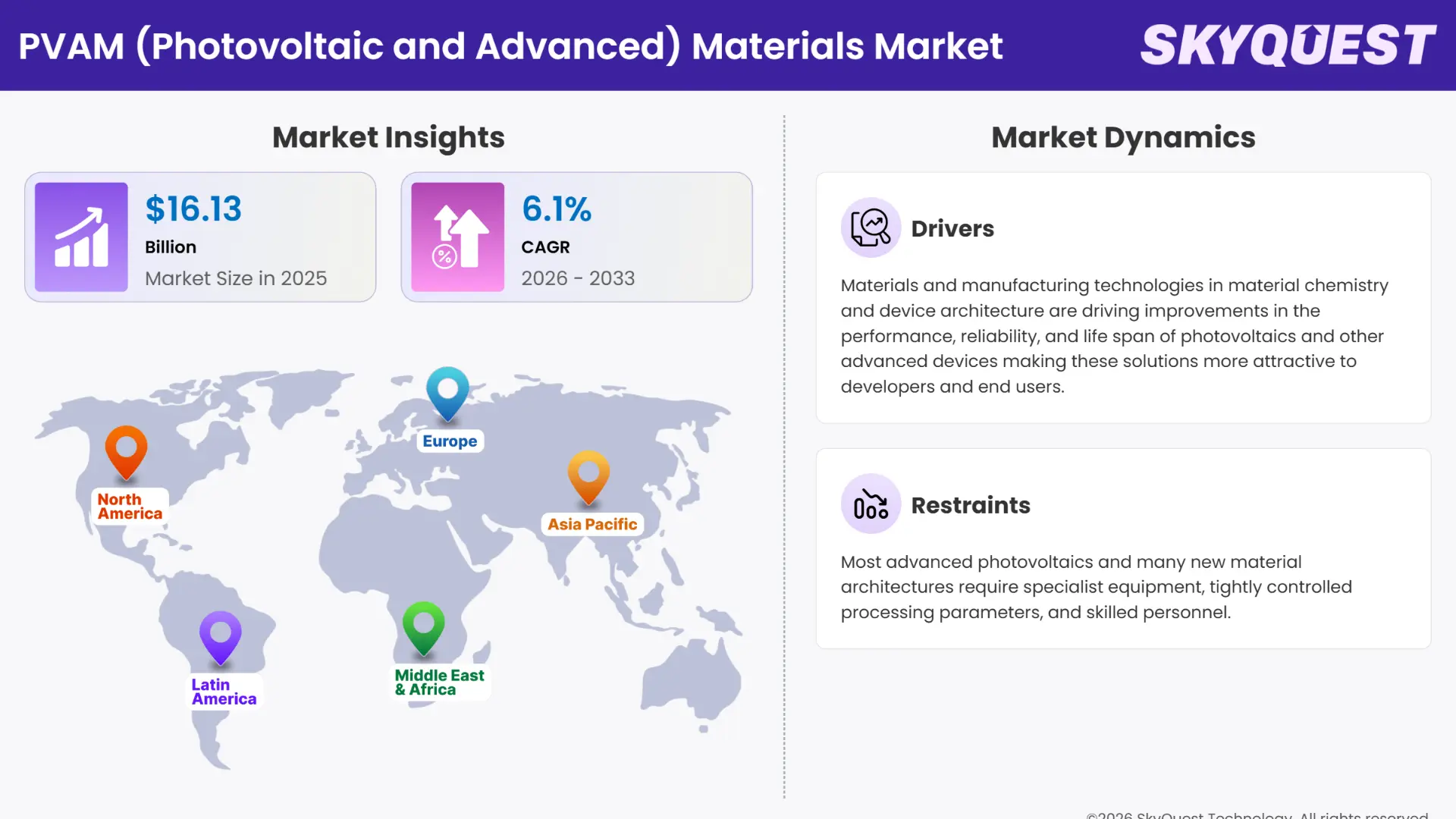
Global PVAM (Photovoltaic and Advanced) Materials Market size was valued at USD 15.2 Billion in 2024 and is poised to grow from USD 16.13 Billion in 2025 to USD 25.9 Billion by 2033, growing at a CAGR of 6.1% during the forecast period (2026-2033).
Key Takeaways: Market Trends & Insights
• Asia Pacific dominated the PVAM (Photovoltaic and Advanced) Materials market with the largest market share in 2025.
• China PVAM Materials market is expected to grow significantly over the forecast period.
• By Material Type, the Silicon-Based Materials segment held the largest market share in 2024.
• The Advanced Functional Materials segment is expected to be the fastest-growing segment over the forecast period.
• Asia Pacific: Largest Market in 2025.
• North America: Fastest Growing Market.
• 2025 Market Size: USD 16.13 Billion.
• 2026 Projected Market Size: USD 17.11 Billion.
• 2033 Projected Market Size: USD 25.90 Billion.
• CAGR (2026-2033): 6.1%.
The global push to decarbonize energy systems and the cost reductions resulting from scaling and innovation in materials is the key driver behind the growth of the photovoltaic and advanced materials manufacturing sector. The photovoltaic and advanced materials sector includes the conventional crystalline silicon technology that has been used for many years to produce a product that has been commercially manufactured at mass scale, as well as new and emerging technologies. The main benefit of this sector is that it provides a significant supply of low-costelectricity that enables the electrification of transportation and industry, as well as reduces greenhouse gas emissions from the grid.
In addition to these key technological and policy drivers, the continued the PVAM (photovoltaic and advanced)materials market growth will be driven by the continued maturation of scalable manufacturing processes and supply chains, which will lead to increased manufacturing output and reduced unit costs. The continued improvement in the stability and roll-to-roll deposition of perovskite-based photovoltaic technologies and the achievement of commercially viable yields for tandem cell technologies will result in increased efficiencies for photovoltaic modules and reduced levelized costs of electricity. Thereby opening significant new markets, such as building integrated photovoltaic, floating photovoltaic, and electric vehicle charging canopies.
How is AI Accelerating Innovation in the PVAM (Photovoltaic and Advanced) Materials Market?
Innovation in the PVAM (photovoltaic and advanced) materials industry has accelerated due to increased use of AI, which has altered both how new materials and processes are designed and validated. AI has made material development more data-driven and iterative by using machine learning methods to predict how current materials will behave in a device and guide the experimentation and validation of new materials and processes. By replacing the traditional trial-and-error method of experimentation with closed-loop testing methods, AI can speed up the development process of a given technology toward mass production.
AI can assist in proposing perovskite and organic chemistry options, optimize materials to improve performance in devices, increase reliability of materials at scale, and use machine learning examples for predictive modeling of materials. As a result, companies and research teams can confidently accelerate development toward mass production because of increased use of data analytics to guide the decision-making process. The recent joint development between XtalPi and JinkoSolar, announced in January 2026, to use AI for research on perovskite and tandem cells will illustrate how AI's ability to predict and automate will shorten R&D cycles and increase the efficiency of scaling and manufacturing.
To get more insights on this market click here to Request a Free Sample Report
Global PVAM (photovoltaic and advanced) materials market is segmented into application, technology, material type, end-user and region. Based on application, the market is segmented into residential, commercial, industrialand others. Based on technology, the market is segmented into crystalline silicon (C-Si), thin-film, concentrated photovoltaics (CPV), perovskite solar cells and others. Based on material type, the market is segmented into silicon-based materials, cadmium telluride (CdTe), gallium arsenide (GaAs) and others. Based on end-user, the market is segmented into manufacturers, installers, project developers, government and regulatory bodies and others. Based on region, the market is segmented into North America, Europe, Asia Pacific, Latin America and Middle East & Africa.
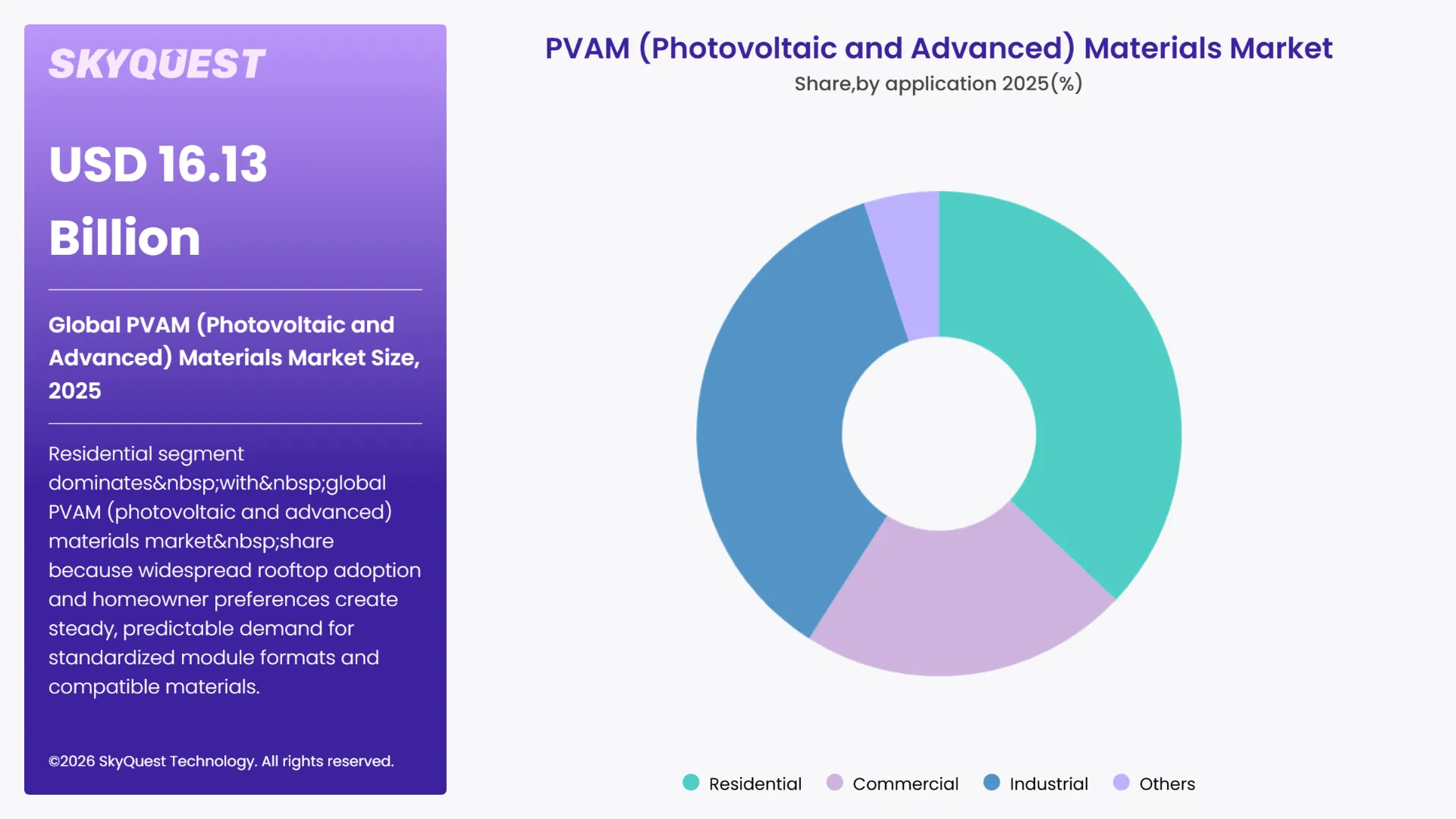
Residential segment dominates with global PVAM (photovoltaic and advanced) materials market share because widespread rooftop adoption and homeowner preferences create steady, predictable demand for standardized module formats and compatible materials. Furthermore, the emphasis on quality by consumers has led to the continued optimization of silicon wafers, glass, encapsulants, and mounting systems by suppliers and manufacturers so that they can have predictable repeatable numbers for manufacturing their products over time. Retail finance programs as well as installer networks have helped to reduce the cost of producing residential solar panels, so most manufacturers focus on producing large quantities of solar panels and using efficient methods of sourcing and manufacturing materials for residential use.
As per global PVAM (photovoltaic and advanced) materials market outlook, commercial applications are rapidly expanding as businesses pursue larger rooftop and facade projects requiring higher performance glass and advanced module formats. The emphasis businesses place on sustainability, and other business-related reasons, to use more advanced materials and systems in their commercial buildings will create new opportunities for development of new products for suppliers.
As per global PVAM (photovoltaic and advanced) materials market forecast, crystalline silicon segment dominates because long established manufacturing scale and proven performance have created a mature supply chain and material ecosystem that financiers and buyer's trust. The bankability of silicon technologies provides an important influence on procurement and design choices, thereby causing manufacturers to standardize specific wafers, metallization materials, and encapsulants. This familiarity among manufacturers reduces technology risk for developers and helps justify the investment made in optimized processing equipment and long-term material qualification programs.
As per global PVAM (photovoltaic and advanced) materials market analysis, perovskite solar cells are the fastest growing segment due to rapid efficiency gains and low temperature processing that enable new substrate options. Further advancements in tandem designs and scalable deposition methods, along with strong research and investment momentum, are increasing the demand for specialized encapsulants and interface materials, providing new commercialization avenues for both materials suppliers and module innovators.
To get detailed segments analysis, Request a Free Sample Report
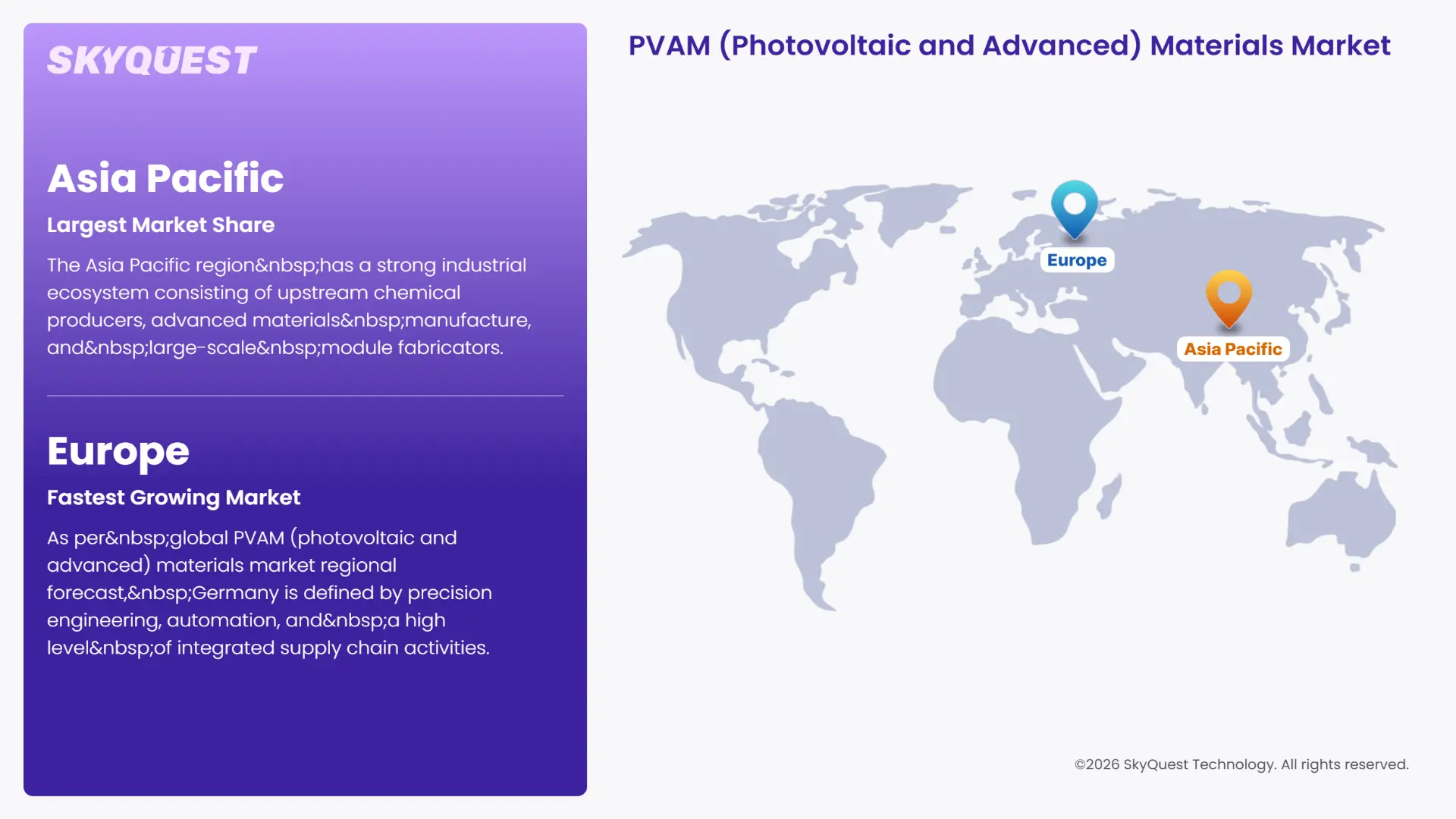
The Asia Pacific region has a strong industrial ecosystem consisting of upstream chemical producers, advanced materials manufacture, and large-scale module fabricators. Companies within the region have considerable experience producing semi-conductors and displays and are investing significantly in high performance solar cell materials. As a result, the group has been able to rapidly commercialize innovative materials such as advanced absorbers, conductive coatings and long-term encapsulates.
The PVAM (photovoltaic and advanced) materials market in Japan is currently comprised of high-value specialty materials with a focus on high precision manufacturing processes. Japanese companies have developed extensive research capabilities that allow them to continually improve the quality of PVAM materials while maintaining a particular emphasis on purity, testing and quality assurance to ensure that materials are delivered to global premium manufacturers.
The South Korean market benefits from large chemical and electronics companies that offer a high degree of vertical integration from precursor synthesis to final product. South Korean manufacturers are adept at producing thin film technologies and flexible substrates which enable them to quickly incorporate new technologies into their manufacturing lines. Developed relationships between the display supply chain and PVAM manufacturers foster significant cross sector synergies with respect to conductive materials and barrier movies.
As per global PVAM (photovoltaic and advanced) materials market regional outlook, a policy framework that emphasizes energy resilience, local manufacturing capabilities, and circularity within material lifecycles has driven an unprecedented rate of growth across Europe. Investment has gone toward the establishment of regional supply chains in order to mitigate reliance on overseas supply, while simultaneously facilitating advanced material innovation via collaborative research networks. Industrial policy incentives are creating opportunities for the reshoring of material processing and module assembly and enhancing recycling and reuse of critical components. Engineering expertise and existing capabilities of the chemical industry enhance the ability of manufacturers to quickly adapt to advanced absorbers and encapsulants to meet stringent regulatory requirements. Growth in the market has also been driven by the clustering of specialized suppliers, pilot production facilities, and cross-border partnerships that support commercializing next-generation PVAM (photovoltaic and advanced) solutions for integration into the European grid and for use in European climate conditions.
As per global PVAM (photovoltaic and advanced) materials market regional forecast, Germany is defined by precision engineering, automation, and a high level of integrated supply chain activities. Long-term durability, clear traceability, and adherence to stringent environmental regulations have established companies in Germany as preferred suppliers of PVAM products. Industrial clusters enable material manufacturers, testing laboratories, and module manufacturers to work in close collaboration, thus allowing for rapid scaling-up of advanced films and encapsulants. The market is also focused on providing supporting infrastructure for recycling pathways and materials recovery consistent with the regional circular economy goals.
The UK has a lot of innovative projects, startup activities and collaborations with universities that will help develop new absorber technologies and tandem architectures. The emphasis on pilot projects and demonstrations helps validate new materials in the real world, which leads to financial and technical support for converting lab-scale developments into commercial products. This is creating a new group of suppliers committed to improving the efficiency of their products and integrating systems for offshore and urban markets.
In France, the market is promoted by the strength of the French chemicals industry and through coordinated industrial efforts to manufacture materials in France. The desire for strategic autonomy and industrial competitiveness fosters investments in new manufacturing and coating processes for developing and producing materials that meet French needs. Companies and research institutes work together to develop new encapsulation and conductive materials according to the needs of the region, but environmental performance and recyclability are the focus of selling these products.
As per global PVAM (photovoltaic and advanced) materials industry analysis, North America's efforts to strengthen its position include the use of private capital, targeted industrial investment, and increased research collaboration among universities and national laboratories. A focus on establishing domestic processing capacity for key precursors and advanced functional materials will help reduce supply chain vulnerability. By utilizing the rapid movement of technology through partnerships between traditional manufacturers and agile start-ups, the commercialization of new types of absorbers, tandem cell devices, and encapsulation of chemistries can happen quicker.
PVAM (photovoltaic and advanced) materials market in the United States utilizes vast levels of private investments, as well as significant amounts of research infrastructure, to bring advanced materials into the market. The geographic/economic clustering of industries enables close collaboration between material developers, pilot fabrication facilities, and module manufacturers. Supply chain resilience and domestic processing of key precursor materials are critical areas of emphasis to support larger scale development activities. Venture and industrial investment allow for rapid prototyping and qualification of materials that may be used for utility-scale or distributed applications.
In Canada, the PVAM (photovoltaic and advanced) materials market's strength comes from its abundant natural resources (such as those found in the oil sands) as well as its strong materials science capabilities for the development of novel specialty feedstocks and sustainable processing methods. The partnership between research institutions and the industrial sector produces environmentally responsible encapsulants and recovery technologies.
To know more about the market opportunities by region and country, click here to
Buy The Complete Report
Innovation in PV Materials
Materials and manufacturing technologies in material chemistry and device architecture are driving improvements in the performance, reliability, and life span of photovoltaics and other advanced devices making these solutions more attractive to developers and end users. The ongoing research efforts of manufacturers will lead to decreased energy losses as well as increased efficiency under a wide variety of operating conditions, creating better opportunities for integration with existing systems. As new materials continue to become more flexible in terms of processing and manufacture at scale, supply chains and installers will find it easier to specify these materials for use, spurring additional market demand for advanced materials and propelling continued investment throughout the value chain.
Policy Incentives Encouraging Adoption
The presence of stable, reliable, and supportive policy frameworks around renewable energy targets and procurement obligations along with incentives for photovoltaic and advanced materials innovation can reduce perceived market risk and encourage investment in the development and deployment of photovoltaics. Clear signals of long-term growth will provide manufacturers with the impetus to expand manufacturing capacity and innovators with the motivation to apply their innovations to the market. Procurement policies will create predictable demand for new materials assisting with consistency in procurement. Policymakers that align their public procurement, permitting, and standards with manufacturer's technology capabilities will help lower entry barriers while accelerating coordination of the supply chain thus opening larger markets for adoption and strengthening the development of sustainable markets.
Complex Manufacturing Processes
Most advanced photovoltaics and many new material architectures require specialist equipment, tightly controlled processing parameters, and skilled personnel. This creates barriers to scaling and ultimately increasestimelines for commercialization. Manufacturers must be able to successfully learn how to integrate new materials; therefore, the upstream suppliers must learn how to adapt their materials handling to meet the unique processing requirements of the manufacturer and ensure their quality control meets manufacturers’ specifications. These practical obstacles to introducing new materials and technologies limit the number of firms that can introduce innovations across their industry, limit suppliers’ ability to participate in markets.
Material Availability and Sourcing
Dependency on specific precursor chemicals, rare elements or constrained feedstocks can lead to procurement bottlenecks that significantly slow commercial rollout and deter new firms from entering the market. When a small number of suppliers provide key inputs or suppliers are subject to volatile supply conditions, it is difficult for manufacturers to secure the consistent quality or timing needed for product assurance. The cost and complexity associated with sourcing materials compound the risks incurred by purchasers of materials, forcing manufacturers to maintain higher inventory buffers, and/or invest in expensive qualification processes. As a result, operational burdens created by poor availability or high sourcing complexity will generally postpone broader adoption and use of new materials or technologies until sufficient supply stability and sufficient diversity in sourcing strategies are established.
Request Free Customization of this report to help us to meet your business objectives.
Firms are competing for dominance in the global PVAM (photovoltaic and advanced) materials market through the traditional elements of consolidation, scale-up, and integrating various manufacturers across different industries, along with improving scale-up through M&A and external supply agreements and equipment partnerships. Recent relevant M&A and asset transactions include Swift Solar's recent acquisition of Meyer Burger's IP, CubicPV's long-term silicon supply agreement with OCI, and Oxford PV's collaborative pilot lines with manufacturers of perovskite-silicon tandem cells.
Integration with Energy Storage: There continues to be an increasing need to harmonize photovoltaic modules with energy storage systems to create seamless and effective hybrid solutions within distributions or utility architectures. The goal of developing PVAM is to create products that are compatible with one another as an interface, create a thermal management system that creates long-term stability when coupled with electrochemical storage, and in turn create a complete range of products and services that can be offered together. This area of innovation will continue to foster cross-sector partnerships between material suppliers, storage manufacturers and system integrators and continue to reshape the value chain into platform-based solutions making it easier to install and operate these systems.
Circular Economy Adoption: In the realm of circular economy adoption there is a growing number of participants within the market to have an increased emphasis on end-of-life management and closed-loop strategies that advocate recycling, reclaiming, and reusing of photovoltaic materials to reduce their environmental footprints as well as provide new sources of secondary materials. The suppliers of PVAM products are making efforts to consider designing disassembly and compatible chemistries into their products; in turn enabling the efficient recovery of the product. Thereby encouraging partnerships with recyclers and service providers who specialize in the handling of this type of material. This will create and support new business models such as takeback or refurbishment as well as a model where the PVAM products are provided as a service, enhancing the sustainability credentials of brands in this market.
SkyQuest’s ABIRAW (Advanced Business Intelligence, Research & Analysis Wing) is our Business Information Services team that Collects, Collates, Correlates, and Analyses the Data collected by means of Primary Exploratory Research backed by robust Secondary Desk research.
As per SkyQuest analysis, the global PVAM (photovoltaic and advanced) materials industry is propelled primarily by the drive to decarbonize energy systems and ongoing cost reductions from scale and materials innovation, while a second major driver is AI enabled materials design and predictive modeling that accelerates development and scale-up. Growth is concentrated in the Asia Pacific region, supported by integrated supply chains and manufacturing capacity, with residential applications currently the dominant segment due to rooftop adoption and standardized module formats. The market still faces a key restraint in complex manufacturing processes that raise scaling barriers and extend qualification timelines. Overall, the interplay of policy, innovation, and supply chain maturity will shape commercialization paths and investment priorities.
| Report Metric | Details |
|---|---|
| Market size value in 2024 | USD 15.2 Billion |
| Market size value in 2033 | USD 25.9 Billion |
| Growth Rate | 6.1% |
| Base year | 2024 |
| Forecast period | 2026-2033 |
| Forecast Unit (Value) | USD Billion |
| Segments covered |
|
| Regions covered | North America (US, Canada), Europe (Germany, France, United Kingdom, Italy, Spain, Rest of Europe), Asia Pacific (China, India, Japan, Rest of Asia-Pacific), Latin America (Brazil, Rest of Latin America), Middle East & Africa (South Africa, GCC Countries, Rest of MEA) |
| Companies covered |
|
| Customization scope | Free report customization with purchase. Customization includes:-
|
To get a free trial access to our platform which is a one stop solution for all your data requirements for quicker decision making. This platform allows you to compare markets, competitors who are prominent in the market, and mega trends that are influencing the dynamics in the market. Also, get access to detailed SkyQuest exclusive matrix.
Table Of Content
Executive Summary
Market overview
Parent Market Analysis
Market overview
Market size
KEY MARKET INSIGHTS
COVID IMPACT
MARKET DYNAMICS & OUTLOOK
Market Size by Region
KEY COMPANY PROFILES
Methodology
For the PVAM (Photovoltaic and Advanced) Materials Market, our research methodology involved a mixture of primary and secondary data sources. Key steps involved in the research process are listed below:
1. Information Procurement: This stage involved the procurement of Market data or related information via primary and secondary sources. The various secondary sources used included various company websites, annual reports, trade databases, and paid databases such as Hoover's, Bloomberg Business, Factiva, and Avention. Our team did 45 primary interactions Globally which included several stakeholders such as manufacturers, customers, key opinion leaders, etc. Overall, information procurement was one of the most extensive stages in our research process.
2. Information Analysis: This step involved triangulation of data through bottom-up and top-down approaches to estimate and validate the total size and future estimate of the PVAM (Photovoltaic and Advanced) Materials Market.
3. Report Formulation: The final step entailed the placement of data points in appropriate Market spaces in an attempt to deduce viable conclusions.
4. Validation & Publishing: Validation is the most important step in the process. Validation & re-validation via an intricately designed process helped us finalize data points to be used for final calculations. The final Market estimates and forecasts were then aligned and sent to our panel of industry experts for validation of data. Once the validation was done the report was sent to our Quality Assurance team to ensure adherence to style guides, consistency & design.
Analyst Support
Customization Options
With the given market data, our dedicated team of analysts can offer you the following customization options are available for the PVAM (Photovoltaic and Advanced) Materials Market:
Product Analysis: Product matrix, which offers a detailed comparison of the product portfolio of companies.
Regional Analysis: Further analysis of the PVAM (Photovoltaic and Advanced) Materials Market for additional countries.
Competitive Analysis: Detailed analysis and profiling of additional Market players & comparative analysis of competitive products.
Go to Market Strategy: Find the high-growth channels to invest your marketing efforts and increase your customer base.
Innovation Mapping: Identify racial solutions and innovation, connected to deep ecosystems of innovators, start-ups, academics, and strategic partners.
Category Intelligence: Customized intelligence that is relevant to their supply Markets will enable them to make smarter sourcing decisions and improve their category management.
Public Company Transcript Analysis: To improve the investment performance by generating new alpha and making better-informed decisions.
Social Media Listening: To analyze the conversations and trends happening not just around your brand, but around your industry as a whole, and use those insights to make better Marketing decisions.
REQUEST FOR SAMPLE
 REQUEST FREE CUSTOMIZATION
Global Pvam (Photovoltaic And Advanced) Materials Market size was valued at USD 15.2 Billion in 2024 and is poised to grow from USD 16.13 Billion in 2025 to USD 25.9 Billion by 2033, growing at a CAGR of 6.1% during the forecast period (2026-2033).
Competition in the global PVAM materials market is driven by scale up and IP races, with firms pursuing consolidation, strategic supply deals, and equipment partnerships to secure manufacturing compatibility and feedstock. Recent M&A and asset buys, such as Swift Solar’s acquisition of Meyer Burger IP, CubicPV’s long term silicon supply agreement with OCI, and Oxford PV’s collaborative pilot lines, illustrate technology driven competitive moves. 'Dupont', 'Heraeus', 'Monocrystal', 'Indium Corporation', 'BASF', 'Jinko Solar', 'Longi Solar', 'REC Group', 'First Solar', 'Trina Solar', 'Enphase Energy', 'Canadian Solar', 'JA Solar', 'Q CELLS', 'Risen Energy', 'Solaria', 'Tesla (Solar)', 'Mayer & Cie', 'SunPower Corporation', 'Sika AG'
Innovation in material chemistry, manufacturing methods, and device architectures enhances efficiency, reliability, and lifetimes of photovoltaic and advanced devices, making them more attractive to developers and end users. Continuous research enables lower energy losses, improved performance under diverse conditions, and better integration with existing systems, which supports broader adoption across applications. As materials become more versatile and easier to process at scale, supply chains and installers find it more feasible to specify these solutions, stimulating demand and encouraging further investment across the value chain.
Integration With Energy Storage: Materials development is increasingly driven by the need to harmonize photovoltaic modules with energy storage systems, enabling seamless hybrid solutions for distributed and utility architectures. PVAM innovations focus on interface compatibility, thermal management, and long term stability when paired with electrochemical storage, unlocking integrated product offerings and service contracts. This trend encourages cross sector partnerships between material suppliers, storage manufacturers, and system integrators, and reshapes value chains toward platform based solutions that simplify installation and operations while enhancing overall system reliability, and lifecycle outcomes.
Asia Pacific Dominate the Global PVAM (Photovoltaic and Advanced) Materials Market?
The market is primarily driven by the global push toward decarbonization, increasing adoption of renewable energy, and continuous innovation in photovoltaic materials. Cost reductions through manufacturing scale and advancements in material technologies are also supporting market expansion.
Perovskite solar cells are emerging as the fastest-growing technology segment due to rapid efficiency improvements, scalable manufacturing potential, and increasing investments in tandem solar cell development.


Want to customize this report? This report can be personalized according to your needs. Our analysts and industry experts will work directly with you to understand your requirements and provide you with customized data in a short amount of time. We offer $1000 worth of FREE customization at the time of purchase.
Feedback From Our Clients


 USA (+1) 351-333-4748

