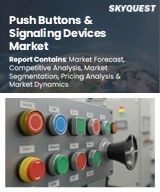
Push Buttons & Signaling Devices Market
Report ID: SQMIG20D2409
Report ID: SQMIG20D2409
[email protected]
USA +1 351-333-4748
Report ID:
SQMIG20D2409 |
Region:
Global |
Published Date: January, 2026
Pages:
181
|Tables:
92
|Figures:
71


Global Push Buttons and Signaling Devices Market size was valued at USD 2.77 Billion in 2024 and is poised to grow from USD 2.95 Billion in 2025 to USD 4.88 Billion by 2033, growing at a CAGR of 6.5% during the forecast period (2026–2033).
This global push buttons and signalling devices market share is gaining traction due to increasing industrial automation, particularly across manufacturing, oil & gas, and energy sectors. These devices are integral to operator control panels and safety systems, providing visual and audible alerts for process monitoring and machine operations. The rising focus on workplace safety, combined with the demand for reliable human-machine interface (HMI) solutions, is propelling the adoption of advanced signalling technologies. Additionally, the growing use of LED-based indicators and wireless signalling systems is enhancing operational efficiency and reducing maintenance needs.
However, push buttons and signalling devices market growth is moderately restrained by the availability of low-cost alternatives from unorganized markets and the growing shift toward touch-based interfaces, which could reduce reliance on traditional push buttons. Despite these factors, technological upgrades such as modular designs and integration with Industrial Internet of Things (IIoT) systems are creating new growth opportunities. The market also benefits from strong demand across emerging economies undergoing rapid industrialization and infrastructure development.
How are AI and IoT Technologies Transforming the Global Push Buttons and Signalling Devices Market?
The integration of AI and IoT technologies is reshaping the global push buttons and signalling devices industry by enhancing functionality, safety, and efficiency. These devices are no longer limited to basic control and alerting; they now serve as smart, connected endpoints within broader industrial automation systems. Embedded sensors and wireless connectivity allow real-time monitoring, diagnostics, and predictive maintenance, which help reduce downtime and operational costs. The growing demand for smart manufacturing solutions, especially under Industry 4.0 frameworks, is fueling this transformation. Industrial players are increasingly adopting intelligent HMI components to streamline workflows and ensure better safety compliance on shop floors.
A notable example of this shift occurred in August 2024 when ABB introduced a new line of IoT-enabled illuminated push buttons. These devices offer not only visual status updates but also integrate with cloud-based monitoring systems to provide real-time feedback and maintenance alerts. This advancement allows operators to track equipment status remotely, anticipate failures, and optimize replacement schedules, resulting in improved efficiency and reduced downtime. As more manufacturers move toward digitalization, such intelligent signalling solutions are expected to become standard across industrial environments, especially in sectors like automotive, energy, and pharmaceuticals.
Market snapshot - 2026-2033
Global Market Size
USD 1.96 Billion
Largest Segment
Round or Square Body Type
Fastest Growth
Non-lighted Push Button
Growth Rate
5.8% CAGR
To get more insights on this market click here to Request a Free Sample Report
The global push buttons and signalling devices market is segmented based on product, type, end user. In terms of product, the market is segmented into round or square body type, non-lighted push button, and others. Based on type, the market is segmented into audible, visible, and others. Based on end users, the market is grouped into automotive, energy and power, manufacturing, food and beverage, and transportation. Based on the region, the market is segmented into North America, Europe, Asia-Pacific, Latin America, and the Middle East & Africa.
The illuminated push buttons segment currently dominates the global market due to their widespread application in industrial control panels, machinery interfaces, and safety systems. These buttons offer enhanced visibility, status indication, and user-friendly operation in complex environments. Their ability to function effectively in low-light and high-noise conditions makes them indispensable in manufacturing, oil & gas, and energy sectors. The integration of LED technology has further increased their efficiency, durability, and appeal across a wide range of industries.
The wireless signaling devices segment is experiencing the fastest growth, driven by the demand for flexible, cable-free installation and smart monitoring capabilities. These devices are ideal for retrofit applications and environments where wiring is complex or cost-prohibitive. Their compatibility with IIoT platforms enables remote monitoring, predictive maintenance, and seamless integration into Industry 4.0 systems. As industries prioritize digital transformation and operational agility, wireless signaling solutions are increasingly favored for their scalability and reduced maintenance requirements.
The emergency stop devices segment is emerging as the fastest-growing due to rising emphasis on industrial safety and regulatory compliance. These devices are critical in halting operations immediately during equipment failure or hazardous situations, thus preventing accidents and damage. Increasing automation in manufacturing, along with stricter occupational safety standards across regions like North America and Europe, is fueling demand. The integration of smart E-stop systems with real-time alert features further enhances their role in modern safety architectures.
The non-illuminated push buttons segment dominates the market due to their cost-effectiveness, simplicity, and widespread use in basic industrial operations. These devices are preferred in applications where visual signaling isn’t critical but tactile feedback is essential, such as in control stations and factory machinery. Their robust design, long service life, and compatibility with various control systems make them a reliable choice across sectors like manufacturing, transportation, and utilities. Continued demand for dependable and affordable interface solutions supports their dominant position.
To get detailed segments analysis, Request a Free Sample Report
North America, particularly the United States, leads the push buttons and signaling devices market strategies due to its strong industrial base across sectors such as manufacturing, petrochemicals, automotive, and energy. The region’s emphasis on workplace safety, coupled with widespread adoption of industrial automation, has significantly increased the deployment of advanced signaling solutions. Major companies continue to invest in modernizing control systems and integrating smart technologies. Additionally, growing demand from sectors like food processing, transportation, and smart infrastructure further strengthens North America’s dominant market position.
The United States is witnessing robust growth driven by increasing automation, regulatory compliance, and advanced product adoption across industrial and automotive applications. The widespread integration of keyless ignition systems in vehicles and the emphasis on safety compliance in manufacturing facilities have accelerated demand for signaling devices. Recent innovations, including smart signaling systems with real-time health monitoring and sustainable product designs, are enhancing functionality and user experience. These advancements reflect the U.S. market's strong focus on enhancing industrial safety, operational efficiency, and technological innovation.
Canada is experiencing steady growth in this market, supported by national automation strategies and a rising emphasis on industrial safety. Provinces such as Ontario are seeing increased investment in smart manufacturing and automotive production, driving demand for advanced control and signaling systems. Additionally, the expansion of smart infrastructure and urban transit systems is creating new opportunities beyond traditional industrial applications. Collaborative efforts between public institutions and private industries are accelerating Canada's transition toward intelligent, efficient, and safer operational environments.
The Asia-Pacific region is the fastest-growing push buttons and signalling devices market regional forecast, driven by rapid industrial automation, expanding manufacturing capabilities, and rising safety regulations across key sectors such as automotive, electronics, and energy. Government-backed initiatives focusing on smart city development and Industry 4.0 adoption are further boosting demand for intelligent push buttons and signalling devices. The region is witnessing strong investments in modernized infrastructure, digital transformation, and remote monitoring technologies. Increasing preference for wireless and IoT-enabled solutions is also contributing to the region’s rapid expansion, as industries seek to enhance operational efficiency and reduce downtime.
Japan is experiencing steady growth in the push buttons and signalling devices market regional analysis, supported by ongoing advancements in factory automation and smart manufacturing. The country’s leading automotive and electronics sectors are incorporating IIoT-ready push buttons and illuminated signalling devices into production systems to meet evolving safety and performance standards. Recent developments emphasize compact and rugged designs suitable for high-precision environments. Japan’s commitment to technological innovation and its strong industrial base continue to drive the adoption of advanced HMI components in various high-demand applications.
South Korea’s market growth is being propelled by national infrastructure upgrades and widespread adoption of digital technologies in manufacturing and public transportation. Recent advancements in railway signaling and control systems highlight the increasing use of intelligent signaling devices to improve operational safety and reliability. Additionally, the country’s emphasis on building smart factories is encouraging the integration of IIoT-compatible push buttons within automated systems. This shift toward connected, real-time monitoring solutions is enhancing predictive maintenance capabilities and supporting South Korea’s transition to highly efficient, tech-driven industrial environments.
Europe ranks as the third-largest region in the global push buttons and signaling devices market, driven by its strong industrial heritage, rigorous safety standards, and rising automation across core sectors. Countries like Germany, France, and the UK are investing heavily in smart manufacturing, energy efficiency, and worker safety, which support the adoption of advanced signaling components. EU-wide regulations mandating high safety and operational standards across factories and infrastructure projects are further fueling market expansion. Additionally, the region’s growing emphasis on digital transformation and sustainability is encouraging the use of eco-friendly and intelligent control systems.
Germany, known for its engineering excellence, is seeing strong growth due to its leadership in industrial automation and robotics. Manufacturers are increasingly integrating IIoT-ready push buttons and smart signaling devices in production environments to enhance reliability and process control. Recent initiatives promoting Industry 4.0 adoption in medium and small enterprises have intensified demand for modern HMI systems. Moreover, Germany’s advanced automotive sector continues to deploy advanced operator interfaces in assembly lines, further boosting market growth.
France is experiencing increased adoption of signaling devices, particularly in energy, transportation, and manufacturing sectors. Government incentives supporting factory automation and safety system upgrades are contributing to market growth. Recent infrastructure modernization programs and investments in renewable energy facilities have created demand for durable, high-performance signaling solutions. French industries are also embracing ergonomic and customizable HMI devices to comply with safety regulations and improve user interaction across complex operating environments.
The UK market is expanding due to strong demand for automation in logistics, automotive, and process industries. With the rise of smart warehousing and distribution systems, signaling devices are increasingly used to monitor operations, enhance worker safety, and streamline workflows. Recent investments in rail infrastructure and public transport modernization have also driven the integration of advanced signaling systems. Additionally, the UK’s push for industrial decarbonization and digitization is encouraging the deployment of intelligent, energy-efficient control devices across multiple sectors.
To know more about the market opportunities by region and country, click here to
Buy The Complete Report
Rising Industrial Automation Across Key Sectors
Stringent Safety Regulations and Compliance Standards
Availability of Low-Cost Alternatives from Unorganized Markets
Rising Adoption of Touch-Based and Wireless Interfaces
Request Free Customization of this report to help us to meet your business objectives.
ABB, a global leader in electrification and automation, holds a dominant position in the push buttons and signaling devices market through its focus on innovation and strategic expansion. In 2023, the company launched advanced LED-integrated signaling solutions aimed at enhancing safety and visibility in industrial environments. Further strengthening its market presence, ABB expanded its distribution capabilities significantly across the Asia-Pacific region following key acquisitions. Its modular product designs, integration with IIoT platforms, and targeted M&A strategies enable ABB to lead in providing high-performance, scalable signaling solutions across industries including manufacturing, utilities, and infrastructure.
SkyQuest’s ABIRAW (Advanced Business Intelligence, Research & Analysis Wing) is our Business Information Services team that Collects, Collates, Correlates, and Analyses the Data collected by means of Primary Exploratory Research backed by robust Secondary Desk research.
As per SkyQuest analysis, the global push buttons and signaling devices market is primarily driven by the rise in industrial automation across sectors such as manufacturing, oil & gas, and energy. These industries rely heavily on push buttons and signaling devices for efficient process control, safety, and communication within increasingly automated environments. A major restraint, however, is the proliferation of low-cost, non-compliant alternatives from unorganized markets, which create pricing pressure and undermine quality standards. The Asia-Pacific region stands out as the fastest-growing market, supported by government-led Industry 4.0 initiatives, expanding manufacturing capabilities, and growing safety compliance requirements. Within the product landscape, illuminated push buttons dominate due to their enhanced visibility, operational clarity, and growing integration with LED and IoT technologies. These devices are widely used in control panels, machine interfaces, and safety systems.
A secondary yet significant driver is the stringent global enforcement of workplace safety standards. Regulatory mandates are pushing industries to implement visible and audible alert systems that meet ISO and IEC guidelines. This compliance-focused trend is leading to increased investment in smart, durable signaling devices capable of supporting real-time diagnostics and predictive maintenance across complex industrial operations.
| Report Metric | Details |
|---|---|
| Market size value in 2024 | USD 2.77 Billion |
| Market size value in 2033 | USD 4.88 Billion |
| Growth Rate | 6.5% |
| Base year | 2024 |
| Forecast period | 2026-2033 |
| Forecast Unit (Value) | USD Billion |
| Segments covered |
|
| Regions covered | North America (US, Canada), Europe (Germany, France, United Kingdom, Italy, Spain, Rest of Europe), Asia Pacific (China, India, Japan, Rest of Asia-Pacific), Latin America (Brazil, Rest of Latin America), Middle East & Africa (South Africa, GCC Countries, Rest of MEA) |
| Companies covered |
|
| Customization scope | Free report customization with purchase. Customization includes:-
|
To get a free trial access to our platform which is a one stop solution for all your data requirements for quicker decision making. This platform allows you to compare markets, competitors who are prominent in the market, and mega trends that are influencing the dynamics in the market. Also, get access to detailed SkyQuest exclusive matrix.
Table Of Content
Executive Summary
Market overview
Parent Market Analysis
Market overview
Market size
KEY MARKET INSIGHTS
COVID IMPACT
MARKET DYNAMICS & OUTLOOK
Market Size by Region
KEY COMPANY PROFILES
Methodology
For the Push Buttons & Signaling Devices Market, our research methodology involved a mixture of primary and secondary data sources. Key steps involved in the research process are listed below:
1. Information Procurement: This stage involved the procurement of Market data or related information via primary and secondary sources. The various secondary sources used included various company websites, annual reports, trade databases, and paid databases such as Hoover's, Bloomberg Business, Factiva, and Avention. Our team did 45 primary interactions Globally which included several stakeholders such as manufacturers, customers, key opinion leaders, etc. Overall, information procurement was one of the most extensive stages in our research process.
2. Information Analysis: This step involved triangulation of data through bottom-up and top-down approaches to estimate and validate the total size and future estimate of the Push Buttons & Signaling Devices Market.
3. Report Formulation: The final step entailed the placement of data points in appropriate Market spaces in an attempt to deduce viable conclusions.
4. Validation & Publishing: Validation is the most important step in the process. Validation & re-validation via an intricately designed process helped us finalize data points to be used for final calculations. The final Market estimates and forecasts were then aligned and sent to our panel of industry experts for validation of data. Once the validation was done the report was sent to our Quality Assurance team to ensure adherence to style guides, consistency & design.
Analyst Support
Customization Options
With the given market data, our dedicated team of analysts can offer you the following customization options are available for the Push Buttons & Signaling Devices Market:
Product Analysis: Product matrix, which offers a detailed comparison of the product portfolio of companies.
Regional Analysis: Further analysis of the Push Buttons & Signaling Devices Market for additional countries.
Competitive Analysis: Detailed analysis and profiling of additional Market players & comparative analysis of competitive products.
Go to Market Strategy: Find the high-growth channels to invest your marketing efforts and increase your customer base.
Innovation Mapping: Identify racial solutions and innovation, connected to deep ecosystems of innovators, start-ups, academics, and strategic partners.
Category Intelligence: Customized intelligence that is relevant to their supply Markets will enable them to make smarter sourcing decisions and improve their category management.
Public Company Transcript Analysis: To improve the investment performance by generating new alpha and making better-informed decisions.
Social Media Listening: To analyze the conversations and trends happening not just around your brand, but around your industry as a whole, and use those insights to make better Marketing decisions.
REQUEST FOR SAMPLE
 REQUEST FREE CUSTOMIZATION


Want to customize this report? This report can be personalized according to your needs. Our analysts and industry experts will work directly with you to understand your requirements and provide you with customized data in a short amount of time. We offer $1000 worth of FREE customization at the time of purchase.
Feedback From Our Clients


 USA (+1) 351-333-4748

