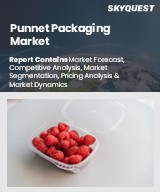
Punnet Packaging Market
Report ID: SQMIG15H2128
Report ID: SQMIG15H2128
[email protected]
USA +1 351-333-4748
Report ID:
SQMIG15H2128 |
Region:
Global |
Published Date: December, 2025
Pages:
187
|Tables:
120
|Figures:
69


Global Punnet Packaging Market size was valued at USD 3.52 Billion in 2024 and is poised to grow from USD 3.69 Billion in 2025 to USD 5.46 Billion by 2033, growing at a CAGR of 5% during the forecast period (2026–2033).
The global punnet packaging market is experiencing robust growth, driven by surging consumer demand for fresh, ready-to-eat produce and the expansion of e-commerce grocery services, which require lightweight yet durable packaging solutions. Urbanization and rising health consciousness further boost this trend, as portion-controlled, visually appealing punnets offer convenience and protect perishables during transit. Meanwhile, sustainability concerns and regulatory pressure are accelerating the shift toward eco-friendly materials—such as recycled PET, biodegradable plastics, molded fiber, and paper-based alternatives—aimed at reducing waste and complying with plastic bans. On the technological front, innovations like modified-atmosphere packaging (MAP), anti-mist and antimicrobial coatings, and smart packaging features (e.g., QR codes, RFID, freshness sensors) are being integrated to extend shelf life, improve traceability, and enhance consumer engagement. Combined, these factors—consumer demand, convenience, sustainability, and technological advancement—are shaping a dynamic market landscape.
Asia-Pacific traceability punnets' technology underpinning QR- and RFID-capable functionality made it easier for companies to manage shelf life and fulfill international trade regulation, as smart packaging format innovation was propelled at breakneck speed by advances in digital supply chain solutions. Public–private pilot project alliances and packaging innovation awards also spur private-label product innovation launches and material innovations. Paperboard and fiber price volatility is still a threat to procurement strategy and profitability. Against such headwinds, the market is supported by growth in sustainability practices, supply chain digital technologies, and higher punnet packaging penetration in an international food and retail logistics center throughout the 2032 term.
How Artificial Intelligence is Revolutionizing Punnet Packaging Manufacturing and Transportation?
Artificial intelligence actually fuels traceability and business efficiency in the punnet packaging industry, with tangible take-up by large retailers and international produce brands. Western European and North American leading supermarket chains now use AI-powered analytics to read massive data streams from QR-coded and RFID-tagged punnets, tracking freshness, shelf-life, and cold-chain integrity farm gate to shelf. This transparency in detail enables supply chain managers to forecast inventory turn, enhance replenishment, and detect quality issues prior to undermining consumer confidence. Pilot programs introduced early on such as Tesco's programs in the UK and Spain's largest berry suppliers already have produced quantified reductions in food wastage and spoilage, empowering sustainability requirements directly.
At the converter and producer level, digital twins and artificial intelligence-driven demand forecasting are assisting in synchronizing production plans to changing customer preferences, minimizing material procurement and waste fiber or resin usage. The technologies enable punnet packaging market growth with the industry able to rapidly transition to circular economy objectives with profit, regulation, and openness with digitally enabled supply chains.
Market snapshot - 2026-2033
Global Market Size
USD 3.35 Billion
Largest Segment
Vented Punnets
Fastest Growth
Clamshell Punnets
Growth Rate
5.0% CAGR
To get more insights on this market click here to Request a Free Sample Report
Global Punnet Packaging Market is segmented by Product Type, Capacity, Material Type, End Use and region. Based on Product Type, the market is segmented into Vented Punnets, Non-Vented Punnets, Clamshell Punnets and Lidded Punnets. Based on Capacity, the market is segmented into Less than 250 grams, 250–500 grams and More than 500 grams. Based on Material Type, the market is segmented into Plastic, Paperboard and Molded Fiber. Based on End Use, the market is segmented into Fruits, Vegetables, Meat & Poultry, Bakery Products and Ready Meals. Based on region, the market is segmented into North America, Europe, Asia Pacific, Latin America and Middle East & Africa.
Vented punnets are the first choice in the product type range because they can offer the right amount of air flow and retain the freshness of soft fruit and leafy greens for far-off transportation. This kind of performance is very attractive in hot climates and high-speed supply chains. Major retailers such as AVI Global Plast ramped up production of PET vented punnets to meet new orders for Middle Eastern exports, while Faerch won supermarket business in the UK for compostable molded fiber trays. Their use on high-speed fill lines and recyclable formats have established vented trays as the norm for packaging fresh produce among top retailers and exporters.
Clamshells, on the other hand, have quickly caught up with the demands for rising automation and food safety. Their hinged-lid style gives superior tamper resistance while permitting convenient merchandising on the supermarket shelves. Subsequent Coveris launches, including RPET clamshell fruit salad trays pre-cut, have secured shelf space in Germany, France, and the UK. In North America, snack and grape packs have been driving convenience foods demand for clamshells as automation and safety codes increasingly drive retail growth globally.
Mid-sized punnets, particularly in the 250–500 gram capacity, are even the largest retailers of retail logistics for fresh produce, easily with standard shelf footprints and mass-market pallet units. Their effectiveness has established them as the go-to option for UK supermarket and online store berries, grapes, and salads. AVI Global Plast grew Southeast Asian exports with fresh 500g punnets, and Faerch's 400g molded fiber containers fulfilled UK retailer specifications for cut products. Their synergistic combination of portion control and merchandising appeal has established them as the go-to solution in high-volume product categories.
Small punnets below 250 grams are seeing the greatest market momentum, driven especially in the ready-to-eat food and grab-and-go food segment. Japanese converters launched small trays for convenience store mini-fruit packs and Italian converters launched fiber packs for high-end fruit samplers. Their light weight and suitability for use with automated lidding machines make them perfect for impulse sales and city retail stores, fueling the segment's consistent growth among city shoppers and health-conscious shoppers.
To get detailed segments analysis, Request a Free Sample Report
According to the global punnet packaging regional forecast, Asia-Pacific is leading due to its determination to invest in export readiness, automation, and sustainability. Regional collaboration has developed a high-speed molding, digital inspection, and molded fiber technology innovation that has revolutionized the protection and export of fresh produce globally. During 2024, government-sponsored and industry-funded initiatives encouraged adoption of aggressive quality control led by quality control-driven programs, track-and-trace logistics, and recycling packaging. With increasingly better Asian-Pacific suppliers competing to be at the leading edge of innovative compliance, the Asia-Pacific is a hub of bleeding-edge technology-facilitated innovative punnet packaging practice with global applicability to fresh produce markets.
As per the global punnet packaging market analysis, Japanese punnet packaging is characterized by compliant export strategies that are high-quality and technology-led. Exclusive North American and European markets were served by top packers that invested in AI-based inspection systems, QR-coded punnet trays, and next-generation heat-seal lines. 2024 government stimulus accelerated investment in recyclable coatings and automation to make it possible for Japanese firms to sustain leadership in safety-focused, high-quality packaging. These technologies substantiate Japan's world leadership in product integrity and market-driven innovation in punnet logistics.
As per the global punnet packaging market trends, The South Korean industry grew in 2024 with the aid of smart manufacturing, IoT-enabled quality checking, and advanced recycling. Government regulation of green responsibility and extensive use of compostable vented trays for greenhouse crops and cold chain exports drove growth. Digitally marking and energy-saving tooling were key priorities with manufacturers to enhance traceability, product safety, and market differentiation. South Korea's twin focus on technology and green accountability keeps it at the front of Asia-Pacific and global supply chains' high-end traceable punnet solutions.
As per the global punnet packaging regional outlook, punnet packing in North America is the model of innovative convergence of regulation control, automation, and retail-led innovation. There is a common endeavor by the manufacturers and retailers alike to launch PET and fiber tray plants that are innovative and novel, digital labeling, and accurate food safety processes. In 2024, U.S.-Canadian business partnerships were at the forefront in pursuing sustainable packaging solutions where operations transparency and circular economy plans are concerned. The region's innovative compliance method, technology adoption, and marketplace flexibility enable North America to continue reshaping the way safe and sustainable produce transportation is conducted in the world market.
The United States takes the lead with store readiness, automation, and compliance-driven punnet packaging innovations. Large grocery retail chains adopted antimicrobial and automation-friendly trays to increase shelf life, safety, and marketplace appeal enhancement. Converters increased 2024 post-consumer recycled content trays production and tested QR and RFID-ready packaging for top-of-mind produce categories. These innovations established America as a design leader and compliance trendsetter and boosts the punnet packaging market penetration in the rapidly developing market.
Canada's punnet packaging sector rose to new heights in 2024 through provincial sustainability programs and retailer demands for compostable and FSC-tray certified trays. Ontario and British Columbia leading producers were at the forefront of commercializing water-based paints and engineered molded fiber, cooperating with U.S. converters in partnerships to realize optimal operating efficiencies. These cross-border plants positioned Canada in a best practice for environmentally friendly, innovative packaging that supports integrity and transparency of the fresh fruit and vegetable supply chain.
According to the global punnet packaging industry analysis, Europe is continuing to drive ESG leadership and circular economy innovation in punnet packaging. UK, German, Italian, and French companies have leveraged strategic investment in EPR-compatible material, digital monitoring, and future-proof tooling to drive change at pace and establish new regulatory norms. Up to 2024, converters and retailers have worked together to bring market- and sustainability-relevant, high-performance, recyclable formats to market. European culture of cooperation keeps producing first-rate solutions, solidifying the world dominance of the continent in packaging fresh produce.
As per the global punnet packaging industry trends, Germany market continued throughout 2024 with growth in manufacture, solvent-free coatings, and closed-loop quality systems entirely supplied by local and export markets. Industry cooperation with recycling suppliers made large-scale molded fiber factory operations possible, allowing closed-loop logistics and eco-performance. Germany's technical capability and regulation enforcement synergy remains among the most advanced in European fresh produce packaging, providing effective, high-integrity solutions to changing retailer and exporter requirements.
The 2024 UK punnet pack industry continued on the go with plastic-free requirements and country-wide requirements for traceable packs on fruits and vegetables. Movers made final moves towards recyclable and compostable trays, while domestic suppliers debuted hybrid ones with EPR preparedness and digital stickers. The UK's emphasis on innovation and private-label dominance positioned it as a pan-European pacesetter in sustainability and packaging excellence of fresh fruit and vegetable distribution.
As per global punnet packaging market statistics, Italy's punnet packaging market grew on export demand, logistics innovation, and North African and Mediterranean quality control. Genoa and Milan producers in 2024 brought in energy-efficient thermoform lines and digital inspection systems for premium fruit trays. Government paper-based packaging incentives expedited adoption, making Italy a technology and quality leader in Europe's high-value fruit markets.
France pioneered punnet sustainable packaging because of strong national efforts towards plastics savings and R&D culture investment. Paris converters introduced water-soluble coatings and pulp tray modules for tomatoes and salads backed by solar drying and automatic sealing in 2024. These innovations cemented France as the European punnet packaging market leader in energy efficiency, regulatory innovation, and high-end packaging practice.
To know more about the market opportunities by region and country, click here to
Buy The Complete Report
Retail-Grade Vented Format Acceptance and Cleanliness
Sustainability Guidelines and Fiber Material Rebalancing
Price Volatility of Resin and Fibers
Packaging Replacement and End-Use Trade-Offs
Request Free Customization of this report to help us to meet your business objectives.
The global punnet packaging market's competitive landscape is a mix of frantic innovation, the drive to lock in sustainability material, and controlled expansion by incumbents and new entrants alike. Global packs converters and groups are taking advantage of new molding and digital print technology to enable global reach and retailer-grade specification for recyclable, circular-ready formats. The industry is also plagued by food retailing hyperstores, concentration of food and producers and green private-label types, massive investment in automated processing and reconfiguring the luxury market segment.
Part of its expansion plan, Faerch Group made multi-millions of euros investments in molded fiber punnet lines in Denmark with the aim of replacing PET trays and establishing long-term relations with UK and Nordic supermarket groups. This adds to Faerch's exclusivity as the sole Northern European maker of completely circular, supermarket-compatible packaging in volume and continues to stride ahead at the innovation forefront as pressures rise.
New businesses are redefining playbooks in terms of green innovation, digital marking, and regulation-breaking blueprints. Pack8, an Indian start-up launched in 2019, overnight became a top vendor for UK and Middle Eastern retail supply chain's compostable molded fiber punnets. Their answer is in the form of EU EPR compliance integration, tamper-evident lidding, and digital traceability—are powering the shift to more transparency and lower-carbon food logistics and speaking to exporters and retailers who need speed and confidence in partnership packaging.
SkyQuest’s ABIRAW (Advanced Business Intelligence, Research & Analysis Wing) is our Business Information Services team that Collects, Collates, Correlates, and Analyses the Data collected by means of Primary Exploratory Research backed by robust Secondary Desk research.
As per SkyQuest analysis, key drivers of punnet packaging market growth areretailer and brand investment in premiumization, protection of product, and sustainability. Supermarket retailers within mature economies are leading the uptake of fiber-based and recyclable punnets to the limit, driven by regulatory necessity and heightened consumer need for fresh, high-visual-appeal fruit and vegetables. Brands are countering this with investment in automation, high-end molding, and digital traceability promoting enhanced shelf presence and supply chain transparency. The push toward low-carbon, circular-fit solutions is creating new opportunities for established converters and agile new entrants. With private-label and export markets in play, private-label and export markets are in play, the industry's future is rosy, grounded in a coming together of retail innovation, regulatory refreshment, and shifting consumers' values that are positioning punnet packaging at the center of the food logistics of the future globally.
| Report Metric | Details |
|---|---|
| Market size value in 2024 | USD 3.52 Billion |
| Market size value in 2033 | USD 5.46 Billion |
| Growth Rate | 5% |
| Base year | 2024 |
| Forecast period | 2026-2033 |
| Forecast Unit (Value) | USD Billion |
| Segments covered |
|
| Regions covered | North America (US, Canada), Europe (Germany, France, United Kingdom, Italy, Spain, Rest of Europe), Asia Pacific (China, India, Japan, Rest of Asia-Pacific), Latin America (Brazil, Rest of Latin America), Middle East & Africa (South Africa, GCC Countries, Rest of MEA) |
| Companies covered |
|
| Customization scope | Free report customization with purchase. Customization includes:-
|
To get a free trial access to our platform which is a one stop solution for all your data requirements for quicker decision making. This platform allows you to compare markets, competitors who are prominent in the market, and mega trends that are influencing the dynamics in the market. Also, get access to detailed SkyQuest exclusive matrix.
Table Of Content
Executive Summary
Market overview
Parent Market Analysis
Market overview
Market size
KEY MARKET INSIGHTS
COVID IMPACT
MARKET DYNAMICS & OUTLOOK
Market Size by Region
KEY COMPANY PROFILES
Methodology
For the Punnet Packaging Market, our research methodology involved a mixture of primary and secondary data sources. Key steps involved in the research process are listed below:
1. Information Procurement: This stage involved the procurement of Market data or related information via primary and secondary sources. The various secondary sources used included various company websites, annual reports, trade databases, and paid databases such as Hoover's, Bloomberg Business, Factiva, and Avention. Our team did 45 primary interactions Globally which included several stakeholders such as manufacturers, customers, key opinion leaders, etc. Overall, information procurement was one of the most extensive stages in our research process.
2. Information Analysis: This step involved triangulation of data through bottom-up and top-down approaches to estimate and validate the total size and future estimate of the Punnet Packaging Market.
3. Report Formulation: The final step entailed the placement of data points in appropriate Market spaces in an attempt to deduce viable conclusions.
4. Validation & Publishing: Validation is the most important step in the process. Validation & re-validation via an intricately designed process helped us finalize data points to be used for final calculations. The final Market estimates and forecasts were then aligned and sent to our panel of industry experts for validation of data. Once the validation was done the report was sent to our Quality Assurance team to ensure adherence to style guides, consistency & design.
Analyst Support
Customization Options
With the given market data, our dedicated team of analysts can offer you the following customization options are available for the Punnet Packaging Market:
Product Analysis: Product matrix, which offers a detailed comparison of the product portfolio of companies.
Regional Analysis: Further analysis of the Punnet Packaging Market for additional countries.
Competitive Analysis: Detailed analysis and profiling of additional Market players & comparative analysis of competitive products.
Go to Market Strategy: Find the high-growth channels to invest your marketing efforts and increase your customer base.
Innovation Mapping: Identify racial solutions and innovation, connected to deep ecosystems of innovators, start-ups, academics, and strategic partners.
Category Intelligence: Customized intelligence that is relevant to their supply Markets will enable them to make smarter sourcing decisions and improve their category management.
Public Company Transcript Analysis: To improve the investment performance by generating new alpha and making better-informed decisions.
Social Media Listening: To analyze the conversations and trends happening not just around your brand, but around your industry as a whole, and use those insights to make better Marketing decisions.
REQUEST FOR SAMPLE
 REQUEST FREE CUSTOMIZATION


Want to customize this report? This report can be personalized according to your needs. Our analysts and industry experts will work directly with you to understand your requirements and provide you with customized data in a short amount of time. We offer $1000 worth of FREE customization at the time of purchase.
Feedback From Our Clients


 USA (+1) 351-333-4748

