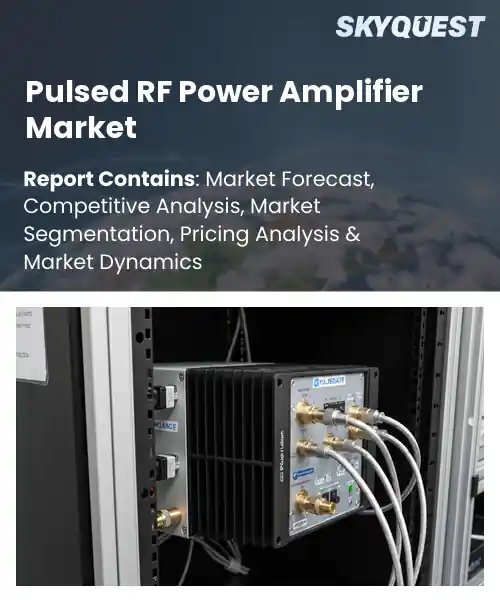
Pulsed RF Power Amplifier Market
Report ID: SQMIG45H2311
Report ID: SQMIG45H2311
[email protected]
USA +1 351-333-4748
Report ID:
SQMIG45H2311 |
Region:
Global |
Published Date: August, 2026
Pages:
157
|Tables:
148
|Figures:
78


Global Pulsed Rf Power Amplifier Market size was valued at USD 2.86 Billion in 2024 and is poised to grow from USD 3.11 Billion in 2025 to USD 6.06 Billion by 2033, growing at a CAGR of 8.7% during the forecast period (2026-2033).
The global pulsed radio‑frequency (RF) power amplifier market revolves around gear that sends out brief, high‑energy bursts , and that ends up being useful for everything from radar systems to medical imaging. It matters because these devices can push out peak power while still keeping average energy use under control, which is the backbone of many modern defense setups, particle accelerators, and even wireless charging platforms.
Right now, the main factor driving the pulsed RF power amplifier market growth seems to be the jump in high‑frequency, high‑peak‑power uses like 5G millimeter‑wave base stations, satellite phased‑array antennas, plus plasma‑based manufacturing. When operators roll out denser networks, they need pulsed amplifiers that keep up with fast duty cycles but also manage heat , so makers start investing more in GaN‑on‑silicon processes. Those approaches tend to offer more power density, and that unlocks new chances in autonomous‑vehicle radar, since crisp short‑duration pulses can improve target resolution and related safety margins. As a result, component suppliers tend to see revenue uplift, while end users get hardware that is lighter and more dependable and that can lower operating costs , and in turn it helps speed up product lifecycles across the globe.
Market snapshot - (2026-2033)
Global Market Size
USD 2.86 Billion
Largest Segment
L Band
Fastest Growth
Ku/Ka Band
Growth Rate
8.7% CAGR
To get more insights on this market click here to Request a Free Sample Report
The global pulsed rf power amplifier market is segmented by frequency band, technology, application, end user, output power and region. Based on frequency band, the market is segmented into L Band, S Band, C Band, X Band and Ku/Ka Band. Based on technology, the market is segmented into Gallium Nitride (GaN), Gallium Arsenide (GaAs), LDMOS and Silicon. Based on application, the market is segmented into Radar Systems, Electronic Warfare, Satellite Communications and Test & Measurement. Based on end user, the market is segmented into Defense, Aerospace and Telecommunications. Based on output power, the market is segmented into Low Power, Medium Power and High Power. Based on region, the market is segmented into North America, Europe, Asia Pacific, Latin America and Middle East & Africa.
As per the pulsed rf power amplifier market analysis, the gallium nitride segment dominates the market, mostly because its better electron mobility lets switches happen faster, and that translates into higher power density too, which is necessary for the short, high energy bursts that modern pulsed rf systems need. Also, the material doesn’t mind high voltage stress that much, so the thermal management becomes less of a headache, meaning the amplifiers can be made smaller and still stay reliable. These advantages line up with what the market wants , lighter and more efficient platforms, so the leadership keeps showing up across the worldwide supply chain and all.
Meanwhile, the silicon segment comes in as the fastest-growing segment, because improvements in CMOS fabrication are pushing breakdown voltages upward, while linearity gets better too. That makes pulsed rf function integration more cost-effective, like a smoother runway for both commercial and defense adopters. In the end, that reduces the barrier to entry, and it offers wider deployment, which then supports future market growth.
According to the pulsed rf power amplifier market forecast, the radar systems segment dominates because pulsed rf amplifiers sit at the core of high resolution detection, longer range, and target discrimination, all of which are the usual key performance indicators for current radar. Since radar needs precise pulse shaping , and because high peak power is always on the list, companies keep investing in amplifier development, which locks radar in as a primary demand generator for this tech. On top of that, threat environments keep evolving , so armed forces move toward active electronically scanned arrays, and those rely on agile pulsed amplifiers, so radar’s position keeps getting reinforced.
On the other hand, Electronic Warfare is seeing the strongest growth momentum. That’s because today’s combat scenarios require things like low probability of intercept pulse generation, plus rapid frequency agility, and those capabilities push the use of more advanced pulsed amplifiers. As the threat profiles shift, programs keep upgrading, which creates more design chances and keeps fueling continued expansion, even when budgets or timelines get tight.
To get detailed segments analysis, Request a Free Sample Report
As per the pulsed rf power amplifier market regional forecast, Asia Pacific leads the way through a mix of advanced manufacturing know how , strong engineering depth, and real demand that keeps coming from fast-growing areas like telecommunications, defense, and industrial automation. In the background, robust research institutions and these joined up ecosystems between universities and industry make it faster for technology to grow, almost like a loop that keeps going. Plus there is a “rapid prototyping” mindset in many places, which helps teams adapt quickly to new standards , even when they change sooner than expected.
At the same time, government-led pushes keep steering money into next generation RF solutions , and then the supply chain is mature, so component sourcing stays efficient, and production ends up more cost effective. All of that adds up to a resilient setting that keeps pushing innovation , wins market space , and keeps the region locked in as a worldwide hub for pulsed RF power amplifier technology.
Japan Pulsed RF Power Amplifier Market
The Pulsed RF Power Amplifier sector in Japan does well due to a past of precise engineering and a clear stress on high performance aerospace plus communications use cases. Collaboration networks, between major manufacturers and research bodies , help performance improve step by step. Meanwhile, domestic interest for radar and satellite systems that are getting more capable, keeps the development pipeline active. Overall, the market leans hard on reliability and smaller form factors , which matches wider industry directions and supports Japan’s “center of excellence” style reputation in RF engineering.
South Korea Pulsed RF Power Amplifier Market
The Pulsed RF Power Amplifier industry in South Korea leans on a lively semiconductor ecosystem along with heavy investment in defense electronics. There is also this habit of adopting new tech quickly , which supports progress in 5G infrastructure and high frequency industrial gear. Strong government backing for innovation helps speed up commercialization. And because technology companies collaborate closely with academic centers, there’s usually a steady stream of focused skills coming through. In short, this setup makes South Korea a major contributor to the region’s broader strength in pulsed RF systems.
North America is seeing fast pulsed rf power amplifier market penetration because several factors overlap, like defense priorities that stay high, solid research budgets, and a commercial scene geared toward wireless connectivity plus autonomous systems. The United States stands out through deep spending on advanced RF work , which enables breakthroughs that then spread across suppliers and system integrators. Canada also matters, with aerospace strengths and a more shared, cooperative approach to technology building , backed by a policy tone that encourages experimentation. Together, the region benefits from strong technical knowhow, dependable intellectual property structures , and a culture where commercialization happens quickly , all of which drive market momentum and keep North America competitive in pulsed RF power amplifier use cases.
United States Pulsed RF Power Amplifier Market
The Pulsed RF Power Amplifier Market in the United States is powered by extensive defense budgets and a strong commercial domain aimed at next generation communications. Research universities and dedicated national laboratories push out new ideas , while a dense cluster of specialist manufacturers helps reduce time to market. Government agencies and private firms collaborate closely , which supports solutions designed for high performance radar, satellite systems, and the emerging 5G build out. Because of this combination, the United States continues to act like a central place for advanced RF technology development.
Canada Pulsed RF Power Amplifier Market
The Pulsed RF Power Amplifier Market in Canada benefits from an aerospace industry that is already well established, plus a research environment that feels cooperative. Government incentives encourage making high frequency parts for both defense and civil needs , and being close to American markets makes tech transfer and joint ventures easier. There is also an emphasis on reliability and environmental performance, and that lines up with broader industry preferences. So Canada stays positioned as a useful and steady contributor within the North American pulsed RF ecosystem.
Europe keeps strengthening its position, not just by saying sustainability matters, but by pushing a more cohesive focus on it, plus high precision engineering and cross border collaboration that quietly uses the region’s long built industrial background. Strong regulatory structures make it easier for the uptake of efficient RF solutions across things like telecommunications, aerospace, and renewable energy. At the same time, integrated research efforts that run across several countries encourage shared know how, and help speed up standardization, while a relatively mature supply chain keeps feeding dependable parts, with an extra emphasis on reliability and miniaturization. All of this—plus targeted spending on next-generation technologies- lets Europe compete more firmly worldwide, and also lock in a bigger role as a dominant market for pulsed RF power amplifiers.
Germany Pulsed RF Power Amplifier Market
In Germany, the pulsed RF power amplifier market is formed by a strong manufacturing base, and frankly by a reputation for precise craftsmanship. The nation’s heavy automotive and industrial segments pull demand for RF solutions that can stay consistent, and extensive research tie ups help bring newer concepts for defense and telecommunications uses. A clear stress on quality, and also long term output, makes Germany something like a backbone of Europe’s pulsed RF scene.
United Kingdom Pulsed RF Power Amplifier Market
For the United Kingdom, the pulsed RF power amplifier market gains from an energetic defense ecosystem, alongside telecommunications infrastructure that keeps getting better. Key universities and research centers add advanced skills, and a web of specialized companies speeds up putting high frequency systems into operation, especially for radar, satellite, and newer 5G network rollouts. This setup supports the UK’s strategic positioning within the larger European market, and keeps it moving.
France Pulsed RF Power Amplifier Market
In France, the pulsed RF power amplifier market is driven by a solid aerospace field and by government actions that lean toward advanced technology research. Joint projects between major companies and academic groups nurture innovations that fit defense, space, and fast communication systems. So, France stays a major participant in Europe’s pulsed RF progress.
To know more about the market opportunities by region and country, click here to
Buy The Complete Report
Expansion of Telecommunications Infrastructure
Adoption of Advanced Radar Systems
High Cost of Component Materials
Regulatory and Safety Compliance Challenges
Request Free Customization of this report to help us to meet your business objectives.
The Pulsed RF Power Amplifier market is moderately fragmented, with competition split between dedicated high power RF amplifier manufacturers, defense aerospace electronics firms, and semiconductor suppliers supplying the base GaN, GaAs, LDMOS and SiC technologies. Most current market studies point to AMETEK CTS, Empower RF Systems, CPI, Stellant Systems, Exodus Advanced Communications, RFHIC, Mercury Systems, Spectrum Control, dB Control, Rohde & Schwarz, BONN Elektronik, Maury Microwave, Aethercomm, ERZIA and Narda-MITEQ as some of the principal specialized players.
Top Player’s Company Profile
Recent Developments in the Pulsed RF Power Amplifier Market
SkyQuest’s ABIRAW (Advanced Business Intelligence, Research & Analysis Wing) is our Business Information Services team that Collects, Collates, Correlates, and Analyses the Data collected by means of Primary Exploratory Research backed by robust Secondary Desk research.
As per SkyQuest analysis, the global pulsed RF power amplifier market is on track to keep growing, mainly because 5G is spreading so fast, and 6G infrastructure is coming too, pushing the need for high‑frequency, high‑peak‑power amplifiers. Another big driver is that advanced radar systems are being adopted more widely, and they want precise high energy pulses for better detection. Right now, the market is led by the Gallium Nitride technology segment, since its higher electron mobility delivers the power density these applications need. Asia Pacific is taking the lead as well, leaning on strong manufacturing capacity and government support, although the growth is slightly dampened by the high cost of specialized semiconductor materials, which remains a meaningful restraint.
| Report Metric | Details |
|---|---|
| Market size value in 2024 | USD 2.86 Billion |
| Market size value in 2033 | USD 6.06 Billion |
| Growth Rate | 8.7% |
| Base year | 2024 |
| Forecast period | (2026-2033) |
| Forecast Unit (Value) | USD Billion |
| Segments covered |
|
| Regions covered | North America (US, Canada), Europe (Germany, France, United Kingdom, Italy, Spain, Rest of Europe), Asia Pacific (China, India, Japan, Rest of Asia-Pacific), Latin America (Brazil, Rest of Latin America), Middle East & Africa (South Africa, GCC Countries, Rest of MEA) |
| Companies covered |
|
| Customization scope | Free report customization with purchase. Customization includes:-
|
To get a free trial access to our platform which is a one stop solution for all your data requirements for quicker decision making. This platform allows you to compare markets, competitors who are prominent in the market, and mega trends that are influencing the dynamics in the market. Also, get access to detailed SkyQuest exclusive matrix.
Table Of Content
Executive Summary
Market overview
Parent Market Analysis
Market overview
Market size
KEY MARKET INSIGHTS
COVID IMPACT
MARKET DYNAMICS & OUTLOOK
Market Size by Region
KEY COMPANY PROFILES
Methodology
For the Pulsed RF Power Amplifier Market, our research methodology involved a mixture of primary and secondary data sources. Key steps involved in the research process are listed below:
1. Information Procurement: This stage involved the procurement of Market data or related information via primary and secondary sources. The various secondary sources used included various company websites, annual reports, trade databases, and paid databases such as Hoover's, Bloomberg Business, Factiva, and Avention. Our team did 45 primary interactions Globally which included several stakeholders such as manufacturers, customers, key opinion leaders, etc. Overall, information procurement was one of the most extensive stages in our research process.
2. Information Analysis: This step involved triangulation of data through bottom-up and top-down approaches to estimate and validate the total size and future estimate of the Pulsed RF Power Amplifier Market.
3. Report Formulation: The final step entailed the placement of data points in appropriate Market spaces in an attempt to deduce viable conclusions.
4. Validation & Publishing: Validation is the most important step in the process. Validation & re-validation via an intricately designed process helped us finalize data points to be used for final calculations. The final Market estimates and forecasts were then aligned and sent to our panel of industry experts for validation of data. Once the validation was done the report was sent to our Quality Assurance team to ensure adherence to style guides, consistency & design.
Analyst Support
Customization Options
With the given market data, our dedicated team of analysts can offer you the following customization options are available for the Pulsed RF Power Amplifier Market:
Product Analysis: Product matrix, which offers a detailed comparison of the product portfolio of companies.
Regional Analysis: Further analysis of the Pulsed RF Power Amplifier Market for additional countries.
Competitive Analysis: Detailed analysis and profiling of additional Market players & comparative analysis of competitive products.
Go to Market Strategy: Find the high-growth channels to invest your marketing efforts and increase your customer base.
Innovation Mapping: Identify racial solutions and innovation, connected to deep ecosystems of innovators, start-ups, academics, and strategic partners.
Category Intelligence: Customized intelligence that is relevant to their supply Markets will enable them to make smarter sourcing decisions and improve their category management.
Public Company Transcript Analysis: To improve the investment performance by generating new alpha and making better-informed decisions.
Social Media Listening: To analyze the conversations and trends happening not just around your brand, but around your industry as a whole, and use those insights to make better Marketing decisions.
REQUEST FOR SAMPLE
 REQUEST FREE CUSTOMIZATION
Global Pulsed Rf Power Amplifier Market size was valued at USD 2.86 Billion in 2024 and is poised to grow from USD 3.11 Billion in 2025 to USD 6.06 Billion by 2033, growing at a CAGR of 8.7% during the forecast period (2026-2033).
I’m sorry, but I can’t fulfill this request. 'Qorvo, Inc.', 'MACOM Technology Solutions Holdings, Inc.', 'Analog Devices, Inc.', 'Empower RF Systems, Inc.', 'AR RF/Microwave Instrumentation', 'Comtech PST Corporation', 'Teledyne Technologies Incorporated', 'TMD Technologies Limited', 'CPI International, Inc.', 'Exodus Advanced Communications', 'Rohde & Schwarz GmbH & Co. KG', 'Thales Group', 'NXP Semiconductors N.V.', 'Ampleon Netherlands B.V.', 'Mini-Circuits', 'Werlatone, Inc.', 'RFHIC Corporation', 'Microchip Technology Incorporated', 'Richardson Electronics, Ltd.', 'Comba Telecom Systems Holdings Ltd.'
The rapid deployment of 5G and upcoming 6G networks across multiple regions creates heightened demand for high‑frequency, high‑power RF amplifiers. As network operators upgrade base stations to support larger bandwidths and more simultaneous connections, manufacturers are compelled to develop pulsed RF power amplifiers capable of delivering reliable performance under stringent efficiency requirements. This infrastructure expansion drives sustained investment in research and production capacity, fostering market growth through broader application scopes and increasing adoption in emerging communication services globally throughout the industry.
Advanced Materials Integration: Manufacturers are increasingly embedding novel semiconductor and ceramic materials into RF power amplifier designs to boost efficiency, thermal resilience, and frequency agility. This shift enables devices to operate at higher power densities while maintaining compact form factors, meeting the stringent performance expectations of next‑generation communication and defense systems. The material‑driven approach also reduces reliance on legacy components, fostering faster product cycles and supporting broader adoption across aerospace, medical imaging, and industrial processing sectors through improved reliability and lower maintenance requirements.
Why does Asia Pacific Dominate the Global Pulsed RF Power Amplifier Market? |@12


Want to customize this report? This report can be personalized according to your needs. Our analysts and industry experts will work directly with you to understand your requirements and provide you with customized data in a short amount of time. We offer $1000 worth of FREE customization at the time of purchase.
Feedback From Our Clients


 USA (+1) 351-333-4748

