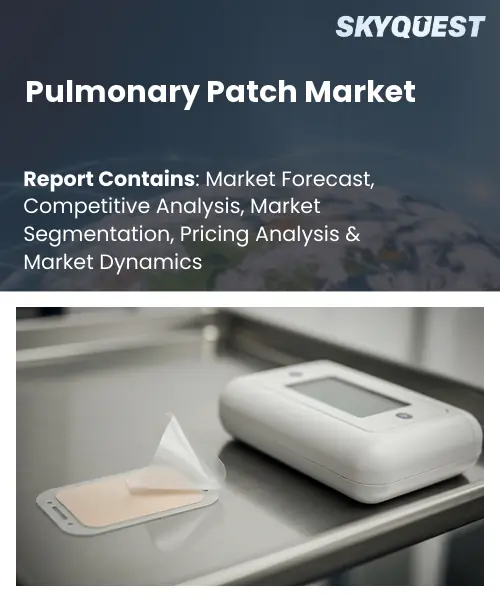
Pulmonary Patch Market
Report ID: SQMIG35B2441
Report ID: SQMIG35B2441
[email protected]
USA +1 351-333-4748
Report ID:
SQMIG35B2441 |
Region:
Global |
Published Date: July, 2026
Pages:
157
|Tables:
149
|Figures:
78


Global Pulmonary Patch Market size was valued at USD 258.9 Million in 2024 and is poised to grow from USD 277.8 Million in 2025 to USD 488.13 Million by 2033, growing at a CAGR of 7.3% during the forecast period (2026-2033).
Pulmonary patches are engineered scaffolds which are used to seal or strengthen any damage done to the lungs, and the market for this equipment has become an important part of regenerative medicine. The major factor which drives the growth of the market is the growing incidence rate of chronic respiratory disorders like COPD and idiopathic pulmonary fibrosis that provide potential patients for this market. Traditionally, these conditions were treated using medications or even lung transplantations; however, poor survival rates and a lack of donors led scientists to search for tissue patches as a solution.
The other important element that will drive the global pulmonary patch market is the intersection of manufacturing with medicine, allowing production and design to become possible. With additive manufacturing, it is possible to design and prototype patches with porous matrix resembling alveolar structure, leading to decreased rejection rates and quicker approvals. With hospitals switching to minimally invasive delivery methods, doctors can deliver patches via bronchoscopy, extending indications from cases of severe emphysema to air leak after surgery. This collaboration between manufacturers and device providers is leading to development of patches with drug-eluting coating that solves problems of inflammation along with tissue closure.
How is AI-driven Automation Influencing the Growth of the Pulmonary Patch Market?
Automation brought about by Artificial Intelligence is influencing the pulmonary patch market through efficient design, manufacturing processes and even post implant monitoring. The machine learning algorithms used help in the analysis of the patient’s anatomy and generation of designs that will work on each unique patient, thereby reducing the design process. In manufacturing, robotic assembly processes are used to bond polymers accurately, increasing consistency and reducing wastage. Post implant sensors monitor the real time data and using this data, cloud analytics helps in predicting the integration of the patch, thereby allowing clinicians to change the therapy quickly. All this reduces the time to market and increases access to patches, prompting more companies to venture into making patches.
Market snapshot - (2026-2033)
Global Market Size
USD 258.9 Million
Largest Segment
Synthetic Patches
Fastest Growth
Biological Patches
Growth Rate
7.3% CAGR
To get more insights on this market click here to Request a Free Sample Report
Global pulmonary patch market is segmented by product type, application, material, end user, distribution channel and region. Based on product type, the market is segmented into Biological Patches, Synthetic Patches, Composite Patches and Others. Based on application, the market is segmented into Lung Tissue Repair, Air Leak Management, Thoracic Surgery, Trauma Repair and Others. Based on material, the market is segmented into Collagen, ePTFE, Polyurethane and Others. Based on end user, the market is segmented into Hospitals, Specialty Thoracic Centers, Ambulatory Surgical Centers and Others. Based on distribution channel, the market is segmented into Direct Sales, Medical Device Distributors and Others. Based on region, the market is segmented into North America, Europe, Asia Pacific, Latin America and Middle East & Africa.
Biological Patches segment is leading the market owing to the fact that medical professionals always give priority to the tissue compatibility of patches since it helps to decrease inflammation and provides easy assimilation with the pulmonary tissues. In addition, the bioactive nature of collagen and extracellular matrix components helps to recruit and remodel the cells and thus addresses the critical nature of lung tissues. Also, sterilization and handling techniques have been improved by the manufacturers, increasing the confidence level of surgeons and improving their efficiency.
On the other hand, the synthetic patches segment is exhibiting the highest growth trend due to the development of advanced polymer technology that offers enhanced tensile strength and customized degradation rates.
Air Leak Management segment ranks first because it addresses postoperative complications that have direct implications on patients' recovery and resource consumption by hospitals. Immediate sealing provided by such patches prevents air leaks, shortens ventilation time and stays in ICU, which are the most important factors considered during surgical operations. Clinical evidence of improved results has boosted surgeons' confidence in this application becoming the core of modern thoracic surgeries.
However, Trauma Repair segment ranks first among potential high growth areas since more and more thoracic surgeries require urgent reinforcement of tissues. Development of new flexible patches with improved hemostasis features allows dealing with various injury patterns in an efficient manner.
To get detailed segments analysis, Request a Free Sample Report
North America has dominated the pulmonary patches market owing to the presence of state-of-the-art clinical infrastructure, highly developed research ecosystems, and early adoption of novel therapeutics technology. There is a good number of world-class hospitals in the region that combine multidisciplinary expertise to fast track approvals and make sure that patients receive the new products in a timely manner. With sound reimbursement policies and favorable regulatory guidelines, companies get an incentive to introduce new therapies. Networks of universities and industry help advance materials and devices on an ongoing basis and secure the reputation of North America as a world leader in terms of performance and quality. Apart from that, considerable investments in digital health systems provide the opportunity for remote monitoring and performance evaluation, giving clinicians confidence in novel technologies of patch therapies.
Pulmonary Patch Market activity in the United States is characterized by clinical trial networks that expedite evaluation of novel biomaterials. Leading academic hospitals collaborate with biotech firms to refine delivery techniques, while reimbursement pathways align with evidence‑based outcomes. Patient advocacy groups promote awareness, encouraging early diagnosis and intervention. This ecosystem sustains a pipeline of differentiated products that consistently meet stringent regulatory expectations and deliver improved respiratory function for patient populations.
The development of Pulmonary Patch Market in Canada operates through a collaboration model where the provincial health organizations and research institutions emphasize safety and cost efficiency. The integrated care approach enables fast integration of the latest patches within the thoracic surgery programs, whereas the incentives provided by the government encourage testing in the indigenous and isolated communities. Training for clinicians emphasizes multidisciplinary approaches to ensure their competence in the latest technologies.
There is a rapid growth in the pulmonary patch market in Europe due to harmonious regulatory system, collaborative public-private partnership, and an innovative health care system. Uniform process of clearance across the countries cuts down the period taken for clearance and thus motivates companies to conduct their clinical trials throughout Europe. European health care focuses on value-based payments, resulting in the usage of technologies with proven clinical efficacy and cost-effectiveness. Research centers in prominent universities enhance biomaterial technology, while cross-border consortiums enable sharing of information among different nations. Early access programs are initiated by the government to make available advanced technologies to patients even before reimbursement is possible. Pulmonologists and surgeons are educated on proper implantation techniques through targeted programs.
Pulmonary Patch Market activity in Germany is anchored by a network of university hospitals that spearhead research on bioengineered scaffolds. Strong reimbursement policies linked to health technology assessments encourage swift integration of validated patches into clinical practice. Collaborative funding mechanisms between federal agencies and industry accelerate development cycles, while quality standards ensure consistency across manufacturers. This environment fosters introduction of high‑performance solutions that address complex pulmonary conditions throughout the nation.
UK Pulmonary Patch Market is boosted by an environment where education and innovation converge into one system. The health systems in the country tend to favor treatments which prove their worthiness for patients, hence speeding up the process of commissioning of the patches. There are collaborations of clinical teams working on different projects, which create data that can help promote clinical use. Intellectual property protection and regulatory guidelines make investments attractive in the country.
Pulmonary Patch Market emergence in France is supported by an emphasis on translational research within medical schools and biotech incubators. Health authorities encourage adoption of new devices, linking reimbursement to outcome data collected in registries. Consortia between hospitals and industry expedite pilot studies, while advocacy networks raise awareness of treatment options. This coordinated approach nurtures a growing significant pipeline of pulmonary patch solutions tailored to the needs of French patients.
Asia Pacific is gaining an advantage in the pulmonary patch industry owing to an emerging trend characterized by growing healthcare investments, increased expertise in the clinical setting, and an increasing focus on the establishment of localized manufacturing capacities. The regulatory authorities within the region have simplified the process of product approval, hence making it possible to have innovative products in the market quickly. Collaboration between multinational organizations and local biotechnology companies enhances technology transfer, and also there is a push towards the development of advanced biomaterials through government incentives. There is a rising prevalence of chronic respiratory diseases that are increasing the need for minimally invasive therapies.
The development of the Pulmonary Patch Market in Japan is enhanced by a healthcare system which places emphasis on diagnostics and treatment paths. National health insurances cover innovations backed up by evidence, making hospitals adopt patches in thoracic surgeries. Excellent cooperation of academic organizations and manufacturers of medical devices promotes research on bioresorbable materials specific to the demographic features of Japan’s patients.
The South Korean market of Pulmonary Patch Market experiences a boost due to government-led efforts to provide grants for scientific investigations in areas of regenerative medicine and medical devices. Outcome-based reimbursement schemes encourage hospitals to employ patches which can show better recovery rates. Excellent relationships between academic institutions and industries contribute to the development of prototype and scaling-up of advanced scaffold technology specifically adapted to the Korean patient population. Training programs prepare thoracic surgeons to use this technology.
To know more about the market opportunities by region and country, click here to
Buy The Complete Report
Innovative Patch Materials
Smart Monitoring Integration
Complex Manufacturing Processes
Regulatory Approval Uncertainty
Request Free Customization of this report to help us to meet your business objectives.
The competitive landscape is shaped by rapid innovation, with firms accelerating pulmonary patch development through strategic M&A, cross‑industry partnerships, and advanced bio‑adhesive technologies; recent large‑scale funding rounds have enabled companies to integrate proprietary scaffold materials and secure distribution agreements with leading thoracic surgery groups, intensifying market rivalry and driving faster product commercialization.
Recent Developments in the Pulmonary Patch Market
SkyQuest’s ABIRAW (Advanced Business Intelligence, Research & Analysis Wing) is our Business Information Services team that Collects, Collates, Correlates, and Analyses the Data collected by means of Primary Exploratory Research backed by robust Secondary Desk research.
As per SkyQuest analysis, the pulmonary patches market will be fueled mainly by novel bio-compatible materials which will enhance the integration of tissue and patient results, whereas the automation and monitoring of AI will act as the second driver by optimizing the designing process and production along with post-implantation monitoring. The biological patches will lead the market owing to the preference of clinicians for native tissue compatibility, while North America will lead the market as it has developed healthcare facilities at major hospitals and reimbursement environment. But the market growth is hindered owing to the complicated manufacturing procedure which increases cost and restricts quick adoption of the technology.
| Report Metric | Details |
|---|---|
| Market size value in 2024 | USD 258.9 Million |
| Market size value in 2033 | USD 488.13 Million |
| Growth Rate | 7.3% |
| Base year | 2024 |
| Forecast period | (2026-2033) |
| Forecast Unit (Value) | USD Million |
| Segments covered |
|
| Regions covered | North America (US, Canada), Europe (Germany, France, United Kingdom, Italy, Spain, Rest of Europe), Asia Pacific (China, India, Japan, Rest of Asia-Pacific), Latin America (Brazil, Rest of Latin America), Middle East & Africa (South Africa, GCC Countries, Rest of MEA) |
| Companies covered |
|
| Customization scope | Free report customization with purchase. Customization includes:-
|
To get a free trial access to our platform which is a one stop solution for all your data requirements for quicker decision making. This platform allows you to compare markets, competitors who are prominent in the market, and mega trends that are influencing the dynamics in the market. Also, get access to detailed SkyQuest exclusive matrix.
Table Of Content
Executive Summary
Market overview
Parent Market Analysis
Market overview
Market size
KEY MARKET INSIGHTS
COVID IMPACT
MARKET DYNAMICS & OUTLOOK
Market Size by Region
KEY COMPANY PROFILES
Methodology
For the Pulmonary Patch Market, our research methodology involved a mixture of primary and secondary data sources. Key steps involved in the research process are listed below:
1. Information Procurement: This stage involved the procurement of Market data or related information via primary and secondary sources. The various secondary sources used included various company websites, annual reports, trade databases, and paid databases such as Hoover's, Bloomberg Business, Factiva, and Avention. Our team did 45 primary interactions Globally which included several stakeholders such as manufacturers, customers, key opinion leaders, etc. Overall, information procurement was one of the most extensive stages in our research process.
2. Information Analysis: This step involved triangulation of data through bottom-up and top-down approaches to estimate and validate the total size and future estimate of the Pulmonary Patch Market.
3. Report Formulation: The final step entailed the placement of data points in appropriate Market spaces in an attempt to deduce viable conclusions.
4. Validation & Publishing: Validation is the most important step in the process. Validation & re-validation via an intricately designed process helped us finalize data points to be used for final calculations. The final Market estimates and forecasts were then aligned and sent to our panel of industry experts for validation of data. Once the validation was done the report was sent to our Quality Assurance team to ensure adherence to style guides, consistency & design.
Analyst Support
Customization Options
With the given market data, our dedicated team of analysts can offer you the following customization options are available for the Pulmonary Patch Market:
Product Analysis: Product matrix, which offers a detailed comparison of the product portfolio of companies.
Regional Analysis: Further analysis of the Pulmonary Patch Market for additional countries.
Competitive Analysis: Detailed analysis and profiling of additional Market players & comparative analysis of competitive products.
Go to Market Strategy: Find the high-growth channels to invest your marketing efforts and increase your customer base.
Innovation Mapping: Identify racial solutions and innovation, connected to deep ecosystems of innovators, start-ups, academics, and strategic partners.
Category Intelligence: Customized intelligence that is relevant to their supply Markets will enable them to make smarter sourcing decisions and improve their category management.
Public Company Transcript Analysis: To improve the investment performance by generating new alpha and making better-informed decisions.
Social Media Listening: To analyze the conversations and trends happening not just around your brand, but around your industry as a whole, and use those insights to make better Marketing decisions.
REQUEST FOR SAMPLE
 REQUEST FREE CUSTOMIZATION
Global Pulmonary Patch Market size was valued at USD 258.9 Million in 2024 and is poised to grow from USD 277.8 Million in 2025 to USD 488.13 Million by 2033, growing at a CAGR of 7.3% during the forecast period (2026-2033).
The competitive landscape is shaped by rapid innovation, with firms accelerating pulmonary patch development through strategic M&A, cross‑industry partnerships, and advanced bio‑adhesive technologies; recent large‑scale funding rounds have enabled companies to integrate proprietary scaffold materials and secure distribution agreements with leading thoracic surgery groups, intensifying market rivalry and driving faster product commercialization. 'Baxter International Inc.', 'W. L. Gore & Associates, Inc.', 'LeMaitre Vascular, Inc.', 'Edwards Lifesciences Corporation', 'Terumo Corporation', 'Artivion, Inc.', 'Getinge AB', 'B. Braun SE', 'BioTissue Holdings Inc.', 'Synovis Micro Companies Alliance, Inc.', 'Cook Medical LLC', 'Integra LifeSciences Holdings Corporation', 'CorMatrix Cardiovascular, Inc.', 'Xeltis B.V.', 'Admedus Ltd.', 'Abbott Laboratories', 'Boston Scientific Corporation', 'Medtronic plc', 'Aziyo Biologics, Inc.', 'CollPlant Biotechnologies Ltd.'
The introduction of biocompatible, stretchable polymers enables patches that conform closely to lung tissue, reducing irritation and improving therapeutic efficacy. Clinicians are adopting these materials because they support longer wear times and simplify post‑operative care. By leveraging such advancements, manufacturers can differentiate products, attract broader clinical acceptance, and expand indications across chronic respiratory conditions, thereby driving market expansion through enhanced patient outcomes and physician confidence in patch technology. The improved comfort profile also encourages patient adherence, which in turn promotes broader adoption across healthcare settings and supports sustained market growth.
Personalized Regenerative Therapies: Advances in biomaterials and cell‑engineering are enabling highly customized pulmonary patches that match patient‑specific anatomy and disease pathology. Manufacturers are integrating 3‑D printing, bio‑ink formulations, and autologous cell sourcing to produce implants that promote seamless tissue integration and functional recovery. This shift toward personalization reduces postoperative complications, shortens rehabilitation periods, and aligns with payer preferences for value‑based care, driving heightened demand among hospitals and specialty clinics seeking cutting‑edge therapeutic options and improved long‑term pulmonary function outcomes for patients worldwide significantly.
Why does North America Dominate the Global Pulmonary Patch Market? |@12


Want to customize this report? This report can be personalized according to your needs. Our analysts and industry experts will work directly with you to understand your requirements and provide you with customized data in a short amount of time. We offer $1000 worth of FREE customization at the time of purchase.
Feedback From Our Clients


 USA (+1) 351-333-4748

