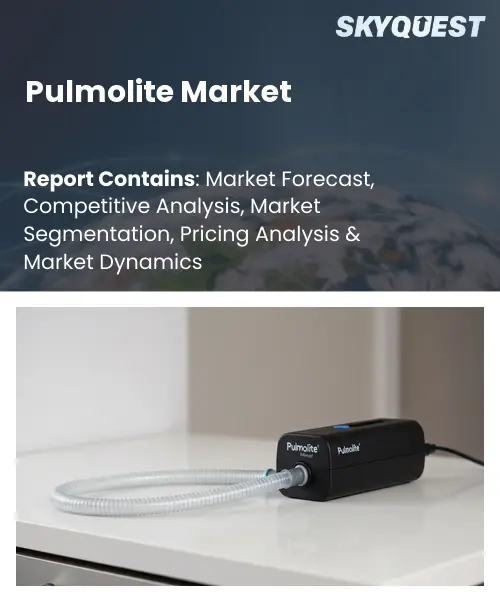
Pulmolite Market
Report ID: SQMIG35I2987
Report ID: SQMIG35I2987
[email protected]
USA +1 351-333-4748
Report ID:
SQMIG35I2987 |
Region:
Global |
Published Date: June, 2026
Pages:
157
|Tables:
170
|Figures:
79


Global Pulmolite Market size was valued at USD 184.2 Million in 2024 and is poised to grow from USD 194.88 Million in 2025 to USD 305.96 Million by 2033, growing at a CAGR of 5.8% during the forecast period (2026-2033).
Pulmolite Market Pulmolite market is focused on the manufacturing and sale of handheld, portable devices that analyze particles in exhaled breath for diagnosis and monitoring of respiratory diseases. Fast, non-invasive testing is becoming important in clinical and home settings for asthma, COPD and emerging infectious diseases. The key driver is the increasing awareness of the benefits of early detection, which is driving investment in sensor technology and cloud-based analytics. Large laboratory spectrometers dominated the market in the 1990s, but the market has now moved towards smartphone-integrated units, such as the 2021 launch of the BreathaSense Pro, which reduced test turnaround from hours to minutes.
The main growth driver is early detection coupled with the integration of artificial intelligence algorithms into Pulmolite platforms. Breath signatures rich in data allow for predictive analytics to describe personal treatment pathways. The technology is being deployed by hospitals for chronic disease management, exemplified by a 2023 collaboration between a European health system and Pulmolite manufacturer that reduced asthma exacerbations by 18% via real-time alerts. The result is a feedback loop of cost savings and better patient outcomes that attracts venture capital. This drives more R&D on miniaturized sensors and drives wider market penetration into tele-health and workplace wellness programs globally and adoption.
How is AI enhancing diagnostic accuracy in the Pulmolite market?
In the Pulmolite space, AI is improving diagnostic accuracy by turning raw sensor data into actionable insights. Machine learning models scan breath analysis patterns, picking up on subtle abnormalities that might escape the human eye. Real-time analytics allow clinicians to confirm disease presence in one visit without having to retest. The technology also learns from different populations of patients, so its predictive power grows over time. Hospitals using these smart platforms see faster workflows, more confidence in early detection and wider market acceptance in the end.
Pulmonx Corporation launched an AI-powered diagnostic module for its Pulmolite system in April 2026, emphasizing the potential of intelligent analysis to improve accuracy and speed up treatment decisions, which will further bolster its market momentum.
Market snapshot - (2026-2033)
Global Market Size
USD 184.2 Million
Largest Segment
Fastest Growth
Growth Rate
5.8% CAGR
To get more insights on this market click here to Request a Free Sample Report
Global pulmolite market is segmented by indication, dosage form, end user, patient group, distribution channel, product type and region. Based on indication, no specific sub-segments were identified. Based on dosage form, no specific sub-segments were identified. Based on end user, no specific sub-segments were identified. Based on patient group, no specific sub-segments were identified. Based on distribution channel, no specific sub-segments were identified. Based on product type, no specific sub-segments were identified. Based on region, the market is segmented into North America, Europe, Asia Pacific, Latin America and Middle East & Africa.
Asthma is the leading segment due to its alignment with Pulmolite’s core therapeutic focus of rapid bronchodilation for a large patient population dependent on daily inhalation therapy. This indication is preferred by clinicians due to its proven efficacy and safety profile which results in consistent prescribing patterns. Manufacturers are investing in R&D and marketing to reinforce market leadership for asthma, which has a strong market position, leading to a self-fulfilling cycle of demand and product enhancement through collaborative development partnerships.
However, the most significant growth momentum is seen in the COPD segment, driven by the increasing prevalence of chronic obstructive conditions leading clinicians to seek novel inhalation solutions. There is growing evidence of Pulmolite’s anti-inflammatory effects on COPD which is driving formulary additions and patient advocacy groups are increasing demand. This makes the market and attracts investment in delivery technologies.
The meter dose inhaler leads the Pulmolite market as it is a familiar, portable delivery mechanism that fits established prescribing habits and patient convenience expectations. Accurate dose delivery enabled by valve technology boosts clinician confidence and treatment adherence. This supply chain infrastructure for MDIs has been set up to support mass production and the well-defined regulatory pathways ensure its entrenched position in chronic respiratory management in all therapeutic settings globally.
Meanwhile, the dry powder inhaler segment is emerging as the key segment as patients prefer breath actuated devices, which eliminate the issues of coordination and propellant. Advances in formulation have made high drug loading and uniform aerosol performance for pulmonary deposition attractive to clinicians. The momentum broadens the application scope of Pulmolite and is spurring investment in powder technologies to accelerate market growth.
To get detailed segments analysis, Request a Free Sample Report
North America is driving the Pulmolite market because of the existence of a well-developed healthcare infrastructure, robust clinical research activities, and favorable reimbursement policies that promote the use of innovative respiratory solutions. Suppliers benefit from integrated supply chains and a regulatory environment that ensures safety but does not slow product approvals. The region’s focus on personalized medicine and chronic disease management is fuelling the demand for accurate aerosol delivery solutions. Top universities and specialty hospitals are leading innovation, and existing collaborations between device makers and health providers facilitate product rollouts. This ecosystem of supportive policy, investment in R&D and broad clinician acceptance supports the region’s leadership and cements its position as a benchmark for market development worldwide.
The United States Pulmolite Market is characterized by a large network of tertiary care centers specializing in advanced pulmonary therapies. Strong collaboration between device makers and leading research hospitals accelerates clinical validation, and insurance structures that support evidence-based interventions enable widespread adoption. The US has a climate where new delivery platforms move from concept to bedside quickly, in part due to a focus on chronic respiratory disease management and the presence of multiple technology incubators, solidifying the US as a key hub for Pulmolite innovation.
Due to the publicly funded healthcare system in Canada, Pulmolite Market is growing in the country which provides equitable access to advanced treatment options. Provincial health agencies are actively assessing new respiratory technologies and promoting their adoption in academic medical centres. National guidelines emphasize patient-centered care, supporting uniformity of application at urban and regional hospitals, and collaborative research programs between universities and industry accelerate product refinement. This support makes Canada a good place for Pulmolite to continue its growth.
The harmonized regulatory pathways in Europe allow the registration of products in multiple countries, creating a uniform market environment, a key driver for the rapid expansion of the Pulmolite market. Healthcare providers are moving towards sophisticated aerosol delivery systems with a strong public health agenda around the prevention and management of chronic respiratory diseases. Robust funding for clinical research at top-tier universities and specialty clinics continues to fuel innovation, and collaborative networks among manufacturers, regulators and professional societies accelerate the dissemination of best practices. Extensive reimbursement schemes in many Member States remove financial barriers for hospitals and promote wider implementation. All these factors combine to create a fertile ecosystem for the development of advanced pulmonary technologies, making Europe a vibrant space for Pulmolite innovation.
High density of university hospitals drives the Germany Pulmolite market facilitating evidence based respiratory care. Reimbursement for the therapeutic benefit of accurate aerosol delivery by national health insurance providers encourages the routine integration of aerosol therapy into treatment protocols. Strong links between engineering companies and clinical research units speed up device tailoring to local practice patterns. The interest in efficient, low-waste Pulmolite solutions is another major driver for Germany’s commitment to sustainability, further cementing the country’s dominance in the European landscape.
The proactive national health policies targeting early intervention in asthma and chronic obstructive pulmonary disease are driving an accelerated adoption of the United Kingdom Pulmolite Market. NHS outcome based therapy commissioning frameworks incentivise hospitals to develop sophisticated delivery platforms. London’s biotech clusters work with leading clinical research organisations to enable rapid clinical trials and dissemination of new technologies. This supportive policy environment and culture of innovation means that the UK is the fastest growing market segment in Europe.
The Pulmolite Market in France is emerging as a lucrative segment due to government initiatives that promote translational research in respiratory health. In France, referral centres are adding Pulmolite devices to multidisciplinary treatment pathways increasingly. Reimbursement reforms acknowledging the clinical efficacy are reducing barriers to adoption. Regional biotech hubs working with hospital networks to test local products will build clinician confidence. These evolutions, along with a growing concern for the quality of life of the patient, indicate a France moving towards a more important place in the European Pulmolite scene.
The Pulmolite is growing its footprint in the Asia Pacific region through strategic investments in healthcare infrastructure and focusing on respiratory disease management for diverse populations. Governments are updating regulatory regimes to fit international standards, attracting global manufacturers looking to enter markets. Fast urbanization and awareness of the effects of air quality are boosting demand for precise aerosol therapy in public and private hospitals. Joint research programs between top universities and device manufacturers speed the adaptation of technology to regional clinical needs. Also driving higher use are new reimbursement approaches that link funding to therapy outcomes. Together these dynamics make Asia Pacific an ever more powerful player in the global Pulmolite landscape.
In Japan, the Pulmolite market is supported by a culture of clinical excellence and a dense network of research hospitals dedicated to advanced pulmonary care. National health insurance policies that favor evidence-based technologies could promote routine use of high-precision delivery systems. Electronics manufacturers and medical institutions are joining forces to create small, easy-to-use Pulmolite devices that are compatible with the country's clinical workflows. Japan remains a key driver for the regional market growth, owing to the focus on the health of a growing aging population, which also drives the demand for effective respiratory therapies.
South Korea Pulmolite Market has a strong biotech ecosystem and active government support for medical technology innovation. Regulatory reforms accelerate the approval process for new aerosol delivery solutions, accelerating the path to market. Major university hospitals are often involved in multi-center trials, providing strong clinical evidence for adoption. Private insurance plans that cover advanced respiratory therapies also create a financial incentive for hospitals to install Pulmolite systems. This synergetic environment is propelling South Korea’s emergence as a strategic hub in the Asia Pacific Pulmolite market.
To know more about the market opportunities by region and country, click here to
Buy The Complete Report
Rising Prevalence Of Respiratory Diseases
Advancements In Portable Monitoring Technology
High Initial Capital Investment
Regulatory Approval Complexity
Request Free Customization of this report to help us to meet your business objectives.
Competitive Dynamics The market players in the Pulmolite market are engaged in cut-throat competition and are involved in strategic Mergers & Acquisitions (M&A) activities to expand their product portfolio and establish partnerships with healthcare providers to integrate diagnostic platforms seamlessly and also promote technological advancements by incorporating AI-powered lung imaging and integration of portable sensor technology. For instance, new partnerships between Pulmolite and diagnostics firms have led to enhanced data analytics and wider global distribution channels.
SkyQuest’s ABIRAW (Advanced Business Intelligence, Research & Analysis Wing) is our Business Information Services team that Collects, Collates, Correlates, and Analyses the Data collected by means of Primary Exploratory Research backed by robust Secondary Desk research. As per SkyQuest analysis the global Pulmolite market is projected to rise to about $306 million by 2033 driven primarily by the growing prevalence of respiratory diseases that push hospitals and home‑care providers to adopt non‑invasive breath monitoring. A second important engine is the rapid advancement of portable monitoring technology which improves accuracy, connectivity and ease of use. The asthma indication still commands the largest share, reinforcing the dominance of the asthma segment. North America leads the market thanks to mature health systems, strong reimbursement and intensive R&D activity. However high initial capital investment for devices and software remains a notable restraint that can slow uptake in smaller facilities.
| Report Metric | Details |
|---|---|
| Market size value in 2024 | USD 184.2 Million |
| Market size value in 2033 | USD 305.96 Million |
| Growth Rate | 5.8% |
| Base year | 2024 |
| Forecast period | (2026-2033) |
| Forecast Unit (Value) | USD Million |
| Segments covered |
|
| Regions covered | North America (US, Canada), Europe (Germany, France, United Kingdom, Italy, Spain, Rest of Europe), Asia Pacific (China, India, Japan, Rest of Asia-Pacific), Latin America (Brazil, Rest of Latin America), Middle East & Africa (South Africa, GCC Countries, Rest of MEA) |
| Companies covered |
|
| Customization scope | Free report customization with purchase. Customization includes:-
|
To get a free trial access to our platform which is a one stop solution for all your data requirements for quicker decision making. This platform allows you to compare markets, competitors who are prominent in the market, and mega trends that are influencing the dynamics in the market. Also, get access to detailed SkyQuest exclusive matrix.
Table Of Content
Executive Summary
Market overview
Parent Market Analysis
Market overview
Market size
KEY MARKET INSIGHTS
COVID IMPACT
MARKET DYNAMICS & OUTLOOK
Market Size by Region
KEY COMPANY PROFILES
Methodology
For the Pulmolite Market, our research methodology involved a mixture of primary and secondary data sources. Key steps involved in the research process are listed below:
1. Information Procurement: This stage involved the procurement of Market data or related information via primary and secondary sources. The various secondary sources used included various company websites, annual reports, trade databases, and paid databases such as Hoover's, Bloomberg Business, Factiva, and Avention. Our team did 45 primary interactions Globally which included several stakeholders such as manufacturers, customers, key opinion leaders, etc. Overall, information procurement was one of the most extensive stages in our research process.
2. Information Analysis: This step involved triangulation of data through bottom-up and top-down approaches to estimate and validate the total size and future estimate of the Pulmolite Market.
3. Report Formulation: The final step entailed the placement of data points in appropriate Market spaces in an attempt to deduce viable conclusions.
4. Validation & Publishing: Validation is the most important step in the process. Validation & re-validation via an intricately designed process helped us finalize data points to be used for final calculations. The final Market estimates and forecasts were then aligned and sent to our panel of industry experts for validation of data. Once the validation was done the report was sent to our Quality Assurance team to ensure adherence to style guides, consistency & design.
Analyst Support
Customization Options
With the given market data, our dedicated team of analysts can offer you the following customization options are available for the Pulmolite Market:
Product Analysis: Product matrix, which offers a detailed comparison of the product portfolio of companies.
Regional Analysis: Further analysis of the Pulmolite Market for additional countries.
Competitive Analysis: Detailed analysis and profiling of additional Market players & comparative analysis of competitive products.
Go to Market Strategy: Find the high-growth channels to invest your marketing efforts and increase your customer base.
Innovation Mapping: Identify racial solutions and innovation, connected to deep ecosystems of innovators, start-ups, academics, and strategic partners.
Category Intelligence: Customized intelligence that is relevant to their supply Markets will enable them to make smarter sourcing decisions and improve their category management.
Public Company Transcript Analysis: To improve the investment performance by generating new alpha and making better-informed decisions.
Social Media Listening: To analyze the conversations and trends happening not just around your brand, but around your industry as a whole, and use those insights to make better Marketing decisions.
REQUEST FOR SAMPLE
 REQUEST FREE CUSTOMIZATION
Global Pulmolite Market size was valued at USD 184.2 Million in 2024 and is poised to grow from USD 194.88 Million in 2025 to USD 305.96 Million by 2033, growing at a CAGR of 5.8% during the forecast period (2026-2033).
The Pulmolite market is shaped by intense competition as firms pursue strategic M&A to broaden product portfolios, forge partnerships with healthcare providers to embed diagnostic platforms, and accelerate tech innovation through AI‑driven lung imaging and portable sensor integration, exemplified by recent collaborations that streamline data analytics and expand global distribution networks. 'Lupin Limited', 'Cipla Limited', 'Sun Pharmaceutical Industries Ltd.', 'Dr. Reddy's Laboratories Ltd.', 'Zydus Lifesciences Limited', 'Aurobindo Pharma Limited', 'Torrent Pharmaceuticals Limited', 'Alkem Laboratories Limited', 'Glenmark Pharmaceuticals Limited', 'Macleods Pharmaceuticals Limited', 'Intas Pharmaceuticals Limited', 'Abbott Laboratories', 'Sanofi S.A.', 'Pfizer Inc.', 'Teva Pharmaceutical Industries Ltd.', 'Viatris Inc.', 'AstraZeneca plc', 'Boehringer Ingelheim International GmbH', 'Novartis AG', 'Merck & Co., Inc.'
Rising prevalence of respiratory diseases across various age groups fuels demand for reliable, non‑invasive monitoring solutions, prompting healthcare providers to integrate Pulmolite devices into routine assessments. Clinicians value the ability to detect early changes in lung function, which supports timely interventions and improves patient outcomes. This clinical relevance encourages hospitals, outpatient clinics, and home‑care programs to adopt the technology, thereby expanding the market footprint and driving sustained growth through broader usage and increased awareness among medical professionals worldwide, continually expanding.
Ai‑Enabled Diagnostics: AI‑Enabled Diagnostics are reshaping pulmonary care by integrating advanced algorithms with Pulmolite devices, delivering real‑time analysis of breath biomarkers and enabling clinicians to identify disease patterns earlier than conventional methods. This convergence accelerates personalized treatment plans, reduces diagnostic uncertainty, and supports remote monitoring initiatives, making lung health management more proactive. Healthcare providers increasingly prioritize platforms that combine data intelligence with non‑invasive measurement, fostering collaborations between technology firms and medical institutions to refine predictive models and enhance patient outcomes across populations.
Why does North America Dominate the Global Pulmolite Market? |@12


Want to customize this report? This report can be personalized according to your needs. Our analysts and industry experts will work directly with you to understand your requirements and provide you with customized data in a short amount of time. We offer $1000 worth of FREE customization at the time of purchase.
Feedback From Our Clients


 USA (+1) 351-333-4748

