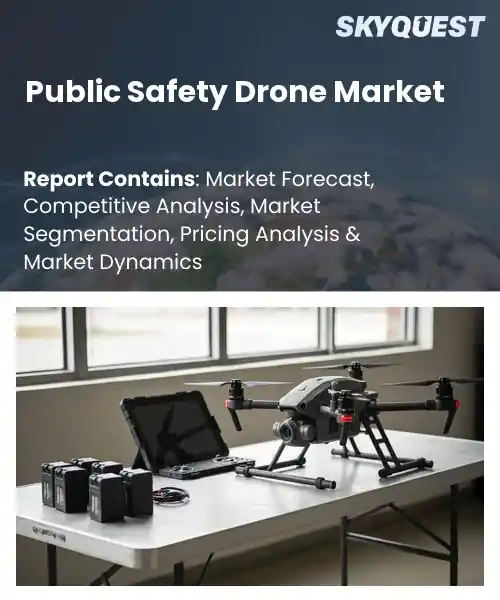
Public Safety Drone Market
Report ID: SQMIG20A2685
Report ID: SQMIG20A2685
[email protected]
USA +1 351-333-4748
Report ID:
SQMIG20A2685 |
Region:
Global |
Published Date: June, 2026
Pages:
157
|Tables:
93
|Figures:
75


Global Public Safety Drone Market size was valued at USD 1.76 Billion in 2024 and is poised to grow from USD 1.93 Billion in 2025 to USD 4.11 Billion by 2033, growing at a CAGR of 9.87% during the forecast period (2026-2033).
The public safety drone market is segmented by Type (Fixed Wing, Rotary Wing, and Hybrid), Application (Disaster Management, Law Enforcement, and Emergency Response), and Geography (North America, Europe, Asia-Pacific, and Rest of the World). The main motivation is the need for rapid, low-risk reconnaissance that saves human lives as well as response time and costs. Since then the market has evolved from hobbyist aircraft refitted for surveillance to purpose-built platforms equipped with thermal imaging, encrypted communications and automated flight controls. Real benefits have been demonstrated in events such as wildfire suppression in California and flood rescue operations in Southeast Asia, shortening procurement cycles and creating regulatory frameworks that promote adoption.
Another key driver of the global public safety drone market is interoperability between drones, sensors, and command-and-control systems as seamless data sharing enhances operational impact and allows for multi-agency coordination. Standardized communication protocols and APIs allow real-time fusion of video feeds and telemetry to guide decision making, minimizing duplication of effort and improving rescue outcomes. For instance, integrated drone swarms supported wildfire mapping that helped incident commanders prioritize evacuations and assign aerial water drops more efficiently. Investment in open architectures and training yields market opportunities for manufacturers, software providers and analytics firms.
How is AI enhancing real-time situational awareness in the public safety drone market?
AI is enhancing real time situational awareness for public safety drones with a combination of onboard perception, sensor fusion and edge analytics. Critical functions include autonomous obstacle avoidance, object detection and classification, continuous tracking and secure transmission of processed alerts to command centers. Vendors are putting AI models on aircraft but also in the cloud so teams are getting actionable intelligence not raw video. This reduces the operator workload, and speeds decisions. The momentum in the market suggests a transition from trials to routine operations, with platforms incorporating automated mission workflows, encrypted data management and conversational controls to improve the reliability and integration of drone responses with existing public safety tools.
May 2026, Axon announced a partnership with Echodyne to add advanced radar and AI driven awareness to its drone ecosystem to improve detection of nearby aircraft and threats and streamline operator focus on critical incidents. This improvement allows for the growth of programs and operational efficiencies by combining radar and camera intelligence for live response.
Market snapshot - (2026-2033)
Global Market Size
USD 1.76 Billion
Largest Segment
Rotary Wing Drones
Fastest Growth
Fixed Wing Drones
Growth Rate
9.87% CAGR
To get more insights on this market click here to Request a Free Sample Report
Global public safety drone market is segmented by drone type, application, end-user and region. Based on drone type, the market is segmented into Rotary Wing Drones, Fixed Wing Drones and Others. Based on application, the market is segmented into Law Enforcement and Surveillance, Search and Rescue Operations, Disaster Management, Firefighting and Others. Based on end-user, the market is segmented into Government Agencies, Municipal Authorities, Educational Institutions and Others. Based on region, the market is segmented into North America, Europe, Asia Pacific, Latin America and Middle East & Africa.
Rotary Wing Drones segment dominates due to their vertical take-off and landing capability and agile maneuverability that makes them ideally suited for complex urban and close quarters public safety tasks. The ability to carry various sensor suites allows for quick situational awareness while simple pilot training and wide vendor support ease procurement. They’re the go-to for public safety use cases, partly because of their ability to deploy frequently and flexibly for incident response and crowd management, which generates sustained operational demand.
However, Fixed Wing Drones are the fastest growing segment as extended endurance and efficient wide area coverage are suitable for large scale search efforts and disaster assessment missions. With developments in light-weight structures, modular sensors and endurance centric designs, combined with the maturing operational frameworks, applications are expanding and new procurement and service opportunities are emerging for public safety providers.
The Law Enforcement and Surveillance segment is leading as agencies are focusing on aerial platforms for real-time situational awareness, deterrence, and evidence capture across a wide range of incidents. The obvious operational fit for persistent monitoring, rapid deployment, and integration with dispatch and analytics systems is driving targeted procurement and specialized training. Custom payloads and vendor solutions for documentation and civilian safety add yet another layer of adoption, driving consistent demand for organizations upgrading their public safety toolsets.
Meanwhile, Search and Rescue Operations is the fastest growing area as advances in thermal imaging, autonomy and obstacle avoidance enable faster survivor detection in difficult environments. Better coordination between agencies and modular payload integration speeds up adoption, enabling new operational roles and funding sources that extend drone deployment across urgent response scenarios.
To get detailed segments analysis, Request a Free Sample Report
North America holds the top spot in the global public safety drone market because of a mix of favorable policy frameworks, mature technology ecosystems, and well-funded public safety agencies that emphasize innovation. Robust industry collaboration between manufacturers, service providers and emergency responders advances operational integration and creates solid use cases. Large-scale pilot programs and well-developed procurement pathways reduce barriers to deployment while robust training and certification programs increase workforce readiness. A sophisticated sensor and communications supply chain supports advanced capabilities for surveillance, search & rescue, and incident management. Market confidence is also buoyed by active investment in research and development and interoperable standards that enable scalable deployment across municipal, state, and federal public safety organizations. A dense network of service providers and emergency technology integrators enable rapid customization and local support, giving agencies the confidence to expand drone enabled operations across diverse mission profiles.
The United States Public Safety Drone Market is marked by extensive operational deployments and robust integration with emergency services. Federal and local agencies work with private-sector innovators to improve mission profiles and approaches to procurement. A broad ecosystem of manufacturers, software providers and systems integrators supports rapid fielding and sustainment. Scale capabilities. Training programs and standardized operational doctrines for search and rescue, disaster response, and routine public safety patrols.
Canada Public Safety Drone Market exhibits the concerted efforts of provincial and municipal responders to adopt unmanned systems for remote area operations and mass incident support. The emphasis on interoperability with land and air assets guides procurement and mission planning. Agencies work with local service providers to provide tailored training, maintenance and operational support. This collaborative approach fosters careful adoption, with attention to operational reliability, community acceptance and long term capability development.
The Asia Pacific region is growing fast, with the need for urban safety, sophisticated manufacturing hubs, and regulatory tweaks that make for some experimental deployments. Facing the challenges of densely populated cities and exposure to natural hazards, municipal governments and authorities are increasingly focusing on using technology to improve public safety. Strong local drone manufacturers and indigenous sensor manufacturers offer customized platforms tailored to local operational needs and partnerships between public agencies and private integrators help to expedite proof of concept activities. Investments in training, localized operational doctrines and interoperable communication links are boosting the effectiveness of missions and institutional confidence, making the region a vibrant market for innovative public safety drone applications. Support market traction and promote regional innovation centers. Focus on fast incident evaluation, maritime monitoring and integrated response processes, driven by flexible regulation and cross sector partnership.
Japan’s advanced robotics expertise and strict safety-oriented regulation drive a high-quality, mission-ready solution in the public safety drone market. Local Manufacturers lean towards Endurance and Sensor Integration tailored for city operations. Pilot programs are used by municipalities and industry partners to test operational concepts and improve training standards. Reliability, certification and human machine teaming are key focus areas to help adoption across emergency response and disaster mitigation roles and complex missions.
South Korea Public Safety Drone Market is driven by strong electronics manufacturing, advanced sensors, and strong collaboration between government agencies and technology companies. Development of customized unmanned platforms and integrated command solutions is driven by the needs for urban density and coast security. Testbeds and demonstration projects can be used for iterative improvements and workforce training can be applied to interoperable operations. The market incentivizes innovation cycles and deployments that enhance situational awareness, emergency response and law enforcement support.
Europe is strengthening its position in the public safety drone market by harmonizing regulations, conducting collaborative research, and fostering industry cooperation, which collectively enhance interoperability and responsible deployment. Standardization of communication protocols and operational procedures is critical to integrating unmanned systems into existing emergency frameworks for public agencies. Cross border exercises and joint procurement pilots show practical interoperability and encourage economies of scale for manufacturers. The regional focus on civilian centric applications such as search and rescue, critical infrastructure monitoring and public order support is enhanced by strong aerospace supply chains and skilled systems integrators who translate advanced research into field ready solutions. Additional investment in training centers, data governance frameworks, and community engagement leads to improved public acceptance and scalable integration of drone solutions into urban and rural safety operations.
Germany capitalizes on strong aerospace base and engineering expertise to field robust platforms and sophisticated sensors in Public Safety Drone Market. Research institutes work together with federal and state agencies to test operational concepts and safety cases. Focus on systems engineering and certification routes allows for dependable integration into fire, police and emergency services. Domestic integrators stress secure communications and interoperability to enable coordinated national responses across urban and industrial geographies.
The United Kingdom Public Safety Drone Market is driven by policing needs and maritime search priorities. Emergency services, academic centers and start-ups are collaborating to promote prototyping and operational testing. Focus on data protection, public engagement and ethical deployment informs procurement. Robust communications, command and control integration and community use cases are the focus of service providers to build trust and enable drone assets to be integrated into public safety workflows and training programs.
The Public Safety Drone Market for France presents the use of unmanned systems in civil protection, fire services and law enforcement operations. National initiatives promote cooperative testing on different terrains to validate operational procedures and interoperability. Local manufacturers and systems integrators concentrate on secure data handling and command solutions for regional responder needs. Training centers and joint exercises educate standardized procedures and community outreach that builds acceptance and real-world adoption at scale.
To know more about the market opportunities by region and country, click here to
Buy The Complete Report
Advancements In Sensor Technology
Integration With Emergency Networks
Regulatory And Privacy Challenges
Limited Skilled Operator Availability
Request Free Customization of this report to help us to meet your business objectives.
The global public safety drone market is mainly driven by consolidation, ecosystem plays, and differentiation through autonomy and integration. The paths to scale for startups and incumbents are changing through mergers and acquisitions and strategic partnerships. For example, Flock Safety acquired Aerodome, and Axon added counter-drone capabilities. Public agency business is also won by top firms competing on mission software innovation and emergency dispatch integrations.
SkyQuest’s ABIRAW (Advanced Business Intelligence, Research & Analysis Wing) is our Business Information Services team that Collects, Collates, Correlates, and Analyses the Data collected by means of Primary Exploratory Research backed by robust Secondary Desk research. As per SkyQuest analysis, a key driver is advancements in sensor technology that deliver clearer actionable intelligence and a second driver is integration with emergency networks that embed drones into operational workflows. Regulatory and privacy challenges remain a material restraint, slowing deployments and increasing procurement complexity. Rotary wing drones lead the market due to VTOL agility and payload flexibility, while North America dominates thanks to supportive policy, mature suppliers and well funded agencies. Overall the market is maturing from retrofit hobbyist platforms to purpose built systems with autonomy, sensor fusion and standardized interfaces, creating opportunities for vendors offering integrated hardware, software and training solutions.
| Report Metric | Details |
|---|---|
| Market size value in 2024 | USD 1.76 Billion |
| Market size value in 2033 | USD 4.11 Billion |
| Growth Rate | 9.87% |
| Base year | 2024 |
| Forecast period | (2026-2033) |
| Forecast Unit (Value) | USD Billion |
| Segments covered |
|
| Regions covered | North America (US, Canada), Europe (Germany, France, United Kingdom, Italy, Spain, Rest of Europe), Asia Pacific (China, India, Japan, Rest of Asia-Pacific), Latin America (Brazil, Rest of Latin America), Middle East & Africa (South Africa, GCC Countries, Rest of MEA) |
| Companies covered |
|
| Customization scope | Free report customization with purchase. Customization includes:-
|
To get a free trial access to our platform which is a one stop solution for all your data requirements for quicker decision making. This platform allows you to compare markets, competitors who are prominent in the market, and mega trends that are influencing the dynamics in the market. Also, get access to detailed SkyQuest exclusive matrix.
Table Of Content
Executive Summary
Market overview
Parent Market Analysis
Market overview
Market size
KEY MARKET INSIGHTS
COVID IMPACT
MARKET DYNAMICS & OUTLOOK
Market Size by Region
KEY COMPANY PROFILES
Methodology
For the Public Safety Drone Market, our research methodology involved a mixture of primary and secondary data sources. Key steps involved in the research process are listed below:
1. Information Procurement: This stage involved the procurement of Market data or related information via primary and secondary sources. The various secondary sources used included various company websites, annual reports, trade databases, and paid databases such as Hoover's, Bloomberg Business, Factiva, and Avention. Our team did 45 primary interactions Globally which included several stakeholders such as manufacturers, customers, key opinion leaders, etc. Overall, information procurement was one of the most extensive stages in our research process.
2. Information Analysis: This step involved triangulation of data through bottom-up and top-down approaches to estimate and validate the total size and future estimate of the Public Safety Drone Market.
3. Report Formulation: The final step entailed the placement of data points in appropriate Market spaces in an attempt to deduce viable conclusions.
4. Validation & Publishing: Validation is the most important step in the process. Validation & re-validation via an intricately designed process helped us finalize data points to be used for final calculations. The final Market estimates and forecasts were then aligned and sent to our panel of industry experts for validation of data. Once the validation was done the report was sent to our Quality Assurance team to ensure adherence to style guides, consistency & design.
Analyst Support
Customization Options
With the given market data, our dedicated team of analysts can offer you the following customization options are available for the Public Safety Drone Market:
Product Analysis: Product matrix, which offers a detailed comparison of the product portfolio of companies.
Regional Analysis: Further analysis of the Public Safety Drone Market for additional countries.
Competitive Analysis: Detailed analysis and profiling of additional Market players & comparative analysis of competitive products.
Go to Market Strategy: Find the high-growth channels to invest your marketing efforts and increase your customer base.
Innovation Mapping: Identify racial solutions and innovation, connected to deep ecosystems of innovators, start-ups, academics, and strategic partners.
Category Intelligence: Customized intelligence that is relevant to their supply Markets will enable them to make smarter sourcing decisions and improve their category management.
Public Company Transcript Analysis: To improve the investment performance by generating new alpha and making better-informed decisions.
Social Media Listening: To analyze the conversations and trends happening not just around your brand, but around your industry as a whole, and use those insights to make better Marketing decisions.
REQUEST FOR SAMPLE
 REQUEST FREE CUSTOMIZATION
Global Public Safety Drone Market size was valued at USD 1.76 Billion in 2024 and is poised to grow from USD 1.93 Billion in 2025 to USD 4.11 Billion by 2033, growing at a CAGR of 9.87% during the forecast period (2026-2033).
Competitive dynamics in the global public safety drone market center on consolidation, ecosystem plays, and differentiation through autonomy and integration. Mergers and acquisitions and strategic partnerships are reshaping routes to scale for startups and incumbents, exemplified by Flock Safety buying Aerodome and Axon integrating counter drone capabilities. Leading firms also compete via mission software innovation and emergency dispatch integrations to win public agency contracts. 'DJI', 'Skydio', 'Autel Robotics', 'Parrot', 'AeroVironment', 'Teledyne FLIR', 'Yuneec', 'Draganfly', 'Flyability', 'Hoverfly Technologies', 'Impossible Aerospace', 'Microdrones', 'Altavian', 'EHang', 'Intel', 'Freefly Systems', 'Wingtra', 'Percepto', 'Delair'
Enhanced sensor capabilities, including improved imaging, thermal detection, and environmental sensing, enable drones to perform complex surveillance, search, and rescue tasks with greater reliability and situational awareness, which directly increases their appeal for public safety organizations. By providing clearer actionable information in diverse conditions, these sensors reduce uncertainty for incident commanders and support faster decision making, encouraging investment in drone platforms and expanding use cases across policing, firefighting, and disaster response, thereby supporting broader market adoption and sustained growth.
Integrated Sensor Fusion Platforms: Public safety agencies are increasingly adopting integrated sensor fusion platforms that combine electro optical, thermal, LiDAR and acoustic inputs into coherent real time overlays. These platforms emphasize modular payloads, standardized interfaces and edge processing to deliver enhanced situational awareness, robust target detection and reduced false positives. The trend supports interoperable data feeds to command centers and facilitates coordinated multi drone operations across missions, driving procurement preferences for adaptable systems to simplify training, planning and improve operational resilience in varied environments.
Why does North America Dominate the Global Public Safety Drone Market? |@12


Want to customize this report? This report can be personalized according to your needs. Our analysts and industry experts will work directly with you to understand your requirements and provide you with customized data in a short amount of time. We offer $1000 worth of FREE customization at the time of purchase.
Feedback From Our Clients


 USA (+1) 351-333-4748

