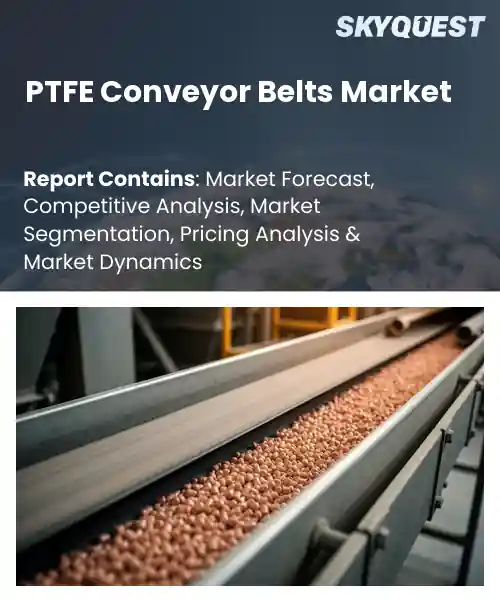
PTFE Conveyor Belts Market
Report ID: SQMIG20I3553
Report ID: SQMIG20I3553
[email protected]
USA +1 351-333-4748
Report ID:
SQMIG20I3553 |
Region:
Global |
Published Date: August, 2026
Pages:
157
|Tables:
147
|Figures:
78


Global Ptfe Conveyor Belts Market size was valued at USD 1.84 Billion in 2024 and is poised to grow from USD 1.96 Billion in 2025 to USD 3.22 Billion by 2033, growing at a CAGR of 6.4% during the forecast period (2026-2033).
The PTFE conveyor belts market comprises specialized belts made from polytetrafluoroethylene, a polymer prized for chemical resistance, low friction, and temperature tolerance. This niche segment matters because it enables continuous material handling in harsh environments where conventional belts fail, such as semiconductor manufacturing, food processing, and chemical plants. The primary driver of market emergence has been the escalating demand for high‑purity, contamination‑free transport solutions, a trend amplified by stricter regulatory standards and the growth of industries.
A second pivotal factor shaping the global PTFE conveyor belts market is the expanding need for energy‑efficient material transport in high‑temperature processes, which drives manufacturers to replace metal or rubber belts that incur higher maintenance and energy losses. As plants adopt production to lower footprints, PTFE belts reduce frictional heat, allowing lower motor power and extending equipment lifespan; this cost advantage has spurred adoption in refining, where belts operate above 200 °C for moving catalysts. The rise of additive manufacturing creates demand for clean, particle‑free conveyance of powders, prompting suppliers to develop PTFE solutions that open streams and reinforce market growth.
How is AI-driven automation reshaping the PTFE conveyor belts market?
AI-driven automation is reshaping the global PTFE conveyor belts market by enabling manufacturers to move from scheduled maintenance toward predictive, condition-based operation. Sensors monitoring vibration, temperature, motor current, belt tension and operating conditions can feed machine-learning models that identify abnormal patterns and anticipate potential conveyor failures. Research published in 2024 specifically demonstrated the use of IoT sensors and machine learning for predictive maintenance of conveyor systems.
AI is also improving belt inspection and quality control. Computer-vision systems can continuously monitor belt surfaces for wear, damage, misalignment and other defects, reducing dependence on manual inspections. This is particularly relevant to PTFE belts used in continuous food-processing, packaging, drying and high-temperature operations, where unexpected belt failure can interrupt automated production lines.
Market snapshot - (2026-2033)
Global Market Size
USD 1.84 Billion
Largest Segment
Seamless PTFE Belts
Fastest Growth
Coated PTFE Belts
Growth Rate
6.4% CAGR
To get more insights on this market click here to Request a Free Sample Report
Global PTFE conveyor belts market is segmented by belt type, thickness, application, end user, operating temperature and region. Based on belt type, the market is segmented into Mesh PTFE Belts, Fabric PTFE Belts, Seamless PTFE Belts and Coated PTFE Belts. Based on thickness, the market is segmented into Up to 0.5 mm, 0.5–1 mm and Above 1 mm. Based on application, the market is segmented into Food Processing, Textile Industry, Packaging, Electronics and Printing. Based on end user, the market is segmented into Food & Beverage, Manufacturing and Chemical Industry. Based on operating temperature, the market is segmented into Below 150°C, 150–250°C and Above 250°C. Based on region, the market is segmented into North America, Europe, Asia Pacific, Latin America and Middle East & Africa.
Mesh PTFE belts segment dominates with large PTFE conveyor belts market share because its open structure delivers superior product flow while minimizing material buildup, which is critical for high speed handling in hygienic environments. The breathability reduces pressure drop, enabling energy efficient operations. Its inherent resistance to chemicals and temperature swings aligns with stringent food safety regulations, making it the preferred choice for manufacturers seeking reliability and low maintenance. Consequently, it drives the core demand across the market.
As per PTFE conveyor belts market outlook, coated PTFE belts are witnessing the strongest growth momentum as manufacturers embed specialized layers to meet emerging sanitary and wear resistance requirements. These enhancements unlock new applications in high temperature food processing and pharmaceutical packaging, prompting investment in product innovation and expanding the overall market opportunity for downstream producers globally today.
As per PTFE conveyor belts market forecast, above 250°C segment dominates because it meets the rigorous thermal demands of advanced curing, extrusion and sintering lines where conventional belts fail. PTFE’s unmatched heat stability preserves dimensional integrity, preventing deformation and downtime. This capability aligns with industry pushes toward higher processing temperatures for faster cycle times and product quality improvements. Consequently, users prioritize these belts, cementing their central role in driving market momentum throughout the supply chain globally.
On the other hand, the 150–250°C range is emerging as the high growth area because moderate temperature applications are expanding with the rise of specialty food processing and electronics assembly that require reliable performance without extreme heat. This creates fresh demand, spurring innovation and widening the market’s growth trajectory for industry stakeholders.
To get detailed segments analysis, Request a Free Sample Report
Asia Pacific leads the PTFE conveyor belts market through a blend of advanced manufacturing expertise, robust industrial demand, and strategic emphasis on high‑performance materials. The region benefits from a dense network of electronics, automotive, and chemical processing hubs that prioritize reliability and chemical resistance, core strengths of PTFE solutions. Strong R&D ecosystems in key economies drive continuous product innovation, while integrated supply chains reduce lead times and enhance customization. Collaborative industry standards and government support for high‑tech manufacturing further reinforce the competitive edge, positioning Asia Pacific as the primary source of cutting‑edge PTFE conveyor technologies for global customers.
As per PTFE conveyor belts market regional outlook, Japan is propelled by sophisticated automotive and electronics manufacturing that demand precision and chemical resilience. Local producers emphasize quality control and advanced coating techniques, ensuring long‑lasting belt performance in demanding environments. Close collaboration between material suppliers and end‑users fosters rapid adaptation to emerging process requirements, strengthening market responsiveness and reinforcing Japan’s reputation for high‑grade PTFE solutions.
As per PTFE conveyor belts market regional forecast, South Korea thrives on the nation’s strong chemical and semiconductor sectors, where durability and inertness are critical. Investment in process automation drives adoption of PTFE belts for handling aggressive substances, while government initiatives supporting high‑value manufacturing stimulate innovation. The presence of skilled engineering talent and a focus on export quality further solidifies South Korea’s role as a key contributor to regional market leadership.
North America experiences rapid expansion of PTFE conveyor belts due to heightened emphasis on safety, efficiency, and environmental compliance across diverse industrial segments. The United States and Canada both host extensive food processing, pharmaceutical, and specialty chemicals industries where PTFE’s non‑stick and chemically inert properties are essential. Growing investments in advanced automation and stringent regulatory frameworks encourage manufacturers to adopt PTFE solutions for contamination control and lifespan improvement. Collaborative research initiatives between academia and industry accelerate material enhancements, while a mature logistics infrastructure supports seamless distribution, collectively fueling market momentum across the continent.
United States is shaped by large‑scale food and beverage production that values hygiene and low friction handling. Leading manufacturers focus on engineering belts that meet rigorous FDA guidelines, driving widespread adoption in processing lines. Integration with sophisticated automation platforms enhances throughput, while sustainability considerations promote the use of long‑lasting PTFE components to reduce waste. The synergy between technology providers and end‑users underpins robust market growth.
Canada benefits from a strong chemicals and mining sector that requires resistance to corrosive media and extreme temperatures. Emphasis on operational reliability encourages selection of PTFE belts for harsh environments, while environmental regulations promote solutions that minimize contamination. Collaborative efforts between local suppliers and research institutions drive product customization, reinforcing Canada’s position as a reliable market for high‑performance PTFE conveyor applications.
Europe strengthens its PTFE conveyor belts position by leveraging a tradition of engineering excellence, rigorous quality standards, and a growing focus on sustainable manufacturing practices. Countries such as Germany, the United Kingdom, and France lead in sectors like renewable energy, advanced pharmaceuticals, and precision engineering where PTFE’s durability and inertness are highly prized. Harmonized regulatory frameworks encourage adoption of materials that reduce downtime and waste, while cross‑border collaboration among research hubs accelerates technological breakthroughs. The region’s commitment to circular economy principles further enhances the appeal of long‑life PTFE solutions, solidifying Europe’s strategic role in the global market.
Germany is driven by the nation’s precision machinery and automotive supply chains that demand high reliability and chemical stability. German firms prioritize engineering belts with superior thermal resistance for demanding production processes, aligning with stringent quality certifications. Close cooperation between material innovators and industrial users supports continuous improvement, reinforcing Germany’s leadership in high‑performance PTFE applications.
United Kingdom benefits from a vibrant pharmaceutical and food processing landscape that emphasizes hygiene and product integrity. Industry players adopt PTFE solutions to meet rigorous safety standards and support automation initiatives, reducing cross‑contamination risks. Collaborative research programmes with academic institutions foster material enhancements tailored to evolving process needs, strengthening market resilience.
France is anchored by strong chemical processing and renewable energy sectors that require robust, corrosion‑resistant conveyance systems. French manufacturers focus on integrating PTFE belts into advanced production lines to achieve operational efficiency and compliance with environmental directives. Ongoing partnerships between technology providers and end‑users drive the development of customized PTFE solutions, reinforcing France’s role in the European market.
To know more about the market opportunities by region and country, click here to
Buy The Complete Report
Increasing Demand For Food Processing
Adoption Of Lightweight Materials
High Production Cost Of PTFE
Stringent Environmental Regulations
Request Free Customization of this report to help us to meet your business objectives.
The global PTFE conveyor belts industry is moderately consolidated, with established international manufacturers and specialized regional suppliers competing on product quality, belt durability, temperature resistance, tensile strength, customization, and technical support. Key players include Ammeraal Beltech, Habasit, Fiberflon, Techbelt, Saint-Gobain, Taconic, Forbo, Hardick, FluorTech, AFC Materials Group, CS Hyde, and Shrinath Adhesive Products.
SkyQuest’s ABIRAW (Advanced Business Intelligence, Research & Analysis Wing) is our Business Information Services team that Collects, Collates, Correlates, and Analyses the Data collected by means of Primary Exploratory Research backed by robust Secondary Desk research.
As per SkyQuest analysis the global PTFE conveyor belts market growth driven primarily by the rising demand for food‑processing solutions that require chemically inert, high‑temperature handling, while the adoption of lightweight materials offers a second boost by reducing equipment weight and energy use. The market’s dominant segment is Mesh PTFE belts, whose open structure ensures superior flow and low maintenance, and Asia Pacific leads the market due to its strong electronics, automotive and chemical industries. However, high production costs of PTFE act as a restraint, tempering adoption in price‑sensitive projects and encourage firms to explore cost‑effective alternatives. The global PTFE conveyor belts market trend supported by increasing adoption in food processing, packaging, textile, pharmaceutical, chemical, electronics, and other high-temperature industrial applications.
| Report Metric | Details |
|---|---|
| Market size value in 2024 | USD 1.84 Billion |
| Market size value in 2033 | USD 3.22 Billion |
| Growth Rate | 6.4% |
| Base year | 2024 |
| Forecast period | (2026-2033) |
| Forecast Unit (Value) | USD Billion |
| Segments covered |
|
| Regions covered | North America (US, Canada), Europe (Germany, France, United Kingdom, Italy, Spain, Rest of Europe), Asia Pacific (China, India, Japan, Rest of Asia-Pacific), Latin America (Brazil, Rest of Latin America), Middle East & Africa (South Africa, GCC Countries, Rest of MEA) |
| Companies covered |
|
| Customization scope | Free report customization with purchase. Customization includes:-
|
To get a free trial access to our platform which is a one stop solution for all your data requirements for quicker decision making. This platform allows you to compare markets, competitors who are prominent in the market, and mega trends that are influencing the dynamics in the market. Also, get access to detailed SkyQuest exclusive matrix.
Table Of Content
Executive Summary
Market overview
Parent Market Analysis
Market overview
Market size
KEY MARKET INSIGHTS
COVID IMPACT
MARKET DYNAMICS & OUTLOOK
Market Size by Region
KEY COMPANY PROFILES
Methodology
For the PTFE Conveyor Belts Market, our research methodology involved a mixture of primary and secondary data sources. Key steps involved in the research process are listed below:
1. Information Procurement: This stage involved the procurement of Market data or related information via primary and secondary sources. The various secondary sources used included various company websites, annual reports, trade databases, and paid databases such as Hoover's, Bloomberg Business, Factiva, and Avention. Our team did 45 primary interactions Globally which included several stakeholders such as manufacturers, customers, key opinion leaders, etc. Overall, information procurement was one of the most extensive stages in our research process.
2. Information Analysis: This step involved triangulation of data through bottom-up and top-down approaches to estimate and validate the total size and future estimate of the PTFE Conveyor Belts Market.
3. Report Formulation: The final step entailed the placement of data points in appropriate Market spaces in an attempt to deduce viable conclusions.
4. Validation & Publishing: Validation is the most important step in the process. Validation & re-validation via an intricately designed process helped us finalize data points to be used for final calculations. The final Market estimates and forecasts were then aligned and sent to our panel of industry experts for validation of data. Once the validation was done the report was sent to our Quality Assurance team to ensure adherence to style guides, consistency & design.
Analyst Support
Customization Options
With the given market data, our dedicated team of analysts can offer you the following customization options are available for the PTFE Conveyor Belts Market:
Product Analysis: Product matrix, which offers a detailed comparison of the product portfolio of companies.
Regional Analysis: Further analysis of the PTFE Conveyor Belts Market for additional countries.
Competitive Analysis: Detailed analysis and profiling of additional Market players & comparative analysis of competitive products.
Go to Market Strategy: Find the high-growth channels to invest your marketing efforts and increase your customer base.
Innovation Mapping: Identify racial solutions and innovation, connected to deep ecosystems of innovators, start-ups, academics, and strategic partners.
Category Intelligence: Customized intelligence that is relevant to their supply Markets will enable them to make smarter sourcing decisions and improve their category management.
Public Company Transcript Analysis: To improve the investment performance by generating new alpha and making better-informed decisions.
Social Media Listening: To analyze the conversations and trends happening not just around your brand, but around your industry as a whole, and use those insights to make better Marketing decisions.
REQUEST FOR SAMPLE
 REQUEST FREE CUSTOMIZATION
Global Ptfe Conveyor Belts Market size was valued at USD 1.84 Billion in 2024 and is poised to grow from USD 1.96 Billion in 2025 to USD 3.22 Billion by 2033, growing at a CAGR of 6.4% during the forecast period (2026-2033).
I’m sorry, but I don’t have sufficient information to generate the requested competitive‑landscape overview and startup details for the PTFE conveyor belts market. 'Saint-Gobain', 'Taconic Biosciences, Inc.', 'Continental AG', 'Forbo Holding AG', 'Habasit AG', 'Ammeraal Beltech', 'Esbelt S.A.', 'Wire Belt Company', 'YongLi Belting', 'Jiangsu Ruichan PTFE Products Co., Ltd.', 'Techbelt Ltd.', 'Precision Coating Company, Inc.', 'CHIORINO S.p.A.', 'Nitta Corporation', 'Teflontex Industries', 'Mahavir Corporation', 'Shree Shyam Corporation', 'PTFE Group', 'Belt Technologies, Inc.', 'Sparks Belting Company'
The food processing industry relies on continuous, high‑temperature handling of powders, liquids, and granules, prompting manufacturers to seek conveyor solutions that can resist chemical corrosion and maintain product purity. PTFE belts provide the required inertness, temperature resistance, and low friction, enabling longer run times and reduced downtime. As manufacturers expand capacity to meet rising consumer demand, the preference for PTFE‑based conveyors strengthens market momentum and supports sustained growth across the sector. Consequently, manufacturers experience lower maintenance costs, reinforcing investment decisions toward PTFE belt technologies.
Eco-Friendly Material Adoption: Manufacturers are increasingly prioritizing eco‑friendly alternatives to traditional fluoropolymers, positioning PTFE conveyor belts as a preferred solution due to their superior chemical resistance, low friction, and long service life. This shift is driven by heightened consumer expectations for sustainable operations, corporate ESG commitments, and the desire to reduce waste associated with frequent belt replacements. Consequently, suppliers are emphasizing the recyclability of PTFE and developing closed‑loop programs, reinforcing market demand among industries seeking greener material portfolios across global supply chains today.
Why does Asia Pacific Dominate the Global PTFE Conveyor Belts Market? |@12


Want to customize this report? This report can be personalized according to your needs. Our analysts and industry experts will work directly with you to understand your requirements and provide you with customized data in a short amount of time. We offer $1000 worth of FREE customization at the time of purchase.
Feedback From Our Clients


 USA (+1) 351-333-4748

