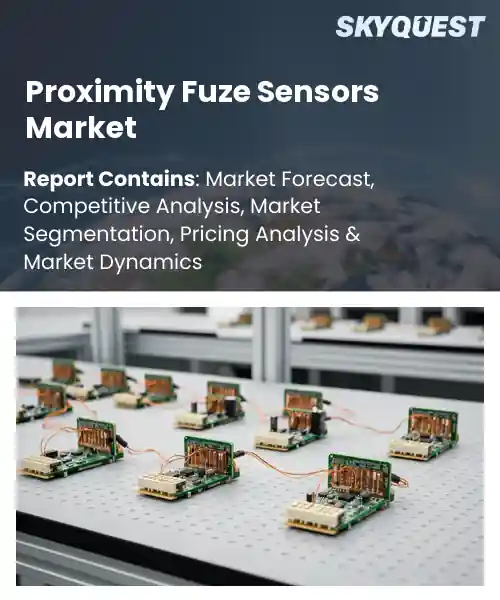
Proximity Fuze Sensors Market
Report ID: SQMIG45N2173
Report ID: SQMIG45N2173
[email protected]
USA +1 351-333-4748
Report ID:
SQMIG45N2173 |
Region:
Global |
Published Date: February, 2026
Pages:
157
|Tables:
123
|Figures:
77


Global Proximity Fuze Sensors Market size was valued at USD 2.67 Billion in 2024 and is poised to grow from USD 2.77 Billion in 2025 to USD 3.73 Billion by 2033, growing at a CAGR of 3.8% during the forecast period (2026-2033).
The primary driver is rising demand for precision and reduced collateral damage in conflicts, which has accelerated growth in the proximity fuze sensors market. Proximity fuzes are sensor-equipped devices that detect nearby objects and trigger munitions or countermeasures at an optimal distance, making them essential for air defense, artillery and counter-UAS missions. The market matters because these sensors improve lethality and survivability while lowering civilian harm, prompting continued investment. Originating in World War II as bulky radio sets, fuze technology progressed through transistorization to today’s compact radar, laser and IR solutions, exemplified by modern airburst shells and smart anti-air munitions.Building on technological maturation, a key factor driving the global proximity fuze sensors market is the convergence of miniaturization, RF technologies, and the surge in unmanned threats, which create scalable demand across platforms. As sensor footprints shrink and costs fall, manufacturers can embed proximity triggers into small-caliber projectiles, loitering munitions and shipboard close-in weapon systems, producing effective area denial and counter-UAS defenses. Procurement agencies respond by increasing orders, prompting suppliers to invest in higher-frequency radars, AI-enabled signal processing and testing regimes. Consequently, these feedback loops further unlock commercial opportunities in nontraditional sectors, including mining safety and autonomous vehicle collision avoidance.
How is AI enhancing detection accuracy in the proximity fuze sensors market?
Proximity fuze sensors detect nearby targets by emitting and analyzing returns from radar and other modalities. AI improves detection accuracy by combining data from multiple sensors, cleaning noisy signals with machine learning, and adjusting trigger logic to local conditions. This lowers false alarms and sharpens discrimination between relevant targets and environmental clutter. Market demand is driven by needs for smarter munitions and counter unmanned systems, so suppliers are adopting onboard AI models and advanced signal processing to make fuzes more reliable in complex operational environments.Raytheon September 2025, a Naval Air Systems Command action advanced digital proximity fuze development that emphasizes AI enabled signal processing on guided weapons, supporting market growth by improving target discrimination and reducing unnecessary engagements while easing integration and sustainment burdens for operators.
Market snapshot - (2026-2033)
Global Market Size
USD 2.67 Billion
Largest Segment
Electronic Fuze
Fastest Growth
Smart Fuze
Growth Rate
3.8% CAGR
To get more insights on this market click here to Request a Free Sample Report
Global proximity fuze sensors market is segmented by product type, technology, application, end-user and region. Based on product type, the market is segmented into Mechanical Fuze, Electronic Fuze and Smart Fuze. Based on technology, the market is segmented into Radar‑based Sensors, Infrared (IR) Proximity Sensors, Acoustic / Ultrasonic Sensors, Optical Sensors and Others. Based on application, the market is segmented into Defense & Military Systems, Aerospace, Automotive Safety Systems, Industrial & Automation Applications and Other Sectors. Based on end-user, the market is segmented into Defense & Military, Commercial Aviation, Automotive Industry, Industrial Manufacturing and Other Verticals. Based on region, the market is segmented into North America, Europe, Asia Pacific, Latin America and Middle East & Africa.
Electronic Fuze segment dominates because its electronic architecture enables higher reliability and finer detection thresholds compared with mechanical designs, allowing consistent detonation timing in varied engagement scenarios. Robust signal processing and easier integration with multiple sensor inputs improve situational awareness and reduce false triggers, driving adoption across weapon platforms. Advances in miniaturization and power management further lower system weight and complexity, enabling widespread retrofit and new design adoption.
However, Smart Fuze is the most rapidly expanding product type as embedded processing and connectivity enable adaptive targeting and mission tailoring. Rising demand for intelligent lethality and field upgradeability drives adoption in modern munitions, creating new software driven business models and opening opportunities in complex engagement environments.
Radar based Sensors segment dominates because radar technology provides reliable target detection across varying environmental and engagement conditions, enabling consistent approach sensing for proximity fuzes. Mature signal processing techniques and established integration pathways with fire control systems reduce developmental risk and enhance interoperability with existing platforms, encouraging system designers to prefer radar options. Continuous improvements in antenna design and solid state transmitters drive better range and clutter resilience, reinforcing market preference.
Conversely, Infrared Proximity Sensors are emerging as the fastest growing technology as enhanced detector sensitivity and reduced power and size suit small munitions and cluttered environments. Improved thermal discrimination algorithms enable passive target recognition, expanding use cases where radar is less effective and stimulating new supplier innovation and system integration opportunities.
To get detailed segments analysis, Request a Free Sample Report
North America benefits from a highly integrated defense ecosystem that links advanced research institutions, established prime contractors, and specialized component suppliers into a seamless innovation pipeline. Mature procurement practices and long-term modernization priorities create consistent demand for sophisticated proximity fuze sensors, while extensive testing and certification infrastructure accelerates transition from prototype to fielded systems. Close cooperation between military end users and industry fosters rigorous requirements definition and iterative improvement. Strong supply chain resilience, robust aftermarket support, and a skilled engineering workforce enable scalable production and sustained performance in harsh operational environments. Strategic partnerships with allied markets and a focus on interoperability further amplify market reach and technological leadership across sensor design, systems integration, and lifecycle sustainment.
Proximity Fuze Sensors Market in the United States is anchored by concentration of prime defense contractors, comprehensive R&D capabilities, and high-fidelity test facilities that support advanced sensor validation and certification. Procurement favors integrated solutions and sustained support contracts, encouraging collaboration between government laboratories and industrial teams. Emphasis on interoperability with allied systems, rigorous quality standards, and domestic manufacturing resilience underpins a mature supply chain that advances innovation across sensor electronics, miniaturization, and systems integration for a range of munition architectures.
Proximity Fuze Sensors Market in Canada leverages close collaboration with allied programs and a focused domestic industrial base that concentrates on niche sensor technologies and precision manufacturing. Procurement strategies prioritize interoperability and partnership with larger programs, enabling Canadian firms to contribute subsystems, testing services, and specialized integration capabilities. Public-private initiatives and skilled engineering talent support incremental innovation and sustainment activities, allowing Canadian suppliers to complement broader North American supply chains while developing sovereign expertise in sensor electronics and system assurance.
Expansion in Europe is driven by concerted efforts to modernize munitions and enhance national and alliance-level deterrence capabilities, prompting renewed investment in proximity fuze sensor technologies. A growing network of collaborative procurement initiatives and industrial cooperation is reducing fragmentation and enabling cross-border systems integration. Europe combines strong aerospace and electronics clusters with innovative small and medium enterprises that accelerate adoption of advanced sensing, signal processing, and ruggedization techniques. Emphasis on sovereign capability, secure supply chains, and lifecycle support encourages domestic production and testing capacity. Additionally, alignment with alliance interoperability standards, public investment in research funding mechanisms, and tighter collaboration between military end users and industry expedite development cycles and expand market opportunities across defense and dual-use applications.
Proximity Fuze Sensors Market in Germany is characterized by a robust engineering and manufacturing base that emphasizes precision, reliability, and export readiness. Strong collaboration between industrial integrators, specialized component suppliers, and research institutes fosters rapid development of advanced sensing solutions and ruggedized assemblies. Public procurement programs and targeted industrial policy support capacity growth and enable integration of domestic sensor subsystems into larger munitions platforms. The market benefits from a dense supplier network and an emphasis on quality assurance, systems engineering, and cross-sector technology transfer.
Proximity Fuze Sensors Market in the United Kingdom reflects a long-standing defense industrial tradition with prominent prime contractors, established testing ranges, and deep systems integration expertise. Market dynamics are shaped by strategic procurement that prioritizes interoperability, resilience, and sustainment of deployed systems. Strong relationships between industry, military research establishments, and international partners support advanced sensor design, qualification, and operational feedback loops. The environment encourages export-oriented solutions and modular approaches that simplify integration across a variety of munitions and delivery platforms.
Proximity Fuze Sensors Market in France shows emergence driven by national emphasis on sovereign defense capabilities and technological autonomy. Domestic manufacturers and research centers focus on developing resilient, high-reliability sensor architectures and robust environmental hardening. Government procurement and collaborative programs with industry stimulate capability development and integration into national munitions programs. The market is marked by growing investment in electronics and signal processing expertise, and by efforts to strengthen domestic supply chains for critical components and testing infrastructure.
Asia Pacific is strengthening its position through a combination of indigenous capability development, strategic partnerships with established suppliers, and expansion of regional manufacturing and testing infrastructure. National defense priorities and regional security dynamics have encouraged localization of key technologies and closer coordination between government procurement agencies and domestic industry. Electronics manufacturing strength and rapid adoption of advanced signal processing and miniaturization techniques support competitive sensor development. Collaboration with international original equipment manufacturers facilitates technology transfer and integration practices, while investment in skilled engineering talent and specialized test ranges enhances validation capabilities. Emphasis on cost-effective production, supply chain diversification, and regional export initiatives further consolidates the role of Asia Pacific firms in the global proximity fuze sensors landscape.
Proximity Fuze Sensors Market in Japan benefits from a mature electronics industry, disciplined manufacturing practices, and an emphasis on high reliability and quality assurance. Domestic firms focus on integrating advanced signal processing and ruggedized hardware into munitions-compatible sensor packages, supported by defense research institutes and close ties to allied suppliers. Procurement strategies emphasize interoperability and lifecycle sustainment, while strict testing and certification regimes ensure operational robustness. The market leverages strong supplier networks and engineering expertise to deliver precision sensor systems tailored to national defense requirements.
Proximity Fuze Sensors Market in South Korea is advancing rapidly through strong domestic defense industrialization, active government support for indigenous technologies, and partnerships with global primes. Local manufacturers and system integrators focus on scalable production, rapid prototyping, and integration of sensors into a range of missile and artillery systems. Emphasis on talent development, electronics manufacturing capability, and expanded testing infrastructure supports qualification and deployment. The market benefits from a pragmatic approach to localization and export orientation that aligns technical innovation with regional operational needs.
To know more about the market opportunities by region and country, click here to
Buy The Complete Report
Advancements In Sensor Technology
Rising Demand For Precision Munitions
Strict Export Control Regulations
High Development and Integration Costs
Request Free Customization of this report to help us to meet your business objectives.
The competitive landscape is consolidating as tier one primes secure specialist fuze and sensor houses to offer bundled seeker, guidance and fuze packages. Demand from counter unmanned aerial systems and battlefield digitization is pushing adoption of solid state radar and programmable airburst solutions. Real strategies include acquisitions such as Northrop Grumman acquiring L3Harris fuze assets and BAE Systems buying European sensor lines, plus supplier partnerships and targeted sensor innovation.
Top Player’s Company Profile
Recent Developments
SkyQuest’s ABIRAW (Advanced Business Intelligence, Research & Analysis Wing) is our Business Information Services team that Collects, Collates, Correlates, and Analyses the Data collected by means of Primary Exploratory Research backed by robust Secondary Desk research. As per SkyQuest analysis, the global proximity fuze sensors market is being driven primarily by rising demand for precision munitions that reduce collateral damage and enhance mission success. A second driver is AI-enabled signal processing and sensor fusion, which improve detection accuracy and lower false alarms in complex environments. However strict export control regulations remain a major restraint, limiting cross-border collaboration and market access. North America is the dominating region thanks to its integrated defense ecosystem, procurement strength and testing infrastructure, while electronic fuzes are the dominating segment due to superior reliability and integration flexibility. Ongoing miniaturization and counter-UAS demand should sustain growth despite regulatory and cost headwinds.
| Report Metric | Details |
|---|---|
| Market size value in 2024 | USD 2.67 Billion |
| Market size value in 2033 | USD 3.73 Billion |
| Growth Rate | 3.8% |
| Base year | 2024 |
| Forecast period | (2026-2033) |
| Forecast Unit (Value) | USD Billion |
| Segments covered |
|
| Regions covered | North America (US, Canada), Europe (Germany, France, United Kingdom, Italy, Spain, Rest of Europe), Asia Pacific (China, India, Japan, Rest of Asia-Pacific), Latin America (Brazil, Rest of Latin America), Middle East & Africa (South Africa, GCC Countries, Rest of MEA) |
| Companies covered |
|
| Customization scope | Free report customization with purchase. Customization includes:-
|
To get a free trial access to our platform which is a one stop solution for all your data requirements for quicker decision making. This platform allows you to compare markets, competitors who are prominent in the market, and mega trends that are influencing the dynamics in the market. Also, get access to detailed SkyQuest exclusive matrix.
Table Of Content
Executive Summary
Market overview
Parent Market Analysis
Market overview
Market size
KEY MARKET INSIGHTS
COVID IMPACT
MARKET DYNAMICS & OUTLOOK
Market Size by Region
KEY COMPANY PROFILES
Methodology
For the Proximity Fuze Sensors Market, our research methodology involved a mixture of primary and secondary data sources. Key steps involved in the research process are listed below:
1. Information Procurement: This stage involved the procurement of Market data or related information via primary and secondary sources. The various secondary sources used included various company websites, annual reports, trade databases, and paid databases such as Hoover's, Bloomberg Business, Factiva, and Avention. Our team did 45 primary interactions Globally which included several stakeholders such as manufacturers, customers, key opinion leaders, etc. Overall, information procurement was one of the most extensive stages in our research process.
2. Information Analysis: This step involved triangulation of data through bottom-up and top-down approaches to estimate and validate the total size and future estimate of the Proximity Fuze Sensors Market.
3. Report Formulation: The final step entailed the placement of data points in appropriate Market spaces in an attempt to deduce viable conclusions.
4. Validation & Publishing: Validation is the most important step in the process. Validation & re-validation via an intricately designed process helped us finalize data points to be used for final calculations. The final Market estimates and forecasts were then aligned and sent to our panel of industry experts for validation of data. Once the validation was done the report was sent to our Quality Assurance team to ensure adherence to style guides, consistency & design.
Analyst Support
Customization Options
With the given market data, our dedicated team of analysts can offer you the following customization options are available for the Proximity Fuze Sensors Market:
Product Analysis: Product matrix, which offers a detailed comparison of the product portfolio of companies.
Regional Analysis: Further analysis of the Proximity Fuze Sensors Market for additional countries.
Competitive Analysis: Detailed analysis and profiling of additional Market players & comparative analysis of competitive products.
Go to Market Strategy: Find the high-growth channels to invest your marketing efforts and increase your customer base.
Innovation Mapping: Identify racial solutions and innovation, connected to deep ecosystems of innovators, start-ups, academics, and strategic partners.
Category Intelligence: Customized intelligence that is relevant to their supply Markets will enable them to make smarter sourcing decisions and improve their category management.
Public Company Transcript Analysis: To improve the investment performance by generating new alpha and making better-informed decisions.
Social Media Listening: To analyze the conversations and trends happening not just around your brand, but around your industry as a whole, and use those insights to make better Marketing decisions.
REQUEST FOR SAMPLE
 REQUEST FREE CUSTOMIZATION


Want to customize this report? This report can be personalized according to your needs. Our analysts and industry experts will work directly with you to understand your requirements and provide you with customized data in a short amount of time. We offer $1000 worth of FREE customization at the time of purchase.
Feedback From Our Clients


 USA (+1) 351-333-4748

