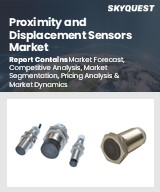
Global Proximity and Displacement Sensors Market
Proximity and Displacement Sensors Market

Report ID: SQMIG45K2182

sales@skyquestt.com
USA +1 351-333-4748

Proximity and Displacement Sensors Market Size, Share, and Growth Analysis

Global Proximity and Displacement Sensors Market

Proximity and Displacement Sensors Market By Type (Inductive Proximity Sensors, Capacitive Proximity Sensors), By Technology (Analog Sensors, Digital Sensors), By Application, By End-User Industry, By Output Type, By Region - Industry Forecast 2026-2033


Report ID: SQMIG45K2182 | Region: Global | Published Date: December, 2025
Pages: 184 |Tables: 64 |Figures: 68

Format - word format excel data power point presentation

Proximity and Displacement Sensors Market Insights

Global Proximity and Displacement Sensors Market size was valued at USD 7.58 Billion in 2024 and is poised to grow from USD 8.33 Billion in 2025 to USD 17.73 Billion by 2033, growing at a CAGR of 9.9% during the forecast period (2026–2033).

The global proximity and displacement sensors market growth is fueled by increasing demand for high-precision sensing solutions, advancements in automation and robotics technologies, and expanding applications in various industrial and consumer electronics sectors. Future manufacturing and smart infrastructure industries across the globe are focusing on the development of advanced automation systems and on the deployment of high-performance sensors for next-generation industrial, automotive, and consumer applications.

    • For instance, the use of proximity and displacement sensors, has expanded due to the growing emphasis on Industry 4.0 and IoT-based automation on a global scale. This covers their function in autonomous machinery, predictive maintenance systems and sophisticated robotics. High-accuracy sensors are especially in demand in regions like North America, Europe and emerging Asian markets that have strong manufacturing and electronics production capacities. It is anticipated that the use of proximity and displacement sensors in sophisticated automation systems and real-time monitoring applications will continue to be fueled by public-private partnerships, similar to Japan’s Society 5.0 initiative. This program is part of a broader commitment to build robust smart infrastructure networks and improve operational efficiency globally.

The global proximity and displacement sensors industry has witnessed several advancements, and innovations that have spurred technological development. Predictive and adaptive sensing capabilities are now possible, thanks to the transformation of sensing systems data processing and interpretation processes brought about by artificial intelligence (AI), and machine learning (ML). Additionally, the adoption of sensors in energy-sensitive applications is increasingly being driven by energy conservation through low-power consumption designs and environmentally friendly manufacturing.

What Makes AI Integration Crucial for Next-Gen Proximity and Displacement Sensor Applications?

Artificial intelligence (AI) is enabling real-time, adaptive sensing and predictive maintenance, which is massively changing the global proximity, and displacement sensors market outlook. AI-enabled sensor platforms draw upon data such as machine operating patterns, environmental conditions, and wear indicators to optimize detection parameters, improve accuracy, and reduce downtime. AI-powered industrial systems with dynamic sensing capabilities that automatically adjust sensitivity and range depending on operating environments are being deployed in major factories and autonomous systems. Moreover, advanced AI-powered control units are being launched that use predictive analytics to adjust sensor thresholds in real-time, improving operational efficiency and safety.

Market snapshot - 2026-2033

Global Market Size

USD 6.9 billion

Largest Segment

Non-Contact Sensing

Fastest Growth

Contact Sensing

Growth Rate

9.9% CAGR

Proximity and Displacement Sensors Market 2026-2033 ($ Bn)
Country Share for North America 2025 (%)

To get more insights on this market click here to Request a Free Sample Report

Proximity and Displacement Sensors Market Segments Analysis

Global Proximity and Displacement Sensors Market is segmented by Type, Technology, Application, End-User Industry, Output Type and region. Based on Type, the market is segmented into Inductive Proximity Sensors, Capacitive Proximity Sensors, Photoelectric Sensors, Ultrasonic Sensors, Lidar Sensors and Magnetic Proximity Sensors. Based on Technology, the market is segmented into Analog Sensors, Digital Sensors and Smart Sensors. Based on Application, the market is segmented into Automotive Industry, Aerospace and Defense, Industrial Automation, Consumer Electronics, Robotics and Healthcare Equipment. Based on End-User Industry, the market is segmented into Manufacturing, Oil and Gas, Mining, Food and Beverage, Pharmaceuticals and Building Automation. Based on Output Type, the market is segmented into Normally Open (NO), Normally Closed (NC), Digital Output and Analog Output. Based on region, the market is segmented into North America, Europe, Asia Pacific, Latin America and Middle East & Africa.

Why Are Industrial Automation Applications More Dominant Than Others?

Based on global proximity and displacement sensors market forecast, Non-contact sensing dominates the global market due to its advantages in speed, accuracy, and durability. It avoids mechanical wear, works in extreme conditions, and can detect moving or fragile targets. The rising adoption in Industry 4.0, autonomous vehicles, and semiconductor manufacturing is accelerating its demand compared to traditional contact-based methods.

Contact sensing remains relevant in cost-sensitive markets and in environments where physical contact does not hinder performance, such as rugged machinery or simple position switches. Its low cost, straightforward installation, and high mechanical resistance make it ideal for certain industrial automation and mechanical assembly applications.

What Makes Inductive and Optical Sensors Essential in Industrial Automation?

As per global proximity and displacement sensors market analysis, because of their extensive application in industrial robotics, quality inspection systems and manufacturing automation, as well as their exceptional resilience in challenging conditions, inductive sensors remain at the forefront. To improve production efficiency, and lower defect rates, for instances, a major European robotics manufacturer installed high-speed inductive sensors, on its assembly line in May 2025.

In the meantime, optical displacement sensors are becoming more popular, for uses that call for a high degree of precision, like the assembly of consumer electronics, medical equipment and semiconductors. Because of their micron-level accuracy, these sensors are essential for high-tech industries measurement, and inspection procedures.

Proximity and Displacement Sensors Market By Technology 2026-2033

To get detailed segments analysis, Request a Free Sample Report

Proximity and Displacement Sensors Market Regional Insights

Why Does North America Lead the Proximity and Displacement Sensors Market?

As per proximity and displacement sensors market regional forecast, because of its sophisticated manufacturing infrastructure, significant R&D expenditures and stringent quality and safety regulations, North America is the leader. In addition to securing supply chains for state-of-the-art, non-contact sensing solutions, the region's strategic focus on AI-integrated, high-precision sensors has enhanced its position in industries like industrial automation, automotive safety and aerospace.

U.S. Proximity and Displacement Sensors Market

The growing use of sensors in autonomous vehicles, smart manufacturing systems and industrial robotics is driving the growth of the U.S. market. Industry data from 2024 shows that the demand for precision and predictive maintenance led to a sharp increase in the use of optical and inductive sensors in production lines and quality control procedures. Advanced displacement sensors are being used by manufacturers more to improve operational effectiveness, protect worker safety, and open up new markets for consumer and industrial electronics applications.

Canada Proximity and Displacement Sensors Market

Canada’s proximity and displacement sensors market is expanding rapidly, particularly in mining automation, aerospace engineering, and precision manufacturing in Ontario and Quebec. Growing investment in AI-enabled industrial systems, ruggedized sensor solutions, and sustainable manufacturing practices—along with a strong focus on supply chain transparency—underscores this regional growth.

Why Is Asia-Pacific the Fastest-Growing Region for Proximity and Displacement Sensors?

The fastest-growing market is Asia-Pacific, which is being fueled by growing automotive manufacturing, increased electronics production and fast industrialization. The proximity and displacement sensors market revenue in about USD 8.2 billion. In order to meet both domestic and international quality standards, manufacturers are incorporating cutting-edge sensing technologies like laser displacement, and ultrasonic sensors, which allow for high-volume production while preserving accuracy and efficiency.

South Korea Proximity and Displacement Sensors Market

South Korea leads innovation in semiconductor and display panel manufacturing, industries that require micron-level measurement accuracy. High-performance optical displacement sensors are being deployed in chip fabrication and quality inspection setting a global benchmark for precision sensing in high-value manufacturing environments.

Japan Proximity and Displacement Sensors Market

The Japanese proximity and displacement sensors market is recognized for its role in robotics, automotive safety systems, and healthcare devices. Specialized non-contact sensors are widely used in high-precision industrial automation, driver-assistance systems and surgical robotics, in line with Japan's dedication to miniaturization and ultra-reliable engineering.

How Is Europe Balancing Innovation, and Regulatory Compliance in the Proximity and Displacement Sensors Market?

Based on proximity and displacement sensors market regional outlook, high levels of innovation are combined with rigorous adherence to quality and safety and environmental standards in Europe. Leading companies implemented AI-enhanced manufacturing techniques, energy-efficient designs, and RoHS-compliant designs in 2025. Sensor solutions with multilingual documentation and streamlined cross-border logistics are improving market accessibility across EU member states.

UK Proximity and Displacement Sensors Market

In 2024, the UK strengthened its position in advanced manufacturing, and autonomous systems testing. Prominent corporations increased their production capacity for automotive electronics, and smart factory equipment, by integrating high-reliability sensors with real-time quality monitoring. By creating environmentally friendly sensor designs, and giving priority to traceable, ethically sourced raw materials, the market is also embracing sustainability.

Germany Proximity and Displacement Sensors Market

AI-based process controls in sensor manufacturing are being propelled by Industry 4.0 adoption, in Germany. In 2025, a significant German automation company modernized its production lines in Munich and Berlin, allowing for batch-to-batch performance optimization, and dynamic calibration for proximity and displacement sensors. This guarantees product uniformity, satisfies a range of client requirements, and upholds Germany's position, as a leader in precision engineering.

France Proximity and Displacement Sensors Market

In France, strong R&D activity in aerospace and healthcare has accelerated the adoption of high-precision displacement sensors. The market demonstrated its readiness to increase production of cutting-edge sensing solutions as Paris hosted significant technology and automation expos. A top French aerospace company raised, the bar for operational safety in 2025, with the introduction of a next-generation navigation, and collision avoidance system driven by AI-enhanced proximity sensors.

Proximity and Displacement Sensors Market By Geography, 2026-2033
  • Largest
  • Fastest

To know more about the market opportunities by region and country, click here to
Buy The Complete Report

Proximity and Displacement Sensors Market Dynamics

Proximity and Displacement Sensors Market Drivers

Industrial Automation Expansion

  • The expanding industrial automation and smart manufacturing sector is a significant driver increasing the proximity and displacement sensors market size. In robotics, assembly lines, and quality control systems these sensors are essential for accurate measurement position detection and process optimization. The demand for sophisticated highly reliable sensors is anticipated to soar as Industry 4.0 adoption picks up speed worldwide, propelling market expansion, and industry penetration as a whole.

Consumer Electronics Demand

  • The proximity and displacement sensors market share are increasing, due to their growing integration in smartphones, wearables, and gaming devices. Manufacturers are being forced to use smaller, more energy-efficient sensors, due to growing consumer preferences for touchless control, gesture recognition, and improved user interfaces. Their dominance in the consumer electronics market and their growth into new application areas are directly attributed to this trend, which is fueled by the quick advancements in semiconductor technology.

Proximity and Displacement Sensors Market Restraints

Availability of Low-Cost Alternatives

  • The availability of inexpensive optical, ultrasonic and infrared sensors, with comparable features places limitations on the market. The proximity and displacement sensors market penetration may be impeded by competitive pricing and satisfactory performance in cost-sensitive applications. Despite the benefits of high accuracy, and durability, supply chain consistency and component cost frequently affect procurement decisions providing alternative technologies, a chance to gain market share.

Stringent Industry Standards

  • Navigating stringent performance, safety, and certification requirements in sectors like automotive, aerospace, and medical devices can slow proximity and displacement sensors market growth. Compliance with ISO, IEC, and regional regulatory standards raises production complexity and cost. Smaller sensor manufacturers may face barriers to entry, while extended testing and approval timelines can delay product launches, limiting rapid adoption across high-growth industry verticals.

Request Free Customization of this report to help us to meet your business objectives.

Proximity and Displacement Sensors Market Competitive Landscape

There is fierce competition in the global proximity and displacement sensors market, from both domestic and foreign businesses, that are dedicated to growth and innovation. To stay ahead of the competition, leaders make investments in cutting-edge sensing technologies, AI integration, and strategic partnerships with electronics, automotive and automation manufacturers. Acquisitions and mergers improve product portfolios, increase production capacity, and hasten entry into new application domains like smart infrastructure, and autonomous systems. Furthermore, robust local distribution networks, and customized sensor solutions enable companies to cater to a diverse base of industrial and consumer customers. Through quality, technological leadership, and market flexibility, these proximity and displacement sensor market strategies will lay the groundwork for high performers' sustained success.

  • Founded in 2018, In the USA, Nodar creates cutting-edge 3D depth sensing systems using common automotive-grade cameras, allowing for accurate measurement for uses in robotics, industrial automation and driverless cars. Their HammerheadTM platform maintains resilience against environmental stressors like vibration, moisture, dust and changing light levels, while providing accuracy appropriate for, SAE Level 3 and Level 4 autonomy.
  • Founded in 2022, Sonair is a Norwegian company and is a pioneer in the development of advanced robotics, autonomous systems, and industrial applications using ultrasonic ADAR (Acoustic Detection and Ranging) sensing technology. Their sensors allow for dependable, high-resolution 3D mapping in conditions like dust, fog, or low light levels where optical systems, are less effective. The company's cutting-edge signal processing reduces latency while improving object detection accuracy.

Top Players in Proximity and Displacement Sensors Market

  • OMRON Corporation (Japan)
  • KEYENCE Corporation (Japan)
  • SICK AG (Germany)
  • Pepperl+Fuchs GmbH (Germany)
  • Balluff GmbH (Germany)
  • Honeywell International Inc. (USA)
  • ifm electronic gmbh (Germany)
  • Panasonic Corporation (Japan)
  • Rockwell Automation (USA)
  • Hans Turck GmbH & Co. KG (Germany)
  • TE Connectivity (Switzerland)
  • STMicroelectronics (Switzerland)
  • Baumer Holding AG (Switzerland)
  • ABB Ltd (Switzerland)
  • Infineon Technologies AG (Germany)
  • Micro-Epsilon Messtechnik GmbH & Co. KG (Germany)
  • Broadcom (USA)
  • Banner Engineering Corp. (USA)
  • Renesas Electronics Corporation (Japan)
  • Continental AG (Germany)

Recent Developments in Proximity and Displacement Sensors Market

  • In April 2024, the LK-HD50 laser displacement sensor which has an ultra-high 0.1µm resolution and is intended for semiconductor wafer inspection and other precision manufacturing applications, was introduced by Keyence Corporation.
  • In February 2024, Sick AG added new detection capabilities to its automation technology product line with the release of the W10 photoelectric proximity sensor. Furthermore, in line with their continuous innovation in proximity, and displacement sensors Sick AG introduced the RMS2000 2D radar sensor in December 2024 which features cutting-edge FMCW radar technology for high-precision sensing.
  • In March 2024, to improve accuracy and automation, in the electric vehicle (EV) manufacturing industry, Rockwell Automation introduced new ultra-thin inductive proximity sensors that are especially made for small robotic arms.

Proximity and Displacement Sensors Key Market Trends

Proximity and Displacement Sensors Market SkyQuest Analysis

SkyQuest’s ABIRAW (Advanced Business Intelligence, Research & Analysis Wing) is our Business Information Services team that Collects, Collates, Correlates, and Analyses the Data collected by means of Primary Exploratory Research backed by robust Secondary Desk research.

As per SkyQuest analysis, the expansion of Industry 4.0, growing automation in manufacturing, and growing use in automotive safety systems are all contributing factors to the steady growth of the global market for proximity and displacement sensors. Demand is rising across a range of industries, including consumer electronics, industrial automation, healthcare, defense and aerospace, thanks to technological developments like enhanced sensing accuracy, miniaturization and IoT integration. North America and Europe concentrate on cutting-edge applications, while Asia-Pacific maintains its dominance, due to its fast industrialization. With continued innovation, growing end-use sectors, and an increasing focus on non-contact sensing technologies, the market outlook is favorable.

Report Metric Details
Market size value in 2024 USD 7.58 Billion
Market size value in 2033 USD 17.73 Billion
Growth Rate 9.9%
Base year 2024
Forecast period 2026-2033
Forecast Unit (Value) USD Billion
Segments covered
  • Type
    • Inductive Proximity Sensors ,Capacitive Proximity Sensors ,Photoelectric Sensors ,Ultrasonic Sensors ,Lidar Sensors ,Magnetic Proximity Sensors
  • Technology
    • Analog Sensors ,Digital Sensors ,Smart Sensors
  • Application
    • Automotive Industry ,Aerospace and Defense ,Industrial Automation ,Consumer Electronics ,Robotics ,Healthcare Equipment
  • End-User Industry
    • Manufacturing ,Oil and Gas ,Mining ,Food and Beverage ,Pharmaceuticals ,Building Automation
  • Output Type
    • Normally Open (NO) ,Normally Closed (NC) ,Digital Output ,Analog Output
Regions covered North America (US, Canada), Europe (Germany, France, United Kingdom, Italy, Spain, Rest of Europe), Asia Pacific (China, India, Japan, Rest of Asia-Pacific), Latin America (Brazil, Rest of Latin America), Middle East & Africa (South Africa, GCC Countries, Rest of MEA)
Companies covered
  • OMRON Corporation (Japan)
  • KEYENCE Corporation (Japan)
  • SICK AG (Germany)
  • Pepperl+Fuchs GmbH (Germany)
  • Balluff GmbH (Germany)
  • Honeywell International Inc. (USA)
  • ifm electronic gmbh (Germany)
  • Panasonic Corporation (Japan)
  • Rockwell Automation (USA)
  • Hans Turck GmbH & Co. KG (Germany)
  • TE Connectivity (Switzerland)
  • STMicroelectronics (Switzerland)
  • Baumer Holding AG (Switzerland)
  • ABB Ltd (Switzerland)
  • Infineon Technologies AG (Germany)
  • Micro-Epsilon Messtechnik GmbH & Co. KG (Germany)
  • Broadcom (USA)
  • Banner Engineering Corp. (USA)
  • Renesas Electronics Corporation (Japan)
  • Continental AG (Germany)
Customization scope

Free report customization with purchase. Customization includes:-

  • Segments by type, application, etc
  • Company profile
  • Market dynamics & outlook
  • Region

To get a free trial access to our platform which is a one stop solution for all your data requirements for quicker decision making. This platform allows you to compare markets, competitors who are prominent in the market, and mega trends that are influencing the dynamics in the market. Also, get access to detailed SkyQuest exclusive matrix.

Table Of Content

Executive Summary

Market overview

  • Exhibit: Executive Summary – Chart on Market Overview
  • Exhibit: Executive Summary – Data Table on Market Overview
  • Exhibit: Executive Summary – Chart on Proximity and Displacement Sensors Market Characteristics
  • Exhibit: Executive Summary – Chart on Market by Geography
  • Exhibit: Executive Summary – Chart on Market Segmentation
  • Exhibit: Executive Summary – Chart on Incremental Growth
  • Exhibit: Executive Summary – Data Table on Incremental Growth
  • Exhibit: Executive Summary – Chart on Vendor Market Positioning

Parent Market Analysis

Market overview

Market size

  • Market Dynamics
    • Exhibit: Impact analysis of DROC, 2021
      • Drivers
      • Opportunities
      • Restraints
      • Challenges
  • SWOT Analysis

KEY MARKET INSIGHTS

  • Technology Analysis
    • (Exhibit: Data Table: Name of technology and details)
  • Pricing Analysis
    • (Exhibit: Data Table: Name of technology and pricing details)
  • Supply Chain Analysis
    • (Exhibit: Detailed Supply Chain Presentation)
  • Value Chain Analysis
    • (Exhibit: Detailed Value Chain Presentation)
  • Ecosystem Of the Market
    • Exhibit: Parent Market Ecosystem Market Analysis
    • Exhibit: Market Characteristics of Parent Market
  • IP Analysis
    • (Exhibit: Data Table: Name of product/technology, patents filed, inventor/company name, acquiring firm)
  • Trade Analysis
    • (Exhibit: Data Table: Import and Export data details)
  • Startup Analysis
    • (Exhibit: Data Table: Emerging startups details)
  • Raw Material Analysis
    • (Exhibit: Data Table: Mapping of key raw materials)
  • Innovation Matrix
    • (Exhibit: Positioning Matrix: Mapping of new and existing technologies)
  • Pipeline product Analysis
    • (Exhibit: Data Table: Name of companies and pipeline products, regional mapping)
  • Macroeconomic Indicators

COVID IMPACT

  • Introduction
  • Impact On Economy—scenario Assessment
    • Exhibit: Data on GDP - Year-over-year growth 2016-2022 (%)
  • Revised Market Size
    • Exhibit: Data Table on Proximity and Displacement Sensors Market size and forecast 2021-2027 ($ million)
  • Impact Of COVID On Key Segments
    • Exhibit: Data Table on Segment Market size and forecast 2021-2027 ($ million)
  • COVID Strategies By Company
    • Exhibit: Analysis on key strategies adopted by companies

MARKET DYNAMICS & OUTLOOK

  • Market Dynamics
    • Exhibit: Impact analysis of DROC, 2021
      • Drivers
      • Opportunities
      • Restraints
      • Challenges
  • Regulatory Landscape
    • Exhibit: Data Table on regulation from different region
  • SWOT Analysis
  • Porters Analysis
    • Competitive rivalry
      • Exhibit: Competitive rivalry Impact of key factors, 2021
    • Threat of substitute products
      • Exhibit: Threat of Substitute Products Impact of key factors, 2021
    • Bargaining power of buyers
      • Exhibit: buyers bargaining power Impact of key factors, 2021
    • Threat of new entrants
      • Exhibit: Threat of new entrants Impact of key factors, 2021
    • Bargaining power of suppliers
      • Exhibit: Threat of suppliers bargaining power Impact of key factors, 2021
  • Skyquest special insights on future disruptions
    • Political Impact
    • Economic impact
    • Social Impact
    • Technical Impact
    • Environmental Impact
    • Legal Impact

Market Size by Region

  • Chart on Market share by geography 2021-2027 (%)
  • Data Table on Market share by geography 2021-2027(%)
  • North America
    • Chart on Market share by country 2021-2027 (%)
    • Data Table on Market share by country 2021-2027(%)
    • USA
      • Exhibit: Chart on Market share 2021-2027 (%)
      • Exhibit: Market size and forecast 2021-2027 ($ million)
    • Canada
      • Exhibit: Chart on Market share 2021-2027 (%)
      • Exhibit: Market size and forecast 2021-2027 ($ million)
  • Europe
    • Chart on Market share by country 2021-2027 (%)
    • Data Table on Market share by country 2021-2027(%)
    • Germany
      • Exhibit: Chart on Market share 2021-2027 (%)
      • Exhibit: Market size and forecast 2021-2027 ($ million)
    • Spain
      • Exhibit: Chart on Market share 2021-2027 (%)
      • Exhibit: Market size and forecast 2021-2027 ($ million)
    • France
      • Exhibit: Chart on Market share 2021-2027 (%)
      • Exhibit: Market size and forecast 2021-2027 ($ million)
    • UK
      • Exhibit: Chart on Market share 2021-2027 (%)
      • Exhibit: Market size and forecast 2021-2027 ($ million)
    • Rest of Europe
      • Exhibit: Chart on Market share 2021-2027 (%)
      • Exhibit: Market size and forecast 2021-2027 ($ million)
  • Asia Pacific
    • Chart on Market share by country 2021-2027 (%)
    • Data Table on Market share by country 2021-2027(%)
    • China
      • Exhibit: Chart on Market share 2021-2027 (%)
      • Exhibit: Market size and forecast 2021-2027 ($ million)
    • India
      • Exhibit: Chart on Market share 2021-2027 (%)
      • Exhibit: Market size and forecast 2021-2027 ($ million)
    • Japan
      • Exhibit: Chart on Market share 2021-2027 (%)
      • Exhibit: Market size and forecast 2021-2027 ($ million)
    • South Korea
      • Exhibit: Chart on Market share 2021-2027 (%)
      • Exhibit: Market size and forecast 2021-2027 ($ million)
    • Rest of Asia Pacific
      • Exhibit: Chart on Market share 2021-2027 (%)
      • Exhibit: Market size and forecast 2021-2027 ($ million)
  • Latin America
    • Chart on Market share by country 2021-2027 (%)
    • Data Table on Market share by country 2021-2027(%)
    • Brazil
      • Exhibit: Chart on Market share 2021-2027 (%)
      • Exhibit: Market size and forecast 2021-2027 ($ million)
    • Rest of South America
      • Exhibit: Chart on Market share 2021-2027 (%)
      • Exhibit: Market size and forecast 2021-2027 ($ million)
  • Middle East & Africa (MEA)
    • Chart on Market share by country 2021-2027 (%)
    • Data Table on Market share by country 2021-2027(%)
    • GCC Countries
      • Exhibit: Chart on Market share 2021-2027 (%)
      • Exhibit: Market size and forecast 2021-2027 ($ million)
    • South Africa
      • Exhibit: Chart on Market share 2021-2027 (%)
      • Exhibit: Market size and forecast 2021-2027 ($ million)
    • Rest of MEA
      • Exhibit: Chart on Market share 2021-2027 (%)
      • Exhibit: Market size and forecast 2021-2027 ($ million)

KEY COMPANY PROFILES

  • Competitive Landscape
    • Total number of companies covered
      • Exhibit: companies covered in the report, 2021
    • Top companies market positioning
      • Exhibit: company positioning matrix, 2021
    • Top companies market Share
      • Exhibit: Pie chart analysis on company market share, 2021(%)

Methodology

For the Proximity and Displacement Sensors Market, our research methodology involved a mixture of primary and secondary data sources. Key steps involved in the research process are listed below:

1. Information Procurement: This stage involved the procurement of Market data or related information via primary and secondary sources. The various secondary sources used included various company websites, annual reports, trade databases, and paid databases such as Hoover's, Bloomberg Business, Factiva, and Avention. Our team did 45 primary interactions Globally which included several stakeholders such as manufacturers, customers, key opinion leaders, etc. Overall, information procurement was one of the most extensive stages in our research process.

2. Information Analysis: This step involved triangulation of data through bottom-up and top-down approaches to estimate and validate the total size and future estimate of the Proximity and Displacement Sensors Market.

3. Report Formulation: The final step entailed the placement of data points in appropriate Market spaces in an attempt to deduce viable conclusions.

4. Validation & Publishing: Validation is the most important step in the process. Validation & re-validation via an intricately designed process helped us finalize data points to be used for final calculations. The final Market estimates and forecasts were then aligned and sent to our panel of industry experts for validation of data. Once the validation was done the report was sent to our Quality Assurance team to ensure adherence to style guides, consistency & design.

Analyst Support

Customization Options

With the given market data, our dedicated team of analysts can offer you the following customization options are available for the Proximity and Displacement Sensors Market:

Product Analysis: Product matrix, which offers a detailed comparison of the product portfolio of companies.

Regional Analysis: Further analysis of the Proximity and Displacement Sensors Market for additional countries.

Competitive Analysis: Detailed analysis and profiling of additional Market players & comparative analysis of competitive products.

Go to Market Strategy: Find the high-growth channels to invest your marketing efforts and increase your customer base.

Innovation Mapping: Identify racial solutions and innovation, connected to deep ecosystems of innovators, start-ups, academics, and strategic partners.

Category Intelligence: Customized intelligence that is relevant to their supply Markets will enable them to make smarter sourcing decisions and improve their category management.

Public Company Transcript Analysis: To improve the investment performance by generating new alpha and making better-informed decisions.

Social Media Listening: To analyze the conversations and trends happening not just around your brand, but around your industry as a whole, and use those insights to make better Marketing decisions.

$5,300

REQUEST FOR SAMPLE

Please verify that you're not a robot to proceed!
Want to customize this report? REQUEST FREE CUSTOMIZATION

FAQs

Global Proximity and Displacement Sensors Market size was valued at USD 7.58 Billion in 2024 and is poised to grow from USD 8.33 Billion in 2025 to USD 17.73 Billion by 2033, growing at a CAGR of 9.9% during the forecast period (2026–2033).

There is fierce competition in the global proximity and displacement sensors market, from both domestic and foreign businesses, that are dedicated to growth and innovation. To stay ahead of the competition, leaders make investments in cutting-edge sensing technologies, AI integration, and strategic partnerships with electronics, automotive and automation manufacturers. Acquisitions and mergers improve product portfolios, increase production capacity, and hasten entry into new application domains like smart infrastructure, and autonomous systems. Furthermore, robust local distribution networks, and customized sensor solutions enable companies to cater to a diverse base of industrial and consumer customers. Through quality, technological leadership, and market flexibility, these proximity and displacement sensor market strategies will lay the groundwork for high performers' sustained success. 'OMRON Corporation (Japan)', 'KEYENCE Corporation (Japan)', 'SICK AG (Germany)', 'Pepperl+Fuchs GmbH (Germany)', 'Balluff GmbH (Germany)', 'Honeywell International Inc. (USA)', 'ifm electronic gmbh (Germany)', 'Panasonic Corporation (Japan)', 'Rockwell Automation (USA)', 'Hans Turck GmbH & Co. KG (Germany)', 'TE Connectivity (Switzerland)', 'STMicroelectronics (Switzerland)', 'Baumer Holding AG (Switzerland)', 'ABB Ltd (Switzerland)', 'Infineon Technologies AG (Germany)', 'Micro-Epsilon Messtechnik GmbH & Co. KG (Germany)', 'Broadcom (USA)', 'Banner Engineering Corp. (USA)', 'Renesas Electronics Corporation (Japan)', 'Continental AG (Germany)'

The expanding industrial automation and smart manufacturing sector is a significant driver increasing the proximity and displacement sensors market size. In robotics, assembly lines, and quality control systems these sensors are essential for accurate measurement position detection and process optimization. The demand for sophisticated highly reliable sensors is anticipated to soar as Industry 4.0 adoption picks up speed worldwide, propelling market expansion, and industry penetration as a whole.

Shift Towards Energy-Efficient and Eco-Friendly Sensor Technologies: The growing demand for eco-friendly, energy-efficient sensors that reduce power consumption and environmental impact is a major proximity and displacement sensors market trend. In order to satisfy industry, and consumer demands, this trend is driving businesses to innovate in sensor miniaturization, and create more environmentally friendly production methods.

As per proximity and displacement sensors market regional forecast, because of its sophisticated manufacturing infrastructure, significant R&D expenditures and stringent quality and safety regulations, North America is the leader. In addition to securing supply chains for state-of-the-art, non-contact sensing solutions, the region's strategic focus on AI-integrated, high-precision sensors has enhanced its position in industries like industrial automation, automotive safety and aerospace.
AGC3x.webp
Aisin3x.webp
ASKA P Co. LTD3x.webp
BD3x.webp
BILL & MELIDA3x.webp
BOSCH3x.webp
CHUNGHWA TELECOM3x.webp
DAIKIN3x.webp
DEPARTMENT OF SCIENCE & TECHNOLOGY3x.webp
ETRI3x.webp
Fiti Testing3x.webp
GERRESHEIMER3x.webp
HENKEL3x.webp
HITACHI3x.webp
HOLISTIC MEDICAL CENTRE3x.webp
Institute for information industry3x.webp
JAXA3x.webp
JTI3x.webp
Khidi3x.webp
METHOD.3x.webp
Missul E&S3x.webp
MITSUBISHI3x.webp
MIZUHO3x.webp
NEC3x.webp
Nippon steel3x.webp
NOVARTIS3x.webp
Nttdata3x.webp
OSSTEM3x.webp
PALL3x.webp
Panasonic3x.webp
RECKITT3x.webp
Rohm3x.webp
RR KABEL3x.webp
SAMSUNG ELECTRONICS3x.webp
SEKISUI3x.webp
Sensata3x.webp
SENSEAIR3x.webp
Soft Bank Group3x.webp
SYSMEX3x.webp
TERUMO3x.webp
TOYOTA3x.webp
UNDP3x.webp
Unilever3x.webp
YAMAHA3x.webp
Yokogawa3x.webp

Want to customize this report? This report can be personalized according to your needs. Our analysts and industry experts will work directly with you to understand your requirements and provide you with customized data in a short amount of time. We offer $1000 worth of FREE customization at the time of purchase.

Feedback From Our Clients


