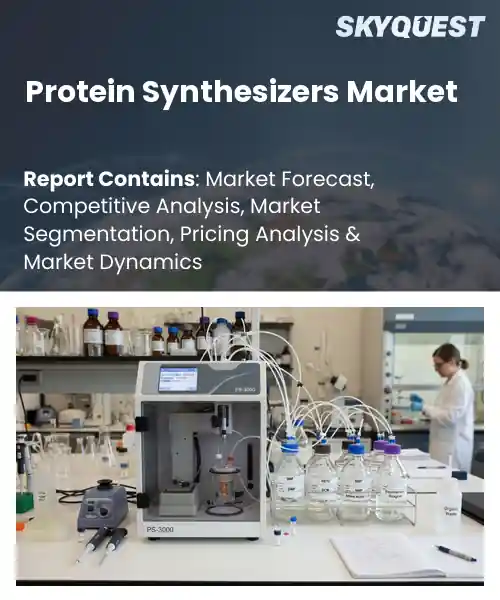
Protein Synthesizers Market
Report ID: SQMIG35J2816
Report ID: SQMIG35J2816
[email protected]
USA +1 351-333-4748
Report ID:
SQMIG35J2816 |
Region:
Global |
Published Date: September, 2026
Pages:
157
|Tables:
125
|Figures:
77


Global Protein Synthesizers Market size was valued at USD 408.88 Million in 2024 and is poised to grow from USD 438.81 Million in 2025 to USD 772.19 Million by 2033, growing at a CAGR of 7.32% during the forecast period (2026-2033).
The global protein synthesizer market encompasses instruments that automate ribosomal translation for research, therapeutic development, and industrial protein production. Its importance lies in accelerating drug discovery, reducing time‑to‑market for biologics, and enabling scalable manufacturing of enzymes and vaccines. Historically, the market emerged from early batch‑wise cell‑free systems in the 1990s, progressed to high‑throughput microfluidic platforms in the 2000s, and now features fully integrated, AI‑guided synthesizers capable of producing gram‑scale proteins in under 24 hours. This evolution reflects rising demand for rapid prototyping, exemplified by the rapid synthesis of SARS‑CoV‑2 spike protein during the pandemic, which underscored the technology’s strategic value for future resilience. The next critical driver of market expansion is the convergence of synthetic biology and personalized medicine, which creates a fertile ground for protein synthesizers to address bespoke therapeutic needs. As researchers design patient‑specific antibodies or enzyme replacement therapies, the ability to produce small batches on demand reduces reliance on bioreactors and shortens supply chains. Companies such as Twist Bioscience have launched on‑demand synthesis services that cut lead times from months to days, unlocking opportunities in oncology where iteration of checkpoint inhibitor variants accelerates clinical validation. Consequently, investment flows toward modular, cloud‑connected devices, promising higher utilization rates and revenue models for contract research organizations.
How is AI-driven automation reshaping the protein synthesizers market?
AI driven automation is redefining the protein synthesizers market by linking machine learning with high throughput synthesis hardware. Algorithms now predict optimal reaction pathways, reducing trial cycles and enabling rapid scale up of complex proteins. Integrated robotic workstations handle reagent dispensing, purification and quality checks without human intervention, which shortens development timelines and improves reproducibility. Vendors are embedding AI modules into existing platforms, allowing users to customize protocols through intuitive software interfaces. This shift is attracting biotech startups and large pharmaceutical labs alike, as the technology promises lower operational costs and faster access to novel therapeutics.Thermo Fisher Scientific March 2024, introduced an AI integrated automated protein synthesizer that combines real time data analytics with robotic pipetting to streamline purification and validation steps. The system accelerates workflow efficiency and supports higher throughput, reinforcing market growth by delivering consistent protein quality with reduced hands on time.
Market snapshot - (2026-2033)
Global Market Size
USD 408.88 Million
Largest Segment
Peptide Synthesizers
Fastest Growth
RNA Synthesizers
Growth Rate
7.32% CAGR
To get more insights on this market click here to Request a Free Sample Report
Global protein synthesizers market is segmented by synthesizer type, synthesis method, application, end user and region. Based on synthesizer type, the market is segmented into Peptide Synthesizers, DNA Synthesizers, RNA Synthesizers, Automated Protein Synthesis Systems and Others. Based on synthesis method, the market is segmented into Solid-Phase Synthesis, Liquid-Phase Synthesis, Cell-Free Synthesis and Hybrid Synthesis. Based on application, the market is segmented into Drug Discovery, Proteomics, Molecular Biology, Biotechnology Research, Academic Research and Others. Based on end user, the market is segmented into Pharmaceutical Companies, Biotechnology Companies, Academic and Research Institutions, Contract Research Organizations and Others. Based on region, the market is segmented into North America, Europe, Asia Pacific, Latin America and Middle East & Africa.
Peptide Synthesizers segment dominates because they provide precise control over amino‑acid coupling, enabling rapid generation of high‑purity peptides essential for early‑stage drug screening. Their flexibility, scalability, and compatibility with existing workflows reduce lead‑time for candidate validation, making them the preferred choice for companies seeking efficient discovery pipelines. Additionally, the mature chemistry and robust automation platforms lower operational risk and simplify regulatory submission, further reinforcing their leadership in the market landscape.
However, Automated Protein Synthesis Systems are witnessing the strongest growth momentum because advances in miniaturized reactors and AI‑driven protocol optimization are expanding their utility beyond academic labs into industrial pipelines. Their ability to produce full‑length proteins rapidly creates new avenues for therapeutic development, thereby accelerating overall market expansion.
Cell‑Free Synthesis segment dominates because it eliminates the need for living cells, enabling protein production without cellular constraints. This freedom accelerates prototyping, lowers contamination risk, and simplifies scale‑up, attracting innovators who require turn‑around. The open format also permits incorporation of special amino acids, expanding functional diversity and meeting the demands of biotechnology research pipelines. Moreover, reduced dependence on cell facilities cuts capital costs and shortens preparation, further cementing its market leadership.
On the other hand, Hybrid Synthesis is emerging as the key high‑growth area because it integrates the precision of solid‑phase chemistry with the scalability of liquid‑phase processes, unlocking new capabilities for complex protein assembly. These combined advantages are driving broader adoption across emerging therapeutic modalities, propelling market expansion and spurring investment in next‑generation platforms.
To get detailed segments analysis, Request a Free Sample Report
North America secures its leadership through a convergence of deep scientific expertise, substantial investment ecosystems, and a regulatory framework that balances safety with rapid innovation. The region’s premier research universities and biotech clusters generate continuous pipeline advancements, while a culture of venture capital and strategic corporate partnerships fuels scale‑up capabilities. Collaborative networks bridge pharmaceutical manufacturers, contract research organizations, and technology developers, creating a seamless pathway from discovery to commercial application. Moreover, a forward‑looking policy environment encourages adoption of next‑generation synthesis platforms, positioning the market to respond swiftly to emerging therapeutic demands and complex biologics challenges.
Protein Synthesizers Market in the United States thrives on an extensive network of research universities, biotech clusters, and a culture of venture‑backed innovation that accelerates technology translation. Robust federal and private funding streams empower startups and established firms alike, while streamlined regulatory pathways encourage rapid product development. Collaborative ecosystems linking pharmaceutical giants, contract manufacturing organizations, and academic laboratories further reinforce market depth and sustain a steady flow of advanced synthesis solutions.
Protein Synthesizers Market in Canada benefits from strong governmental support for life‑science research and a collaborative approach that links provincial research institutes with international partners. The presence of premier academic centers and a growing cohort of biotech incubators nurtures talent and drives early‑stage technology adoption. Favorable trade agreements and a commitment to sustainable manufacturing practices attract multinational players seeking to leverage Canadian expertise, thereby enriching the regional ecosystem and expanding the scope of protein synthesis capabilities.
Europe’s expansion is propelled by coordinated research initiatives, substantial public and private funding, and a strategic emphasis on sustainable biomanufacturing. The region’s mature pharmaceutical sector actively integrates advanced synthesis technologies to address complex therapeutic pipelines, while regulatory harmonization across member states streamlines market entry. Strong collaborations between leading universities, research consortia, and innovative startups foster a fertile environment for knowledge exchange and technology diffusion. Additionally, an increasing focus on green chemistry and circular economy principles aligns market growth with broader environmental objectives, reinforcing Europe’s position as a forward‑looking hub for protein synthesis advancement.
Protein Synthesizers Market in Germany is anchored by a robust engineering heritage and a dense cluster of biotechnological research institutions that drive precision‑focused innovation. Government‑backed research programs and strong industry‑academic partnerships accelerate development cycles, while the presence of leading pharmaceutical manufacturers ensures rapid adoption of cutting‑edge synthesis platforms. Emphasis on high‑value specialty therapeutics and commitment to quality standards further consolidate Germany’s dominant role within the European landscape.
Protein Synthesizers Market in the United Kingdom experiences accelerated growth through dynamic collaboration between world‑class universities, biotech accelerators, and a thriving venture capital community. The country’s strategic focus on translational research and personalized medicine creates a fertile ground for novel protein synthesis applications. Streamlined regulatory guidance and active policy support for life‑science innovation encourage rapid commercialization, positioning the United Kingdom as the fastest‑growing hub for advanced synthesis technologies across Europe.
Protein Synthesizers Market in France is emerging as a key contributor driven by strong public research institutions and a growing network of biotech startups. Emphasis on collaborative projects that blend academic excellence with industrial expertise stimulates the development of innovative synthesis methods. Supportive government initiatives and a commitment to sustainable production practices attract international partnerships, fostering an ecosystem that nurtures emerging technologies and expands the market footprint within the region.
Asia Pacific advances its position through strategic investments in high‑tech infrastructure, a surge in biotech entrepreneurship, and an emphasis on integrating digital tools with biological manufacturing. Countries within the region leverage strong governmental incentives to build state‑of‑the‑art research facilities that attract global talent and encourage cross‑border collaborations. A focus on scalable, cost‑effective production aligns with regional demand for affordable therapeutics, while emerging expertise in artificial intelligence and automation enhances process efficiency. This combination of policy support, talent development, and technological convergence propels the region toward a more influential role in the global protein synthesizers landscape.
Protein Synthesizers Market in Japan benefits from a legacy of precision engineering and a concentrated effort to merge robotics with bioprocessing. Leading research universities collaborate closely with pharmaceutical conglomerates, fostering an environment where advanced synthesis platforms can be rapidly prototyped and scaled. Government initiatives emphasizing advanced manufacturing and health‑technology innovation provide a supportive backdrop that accelerates market maturation and adoption of next‑generation protein synthesis solutions.
Protein Synthesizers Market in South Korea is energized by aggressive investment in bio‑technology clusters and a strong culture of digital innovation. Partnerships between leading universities, semiconductor‑style manufacturing expertise, and biotech firms create synergistic pathways for developing highly efficient synthesis technologies. Policy frameworks that prioritize research commercialization and export‑oriented growth amplify the country’s capability to position itself as a pivotal player in the broader Asia Pacific protein synthesis ecosystem.
To know more about the market opportunities by region and country, click here to
Buy The Complete Report
Increasing Demand for Sustainable Foods
Advances in Synthetic Biology Techniques
Regulatory Uncertainty Across Regions
High Capital Expenditure Requirements
Request Free Customization of this report to help us to meet your business objectives.
Top Player’s Company Profile
Recent Developments
SkyQuest’s ABIRAW (Advanced Business Intelligence, Research & Analysis Wing) is our Business Information Services team that Collects, Collates, Correlates, and Analyses the Data collected by means of Primary Exploratory Research backed by robust Secondary Desk research. As per SkyQuest analysis, the protein synthesizers market is propelled primarily by the fusion of synthetic biology with personalized medicine, which fuels demand for on‑demand small‑batch production and draws strong investment into modular cloud‑connected devices. A second powerful catalyst is AI‑driven automation that links machine‑learning models with robotic workstations, cutting cycle times and improving reproducibility. The peptide synthesizers segment remains the clear leader because its precise amino‑acid coupling accelerates early‑stage drug screening. However, uneven regulatory frameworks across countries create uncertainty and can slow investment decisions. North America dominates the landscape, benefiting from deep biotech expertise, abundant capital and a supportive policy environment that together sustain the market’s growth trajectory.
| Report Metric | Details |
|---|---|
| Market size value in 2024 | USD 408.88 Million |
| Market size value in 2033 | USD 772.19 Million |
| Growth Rate | 7.32% |
| Base year | 2024 |
| Forecast period | (2026-2033) |
| Forecast Unit (Value) | USD Million |
| Segments covered |
|
| Regions covered | North America (US, Canada), Europe (Germany, France, United Kingdom, Italy, Spain, Rest of Europe), Asia Pacific (China, India, Japan, Rest of Asia-Pacific), Latin America (Brazil, Rest of Latin America), Middle East & Africa (South Africa, GCC Countries, Rest of MEA) |
| Companies covered |
|
| Customization scope | Free report customization with purchase. Customization includes:-
|
To get a free trial access to our platform which is a one stop solution for all your data requirements for quicker decision making. This platform allows you to compare markets, competitors who are prominent in the market, and mega trends that are influencing the dynamics in the market. Also, get access to detailed SkyQuest exclusive matrix.
Table Of Content
Executive Summary
Market overview
Parent Market Analysis
Market overview
Market size
KEY MARKET INSIGHTS
COVID IMPACT
MARKET DYNAMICS & OUTLOOK
Market Size by Region
KEY COMPANY PROFILES
Methodology
For the Protein Synthesizers Market, our research methodology involved a mixture of primary and secondary data sources. Key steps involved in the research process are listed below:
1. Information Procurement: This stage involved the procurement of Market data or related information via primary and secondary sources. The various secondary sources used included various company websites, annual reports, trade databases, and paid databases such as Hoover's, Bloomberg Business, Factiva, and Avention. Our team did 45 primary interactions Globally which included several stakeholders such as manufacturers, customers, key opinion leaders, etc. Overall, information procurement was one of the most extensive stages in our research process.
2. Information Analysis: This step involved triangulation of data through bottom-up and top-down approaches to estimate and validate the total size and future estimate of the Protein Synthesizers Market.
3. Report Formulation: The final step entailed the placement of data points in appropriate Market spaces in an attempt to deduce viable conclusions.
4. Validation & Publishing: Validation is the most important step in the process. Validation & re-validation via an intricately designed process helped us finalize data points to be used for final calculations. The final Market estimates and forecasts were then aligned and sent to our panel of industry experts for validation of data. Once the validation was done the report was sent to our Quality Assurance team to ensure adherence to style guides, consistency & design.
Analyst Support
Customization Options
With the given market data, our dedicated team of analysts can offer you the following customization options are available for the Protein Synthesizers Market:
Product Analysis: Product matrix, which offers a detailed comparison of the product portfolio of companies.
Regional Analysis: Further analysis of the Protein Synthesizers Market for additional countries.
Competitive Analysis: Detailed analysis and profiling of additional Market players & comparative analysis of competitive products.
Go to Market Strategy: Find the high-growth channels to invest your marketing efforts and increase your customer base.
Innovation Mapping: Identify racial solutions and innovation, connected to deep ecosystems of innovators, start-ups, academics, and strategic partners.
Category Intelligence: Customized intelligence that is relevant to their supply Markets will enable them to make smarter sourcing decisions and improve their category management.
Public Company Transcript Analysis: To improve the investment performance by generating new alpha and making better-informed decisions.
Social Media Listening: To analyze the conversations and trends happening not just around your brand, but around your industry as a whole, and use those insights to make better Marketing decisions.
REQUEST FOR SAMPLE
 REQUEST FREE CUSTOMIZATION


Want to customize this report? This report can be personalized according to your needs. Our analysts and industry experts will work directly with you to understand your requirements and provide you with customized data in a short amount of time. We offer $1000 worth of FREE customization at the time of purchase.
Feedback From Our Clients


 USA (+1) 351-333-4748

