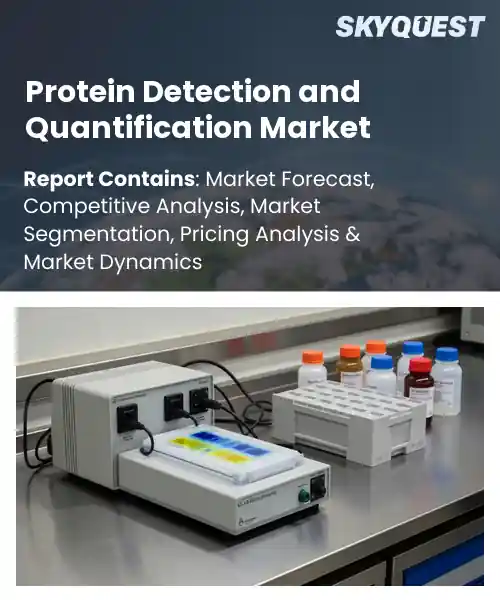
Protein Detection and Quantification Market
Report ID: SQMIG35J2318
Report ID: SQMIG35J2318
[email protected]
USA +1 351-333-4748
Report ID:
SQMIG35J2318 |
Region:
Global |
Published Date: May, 2026
Pages:
157
|Tables:
119
|Figures:
77


Global Protein Detection And Quantification Market size was valued at USD 2.52 Billion in 2024 and is poised to grow from USD 2.75 Billion in 2025 to USD 5.52 Billion by 2033, growing at a CAGR of 9.12% during the forecast period (2026-2033).
The primary driver of the protein detection and quantification market growth is the escalating demand for precise biomolecular measurement in research and clinical diagnostics, which has evolved from labor-intensive assays to high-throughput platforms. This market encompasses technologies such as ELISA, mass spectrometry, Western blotting and immunoassays, and it matters because accurate protein data underpin biomarker discovery, therapeutic development and patient stratification. Over time, advancements in sensitivity and speed have expanded applications from academic labs to biopharmaceutical production and point-of-care testing, illustrated by the adoption of LC-MS workflows in proteomics and lateral flow enhancements enabling antigen detection in infectious disease outbreaks globally.
The principal growth driver is the convergence of increased R&D investment and advances in automation, because larger budgets enable adoption of high-sensitivity instruments and automated workflows that increase throughput while lowering per-sample costs. As a result, biopharmaceutical companies can accelerate antibody characterization and therapeutic monitoring, which incentivizes vendors to develop multiplexed assays and data analysis. Consequently, broader clinical adoption emerges through affordable, validated tests used for cancer biomarker panels and vaccine immunogenicity studies, opening opportunities in decentralized testing, CROs and emerging markets where demand for scalable, robust protein assays continues to rise across clinical trials.
How is AI improving accuracy in the protein detection and quantification market?
Artificial intelligence is revolutionizing the field of protein detection and quantitation through its ability to integrate sophisticated pattern recognition algorithms with signal enhancement technologies and assay-aware calibration. The use of artificial intelligence (AI) in the lab improves the detection and quantitation of protein by using advanced technology such as machine learning, to minimize noise in protein assays from multiple sources; spectral deconvolution to separate overlapping peaks; quality control automations and confidence-scoring methods to help reduce false-positive rates and improve reproducibility of results. Many current manufacturers of laboratory instruments and commercial laboratory companies are integrating AI into their instrument acquisition and downstream applications in order to handle complex spectra and simultaneous assays. This represents a major shift in detecting and producing protein biomarker data, which has far-reaching implications for the reliability and scalability of discovery and diagnostic workflows, including examples of applying Convolutional Neural Networks (CNNs) to Surface-Enhanced Raman Spectroscopy (SERS) platforms and Next-Generation Sequencing (NGS) protein quantification workflow.
Illumina in January 2026, completed the acquisition of SomaLogic which integrates SOMAmer proteomics with Illumina sequencing and analytics and enables AI driven DRAGEN workflows to scale sensitive protein detection and improve quantification efficiency for clinical and research laboratories.
Market snapshot - (2026-2033)
Global Market Size
USD 2.52 Billion
Largest Segment
ELISA
Fastest Growth
Mass Spectrometry
Growth Rate
9.12% CAGR
To get more insights on this market click here to Request a Free Sample Report
Global protein detection and quantification market is segmented by technology, product, application, end-user and region. Based on technology, the market is segmented into Western Blotting, ELISA, Mass Spectrometry, Immunofluorescence and Flow Cytometry. Based on product, the market is segmented into Reagents & Kits, Instruments and Software. Based on application, the market is segmented into Drug Discovery, Biomarker Research and Clinical Diagnostics. Based on end-user, the market is segmented into Pharma & Biotech, Academic Research and CROs & CDMOs. Based on region, the market is segmented into North America, Europe, Asia Pacific, Latin America and Middle East & Africa.
ELISA segment dominates with large protein detection and quantification market share because its long standing validation, straightforward workflows, and compatibility with standardized kits make it the go to choice across laboratories. Robust reagent supply chains and clear regulatory acceptance reduce adoption barriers, while ease of automation and scalability support high throughput testing. This ubiquity in clinical diagnostics and biomarker validation drives steady demand from diverse users, reinforcing its central role in protein detection and quantification market dynamics.
As per protein detection and quantification market outlook, mass spectrometry segment is emerging as the fastest growing area because advances in instrument sensitivity, multiplexing, and label free quantification enable comprehensive proteome profiling for discovery research. Improved sample preparation workflows and stronger informatics pipelines drive broader adoption in complex biomarker characterization, unlocking new value applications and future market opportunities.
As per protein detection and quantification market analysis, reagents/kits segment has the biggest market share due to the fact that they offer users the validated components which are ready to go. These components help users develop their assays more easily and be more efficient when performing their laboratory workflows thereby lowering the technical difficulties associated with performing assays. Additionally, having a consistent level of quality, protocols that allow for easy use of the product, and having technical support provided by the vendor will help promote the average level of reliability and reproducibility obtained from using the reagents/kits will allow for users to want to reorder from the vendor and create a long-term partnership with that vendor.
As per protein detection and quantification market forecast, the software segment is experiencing the fastest rate of growth, as more sophisticated analytical and machine learning tools will address the increasing complexity of quantitative proteomic measurements. Improved instrumentation methods, automated data analysis, and regulatory compliant audit trails, will allow for quicker interpretation and better reproducibility of measurements thus speeding up the adoption by the research community and creating new opportunities for licensing and service.
To get detailed segments analysis, Request a Free Sample Report
As per protein detection and quantification market regional outlook, North America dominates the protein detection and quantification market owing to the confluence of profound scientific competence, dense concentration of biotechnology and pharmaceutical businesses and well developed clinical research infrastructure. Rapid commercialization and wide availability of sophisticated technology are the consequences of the region being a hub for major instrument and reagent makers. Strong translational ecosystems connect academic discovery to industrial development, and well-established regulatory procedures allow for the clinical acceptance of innovative assays. Strong financing channels and contract research organizations and a qualified workforce pool enable continued innovation. The high demand from healthcare, diagnostics and biopharma sectors drives early use of automation and multiplex platforms. Moreover, collaborative networks between industry, hospitals and laboratories speed up the approval and implementation of sensitive detection technologies.
As per protein detection and quantification market regional forecast, US market is growing in particular regions due to the presence of concentrated biotechnology centers, strong clinical research infrastructure and a dense presence of instrument and reagent producers. Strong translational pipelines, active contract research organizations, and strong engagement between academic institutes and industry accelerate the adoption of technologies. Regulatory clarity and established reimbursement systems facilitate the commercialization of novel assays. Private investment and specialized skill pools support continual innovation across diagnostic and research applications.
As per protein detection and quantification industry analysis, strong public research institutes and collaborative networks integrating universities and industry are driving protein detection and quantification industrial analysis in Canada. Regional clinical laboratories promote validation of assays and early use, while specialist service providers and manufacturers respond to specialty needs. Partnerships with broader markets across borders give better access to innovative platforms. A well-trained scientific workforce and concentration on translational research promote the use of sensitive detection technologies in research and therapeutic settings.
In Europe, protein detection and quantification is expanding rapidly in a dense network of world class research institutions, a strong industrial basis in diagnostics and instrument manufacture, and increased emphasis on precision medicine and biomarker driven development. The UK is known for flexible regulatory innovation and vibrant clinical trial activity that speed adoption; Germany has a strong manufacturing and research base. France is developing specialist capacities and regional hubs to transfer research into applied diagnostics. Cross country collaborations, pan regional funding initiatives and integrated health care systems provide fast validation and deployment of innovative assays. Established contract research providers and rising commercial service ecosystems are in place, reducing obstacles to market entrance and helping to create a vibrant scene for established firms and emerging innovators alike.
Germany has a solid manufacturing base for precision equipment and well-backed research organizations. Collaborative clusters link instrument producers, reagent suppliers, and academic centers to promote product refinement and validation. A culture of engineering excellence underpins trustworthy apparatus, and collaboration with clinical laboratories enables assay acceptance. Export orientation and collaborations with contract research firms widen reach into adjacent markets and specialized research fields.
United Kingdom is characterized by agile translational research, vibrant clinical trial activity, and strong life science clusters that accelerate commercial uptake. Flexible regulatory pathways and collaborative ecosystems between universities, hospitals, and industry encourage rapid validation of novel assays. A thriving contract research sector and entrepreneurial culture support companies bringing innovative detection platforms to market. Strategic international partnerships amplify visibility and adoption across European networks.
France is coming up with translational centers, specialized governmental research institutes and expanding links between industry and health care. The regional groups concentrate on assay development and clinical validation for focused applications. Local manufacturers and service providers respond to niche demand and national programs support technological transfer. More broadly, a trained scientific staff contributes to the translation of discoveries into practical detection solutions that meet domestic clinical demands and international markets.
Asia Pacific is increasing its position in protein detection and quantification by targeted funding of research infrastructure, growing capabilities of local manufacturers and increased engagement with global technology suppliers. Japan provides sophisticated instrument engineering and well-established laboratory networks that facilitate high-quality assay development, while South Korea benefits from rapid innovation ecosystems and strong links between industry and academic institutes to expedite platform refinement and clinical validation. Turning findings into useful diagnostics is a priority for governments and regional research institutes through translational programs. Cost-effective manufacturing, tailor-made solutions for local disease patterns, and the use of digital data streams boost competitiveness. Cross border cooperation are increasing and technical knowledge is developing across the area, helping to drive wider take up of sensitive detection platforms. This momentum is forming appealing circumstances for local scale up and global collaboration.
Japan benefits from precision engineering expertise, established instrument manufacturers, and integrated clinical laboratory networks that support assay validation. Strong partnerships between industrial research and academic institutions drive platform improvements. Emphasis on quality, regulatory compliance, and manufacturing excellence enables reliable deployment of detection systems. Local companies focus on high performance instrumentation and tailored reagent solutions, while collaborations with international firms broaden access to advanced methodologies.
South Korea is propelled by innovative ecosystems, government supported research programs and partnerships between technology corporations and medical facilities. Agile development and digital integration allow for rapid prototyping and validation of assays. Local enterprises stress small automated platforms, multiplex capability and regional clinical demands. Strategic partnerships with worldwide partners speed technology transfer, and a competent team facilitates expansion across research and clinical applications.
To know more about the market opportunities by region and country, click here to
Buy The Complete Report
Advancements In High Sensitivity Assays
Rising Adoption Of Multiplex Platforms
High Cost Of Advanced Instruments
Regulatory Complexity And Compliance
Request Free Customization of this report to help us to meet your business objectives.
Competitive activity in the global protein detection and quantification industry is accelerating, driven by demand for high plex and multiomics integration that pushes incumbent instrument makers toward consolidation, partnerships and platform diversification. Recent M&A and tech strategies include Thermo Fisher’s acquisition of Olink and Illumina’s acquisition of SomaLogic, while firms pursue spatial proteomics and single molecule sequencing to differentiate offerings.
SkyQuest’s ABIRAW (Advanced Business Intelligence, Research & Analysis Wing) is our Business Information Services team that Collects, Collates, Correlates, and Analyses the Data collected by means of Primary Exploratory Research backed by robust Secondary Desk research.
As per SkyQuest analysis, the global protein detection and quantification market trend is driven primarily by increasing demand for precise biomolecular measurement in research and clinical diagnostics, while a restraint is the high cost of advanced instruments that limits adoption in smaller labs. The dominating region is North America, supported by concentrated biotech hubs and funding, and the dominating segment is ELISA due to validated workflows and scalability. A second driver is the rise of automation and multiplex platforms that boost throughput and lower per-sample costs, enabling broader clinical and CRO adoption and fostering vendor innovation across consumables, instruments and software.
| Report Metric | Details |
|---|---|
| Market size value in 2024 | USD 2.52 Billion |
| Market size value in 2033 | USD 5.52 Billion |
| Growth Rate | 9.12% |
| Base year | 2024 |
| Forecast period | (2026-2033) |
| Forecast Unit (Value) | USD Billion |
| Segments covered |
|
| Regions covered | North America (US, Canada), Europe (Germany, France, United Kingdom, Italy, Spain, Rest of Europe), Asia Pacific (China, India, Japan, Rest of Asia-Pacific), Latin America (Brazil, Rest of Latin America), Middle East & Africa (South Africa, GCC Countries, Rest of MEA) |
| Companies covered |
|
| Customization scope | Free report customization with purchase. Customization includes:-
|
To get a free trial access to our platform which is a one stop solution for all your data requirements for quicker decision making. This platform allows you to compare markets, competitors who are prominent in the market, and mega trends that are influencing the dynamics in the market. Also, get access to detailed SkyQuest exclusive matrix.
Table Of Content
Executive Summary
Market overview
Parent Market Analysis
Market overview
Market size
KEY MARKET INSIGHTS
COVID IMPACT
MARKET DYNAMICS & OUTLOOK
Market Size by Region
KEY COMPANY PROFILES
Methodology
For the Protein Detection and Quantification Market, our research methodology involved a mixture of primary and secondary data sources. Key steps involved in the research process are listed below:
1. Information Procurement: This stage involved the procurement of Market data or related information via primary and secondary sources. The various secondary sources used included various company websites, annual reports, trade databases, and paid databases such as Hoover's, Bloomberg Business, Factiva, and Avention. Our team did 45 primary interactions Globally which included several stakeholders such as manufacturers, customers, key opinion leaders, etc. Overall, information procurement was one of the most extensive stages in our research process.
2. Information Analysis: This step involved triangulation of data through bottom-up and top-down approaches to estimate and validate the total size and future estimate of the Protein Detection and Quantification Market.
3. Report Formulation: The final step entailed the placement of data points in appropriate Market spaces in an attempt to deduce viable conclusions.
4. Validation & Publishing: Validation is the most important step in the process. Validation & re-validation via an intricately designed process helped us finalize data points to be used for final calculations. The final Market estimates and forecasts were then aligned and sent to our panel of industry experts for validation of data. Once the validation was done the report was sent to our Quality Assurance team to ensure adherence to style guides, consistency & design.
Analyst Support
Customization Options
With the given market data, our dedicated team of analysts can offer you the following customization options are available for the Protein Detection and Quantification Market:
Product Analysis: Product matrix, which offers a detailed comparison of the product portfolio of companies.
Regional Analysis: Further analysis of the Protein Detection and Quantification Market for additional countries.
Competitive Analysis: Detailed analysis and profiling of additional Market players & comparative analysis of competitive products.
Go to Market Strategy: Find the high-growth channels to invest your marketing efforts and increase your customer base.
Innovation Mapping: Identify racial solutions and innovation, connected to deep ecosystems of innovators, start-ups, academics, and strategic partners.
Category Intelligence: Customized intelligence that is relevant to their supply Markets will enable them to make smarter sourcing decisions and improve their category management.
Public Company Transcript Analysis: To improve the investment performance by generating new alpha and making better-informed decisions.
Social Media Listening: To analyze the conversations and trends happening not just around your brand, but around your industry as a whole, and use those insights to make better Marketing decisions.
REQUEST FOR SAMPLE
 REQUEST FREE CUSTOMIZATION
Global Protein Detection And Quantification Market size was valued at USD 2.52 Billion in 2024 and is poised to grow from USD 2.75 Billion in 2025 to USD 5.52 Billion by 2033, growing at a CAGR of 9.12% during the forecast period (2026-2033).
Competitive activity in the global protein detection and quantification market is accelerating, driven by demand for high plex and multiomics integration that pushes incumbent instrument makers toward consolidation, partnerships and platform diversification. Recent M&A and tech strategies include Thermo Fisher’s acquisition of Olink and Illumina’s acquisition of SomaLogic, while firms pursue spatial proteomics and single molecule sequencing to differentiate offerings. 'Thermo Fisher Scientific', 'Bio-Rad Laboratories', 'Abcam plc', 'Merck KGaA (Sigma-Aldrich)', 'Cell Signaling Technology', 'R&D Systems (Bio-Techne)', 'Promega Corporation', 'GE Healthcare Life Sciences', 'Jackson ImmunoResearch', 'Luminex Corporation', 'Meso Scale Diagnostics', 'Quansys Biosciences', 'Singulex Inc.', 'Quanterix Corporation', 'Simoa (Quanterix)', 'Creative Diagnostics', 'BioVision Inc.', 'Novus Biologicals', 'GeneTex Inc.', 'Mybiosource Inc.'
Advancements in assay sensitivity and specificity have enabled detection of low abundance proteins and subtle expression changes, increasing the reliability of experimental results and clinical diagnostics. Improved reagents, signal amplification strategies, and detector technologies have reduced ambiguity in measurements, allowing researchers and clinicians to adopt protein based assays with greater confidence. This broader acceptance drives demand for platforms and consumables, supports investment into novel detection technologies, and encourages translation of discoveries into product development, collectively fostering sustained market expansion and technology diversification.
Multi-Omics Platform Convergence: Integration of proteomics with genomics, transcriptomics, metabolomics and imaging-driven data is driving demand for versatile protein detection and quantification workflows. Stakeholders prioritize platforms that enable seamless sample-to-answer interoperability, richer biological context and streamlined biomarker discovery. This convergence encourages toolkits that support cross-platform data harmonization, modular assay design and collaborative cloud-based analysis, fostering translational research and personalized medicine applications while creating competitive differentiation through expanded utility and deeper insights across drug development and clinical research settings for broader patient-centric outcomes globally.
Why does North America Dominate the Global Protein Detection and Quantification Market? |@12


Want to customize this report? This report can be personalized according to your needs. Our analysts and industry experts will work directly with you to understand your requirements and provide you with customized data in a short amount of time. We offer $1000 worth of FREE customization at the time of purchase.
Feedback From Our Clients


 USA (+1) 351-333-4748

