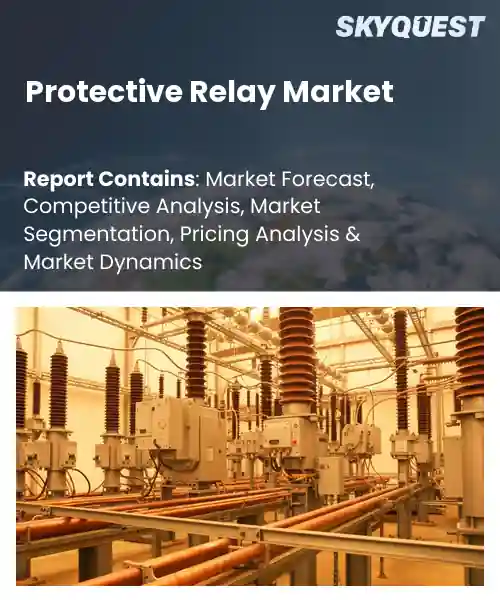
Protective Relay Market
Report ID: SQMIG55A2069
Report ID: SQMIG55A2069
[email protected]
USA +1 351-333-4748
Report ID:
SQMIG55A2069 |
Region:
Global |
Published Date: February, 2026
Pages:
157
|Tables:
147
|Figures:
78


Global Protective Relay Market size was valued at USD 3.1 Billion in 2024 and is poised to grow from USD 3.27 Billion in 2025 to USD 5.06 Billion by 2033, growing at a CAGR of 5.6% during the forecast period (2026-2033).
The protective relay industry is continuing to develop because of improvements in electrical power plants due to modernizing plant infrastructure, increasing demand for electrical power, and the growing amount of renewable energy being integrated into global grids. Protective relays are used by electrical utility companies to detect faults, including short-circuits, overloading, and voltage fluctuations. As utility companies invest more money into smart grid technology, substations, and transmission and distribution (T&D) networks, they are also investing in advanced digital and numerical protective relays to provide better accuracy, faster reaction times, ability to connect via remote access, and integration with supervisory control and data acquisition (SCADA) and automation system technologies. Emerging economies are building new electrical utility infrastructure to support their growth due to increased industrialization and urbanization, while established economies are working to upgrade their aging electrical utility infrastructure, thus providing additional opportunities for growth within this industry.
As the number of renewable generation sources increases (e.g., solar and wind), the need for advanced protective relays that can accommodate intermittent generation sources will need to be fulfilled to enhance the reliability of the electrical grid. Digital protective relays may present challenges to electric utilities due to their high installation costs, complicated integration configurations, and the cybersecurity risks.
How is AI enhancing real-time fault detection in the protective relay market?
Electrical equipment protection is accomplished through use of protective relays, which monitor for abnormal electrical conditions in order to isolate faults that could threaten grid stability. Artificial Intelligence improves upon the ability to detect faults through its ability to learn signatures from normal operating conditions, recognize subtle variations from those signatures, and categorize the various types of faults in order for relay logic to make more precise decisions regarding fault isolation. The use of Edge AI, along with faster analysis times results in improved decision-making time, reducing the number of false trips of protective relays while enabling adaptive threshold levels that are able to compensate for changes that take place in grids with an increased number of inverters. Vendors are creating AI enabled platforms and utilizing travelling wave techniques to enhance the accuracy of fault location identification and provide greater situational awareness of the grid, thereby making upgrades to protective relays and remote diagnostic capabilities more feasible for utilities and industrial operators within North America.
Market snapshot - (2026-2033)
Global Market Size
USD 3.1 Billion
Largest Segment
Digital/IED
Fastest Growth
Digital/IED
Growth Rate
5.6% CAGR
To get more insights on this market click here to Request a Free Sample Report
Global protective relay market is segmented into relay type, voltage, application, end-user, installation type and region. Based on relay type, the market is segmented into electromechanical, static and digital/IED. Based on voltage, the market is segmented into low voltage, medium voltage, high voltage and extra-high voltage. Based on application, the market is segmented into transmission, distribution, generation, protection and industrial equipment. Based on end-user, the market is segmented into utilities, industrial, transportation and commercial & infrastructure. Based on installation type, the market is segmented into new build and retrofit/upgrade. Based on region, the market is segmented into North America, Europe, Asia Pacific, Latin America and Middle East & Africa.
As per protective relay market outlook, medium-voltage segment dominates in the market. Medium-voltage systems are extensively exploited in industrial plants, commercial buildings and electrical distribution systems. The majority of electrical substations and industrial power infrastructures are also working at the medium-voltage levels every day, helping to generate an on-going requirement for protective relay operations & features, as well as safety and reliability, and having supplied that there is a high volume of requests for these relays supporting the control of load distribution and stopping the equipment being damaged across the utility and large-scale manufacturing environments.
As per protective relay market analysis, the high voltage segment is the fastest growing in the market because of the increasing expenditures on transmission infrastructure and long-distance power transfer projects. Investment into the incremental development of renewable energy resources, the expansion of cross-border grid interconnections, and the development of ultra-high voltage transmission corridors all support the requirement for advanced, highly reliable protection systems at these voltage levels.
As per protective relay market forecast, the transmission segment dominates the market mainly because protecting the highest value assets that serve transmission can only be accomplished with highly sophisticated relay systems that allow for stable grids, preventing large-scale blackouts from happening. The transmission segment of this industry is one of the most significant revenue-generating segments of the industry.
However, the distribution segment is now becoming one of the fastest-growing segments of the industry, along with smart grid development, urban electrification projects, and advances in the modernization of aging distribution infrastructure. The rapid growth in automation in industrial equipment and renewable energy sources being integrated into distribution networks are both driving additional growth in advanced digital relays for all distributions and industrial applications.
To get detailed segments analysis, Request a Free Sample Report
As per the protective relay market regional forecast, the Asia Pacific region is dominant in the market due to a combination of infrastructure improvements, manufacturing efficiency, and a technical infrastructure that helps spur rapid adoption of new and advanced protection solutions. In addition, Asia Pacific utilities prioritize reliability of the system and digital integration which provides an impetus for the deployment of relays with enhanced communications and cyber security capabilities. Strong relationships between equipment manufacturers, system integrators and research institutions allows for customized product development and comprehensive field-testing of products.
As per the protective relay market regional outlook, Japan can benefit from the well-established grid modernization, mandate for strict reliability by utilities and strong collaboration between utilities and producers in the country. The market for relays is characterized by a consolidated engineering base which encourages innovation in relay function, interoperability and safety. Demand in the market is being driven by the incorporation of renewable distributed energy resources and increased automation and use of predictive maintenance.
The protective relay market in South Korea is influenced by industrial digitalization; strong utility modernization programs and local manufacturers taking part in advanced relay technology development. There is a strong emphasis placed on grid resiliency, renewable integration and smart grid communication, which is driving demand for advanced functioning, interoperable protection devices. Partnerships between primary technology providers, system integrators and utilities will produce customized solutions and testing. There is a market preference for compact, high-performance relays that are equipped with robust cyber security and comprehensive service support capabilities.
The rapid growth occurring throughout North America results from multiple organizations converging around the topics of grid modernization, resiliency, and integration of distributed energy resources. Utilities and system operators are implementing upgrades capable of accommodating the transformation of generation assets to reduce the economic impact of an outage; therefore, there has been a significant transition towards digital, communications-enabled protection systems for supporting these changes. The fast-paced protective relay market growth is being accelerated by the partnership with a large number of vendors across a dynamic vendor ecosystem, as well as active pilot projects and partnership initiatives with emerging technology companies and research institutions, that will help facilitate the validation and deployment of intelligent relays using advanced diagnostic capability and cybersecurity.
As per the protective relay industry analysis, the market in the United States exhibits characteristics of utility modernization programs, an emphasis on resiliency in the grid, and widely deployed digital protection technologies. Utilities and independent operators are increasing their overall investments in their protection systems to support renewable integration and distributed generation; thus, there is a growing demand for interoperable protective relays that provide advanced diagnostic capabilities integrated with cybersecurity functionality.
The protective relay market in Canada reflects a strong emphasis on providing reliable power across large geographic areas, coordinating renewable resource integration, and working collaboratively with electric utilities and suppliers to address specific regional needs. Because of stretched resources and budget constraints, Canadian electric utilities are evaluating solutions that provide a balance between durability and flexibility, while also allowing the ability to monitor from a distance (remotely) and conduct fault detection. Vendors, both domestic and foreign, are working with Canadian electric utilities to deliver interoperable protective relays with superior communications capabilities and cybersecurity. Service companies are testing, commissioning, and maintaining the entire lifecycle of protective relays across a wide range of climatic conditions.
Through coordinated efforts to modernize the electric power grid, improve reliability through established standards, and integrate renewable and distributed energy resources, Europe is enhancing its position in the global economy. By focusing on interoperability and standardization, utilities and transmission operators are advancing the use of advanced protection systems and enhancing the flexibility of their grids. A robust industrial base and experienced consulting engineers are driving innovation through relay design, secure communication, and testing procedures. Projects to interconnect countries and harmonize regulations continue to be important to establish common specifications for certification and facilitate the widespread deployment of compatible relays. Suppliers benefit from collaboration between the public and private sectors on validation testing, interoperability workshops, and harmonized certification paths, which will help to build supplier confidence and speed up the process of introducing new relay solutions to the market.
The protective relay market in Germany is driven by high levels of industrial usage, a strong commitment toward reliability of the grid and a unique position of leadership in engineering. Utilities and industrial customers try to place a large importance on relays that support interoperability, reliability, communication protocols and cybersecurity. The existence of collaborative testing facilities and standards organizations provides a means for manufacturers to perform rigorous validation and verification of their equipment's conformity.
The protective relay market in the UK focuses on resiliency, the ability to operate the grid flexibly, and the integration of distributed energy resources. Utilities and system operators require relays that have advanced communication, diagnostics and cybersecurity capabilities to implement dynamic protection schemes. There is a strong collaborative effort amongst manufacturers, research organizations, and regulatory bodies to promote interoperability and coordinated testing. Manufacturers stress lifecycle services, remote monitoring and flexible designs that support a variety of network configurations. Service providers are also involved with commissioning and maintaining equipment, helping to ensure that the system maintains reliability.
The protective relay market in France is affected by a focus on modernizing distribution systems, integrating renewable energy sources into the grid and a strong safety culture. Utilities look for relays that will provide safe and reliable protection, clear communication interfaces and resilient cybersecurity capabilities. Manufacturers, utilities, and technical institutes are working collaboratively to conduct testing on the equipment, establish interoperability between equipment, and develop common industry standards. Manufacturers offer modular solutions, service agreements, and localized support to account for the specific topographic characteristics of the distribution network and to ensure that operational requirements are met. Manufacturers also support ongoing stable operation and efficient system upgrade programs.
To know more about the market opportunities by region and country, click here to
Buy The Complete Report
Expansion of Renewable Energy Integration
The constant growth of renewable energy sources means more complexity in how the electrical power is flowing and what it will look like if there's an electrical fault; this is driving the industry need for flexibility and accuracy in protection solutions. Protective relays allow for those stable transmissions and aid in detecting any asymmetric-faults, manage the isolation of the energy sources (islanding) and communicate effectively with the inverter controller; these all support the continued success of the grid and are key components to expanding our use of renewables as further deployed. As system operators are primarily focused on the safe connection and resilient operation of the system, the need is being created for protective relays with improved capabilities of function, communication, and configuration in order to support future-proofed protection schemes and accommodate Distributed Energy Resources (DER's).
Grid Modernization and Digitalization
Modernization initiatives of the grid through Digitalization emphasize automation, real-time monitoring, and interoperable communications are driving utilities to look for more Intelligent Protective Relays that can exchange status, some measurements, and performing control commands between Distributed Energy Resources (DER’s). Intelligent protective relays with more situational awareness through remote configuration of the protective relay will improve speed of fault isolation and efficiency of coordination for the protection scheme, resulting in a reduction in outage time and an increase in the utilization of their assets. As the operators install digital substations or advanced Distribution Management Systems (DMS), their need for protective relays with standard protocols, flexible firmware, and cybersecurity features will only continue to grow as the realization of the operating benefits of digitalizing the grid continues.
High Implementation Complexity and Costs
Utilities' adoption of advanced relays is often hampered by the cost and complexity of upgrading protective infrastructure, especially for those that have legacy systems and limited / available financial capital for such purposes. The need to redesign all protection schemes, reconfigure all communication networks, and verify the compatibility of all devices to be integrated into the system takes considerable planning, as well as specialized engineering capabilities. Long commissioning cycles and prudent risk management practices prolong the time to deploy the advanced protective relay, while operators focus on continuity of operations. These restrictions effectively lengthen the replacement cycles and slow the immediate uptake of advanced protective relay technology, even though many of the long-term benefits are readily apparent, and they influence the timing of procurement and investment decisions.
Regulatory Fragmentation Across Regions
Manufacturers and utilities face hurdles associated with working within two or more regulatory frameworks: the regulatory fragmentation across regions creates barriers that inhibit market expansion and complicate the processes required to certify, customize, and guarantee compliance for products. Differences in technical standards and protection requirements across the globe result in many suppliers having to customize product features and documentation for multiple jurisdictions and to incur associated delays in product development, as well as to lack economies of scale. The delays associated with the uncertainty surrounding regulatory approvals will also delay manufacturers from entering the marketplace and delay rapid adoption of new technologies. Thus, the regulatory fragmentation across regions increases commercial risks and the operational friction associated with deploying advanced protective relay solutions on a global basis.
Request Free Customization of this report to help us to meet your business objectives.
The competitive landscape of protective relay industry is under pressure due to modernization of the grid and the integration of renewable energy sources. This pressure is causing established players to consolidate, upgrade products, and implement ecosystem plays. Recent activities that illustrate this protective relay market trend include the acquisition of ABB’s power grid assets by Hitachi; the functional upgrade of ABB’s REX640 relays; and the launch of Hitachi Energy’s Relion REF6 relay. Suppliers are also expanding their digital services and forming partnerships with other companies to pursue utility contracts.
SkyQuest’s ABIRAW (Advanced Business Intelligence, Research & Analysis Wing) is our Business Information Services team that Collects, Collates, Correlates, and Analyses the Data collected by means of Primary Exploratory Research backed by robust Secondary Desk research.
As per SkyQuest analysis, the global protective relay market has two major drives renewable energy integration is occurring faster than ever before, causing faults to change in the way they occur and driving the need for protection solutions that can adapt to those changes; digitalizing the power grid and increased communications to allow for adaptive protection and changes to protect against those faults makes this easier because it speeds up the time it takes to respond to faults. Asia Pacific is the leader in protective relays as a result of modernization of infrastructure and having manufacturing base infrastructures in close proximity to one another; digital relays and IEDs are the dominant technologies used for these projects; and thus, creating revenue streams from both programmable intelligence as well as from reoccurring revenues for services and software. The other major challenge that will impact the deployment of protective relays is the complexity of implementing protective solutions using legacy systems/resources as well as needing to redesign existing protection philosophies due to both legacy system integration and identifying the need to incorporate protection into existing design schemes, resulting in lengthy commissioning timelines. The market holds a significant protective relay market share within the global power system protection equipment industry, driven by increasing investments in grid modernization, renewable energy integration, and transmission & distribution infrastructure upgrades worldwide.
| Report Metric | Details |
|---|---|
| Market size value in 2024 | USD 3.1 Billion |
| Market size value in 2033 | USD 5.06 Billion |
| Growth Rate | 5.6% |
| Base year | 2024 |
| Forecast period | (2026-2033) |
| Forecast Unit (Value) | USD Billion |
| Segments covered |
|
| Regions covered | North America (US, Canada), Europe (Germany, France, United Kingdom, Italy, Spain, Rest of Europe), Asia Pacific (China, India, Japan, Rest of Asia-Pacific), Latin America (Brazil, Rest of Latin America), Middle East & Africa (South Africa, GCC Countries, Rest of MEA) |
| Companies covered |
|
| Customization scope | Free report customization with purchase. Customization includes:-
|
To get a free trial access to our platform which is a one stop solution for all your data requirements for quicker decision making. This platform allows you to compare markets, competitors who are prominent in the market, and mega trends that are influencing the dynamics in the market. Also, get access to detailed SkyQuest exclusive matrix.
Table Of Content
Executive Summary
Market overview
Parent Market Analysis
Market overview
Market size
KEY MARKET INSIGHTS
COVID IMPACT
MARKET DYNAMICS & OUTLOOK
Market Size by Region
KEY COMPANY PROFILES
Methodology
For the Protective Relay Market, our research methodology involved a mixture of primary and secondary data sources. Key steps involved in the research process are listed below:
1. Information Procurement: This stage involved the procurement of Market data or related information via primary and secondary sources. The various secondary sources used included various company websites, annual reports, trade databases, and paid databases such as Hoover's, Bloomberg Business, Factiva, and Avention. Our team did 45 primary interactions Globally which included several stakeholders such as manufacturers, customers, key opinion leaders, etc. Overall, information procurement was one of the most extensive stages in our research process.
2. Information Analysis: This step involved triangulation of data through bottom-up and top-down approaches to estimate and validate the total size and future estimate of the Protective Relay Market.
3. Report Formulation: The final step entailed the placement of data points in appropriate Market spaces in an attempt to deduce viable conclusions.
4. Validation & Publishing: Validation is the most important step in the process. Validation & re-validation via an intricately designed process helped us finalize data points to be used for final calculations. The final Market estimates and forecasts were then aligned and sent to our panel of industry experts for validation of data. Once the validation was done the report was sent to our Quality Assurance team to ensure adherence to style guides, consistency & design.
Analyst Support
Customization Options
With the given market data, our dedicated team of analysts can offer you the following customization options are available for the Protective Relay Market:
Product Analysis: Product matrix, which offers a detailed comparison of the product portfolio of companies.
Regional Analysis: Further analysis of the Protective Relay Market for additional countries.
Competitive Analysis: Detailed analysis and profiling of additional Market players & comparative analysis of competitive products.
Go to Market Strategy: Find the high-growth channels to invest your marketing efforts and increase your customer base.
Innovation Mapping: Identify racial solutions and innovation, connected to deep ecosystems of innovators, start-ups, academics, and strategic partners.
Category Intelligence: Customized intelligence that is relevant to their supply Markets will enable them to make smarter sourcing decisions and improve their category management.
Public Company Transcript Analysis: To improve the investment performance by generating new alpha and making better-informed decisions.
Social Media Listening: To analyze the conversations and trends happening not just around your brand, but around your industry as a whole, and use those insights to make better Marketing decisions.
REQUEST FOR SAMPLE
 REQUEST FREE CUSTOMIZATION
Global Protective Relay Market size was valued at USD 3.1 Billion in 2024 and is poised to grow from USD 3.27 Billion in 2025 to USD 5.06 Billion by 2033, growing at a CAGR of 5.6% during the forecast period (2026-2033).
Competitive pressure in the protective relay market is driven by grid modernization and renewable integration, forcing incumbents to pursue consolidation, product upgrades and ecosystem plays. Recent examples include Hitachi’s acquisition of ABB’s power-grids assets, ABB’s REX640 functional upgrades and Hitachi Energy’s Relion REF6 launch; vendors also expand digital services and partnerships to win utility contracts. 'ABB Ltd.', 'Siemens AG', 'Schneider Electric SE', 'General Electric', 'Mitsubishi Electric Corporation', 'Eaton Corporation', 'Rockwell Automation Inc.', 'Basler Electric Company', 'Honeywell', 'Doble Engineering Company', 'NR Electric Co., Ltd.', 'Omron Corporation', 'Littlefuse Inc.', 'Doble Engineering', 'Hitachi Energy Ltd.', 'Alstom Grid', 'Fanox Electronics', 'ZIV Automation', 'CG Power & Industrial Solutions Ltd.', 'Bender GmbH and Co. KG'
The rapid integration of renewable generation increases complexity of power flow and fault characteristics, creating a need for adaptable and precise protection solutions; protective relays help maintain stability by detecting asymmetric faults, managing islanding and coordinating with inverter controls, which in turn supports reliable grid operation and enables further renewable deployment. As system operators prioritize safe interconnection and resilience, demand rises for relays with enhanced functionality, communication capabilities and configurability to support evolving protection schemes and accommodate decentralized energy resources.
As per the protective relay market regional forecast, the Asia Pacific region is dominant in the market due to a combination of infrastructure improvements, manufacturing efficiency, and a technical infrastructure that helps spur rapid adoption of new and advanced protection solutions.


Want to customize this report? This report can be personalized according to your needs. Our analysts and industry experts will work directly with you to understand your requirements and provide you with customized data in a short amount of time. We offer $1000 worth of FREE customization at the time of purchase.
Feedback From Our Clients


 USA (+1) 351-333-4748

