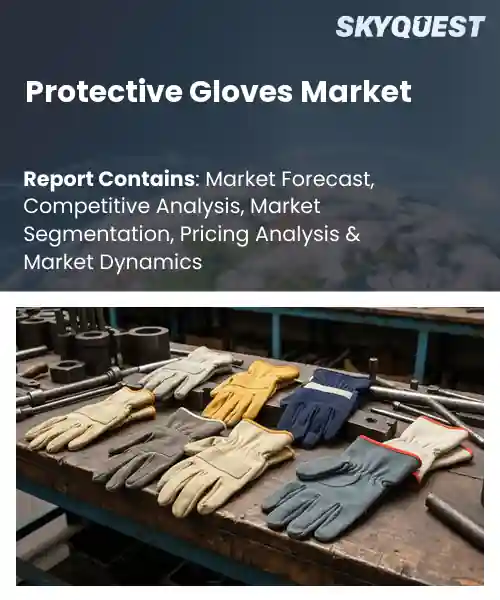
Protective Gloves Market
Report ID: SQMIG35B2349
Report ID: SQMIG35B2349
[email protected]
USA +1 351-333-4748
Report ID:
SQMIG35B2349 |
Region:
Global |
Published Date: June, 2026
Pages:
157
|Tables:
150
|Figures:
78


Global Protective Gloves Market size was valued at USD 26.18 Billion in 2024 and is poised to grow from USD 27.44 Billion in 2025 to USD 39.92 Billion by 2033, growing at a CAGR of 4.8% during the forecast period (2026-2033).
Stringent health and safety regulations have been the primary driver of the global protective gloves market, shaping demand across healthcare, industrial, and consumer segments. The market encompasses disposable and reusable gloves made from latex, nitrile, neoprene, PVC and specialty composites, and it matters because gloves reduce exposure to biological hazards, chemicals, and mechanical risks while enabling compliance with workplace standards. Historically demand shifted from leather and cotton to rubber in the twentieth century and later to synthetic nitrile as allergy awareness and chemical resistance requirements grew. The COVID-19 pandemic accelerated single-use glove consumption, exposed supply-chain fragilities, and prompted capacity expansion.Material innovation and supply-chain resilience drive growth trajectories and competitive dynamics in the protective gloves market because advances change cost, performance and acceptance across applications. The move from natural latex to nitrile lowered allergy risk and improved chemical resistance, prompting adoption in hospitals and labs, while textured coatings and touchscreen-capable formulations broadened use in food processing and assembly. When manufacturers diversified production and invested in flexibility, shortages eased and buyers built inventories, which allowed industries to scale. Opportunities stem from biodegradable polymers, antimicrobial treatments and integrated sensors for worker safety that can create premium segments and secure long-term contracts globally.
How is AI improving quality control in the protective gloves market?
AI is raising quality control standards in the protective gloves market by combining machine vision, deep learning and analytics to detect surface defects, contamination and irregularity as gloves travel on the line. Systems trained on photographic datasets standardise defect calls and create searchable audit trails that support regulatory review. Manufacturers report that replacing repetitive manual inspection with continuous AI inspection reduces touch points, improves hygiene and highlights upstream process issues early. In a market where buyers demand consistent, traceable quality, these capabilities help suppliers stabilise output and reduce costly rework.INTCO, February 2026, announced an intelligent factory automation program featuring full inline vision inspection and automated boxing. That real world development shows how AI inspection and data linkage reduce rework, strengthen traceability and improve operational efficiency, supporting steadier supply and faster audit readiness.
Market snapshot - (2026-2033)
Global Market Size
USD 26.18 Billion
Largest Segment
General Purpose Gloves
Fastest Growth
Cut Resistant Gloves
Growth Rate
4.8% CAGR
To get more insights on this market click here to Request a Free Sample Report
Global protective gloves market is segmented by material, type, function, end-use industry, distribution channel and region. Based on material, the market is segmented into Nitrile Gloves, Latex Gloves, Neoprene Gloves, Kevlar and High-Performance Fibers and Others. Based on type, the market is segmented into Disposable Gloves, Reusable and Industrial Gloves and Others. Based on function, the market is segmented into Chemical and Biological Protection, Mechanical and Cut Resistance, Thermal and Electrical Insulation and Others. Based on end-use industry, the market is segmented into Healthcare and Medical, Chemical Processing, Manufacturing and Construction, Oil and Gas and Others. Based on distribution channel, the market is segmented into Industrial Supply Wholesalers, Direct Sales to Organizations, Online E-commerce Platforms and Others. Based on region, the market is segmented into North America, Europe, Asia Pacific, Latin America and Middle East & Africa.
Nitrile Gloves segment dominates because their combination of superior chemical resistance and puncture protection makes them the preferred choice across healthcare, laboratory, and industrial applications, driving widespread specification by procurement teams. Their allergy-free profile compared with natural rubber, coupled with scalable manufacturing and consistent quality, reduces operational risk and simplifies compliance, which encourages standardization and sustained supplier investment in production and distribution.
However, Latex Gloves are emerging as the most rapidly expanding area due to tactile sensitivity and biodegradability preferences that attract clinicians and users prioritizing dexterity. Renewed formulation innovations and regulatory reuse protocols are expanding applications beyond traditional roles, accelerating demand and creating opportunities for suppliers emphasizing sustainable sourcing and enhanced user experience.
Disposable Gloves segment dominates because single-use design aligns with infection control protocols and regulatory requirements across clinical and laboratory settings, prompting routine replacement and high procurement frequency. Ease of donning and disposal, cost-efficient production, and compatibility with diverse patient-care and testing workflows streamline logistics and inventory strategies, encouraging institutions to standardize on disposable options and sustain supplier focus on mass production capacity.
Meanwhile, Reusable and Industrial Gloves are witnessing the strongest growth momentum as industries prioritize durable protection and lifecycle cost savings for repetitive tasks. Advances in high performance coatings and ergonomic design, together with corporate sustainability commitments and demand for specialized protection in manufacturing and construction, are broadening use cases and attracting long term contracts that accelerate supplier innovation and market depth.
To get detailed segments analysis, Request a Free Sample Report
Asia Pacific dominates due to a combination of manufacturing depth, integrated supply chains, and strong demand across healthcare and industrial sectors. Regional strengths include extensive downstream industries that require high volumes of protective gloves, established chemical and polymer production that supports material availability, and a skilled production workforce that enables rapid scaling and product diversification. Innovation hubs within the region drive development of specialty and high-performance glove types, while competitive cost structures and export orientation enable wide global distribution. Robust supplier networks, proximity to major end markets, and supportive industrial policies further reinforce market leadership. Collaboration between material scientists, OEMs, and large procurement buyers fosters continuous product improvement, quality assurance, and responsiveness to changing safety and regulatory expectations, sustaining the regionwide competitive advantage.
Protective Gloves Market in Japan is characterized by demand for high-quality, precision-oriented products serving healthcare, electronics, and industrial segments. Manufacturers and suppliers emphasize stringent quality control, traceability, and compliance with rigorous testing standards. Innovation focuses on materials that balance tactile sensitivity with protection, and there is significant uptake of specialty gloves for cleanroom and medical device environments. Procurement tends to favor reliability, certification, and long-term supplier partnerships that support product consistency and advanced application requirements.
Protective Gloves Market in South Korea is driven by a strong industrial base in electronics, semiconductors, and automotive supply chains requiring cleanroom and anti-static glove solutions. Domestic suppliers focus on thin-film technologies, advanced polymer formulations, and high-precision manufacturing to meet technical performance demands. The market values rapid innovation cycles, tight integration between glove makers and industrial OEMs, and efficient logistics that support both domestic consumption and export. Emphasis on worker safety, automation compatibility, and material performance underpins product development priorities.
Rapid expansion in North America is propelled by diverse sectoral demand, regulatory emphasis on worker and patient safety, and investment in domestic manufacturing capacity. The region benefits from large healthcare systems, an extensive industrial services sector, and food processing and energy industries that require both disposable and specialty glove solutions. Buyers increasingly prioritize certified quality, traceable supply chains, and environmentally preferable materials, prompting suppliers to innovate in reusable and sustainable glove options. Reshoring trends and strategic procurement initiatives support local capacity building, while collaboration between research institutions and industry accelerates adoption of advanced materials. Strong aftermarket services, distributor networks, and tailored enterprise contracts further enable market penetration and responsiveness to changing occupational health standards.
Protective Gloves Market in United States is shaped by wide-ranging demand across healthcare, industrial manufacturing, and service sectors. Procurement emphasizes regulatory compliance, supplier traceability, and product performance for diverse applications from clinical settings to heavy industry. There is notable focus on innovation in materials and sustainability credentials, with suppliers partnering with research organizations to develop advanced protective solutions. Distribution channels are mature, supporting rapid commercialization and enterprise-level contracts that align product specifications with end user safety protocols and operational requirements.
Protective Gloves Market in Canada reflects a mixture of healthcare procurement and resource-sector needs, including mining, oil and gas, and forestry operations that require durable work gloves. Buyers prioritize ergonomic design, cold-weather performance, and compliance with occupational safety standards. Domestic demand is complemented by integrated supply relationships with North American manufacturers, and there is increasing attention to sustainable sourcing and lifecycle considerations. Suppliers often work closely with occupational health stakeholders to adapt products to remote and harsh operational environments.
Europe is strengthening its market position through stringent regulatory frameworks, emphasis on product certification, and a strong focus on sustainability and circular economy principles. The region leverages established industrial clusters in automotive, pharmaceuticals, and chemical sectors that demand high-performance protective solutions, driving specialization and premium product development. Manufacturers invest in eco-design, recyclable materials, and supply chain transparency to meet evolving procurement criteria. Cross-border collaboration between testing labs, industry associations, and policymakers promotes harmonized standards and market access. Consolidation among suppliers and strategic partnerships with healthcare systems and industrial buyers further enhance capability to deliver certified, application-specific gloves. This combination of regulatory rigor, technical expertise, and sustainability focus raises quality expectations and positions Europe as a leader in advanced and compliant protective glove offerings.
Protective Gloves Market in Germany is anchored by advanced manufacturing and rigorous industrial safety standards that drive demand for technically sophisticated gloves across automotive, engineering, and chemical industries. Suppliers emphasize product reliability, certification, and performance under strenuous operational conditions. There is strong collaboration between industrial buyers and manufacturers to develop tailored solutions that meet exacting engineering and ergonomic requirements, supported by a robust network of testing and certification bodies that reinforce market confidence and export competitiveness.
Protective Gloves Market in United Kingdom features significant demand from healthcare, laboratory, and industrial sectors with procurement focused on infection control, workplace safety, and regulatory compliance. Suppliers prioritize traceability, material performance, and compatibility with clinical workflows and laboratory protocols. Market dynamics are influenced by close engagement between research institutions, certification agencies, and industry players to ensure product suitability for professional use, while distributors and service providers support rapid deployment and end user training.
Protective Gloves Market in France combines strong public healthcare procurement with industrial requirements from chemical, aerospace, and food sectors that emphasize ergonomics and material safety. Manufacturers and suppliers work to align products with national standards and buyer expectations for comfort, durability, and environmental impact. There is notable focus on domestic production capabilities and supplier partnerships that deliver certified, application-specific gloves tailored to professional use cases and institutional procurement processes.
To know more about the market opportunities by region and country, click here to
Buy The Complete Report
Rising Healthcare Safety Standards
Increased Focus On Infection Control
Fluctuating Raw Material Costs
Environmental Concerns And Waste Management
Request Free Customization of this report to help us to meet your business objectives.
The protective gloves competitive landscape is concentrated among global manufacturers while nimble entrants press on sustainability, reshoring, and product differentiation as key competitive drivers. Large firms pursue acquisitions and partnerships to secure materials and technology; for example Ansell advanced its Inteliforz connected safety platform, Rhino Health expanded domestic nitrile capacity in the United States, and Synthomer strengthened specialty coatings through the OMNOVA acquisition.
Top Player’s Company Profile
Recent Developments
SkyQuest’s ABIRAW (Advanced Business Intelligence, Research & Analysis Wing) is our Business Information Services team that Collects, Collates, Correlates, and Analyses the Data collected by means of Primary Exploratory Research backed by robust Secondary Desk research. As per SkyQuest analysis, one key driver is stringent health and safety regulations that boost institutional procurement and standardization of glove use, and one restraint is fluctuating raw material costs that create production and pricing uncertainty. Dominating region is Asia Pacific due to manufacturing depth and integrated supply chains, while the dominating segment is nitrile gloves because of superior chemical and puncture resistance and allergy-free profile. A second driver is increased focus on infection control, which sustained demand for disposable gloves during and after the pandemic. Overall, suppliers who invest in material innovation, quality control and sustainable options are best positioned to capture growth and long-term contracts.
| Report Metric | Details |
|---|---|
| Market size value in 2024 | USD 26.18 Billion |
| Market size value in 2033 | USD 39.92 Billion |
| Growth Rate | 4.8% |
| Base year | 2024 |
| Forecast period | (2026-2033) |
| Forecast Unit (Value) | USD Billion |
| Segments covered |
|
| Regions covered | North America (US, Canada), Europe (Germany, France, United Kingdom, Italy, Spain, Rest of Europe), Asia Pacific (China, India, Japan, Rest of Asia-Pacific), Latin America (Brazil, Rest of Latin America), Middle East & Africa (South Africa, GCC Countries, Rest of MEA) |
| Companies covered |
|
| Customization scope | Free report customization with purchase. Customization includes:-
|
To get a free trial access to our platform which is a one stop solution for all your data requirements for quicker decision making. This platform allows you to compare markets, competitors who are prominent in the market, and mega trends that are influencing the dynamics in the market. Also, get access to detailed SkyQuest exclusive matrix.
Table Of Content
Executive Summary
Market overview
Parent Market Analysis
Market overview
Market size
KEY MARKET INSIGHTS
COVID IMPACT
MARKET DYNAMICS & OUTLOOK
Market Size by Region
KEY COMPANY PROFILES
Methodology
For the Protective Gloves Market, our research methodology involved a mixture of primary and secondary data sources. Key steps involved in the research process are listed below:
1. Information Procurement: This stage involved the procurement of Market data or related information via primary and secondary sources. The various secondary sources used included various company websites, annual reports, trade databases, and paid databases such as Hoover's, Bloomberg Business, Factiva, and Avention. Our team did 45 primary interactions Globally which included several stakeholders such as manufacturers, customers, key opinion leaders, etc. Overall, information procurement was one of the most extensive stages in our research process.
2. Information Analysis: This step involved triangulation of data through bottom-up and top-down approaches to estimate and validate the total size and future estimate of the Protective Gloves Market.
3. Report Formulation: The final step entailed the placement of data points in appropriate Market spaces in an attempt to deduce viable conclusions.
4. Validation & Publishing: Validation is the most important step in the process. Validation & re-validation via an intricately designed process helped us finalize data points to be used for final calculations. The final Market estimates and forecasts were then aligned and sent to our panel of industry experts for validation of data. Once the validation was done the report was sent to our Quality Assurance team to ensure adherence to style guides, consistency & design.
Analyst Support
Customization Options
With the given market data, our dedicated team of analysts can offer you the following customization options are available for the Protective Gloves Market:
Product Analysis: Product matrix, which offers a detailed comparison of the product portfolio of companies.
Regional Analysis: Further analysis of the Protective Gloves Market for additional countries.
Competitive Analysis: Detailed analysis and profiling of additional Market players & comparative analysis of competitive products.
Go to Market Strategy: Find the high-growth channels to invest your marketing efforts and increase your customer base.
Innovation Mapping: Identify racial solutions and innovation, connected to deep ecosystems of innovators, start-ups, academics, and strategic partners.
Category Intelligence: Customized intelligence that is relevant to their supply Markets will enable them to make smarter sourcing decisions and improve their category management.
Public Company Transcript Analysis: To improve the investment performance by generating new alpha and making better-informed decisions.
Social Media Listening: To analyze the conversations and trends happening not just around your brand, but around your industry as a whole, and use those insights to make better Marketing decisions.
REQUEST FOR SAMPLE
 REQUEST FREE CUSTOMIZATION


Want to customize this report? This report can be personalized according to your needs. Our analysts and industry experts will work directly with you to understand your requirements and provide you with customized data in a short amount of time. We offer $1000 worth of FREE customization at the time of purchase.
Feedback From Our Clients


 USA (+1) 351-333-4748

