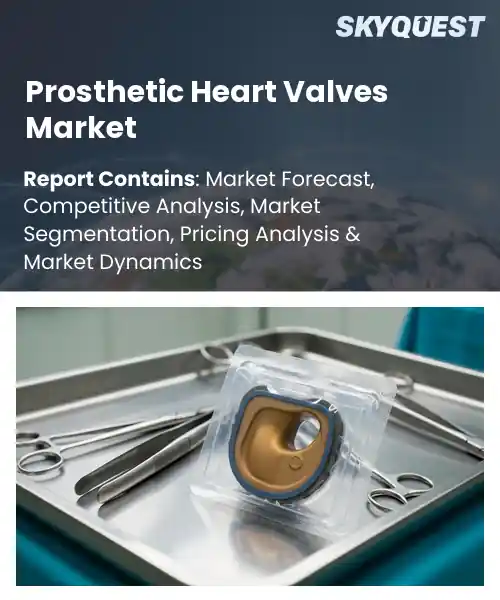
Prosthetic Heart Valves Market
Report ID: SQMIG35A3420
Report ID: SQMIG35A3420
[email protected]
USA +1 351-333-4748
Report ID:
SQMIG35A3420 |
Region:
Global |
Published Date: May, 2026
Pages:
157
|Tables:
90
|Figures:
71


Global Prosthetic Heart Valves Market size was valued at USD 4.82 Billion in 2024 and is poised to grow from USD 5.13 Billion in 2025 to USD 8.52 Billion by 2033, growing at a CAGR of 6.52% during the forecast period (2026-2033).
The major factor in the growth of the prosthetic heart valves market is the increase in prevalence of valvular heart disease accompanied by an increased capacity for sophisticated treatment for cardiovascular diseases, thus making a highly specialized field become strategically important in the global medical market. Prosthetic heart valves encompass three types of devices - mechanical, tissue, and transcatheter valves – used to correct hemodynamics when the original valves malfunction. Innovation in treating such conditions has brought a change from surgical intervention to less invasive techniques like transcatheter aortic valve replacement (TAVR), which is evidenced by the extensive application of the technique in Europe and North America with an increase in production capabilities. Following the trend towards minimally invasive techniques, the key force that is driving the global market of prosthetic valves is innovation in developing technology which reduces the risks associated with the procedure and increases patient pool for potential candidates, thus drawing more investment into the field. With the development of valves becoming smaller and more reliable, the number of procedures performed becomes significantly increased in specialized centers among intermediate and low risk patients.
How is AI Improving Patient Outcomes in the Prosthetic Heart Valves Market?
AI can enhance the effectiveness of treatment through better patient outcomes in the prosthetic heart valves market by ensuring that diagnosis, planning, procedure execution and follow-up become more accurate. This will be made possible through automated image segmentation to determine valve size, AI powered planning that recommends the best prosthetic heart valve and real-time fusion of ultrasound and X-ray images during procedure execution. The current status reveals growing clinical validation efforts and collaborations between vendors to minimize inconsistencies and make procedure less complex. Actual use cases may include AI powered preoperative CT image analyses and warnings to clinicians regarding need for timely referral and interventions. Philips in March 2026 received FDA approval for DeviceGuide.
Market snapshot - (2026-2033)
Global Market Size
USD 4.82 Billion
Largest Segment
Biological/Bioprosthetic Valves
Fastest Growth
TAVR Valves
Growth Rate
6.52% CAGR
To get more insights on this market click here to Request a Free Sample Report
Global prosthetic heart valves market is segmented by product type, application, end-user and region. Based on product type, the market is segmented into Mechanical Heart Valves, Biological/Bioprosthetic Valves and TAVR Valves. Based on application, the market is segmented into Aortic Valve Replacement, Mitral Valve Replacement, Pulmonary Valve Replacement and Tricuspid Valve Replacement. Based on end-user, the market is segmented into Hospitals and Cardiac Centers. Based on region, the market is segmented into North America, Europe, Asia Pacific, Latin America and Middle East & Africa.
Segment TAVR Valves dominates as its minimally invasive nature changes the way of treating aortic disease and enables high throughput as well as a speedy recovery process. Development in clinical applications and iterations of devices have minimized the risk involved in the procedure, increasing adoption by physicians, and hence driving hospitals' interest. This preference for low peri-operative stress valves is a continuous driver for the use of transcatheter solutions and thus supplier scaling and innovation.
Biological/Bioprosthetic Valves, on the other hand, have shown the fastest growth due to the advances made in tissue engineering, improving their durability, and making them suitable for valve-in-valve operations.
Aortic Valve Replacement segment is dominating the market because it is more clinically driven, with more procedures, innovation, and technology investment focused on aortic valve disease and its treatment. Proven outcomes through clinical trials provide motivation for hospitals and providers to invest more resources into treating patients for their aortic valve disease, and reimbursement mechanisms and funding models are being developed around this need. The resultant accumulation of knowledge will further advance device development and enable suppliers to scale up.
Mitral Valve Replacement is currently growing the most rapidly as innovative techniques for transcatheter repair and replacement development that can treat more complex cases. Improved imaging technologies and devices increase physician confidence, resulting in a broader use of procedures and larger patient populations available for treatment.
To get detailed segments analysis, Request a Free Sample Report
The main reason why North America occupies the leading position in the global prosthetic heart valves market can be attributed to several aspects, including high clinical infrastructure standards, innovation-focused ecosystem and regulation framework, which promote both product development and implementation. In terms of demand, the key factor is the abundance of skilled clinicians who embrace innovations in the field, while the existence of successful medtech companies and research collaboration programs facilitates technology advancement. Well-established care pathways and comprehensive reimbursement policies guarantee wider use of the available technologies, while hospital-academic-device maker cooperation contributes to the optimization of the design and procedure itself.
United States Market for Prosthetic Heart Valves: The dense clinical research infrastructure, vast procedure experience, and availability of highly advanced prosthetic valves have made it easier to adopt prosthetic heart valves. Innovative devices have been adopted through collaborations, clinical trials, and registries, and the favorable market environment and concentration of medical technology companies contribute significantly to the evolution of innovative solutions for complex cases.
Canada Prosthetic Heart Valves Market: The presence of coordinated cardiac programs in provinces, close relationships between medical institutes and medical equipment companies, and implementation of highly advanced devices have shaped the market for prosthetic heart valves. Decisions have been made on the basis of outcomes and health systems' perspectives, favoring certain surgical and transcatheter valve products. Strong clinical networks and health technology assessments have ensured safety in the adoption of innovative devices.
In Europe, the market for prosthetic heart valves continues to grow due to a combination of high-quality medical experience, favorable regional policies, and an evolving industry environment that is geared towards innovative design and research. The high standards of heart disease treatments prevalent in major European countries have led to the use of innovative surgical and percutaneous heart valves, and the strong partnership between hospitals, research institutions, and valve manufacturers allows for a focused approach to patient-oriented design and innovation. Health technology assessment policies promote comparative analysis and informed purchasing decisions, while the increasing number of cross-border medical networks and training programs facilitate the spread of good practices.
Market for Prosthetic Heart Valves in Germany is positively influenced by presence of well-developed cardiac surgery facilities, research and development activities, and close cooperation of hospitals and manufacturers of the devices. There are many specialized cardiac centers where skilled surgeons can help evaluate the innovative devices. The process of health technology assessment, along with effective procedures of hospital acquisition of new technologies, promotes the introduction of scientifically validated innovations into practice.
Features of the Prosthetic Heart Valves Market in the United Kingdom include fast adoption rates of minimally invasive heart valves, clinical research, and collaborations between academic institutions and medical technology developers. Patient-focused approaches and easy access to procedural training have been key factors behind the success of innovations in valve technology. Networks formed by hospitals with the help of the medical technology sector have enabled quick adoption of clinical practices, while investments in training have helped maintain procedural quality and capacity.
Market for Prosthetic Heart Valves in France is developing through the improvement of hospital networks, clinical investigation efforts, and the use of latest technologies for treatment through heart valves. The key areas include health technology assessment and value based purchasing of devices, as well as the efforts to promote multidisciplinary approaches to heart team management. Training and involvement in registries will facilitate a systematic approach to evaluating outcomes.
There are signs that the Asia Pacific region will grow in importance within the prosthetic heart valves space via strategic investments in clinical competency, procedures, and close interactions with medical devices companies globally. Increased efforts at conducting local research and partnering with manufacturers internationally are driving technology transfer and localization of technologies. There is greater focus on developing training programs and centers of excellence to foster procedure uptake, and changing dynamics around regulation and reimbursement facilitate access to innovative solutions. Increased collaboration in registry work and data collection around outcomes helps establish a robust body of evidence, positioning the Asia Pacific region as a significant force in driving global innovation and adoption trends in the sector. The development of manufacturing capability within the region as well as the adoption of innovative yet affordable solutions will help increase dissemination.
Market for Prosthetic Heart Valves in Japan has been spurred by its own expertise in scientific research, advanced clinical setup, and interaction between industry and academia. A focus on engineering performance and patient follow-up leads to the innovation and adoption of new valve technology. Effective regulation systems encouraging clinical validation and skilled surgeons help with the application of clinical practice.
South Korea Prosthetic Heart Valves Market is progressing by virtue of the joint efforts of cutting-edge technology manufacturers with advanced tertiary cardiac care facilities, which helps quick adoption and fine-tuning of the devices. The focus on training programs, data registries, and outcome-based research ensures successful deployment of the new technological developments. The existence of favorable conditions for scaling up operations and export-oriented development contributes to successful commercialization.
To know more about the market opportunities by region and country, click here to
Buy The Complete Report
Increasing Prevalence of Valve Disorders
Increasing occurrences of cases related to valvular heart disorders lead to an increasing number of individuals requiring treatment for their condition. The increase in the number of patients needing treatment for their heart valves will lead to an increased need for artificial heart valves. Increased cases of heart valves will make it mandatory for clinicians to recommend patients be fitted with prosthetic devices. Specialized procedures in hospitals will become more common.
Technological Advancements in Valve Design
Improvements in the engineering of prosthetic valves and improvements in their biocompatibility, coupled with improved material composition, will lead to an increase in clinician confidence levels. These changes will also mean that more patients qualify for artificial valve treatment as a result of increased effectiveness. Increased efficiency will increase hospital use of new devices due to their effectiveness while improving the ability of clinicians to perform operations using the devices.
High Procedural and Device Costs
The costs related to prosthetic valves, specific delivery systems, and infrastructure needed for implantations are a burden and can create barriers to access and implementation of the technology in areas of lower income. Concerns about reimbursement and the requirement of making a large amount of money invested in training, equipment, and interventional facility can prevent a hospital from creating such a program. These factors impede the implementation of new valve technologies, decrease their reach in poorer areas, and prompt the parties to consider other cheaper treatment approaches.
Regulatory and Clinical Evidence Challenges
The rigid regulatory framework and high demands for clinical evidence can make it hard for a new prosthetic valve technology to enter the market and gain regulatory approval. The requirement to generate extensive evidence regarding its long-term effects can make development complex and protracted. It might discourage the manufacturer from developing this type of product, and it might limit market competition as well.
Request Free Customization of this report to help us to meet your business objectives.
The nature of competition for the global prosthetic heart valves market entails a scenario of consolidation and technology races, whereby current organizations and emerging competitors in the market strive for M&As, strategic equity partnerships, and technology advancements, in order to capitalize on the burgeoning mitral and tricuspid space by expanding their reach through transfemoral access; such a competition is brought about by label extensions into lower risk patients and minimally invasive procedures that call for the use of robotics and the acquisition of TMVR technologies.
Transcatheter Expansion and Access: The trend towards transcatheter expansion and access will lead to a wider eligibility and a shift from traditional surgery to catheter implantation of prostheses. Medical device manufacturers and hospitals are working together to develop effective delivery mechanisms, optimize their perioperative processes, and implement training sessions for healthcare providers, facilitating the adoption of the approach by more institutions. Efforts in simplifying procedures, reducing hospital stays, and improving the patient experience will create new referral practices and service options, leading to new avenues for growth and partnership.
Advanced Biomaterials and Durability: Improvements in polymers, tissue engineering, and anti-degradation therapies have led to the development of novel prosthetic valves, emphasizing durability and biocompatibility. The study of various biomaterials is directed at minimizing structural degradation and inflammation while manufacturing technologies enable custom production. Through collaborations between material scientists, clinicians, and medical device manufacturers, such advancements facilitate the use of valves in young and high-risk patients, alleviating their issues with durability and requiring fewer interventions throughout their lifetime.
SkyQuest’s ABIRAW (Advanced Business Intelligence, Research & Analysis Wing) is our Business Information Services team that Collects, Collates, Correlates, and Analyses the Data collected by means ofPrimary Exploratory Research backed by robust Secondary Desk research.
According to the SkyQuest study, the global prosthetic heart valve market is driven by one factor, the increasing occurrence of valvular heart disease coupled with improved accessibility to innovative cardiac procedures, and another driver, which is the quick advancements in technology providing more minimally invasive transcatheter treatments. The global prosthetic heart valve market will have a restraint, which will be in form of high procedural costs that are limiting adoption. The regional dominance will be by North America owing to its advanced medical infrastructures and supportive reimbursement policies. The segment dominance will be by TAVR valves.
| Report Metric | Details |
|---|---|
| Market size value in 2024 | USD 4.82 Billion |
| Market size value in 2033 | USD 8.52 Billion |
| Growth Rate | 6.52% |
| Base year | 2024 |
| Forecast period | (2026-2033) |
| Forecast Unit (Value) | USD Billion |
| Segments covered |
|
| Regions covered | North America (US, Canada), Europe (Germany, France, United Kingdom, Italy, Spain, Rest of Europe), Asia Pacific (China, India, Japan, Rest of Asia-Pacific), Latin America (Brazil, Rest of Latin America), Middle East & Africa (South Africa, GCC Countries, Rest of MEA) |
| Companies covered |
|
| Customization scope | Free report customization with purchase. Customization includes:-
|
To get a free trial access to our platform which is a one stop solution for all your data requirements for quicker decision making. This platform allows you to compare markets, competitors who are prominent in the market, and mega trends that are influencing the dynamics in the market. Also, get access to detailed SkyQuest exclusive matrix.
Table Of Content
Executive Summary
Market overview
Parent Market Analysis
Market overview
Market size
KEY MARKET INSIGHTS
COVID IMPACT
MARKET DYNAMICS & OUTLOOK
Market Size by Region
KEY COMPANY PROFILES
Methodology
For the Prosthetic Heart Valves Market, our research methodology involved a mixture of primary and secondary data sources. Key steps involved in the research process are listed below:
1. Information Procurement: This stage involved the procurement of Market data or related information via primary and secondary sources. The various secondary sources used included various company websites, annual reports, trade databases, and paid databases such as Hoover's, Bloomberg Business, Factiva, and Avention. Our team did 45 primary interactions Globally which included several stakeholders such as manufacturers, customers, key opinion leaders, etc. Overall, information procurement was one of the most extensive stages in our research process.
2. Information Analysis: This step involved triangulation of data through bottom-up and top-down approaches to estimate and validate the total size and future estimate of the Prosthetic Heart Valves Market.
3. Report Formulation: The final step entailed the placement of data points in appropriate Market spaces in an attempt to deduce viable conclusions.
4. Validation & Publishing: Validation is the most important step in the process. Validation & re-validation via an intricately designed process helped us finalize data points to be used for final calculations. The final Market estimates and forecasts were then aligned and sent to our panel of industry experts for validation of data. Once the validation was done the report was sent to our Quality Assurance team to ensure adherence to style guides, consistency & design.
Analyst Support
Customization Options
With the given market data, our dedicated team of analysts can offer you the following customization options are available for the Prosthetic Heart Valves Market:
Product Analysis: Product matrix, which offers a detailed comparison of the product portfolio of companies.
Regional Analysis: Further analysis of the Prosthetic Heart Valves Market for additional countries.
Competitive Analysis: Detailed analysis and profiling of additional Market players & comparative analysis of competitive products.
Go to Market Strategy: Find the high-growth channels to invest your marketing efforts and increase your customer base.
Innovation Mapping: Identify racial solutions and innovation, connected to deep ecosystems of innovators, start-ups, academics, and strategic partners.
Category Intelligence: Customized intelligence that is relevant to their supply Markets will enable them to make smarter sourcing decisions and improve their category management.
Public Company Transcript Analysis: To improve the investment performance by generating new alpha and making better-informed decisions.
Social Media Listening: To analyze the conversations and trends happening not just around your brand, but around your industry as a whole, and use those insights to make better Marketing decisions.
REQUEST FOR SAMPLE
 REQUEST FREE CUSTOMIZATION
Global Prosthetic Heart Valves Market size was valued at USD 4.82 Billion in 2024 and is poised to grow from USD 5.13 Billion in 2025 to USD 8.52 Billion by 2033, growing at a CAGR of 6.52% during the forecast period (2026-2033).
Competitive landscape is defined by consolidation and a technology race as incumbents and new entrants pursue M&A, strategic equity partnerships, and platform innovation to capture expanding mitral and tricuspid opportunities and broaden transfemoral access; this competition is driven by label expansion into lower risk patients and demand for less invasive delivery, prompting deals like the acquisition of TMVR developers and large venture backing for robotics enabled delivery platforms. 'Edwards Lifesciences (Sapien TAVR)', 'Medtronic plc (CoreValve)', 'Abbott Laboratories (Tendyne)', 'Boston Scientific (Lotus)', 'LivaNova plc', 'On-X Life Technologies', 'Jenavalve Technology', 'TTK Healthcare', 'Cryolife Inc.', 'NVT AG', 'Colibri Heart Valve', 'Strait Access Technologies', 'Venus Medtech', 'Anteris Technologies', 'HLT Inc.'
The rising incidence of valvular heart diseases expands the pool of patients who require valve repair or replacement, thereby elevating clinical demand for prosthetic heart valves and stimulating healthcare systems to prioritize corrective interventions. As more clinicians encounter severe valve dysfunction, referral pathways and treatment protocols increasingly favor definitive prosthetic solutions, encouraging hospitals to develop specialized programs. This growing patient base supports investment in device availability and clinician training, underpinning broader adoption of both surgical and transcatheter valve technologies across care settings.
Transcatheter Expansion And Access: Clinical and institutional momentum toward catheter-based implantation is widening treatment eligibility and shifting care from open surgery to less invasive pathways. Manufacturers and providers are collaborating to optimize delivery systems, streamline perioperative workflows, and expand clinician training programs that support broader adoption in diverse hospital settings. Focus on simplified procedures, reduced hospitalization needs, and improved patient experience is enabling new referral patterns and integrated care models, opening opportunities for market growth, service innovation, and value-based care partnerships across healthcare networks.
North America Dominate the Global Prosthetic Heart Valves Market


Want to customize this report? This report can be personalized according to your needs. Our analysts and industry experts will work directly with you to understand your requirements and provide you with customized data in a short amount of time. We offer $1000 worth of FREE customization at the time of purchase.
Feedback From Our Clients


 USA (+1) 351-333-4748

