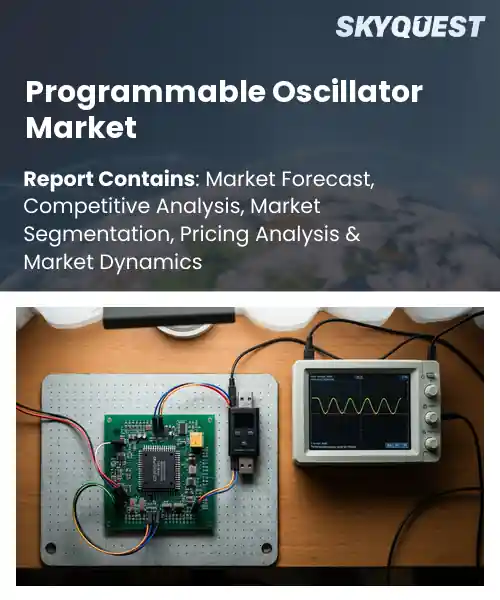
Programmable Oscillator Market
Report ID: SQMIG45K2284
Report ID: SQMIG45K2284
[email protected]
USA +1 351-333-4748
Report ID:
SQMIG45K2284 |
Region:
Global |
Published Date: June, 2026
Pages:
157
|Tables:
122
|Figures:
77


Global Programmable Oscillator Market size was valued at USD 2.92 Billion in 2024 and is poised to grow from USD 3.16 Billion in 2025 to USD 5.98 Billion by 2033, growing at a CAGR of 8.3% during the forecast period (2026-2033).
Programmable oscillators are integrated timing devices that allow engineers to select precise output frequencies through software or hardware configuration, and this flexibility constitutes the primary driver of the market. The market matters because timing underpins communications, computing and consumer electronics, where replacing multiple fixed-frequency crystals with a programmable part reduces BOM and accelerates time-to-market. In recent years demand shifted from fixed, discrete oscillators toward integrated timing solutions as mobile base stations, data centers and IoT endpoints required adaptable clocking. For example, telecom operators deploying 5G infrastructure rapidly adopted programmable oscillators to support diverse bands and synchronization standards without redesigning PCBs.A pivotal factor driving growth is system-level consolidation because designers prioritizing board space and inventory reduction cause manufacturers to specify programmable oscillators rather than multiple fixed clocks. Thus supply chains simplify and procurement costs decline, which in turn enables faster product iterations and broader feature sets. In real-world use cases cellular base stations use a programmable timing device to support multiple radio bands while hyperscale data centers employ centralized clocking to improve synchronization and reduce packet loss. Similarly automotive and industrial control systems demand low-jitter, reprogrammable clocks to meet evolving standards, creating opportunities for vendors offering software-configurable, secure timing platforms.
How is AI reshaping the programmable oscillator market?
AI is reshaping the programmable oscillator market by turning fixed timing parts into software defined, adaptive components. Programmable oscillators provide configurable frequency control, phase stability tuning and remote reconfiguration. Vendors now embed machine learning into calibration and condition monitoring so devices can reduce jitter, extend holdover and adapt to temperature and supply variability. The market is moving from purely component sales to system level timing solutions that emphasize software, telemetry and lifecycle updates. This trend is most visible in timing modules and integrated on chip clocks aimed at data center, telecom and edge AI use cases.SiTime February 2026, announced its planned acquisition of Renesas’ timing business, a move that brings broader clocking portfolios together. This supports market growth by enabling integrated, AI driven calibration across programmable oscillators and system clocks, simplifying architectures and improving efficiency for demanding AI and telecom deployments.
Market snapshot - (2026-2033)
Global Market Size
USD 2.92 Billion
Largest Segment
Surface Mount Programmable Oscillators
Fastest Growth
Surface Mount Programmable Oscillators
Growth Rate
8.3% CAGR
To get more insights on this market click here to Request a Free Sample Report
Global programmable oscillator market is segmented by product mount type, underlying timing technology, frequency output range, end-use market application and region. Based on product mount type, the market is segmented into Surface Mount Programmable Oscillators and Through Hole Programmable Oscillators. Based on underlying timing technology, the market is segmented into Voltage-Controlled Crystal Oscillators, Temperature-Compensated Crystal Oscillators, Simple Packaged Crystal Oscillators, Microelectromechanical System Oscillators and Others. Based on frequency output range, the market is segmented into Up to 125 MHz, 125 MHz to 500 MHz and Above 500 MHz. Based on end-use market application, the market is segmented into Consumer Electronics Hardware, Telecommunications Network Infrastructure, Automotive Advanced Electronics Systems, Medical Electronic Equipment, Aerospace Equipment, Defense Instrumentation and Others. Based on region, the market is segmented into North America, Europe, Asia Pacific, Latin America and Middle East & Africa.
Surface Mount Programmable Oscillators segment dominates because their low-profile packages and compatibility with automated assembly enable designers to integrate precise timing directly onto dense printed circuit boards. This placement reduces signal path lengths and susceptibility to interference, improving jitter performance and thermal coupling. OEMs favor these devices for compact consumer and industrial products, driving design standardization and supply chain efficiencies that reinforce their leading position in the Programmable Oscillator Market.
However, Through Hole Programmable Oscillators are witnessing the strongest growth momentum as manufacturers and legacy equipment providers seek robust, easily replaceable timing modules. Their through-hole construction supports higher mechanical stability and thermal dissipation, which appeals to industrial, aerospace, and defense applications requiring long lifecycle support. Expanding retrofit demand and the need for customizable, serviceable timing components are accelerating opportunities for these through-hole offerings.
Voltage-Controlled Crystal Oscillators segment leads because their tunability allows real-time frequency adjustments that directly reduce phase error accumulation and manage jitter in complex systems. Designers employ VCXOs to refine loop dynamics within phase-locked loops and timing circuits, producing cleaner clock edges and improved synchronization across subsystems. Their integration flexibility and compatibility with closed-loop control create reliable timing references that meet stringent performance needs across communications and instrumentation markets.
Meanwhile, Microelectromechanical System Oscillators are emerging as the key high-growth area due to advancements in MEMS fabrication that deliver compact, low-power, and vibration-resistant timing sources. Their resilience to shock and environmental variation expands programmable oscillator use in portable, IoT, and harsh-environment applications. Continued innovation in MEMS stability and integration promises new product forms and application-driven demand, opening significant future opportunities in the Programmable Oscillator Market.
To get detailed segments analysis, Request a Free Sample Report
Asia Pacific commands the market through a dense convergence of manufacturing capability, specialized supply chains and concentrated innovation ecosystems that favor component-intensive products. Advanced electronics clusters support rapid prototyping, close co‑location of oscillator designers with passive and semiconductor suppliers, and integrated quality control practices that accelerate commercialization. Strong OEM demand from telecommunications, consumer electronics and automotive segments fuels adoption of programmable timing solutions. Regional firms emphasize miniaturization, low phase noise and integration, while collaborative R&D between industry and research institutions drives continual performance improvements. Cost competitiveness combined with high technical expertise allows firms to scale production without sacrificing precision. Trade and logistics advantages within regional networks further reinforce supply resilience and responsiveness to global customer needs, consolidating Asia Pacific leadership.
Programmable Oscillator Market in Japan reflects a focus on precision, reliability and incremental innovation driven by established electronics and instrumentation sectors. Domestic manufacturers prioritize ultra low noise performance, ruggedization for industrial applications and compliance with stringent quality regimes. Close collaboration between component vendors and system houses supports sophisticated package integration and testing methodologies. Research institutions and advanced equipment suppliers contribute to continual refinement of oscillator architectures, positioning Japan as a leader in niche, high‑reliability timing solutions for demanding end markets.
Programmable Oscillator Market in South Korea is characterized by tight integration with major semiconductor and consumer electronics supply chains that demand high performance and compact form factors. Emphasis on high throughput communications and high speed data interfaces drives requirements for low jitter and programmability. Local suppliers work closely with system integrators to enable rapid design cycles and scalable production. Innovation is supported by strong manufacturing infrastructure and a supplier ecosystem that facilitates quick iteration and alignment with global OEM needs.
Expansion in North America is propelled by a vibrant intersection of advanced design capability, bespoke system requirements and substantial end market demand from data centers, aerospace, defense and automotive electronics. A strong base of fabless semiconductor firms and specialized component designers emphasizes customization and integration of timing solutions into complex systems. Investment in high performance computing, networking infrastructure and instrumentation creates sustained demand for programmable oscillators with precise stability and low phase noise. Supportive innovation ecosystems, including research laboratories, design houses and test equipment manufacturers, enable accelerated product development and certification. Strategic partnerships between suppliers and hyperscalers or defense primes facilitate tailored offerings and early adoption, reinforcing market depth and technical leadership across the region.
Programmable Oscillator Market in United States centers on high performance applications and customization driven by advanced computing, telecommunications and defense sectors. Design houses and system integrators seek specialized timing solutions optimized for low jitter and integration into complex platforms. A robust innovation ecosystem of startups, research centers and procurement channels enables rapid development and deployment. Emphasis on security, qualification and interoperability shapes supplier strategies, with collaborations between component vendors and large end users accelerating adoption in mission critical environments.
Programmable Oscillator Market in Canada is influenced by strong niches in telecommunications, aerospace and industrial automation that value reliability and precision. Local research institutions and specialized suppliers collaborate to address timing challenges in instrumentation and control systems. Demand is driven by applications requiring robust environmental performance and long term stability. Close cross border partnerships with neighboring markets amplify access to larger design ecosystems, enabling Canadian firms to focus on tailored solutions and service oriented engagements for complex technical customers.
Europe is reinforcing its market position through a combination of strategic industrial capabilities, regulatory frameworks that emphasize supply chain security, and collaborative innovation initiatives that link research institutions with industry. A strong base of automotive and industrial equipment manufacturers demands timing solutions that meet rigorous reliability and functional safety standards, encouraging suppliers to prioritize quality and lifecycle support. Investment in sovereign capabilities and international partnerships fosters resilience while promoting advanced packaging and low power design approaches. Cross border consortia and standardization efforts facilitate interoperability and accelerate commercialization of next generation timing technologies. Focus on sustainability and long term procurement relationships further incentivize European suppliers to develop differentiated, application specific programmable oscillators.
Programmable Oscillator Market in Germany is anchored by automotive and industrial automation sectors that require precise, durable timing solutions tailored for harsh operational environments. Suppliers emphasize robust validation processes, functional safety alignment and integration with Tier one systems. Engineering strength and close collaboration with manufacturing partners enable development of modular, serviceable oscillator platforms. This ecosystem supports a focus on long term reliability and compatibility with complex control architectures prevalent in German industrial applications.
Programmable Oscillator Market in United Kingdom benefits from strong research capabilities in timing and synchronization, with application focus in communications, defense and test equipment. The supplier community collaborates with universities and specialized test houses to refine oscillator performance for high accuracy and low noise applications. A dynamic startup environment complements established players, enabling novel approaches to miniaturization and system level integration. Emphasis on certification and specialized services supports adoption in demanding institutional markets.
Programmable Oscillator Market in France is shaped by aerospace, transportation and defense requirements that prioritize ruggedness, precision and lifecycle support. Domestic firms coordinate closely with national research laboratories and system integrators to deliver oscillators designed for stringent operational profiles. Emphasis on interoperability and long term procurement relationships encourages development of tailored solutions for mission critical and infrastructure applications. Collaboration between industry and public research fosters innovation in packaging and environmental resilience.
To know more about the market opportunities by region and country, click here to
Buy The Complete Report
Increasing Demand For Precision Timing
Expansion In Communications Applications
Integration Complexity With Legacy Systems
Intellectual Property And Licensing Challenges
Request Free Customization of this report to help us to meet your business objectives.
The competitive landscape in programmable oscillators is consolidating around MEMS based innovation, driven by customers' demand for integrated, field programmable timing and vendor scale. Incumbents use M&A and product integration, exemplified by SiTime's 2026 asset purchase of Renesas' timing business, while newcomers secure strategic partnerships and targeted IP: Stathera partners with MediaTek and Epson to commercialize dual output MEMS, and Chinese entrants emphasize local MEMS XO development.
Top Player’s Company Profile
Recent Developments
SkyQuest’s ABIRAW (Advanced Business Intelligence, Research & Analysis Wing) is our Business Information Services team that Collects, Collates, Correlates, and Analyses the Data collected by means of Primary Exploratory Research backed by robust Secondary Desk research. As per SkyQuest analysis, the programmable oscillator market is driven by system-level consolidation and demand for configurable timing that reduces BOM and accelerates time-to-market. A key driver is the shift from fixed-frequency parts to software-configurable timing for telecom, data center and IoT use cases. A second driver is AI-enabled calibration and remote management that improves jitter, holdover and lifecycle adaptability. A restraint is integration complexity with legacy systems and IP/licensing hurdles that lengthen procurement cycles. The dominating region is Asia Pacific due to concentrated manufacturing and strong OEM demand. The dominating segment is surface mount programmable oscillators for their suitability in compact, automated board-level integration.
| Report Metric | Details |
|---|---|
| Market size value in 2024 | USD 2.92 Billion |
| Market size value in 2033 | USD 5.98 Billion |
| Growth Rate | 8.3% |
| Base year | 2024 |
| Forecast period | (2026-2033) |
| Forecast Unit (Value) | USD Billion |
| Segments covered |
|
| Regions covered | North America (US, Canada), Europe (Germany, France, United Kingdom, Italy, Spain, Rest of Europe), Asia Pacific (China, India, Japan, Rest of Asia-Pacific), Latin America (Brazil, Rest of Latin America), Middle East & Africa (South Africa, GCC Countries, Rest of MEA) |
| Companies covered |
|
| Customization scope | Free report customization with purchase. Customization includes:-
|
To get a free trial access to our platform which is a one stop solution for all your data requirements for quicker decision making. This platform allows you to compare markets, competitors who are prominent in the market, and mega trends that are influencing the dynamics in the market. Also, get access to detailed SkyQuest exclusive matrix.
Table Of Content
Executive Summary
Market overview
Parent Market Analysis
Market overview
Market size
KEY MARKET INSIGHTS
COVID IMPACT
MARKET DYNAMICS & OUTLOOK
Market Size by Region
KEY COMPANY PROFILES
Methodology
For the Programmable Oscillator Market, our research methodology involved a mixture of primary and secondary data sources. Key steps involved in the research process are listed below:
1. Information Procurement: This stage involved the procurement of Market data or related information via primary and secondary sources. The various secondary sources used included various company websites, annual reports, trade databases, and paid databases such as Hoover's, Bloomberg Business, Factiva, and Avention. Our team did 45 primary interactions Globally which included several stakeholders such as manufacturers, customers, key opinion leaders, etc. Overall, information procurement was one of the most extensive stages in our research process.
2. Information Analysis: This step involved triangulation of data through bottom-up and top-down approaches to estimate and validate the total size and future estimate of the Programmable Oscillator Market.
3. Report Formulation: The final step entailed the placement of data points in appropriate Market spaces in an attempt to deduce viable conclusions.
4. Validation & Publishing: Validation is the most important step in the process. Validation & re-validation via an intricately designed process helped us finalize data points to be used for final calculations. The final Market estimates and forecasts were then aligned and sent to our panel of industry experts for validation of data. Once the validation was done the report was sent to our Quality Assurance team to ensure adherence to style guides, consistency & design.
Analyst Support
Customization Options
With the given market data, our dedicated team of analysts can offer you the following customization options are available for the Programmable Oscillator Market:
Product Analysis: Product matrix, which offers a detailed comparison of the product portfolio of companies.
Regional Analysis: Further analysis of the Programmable Oscillator Market for additional countries.
Competitive Analysis: Detailed analysis and profiling of additional Market players & comparative analysis of competitive products.
Go to Market Strategy: Find the high-growth channels to invest your marketing efforts and increase your customer base.
Innovation Mapping: Identify racial solutions and innovation, connected to deep ecosystems of innovators, start-ups, academics, and strategic partners.
Category Intelligence: Customized intelligence that is relevant to their supply Markets will enable them to make smarter sourcing decisions and improve their category management.
Public Company Transcript Analysis: To improve the investment performance by generating new alpha and making better-informed decisions.
Social Media Listening: To analyze the conversations and trends happening not just around your brand, but around your industry as a whole, and use those insights to make better Marketing decisions.
REQUEST FOR SAMPLE
 REQUEST FREE CUSTOMIZATION


Want to customize this report? This report can be personalized according to your needs. Our analysts and industry experts will work directly with you to understand your requirements and provide you with customized data in a short amount of time. We offer $1000 worth of FREE customization at the time of purchase.
Feedback From Our Clients


 USA (+1) 351-333-4748

