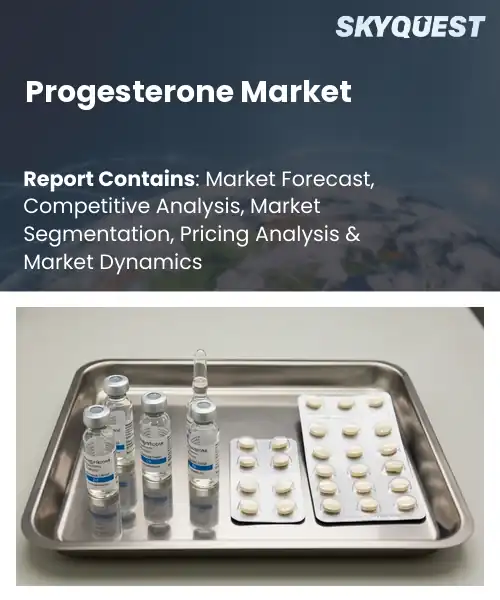
Progesterone Market
Report ID: SQMIG35I3131
Report ID: SQMIG35I3131
[email protected]
USA +1 351-333-4748
Report ID:
SQMIG35I3131 |
Region:
Global |
Published Date: July, 2026
Pages:
157
|Tables:
145
|Figures:
78


Global Progesterone Market size was valued at USD 1.63 Billion in 2024 and is poised to grow from USD 1.84 Billion in 2025 to USD 4.79 Billion by 2033, growing at a CAGR of 12.74% during the forecast period (2026-2033).
Progesterone, a steroid hormone that regulates the menstrual cycle and supports early pregnancy, anchors a market that has grown far beyond traditional pharmaceutical supply. The increasing prevalence of infertility and hormonal disorders is the main driver of demand, with clinicians prescribing oral micronized progesterone and injectable formulations. The market was traditionally confined to obstetrics. However, menopausal hormone-replacement therapy and assisted-reproductive-technology cycles boomed in the 2000s, boosting global sales. The United States accounted for 35% of total revenue in 2018, while emerging economies like India saw double-digit growth due to increasing awareness of fertility treatment. Regulatory evolution is another significant factor influencing the global progesterone market, as it opens new channels for distribution and encourages investment in new delivery systems.
With the 2016 approval of subcutaneous progesterone by agencies such as the FDA, manufacturers have increased research into sustained-release implants that reduce dosing frequency and improve patient adherence. This endorsement prompted insurers to extend coverage, thus further expanding the addressable pool. Consequently, companies have formed alliances with biotech companies to co-develop transdermal patches. The cause and effect chain of policy approval, product innovation and reimbursement expansion creates growth opportunities in both mature and emerging markets.
How is AI Improving Production Efficiency In The Global Progesterone Market?
AI is reshaping progesterone production by automating key steps in synthesis and purification. Machine learning models predict optimal reaction conditions, reducing trial and error cycles and cutting waste. Real time sensors feed data to algorithms that adjust temperature and pressure on the fly, keeping yields steady. Predictive maintenance alerts technicians before equipment failure, minimizing downtime. Digital twins simulate entire production lines, allowing planners to test scale up scenarios without physical runs. Integrated AI driven quality control flags impurities early, shortening release cycles.
These AI interventions also enable faster regulatory submissions by providing documented process consistency. Together these tools tighten supply chains, lower costs and support the market’s rapid growth. In June 2026 the European Medicines Agency highlighted an AI enabled platform for progesterone API manufacturing, noting its ability to streamline batch scheduling and reduce material waste, thereby boosting overall efficiency and supporting market expansion. The agency’s endorsement signals confidence that such digital tools will become standard across manufacturers, accelerating product availability and meeting rising demand.
Market snapshot - (2026-2033)
Global Market Size
USD 1.63 Billion
Largest Segment
Synthetic Progestins
Fastest Growth
Natural Progesterone
Growth Rate
12.74% CAGR
To get more insights on this market click here to Request a Free Sample Report
Global progesterone market is segmented by formulation, route of administration, application, drug type, distribution channel and region. Based on formulation, the market is segmented into Natural Progesterone and Synthetic Progestins. Based on route of administration, the market is segmented into Injectables, Oral, Topical/Vaginal and Transdermal. Based on application, the market is segmented into Menopause Management, Fertility Treatment / IVF, Endometriosis, Abnormal Uterine Bleeding and Preterm Birth Prevention. Based on drug type, the market is segmented into Branded and Generic. Based on distribution channel, the market is segmented into Hospital Pharmacies, Retail Pharmacies and Online Pharmacies. Based on region, the market is segmented into North America, Europe, Asia Pacific, Latin America and Middle East & Africa.
The natural progesterone segment dominates as doctors prefer bioidentical hormone therapy due to its superior safety profile and physiological match. According to the physicians, it is the most appropriate for the endogenous hormone, and has less adverse events and better patient adherence. The perception guides prescribing preferences for both reproductive and menopausal indications so manufacturers are focusing research and manufacturing capacity on bioidentical formulations, which reinforce market leadership and build long term clinical trust among healthcare providers today worldwide.
Meanwhile, the fastest growth momentum is seen in the synthetic progestins segment where drug developers are using the versatile chemical scaffold to create targeted therapies for infertility and prevention of preterm birth. The potential to finetune pharmacokinetic properties accelerates clinical trial pipelines, attracting investment and expanding therapeutic opportunities that drive market expansion.
Oral segment dominates due to unmatched convenience to the patients and also established prescribing habits in both primary care and specialist settings. Tablets and capsules can be self administered, removing the need for clinical visits, simplifying treatment regimens for menopause and fertility protocols. This ease of use drives higher adherence rates and is today encouraging manufacturers around the world to prioritize oral dosage forms in their product pipelines throughout the patient journey.
Meanwhile transdermal segment appears as a high growth area as innovators are using skin permeable technology to deliver consistent hormone levels while avoiding hepatic first pass metabolism. The patches are comfortable for users and are continuously exposed, so they are attractive to clinicians who treat chronic menopausal symptoms and to researchers who are exploring new indications. This benefit accelerates adoption and creates new market opportunities.
To get detailed segments analysis, Request a Free Sample Report
North America progesterone market is propelled by a combination of advanced healthcare delivery systems, high adoption of advanced reproductive technologies, and a regulatory landscape that strikes a balance between safety and fast-track approval of products. The region has a large number of multinational pharmaceutical companies that invest heavily in research and development, creating innovative formulations and delivery mechanisms. Strong reimbursement policies from both public and private payers ensure wide patient access and a large network of specialty clinics and fertility centers drives consistent demand. Academic-industry collaborations speed up clinical trials and knowledge transfer, solidifying the region’s position as a hub for next-generation therapeutic solutions. These elements combine to create a strong ecosystem that sustains market leadership and attracts ongoing investment.
The United States Progesterone Market is backed by a mature pharmaceutical ecosystem that integrates large-scale manufacturing capacity with cutting-edge research. Leading biotech clusters and academic medical centers are building the pipeline of novel delivery systems, and a robust insurance landscape provides patient affordability. The abundance of fertility clinics and the proactive regulatory agency speed up the rollout of products, feeding a relentless cycle of innovation and access that underpins the market’s supremacy.
The Progesterone market in Canada is defined by a robust public health system that promotes equitable access to vital therapies. Collaborative research efforts between universities and industry are spurring the development of patient-centric formulations. Fast approvals are enabled by regulatory processes that prioritize safety. A network of specialized reproductive health providers ensures consistent use of products across the country.
Europe’s rapid expansion stems from harmonized regulatory standards that simplify cross‑border product distribution, coupled with a deep commitment to women’s health policies. Substantial public and private investment in biotech research fuels innovative formulation development, while well‑integrated academic‑industry collaborations expedite clinical validation. Reimbursement strategies across member states increasingly recognize the therapeutic value of progesterone, expanding coverage within both fertility and hormone replacement contexts. Additionally, rising public awareness and proactive patient advocacy groups generate sustained demand, encouraging pharmaceutical firms to prioritize the region for product launches and strategic growth initiatives.
Progesterone Market in Germany is anchored by a robust manufacturing sector that emphasizes high‑quality production and stringent compliance. Strong ties between research universities and pharmaceutical companies nurture a pipeline of advanced delivery technologies. Comprehensive insurance coverage and established clinical guidelines ensure broad patient access, reinforcing Germany’s status as a dominant hub within the European landscape.
Progesterone Market in the United Kingdom experiences accelerated growth through dynamic biotech clusters and a vibrant network of fertility clinics. Progressive regulatory pathways and favorable reimbursement policies encourage rapid adoption of novel therapies. Academic research centers contribute cutting‑edge clinical data, while patient‑focused advocacy drives heightened awareness and demand across the market.
Progesterone Market in France is emerging as a noteworthy segment due to increasing investment in reproductive health research and expanding clinical infrastructure. Collaborative initiatives between government agencies and pharmaceutical firms foster development of new formulations. Growing patient awareness and evolving reimbursement frameworks support broader accessibility, positioning France as a rising contributor to the European market.
Asia Pacific advances its position by leveraging expanding healthcare infrastructure, rising disposable incomes, and a cultural shift toward proactive reproductive health management. Countries in the region are accelerating the establishment of state‑of‑the‑art fertility centers and integrating advanced diagnostic technologies, which drives demand for high‑quality progesterone products. Government incentives for biotech innovation stimulate local R&D capabilities, while strategic partnerships with global pharmaceutical players facilitate technology transfer and market entry. The region’s growing emphasis on personalized medicine and patient‑centric care models further fuels interest in novel delivery systems, positioning Asia Pacific as an increasingly influential market for progesterone therapies.
Progesterone Market in Japan benefits from a healthcare system that emphasizes preventive care and advanced therapeutic options. Strong collaboration between leading universities and pharmaceutical companies generates innovative formulation research. An extensive network of specialized reproductive clinics ensures reliable distribution, while governmental support for medical technology adoption enhances patient access to cutting‑edge treatments.
Progesterone Market in South Korea is propelled by vigorous biotech entrepreneurship and supportive government policies that encourage pharmaceutical innovation. Emerging research hubs focus on novel delivery platforms, and a rapidly expanding network of fertility centers creates robust demand. Integrated insurance schemes and progressive regulatory frameworks further enable swift market adoption and growth.
To know more about the market opportunities by region and country, click here to
Buy The Complete Report
Rising Fertility Treatment Utilization
Expansion of Women's Health Clinics
Stringent Regulatory Approval Processes
High Production Cost of Synthetic Hormone
Request Free Customization of this report to help us to meet your business objectives.
The global progesterone market is shaped by intense competition among specialty pharma firms and emerging biotech players, with accelerated product pipelines and strategic financing driving market dynamics. Companies are leveraging partnership‑driven funding, as seen with Trase’s $107 million round led by Kleiner Perkins, and accelerating tech‑focused development, exemplified by Ovum’s $4 million seed investment to advance hormonal health solutions, intensifying rivalry and innovation across the sector.
SkyQuest’s ABIRAW (Advanced Business Intelligence, Research & Analysis Wing) is our Business Information Services team that Collects, Collates, Correlates, and Analyses the Data collected by means of Primary Exploratory Research backed by robust Secondary Desk research.
As per SkyQuest analysis the global progesterone market is being propelled primarily by the rising utilization of fertility treatments, which lifts prescription volumes across IVF and luteal support protocols, and a second catalyst is the rapid expansion of women’s health platforms that embed progesterone prescribing into tele‑medicine and digital‑health services, boosting accessibility and adherence. Stringent regulatory approval processes act as a restraint, extending development timelines and curbing entry of new products. North America dominates the market due to its advanced healthcare system, strong reimbursement frameworks and concentration of innovative firms. Within the segment landscape oral progesterone formulations retain the largest share due to unmatched patient convenience.
| Report Metric | Details |
|---|---|
| Market size value in 2024 | USD 1.63 Billion |
| Market size value in 2033 | USD 4.79 Billion |
| Growth Rate | 12.74% |
| Base year | 2024 |
| Forecast period | (2026-2033) |
| Forecast Unit (Value) | USD Billion |
| Segments covered |
|
| Regions covered | North America (US, Canada), Europe (Germany, France, United Kingdom, Italy, Spain, Rest of Europe), Asia Pacific (China, India, Japan, Rest of Asia-Pacific), Latin America (Brazil, Rest of Latin America), Middle East & Africa (South Africa, GCC Countries, Rest of MEA) |
| Companies covered |
|
| Customization scope | Free report customization with purchase. Customization includes:-
|
To get a free trial access to our platform which is a one stop solution for all your data requirements for quicker decision making. This platform allows you to compare markets, competitors who are prominent in the market, and mega trends that are influencing the dynamics in the market. Also, get access to detailed SkyQuest exclusive matrix.
Table Of Content
Executive Summary
Market overview
Parent Market Analysis
Market overview
Market size
KEY MARKET INSIGHTS
COVID IMPACT
MARKET DYNAMICS & OUTLOOK
Market Size by Region
KEY COMPANY PROFILES
Methodology
For the Progesterone Market, our research methodology involved a mixture of primary and secondary data sources. Key steps involved in the research process are listed below:
1. Information Procurement: This stage involved the procurement of Market data or related information via primary and secondary sources. The various secondary sources used included various company websites, annual reports, trade databases, and paid databases such as Hoover's, Bloomberg Business, Factiva, and Avention. Our team did 45 primary interactions Globally which included several stakeholders such as manufacturers, customers, key opinion leaders, etc. Overall, information procurement was one of the most extensive stages in our research process.
2. Information Analysis: This step involved triangulation of data through bottom-up and top-down approaches to estimate and validate the total size and future estimate of the Progesterone Market.
3. Report Formulation: The final step entailed the placement of data points in appropriate Market spaces in an attempt to deduce viable conclusions.
4. Validation & Publishing: Validation is the most important step in the process. Validation & re-validation via an intricately designed process helped us finalize data points to be used for final calculations. The final Market estimates and forecasts were then aligned and sent to our panel of industry experts for validation of data. Once the validation was done the report was sent to our Quality Assurance team to ensure adherence to style guides, consistency & design.
Analyst Support
Customization Options
With the given market data, our dedicated team of analysts can offer you the following customization options are available for the Progesterone Market:
Product Analysis: Product matrix, which offers a detailed comparison of the product portfolio of companies.
Regional Analysis: Further analysis of the Progesterone Market for additional countries.
Competitive Analysis: Detailed analysis and profiling of additional Market players & comparative analysis of competitive products.
Go to Market Strategy: Find the high-growth channels to invest your marketing efforts and increase your customer base.
Innovation Mapping: Identify racial solutions and innovation, connected to deep ecosystems of innovators, start-ups, academics, and strategic partners.
Category Intelligence: Customized intelligence that is relevant to their supply Markets will enable them to make smarter sourcing decisions and improve their category management.
Public Company Transcript Analysis: To improve the investment performance by generating new alpha and making better-informed decisions.
Social Media Listening: To analyze the conversations and trends happening not just around your brand, but around your industry as a whole, and use those insights to make better Marketing decisions.
REQUEST FOR SAMPLE
 REQUEST FREE CUSTOMIZATION
Global Progesterone Market size was valued at USD 1.63 Billion in 2024 and is poised to grow from USD 1.84 Billion in 2025 to USD 4.79 Billion by 2033, growing at a CAGR of 12.74% during the forecast period (2026-2033).
The global progesterone market is shaped by intense competition among specialty pharma firms and emerging biotech players, with accelerated product pipelines and strategic financing driving market dynamics. Companies are leveraging partnership‑driven funding, as seen with Trase’s $107 million round led by Kleiner Perkins, and accelerating tech‑focused development, exemplified by Ovum’s $4 million seed investment to advance hormonal health solutions, intensifying rivalry and innovation across the sector. 'IBSA Farmaceutici', 'Besins Healthcare', 'AbbVie Inc.', 'Ferring Pharmaceuticals', 'Merck & Co. Inc.', 'Bayer AG', 'Orion Pharma', 'Pfizer Inc.', 'Sun Pharmaceutical Industries', 'Teva Pharmaceutical Industries', 'Watson Pharmaceuticals (Allergan)', 'Actavis (AbbVie)', 'ANI Pharmaceuticals', 'Laboratoire Theramex', 'CooperSurgical', 'Organon & Co.', 'Medicis Pharma', 'Athenex Inc.', 'AMCO-PHOS', 'Ivagen Pharma'
Rising fertility treatment utilization drives demand for progesterone because it is essential for supporting luteal phase function and early pregnancy maintenance, thereby increasing prescription volumes across both assisted reproductive technology cycles and natural conception support. Clinicians rely on progesterone to improve implantation success rates, prompting broader adoption among patients seeking fertility solutions. This heightened clinical reliance expands market reach, encourages product line extensions, and fosters continuous development of novel delivery systems, collectively strengthening market growth momentum. It also stimulates investment in research aimed at optimizing dosage forms and patient compliance.
Rising Gynecological Demand: The growing prevalence of menstrual disorders, infertility issues, and menopause-related symptoms is driving clinicians to prescribe progesterone more frequently. Healthcare providers are emphasizing natural hormone balance therapies, opting for progesterone as a preferred option over synthetic alternatives. This shift is reinforced by patient awareness campaigns highlighting the benefits of bioidentical hormones, resulting in broader acceptance across obstetrics, fertility clinics, and primary care. Consequently, demand for both oral and injectable progesterone formulations is expanding across established and emerging markets globally over the coming years.
Why does North America Dominate the Global Progesterone Market? |@12


Want to customize this report? This report can be personalized according to your needs. Our analysts and industry experts will work directly with you to understand your requirements and provide you with customized data in a short amount of time. We offer $1000 worth of FREE customization at the time of purchase.
Feedback From Our Clients


 USA (+1) 351-333-4748

