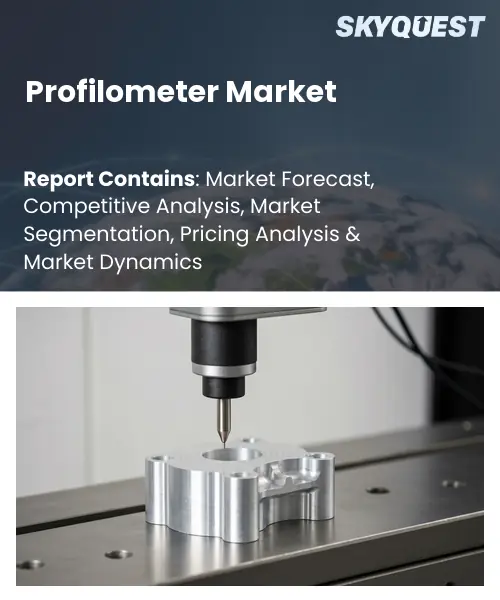
Profilometer Market
Report ID: SQMIG45J2647
Report ID: SQMIG45J2647
[email protected]
USA +1 351-333-4748
Report ID:
SQMIG45J2647 |
Region:
Global |
Published Date: July, 2026
Pages:
157
|Tables:
89
|Figures:
76


Global Profilometer Market size was valued at USD 557.90 Million in 2024 and is poised to grow from USD 590.82 Million in 2025 to USD 934.59 Million by 2033, growing at a CAGR of 5.9% during the forecast period (2026-2033).
Profilometer market trends includes manufacturers and suppliers of instruments which measure surface topography at micro-scale. The importance of it stems from the need to accurately describe surfaces for a variety of applications, from semiconductor fabrication to the manufacture of biomedical devices. The market was born in late 70's when optical interferometry replaced manual profilometry by allowing faster data acquisition. The development of high performance electronics and the trend towards additive manufacturing in the last decade has increased the demand for measurement instruments with tighter tolerance requirements which require more precise measurement instruments. And so the market’s revenue has swelled from a few hundred million dollars to over a billion, reflecting broader industry patterns.
Increasing application of metrology in semiconductor manufacturing is one of the key factors stimulating the profilometer market growth. The reduction of feature size below 5 nanometers in the semiconductor industry requires high-resolution surface characterization. Companies such as ASML and KLA invest heavily in white-light interferometry and confocal microscopy for the uniformity monitoring of wafers. That demand creates opportunities for vendors to bundle analytics with the hardware, giving them the ability to do maintenance and optimize yield. At the same time, the growth of new sectors such as flexible electronics and 3D printed medical implants expands the base of addressable customers, further strengthening a virtuous cycle of tighter process controls leading to more instrument innovation.
How is AI Enhancing Surface Measurement Accuracy in the Profilometer Market?
Embedded machine-learning models in profilometer market share interpret raw sensor data, filtering out environmental noise and improving the accuracy of surface measurement. The algorithms are trained to recognize the characteristic signatures of different materials so the device can tell real surface features from artifacts. Real-time inference allows automatic adjustment of focus, illumination and scanning speed, ensuring consistent measurement across varied samples. The calibration is further improved by cloud-based analytics that compares each scan against an expanding database of reference profiles. Manufacturers requiring tighter tolerances for semiconductor and aerospace components are now using AI-enhanced profilometers to provide the precision and repeatability required to remain competitive, with less manual intervention.
Intel Market Research July 2026, introduced an AI-driven calibration module for laser line detection that reduces noise and improves repeatability, increasing overall market efficiency. The system combines deep-learning algorithms that automatically correct surface artefacts and align measurement grids, delivering sharper point clouds and faster data processing, resulting in higher throughput in semiconductor and aerospace inspection.
Market snapshot - (2026-2033)
Global Market Size
USD 557.9 Million
Largest Segment
Contact Profilometers
Fastest Growth
Non-Contact Profilometers
Growth Rate
5.9% CAGR
To get more insights on this market click here to Request a Free Sample Report
Global profilometer market is segmented by operational technology, measurement capability dimensions, end-use industry vertical and region. Based on operational technology, the market is segmented into contact profilometers and non-contact profilometers. Based on measurement capability dimensions, the market is segmented into 2D surface profiling and 3D surface topography mapping. Based on end-use industry vertical, the market is segmented into semiconductor electronics manufacturing, automotive aerospace engineering, medical devices optical components production and materials science academic research laboratories. Based on region, the market is segmented into North America, Europe, Asia Pacific, Latin America and Middle East & Africa.
The contact profilometers segment is expected to dominate the market, offering direct tactile measurements with unparalleled accuracy for vital surface characterizations. The simplicity and ruggedness of these devices make them the device of choice for high throughput manufacturing lines where repeatability and low maintenance are key. Its enduring reliability instills confidence in customers, fueling ongoing adoption for both upgrades to legacy equipment and new installations, thereby solidifying its leadership in the profilometer market and facilitating accurate defect detection at crucial points in the process.
Meanwhile non contact profilometers are enjoying the strongest growth momentum as optical and laser based techniques open up high speed, non destructive analysis for delicate substrates. The growing use of sophisticated electronics and biomedical industries is driving the demand. The continuous miniaturization and integration into smart factories is pushing the market growth and opening up new streams of opportunity for industry leaders.
The semiconductor electronics manufacturing segment is the largest one as the always-present demand for smaller geometries and tighter tolerances drives the need for ultra-accurate surface inspection. Profilometers provide critical metrology for wafer planarization, thin film thickness control and defect detection, all of which affect yield and performance. The sector’s ongoing technology refresh cycles require manufacturers to have reliable measurement tools in place, highlighting the importance of profilometry today in enabling the maintenance of production efficiency and competitive advantage across all device generations worldwide.
While in contrast, automotive aerospace engineering is emerging as the key high growth area as lightweight composite structures and electric powertrains demand precise surface finish control. New avenues for market expansion are opening up through the increasing adoption of profilometers for aerodynamic surface verification and component reliability testing, spurred by more stringent safety standards and the demand for performance optimization.
To get detailed segments analysis, Request a Free Sample Report
North America is expected to hold a significant share in the profilometer market due to the presence of a mature industrial ecosystem including aerospace, automotive, semiconductor and precision engineering sectors. The region enjoys a wealth of research laboratories and an innovative culture that drives the adoption of cutting edge surface‐characterisation tools. Equipment manufacturers and end‑users work closely hand in hand to create fast feedback loops, which enables them to constantly improve the product. Strong intellectual property regimes and access to capital allow for the development of next generation optical and tactile solutions. A quality and compliance-driven regulatory environment continues to fuel ongoing investments in measurement technology, further cementing the region’s status as a global benchmark for performance and reliability. Availability of a highly skilled engineering workforce and an integrated supply chain accelerates the time-to-market of new instrumentation, while collaborations with top academic institutions foster emerging talent and facilitate exploratory research on nanoscale metrology. The integration of these capabilities drives a virtuous cycle of innovation and market leadership.
Profilometer market outlook in the United States is propelled by investments in aerospace, defense and semiconductor manufacturing, where precision surface analysis is critical for performance and reliability. Leading research universities and national laboratories generate collaborative projects that translate cutting‑edge metrology concepts into commercial instruments. A network of suppliers and service providers ensures adoption of profilometry solutions across automotive and medical device sectors, while an engineering workforce drives integration of these instruments across automotive and medical sectors, reinforcing United States role as a technology hub.
Profilometer market forecast in Canada benefits from a focus on aerospace, renewable energy and precision manufacturing, where accurate surface measurement underpins product quality and compliance. Ecosystems linking universities, research institutes and industrial partners accelerate translation of metrology innovations into tools. Government programmes that emphasize manufacturing technology create a supportive environment for purchasing profilometers, while an engineering workforce drives integration of these instruments across automotive and medical sectors, reinforcing Canada competitive edge.
Europe’s profilometer market is growing quickly, driven by high-value manufacturing, strict quality standards, and collaborative research across the continent. As automotive and aerospace industries push for ever greater surface precision to meet safety and efficiency goals, emerging renewable-energy and medical-device industries are adding new applications for advanced metrology. Harmonized regulations tend to oblige manufacturers to follow consistent measurement practices, which favors the adoption of state-of-the-art profilometers. Cross-border programmes receive significant public-private investment that accelerates technology transfer and allows for joint development of optical and tactile solutions. A broad network of specialized equipment suppliers and a skilled engineering workforce provide fertile ground for continued innovation and market growth across Europe.
Profilometer market regional outlook in Germany is anchored by a precision engineering sector that supplies automotive, aerospace and semiconductor manufacturers demanding exacting surface control. Cooperation between leading instrument firms and research institutes accelerates development of optical and tactile devices. German industry standards emphasize repeatability and traceability, driving implementation of advanced profilometry across production lines. Investment in Industry 4.0 initiatives integrates profilometers with AI analytics, enhancing process optimization and reinforcing Germany’s leadership in measurement technology.
Profilometer market regional forecast in the United Kingdom is growing as aerospace, defense and biotech sectors increase reliance on surface metrology for compliance and innovation. Collaborative clusters linking universities, government labs and OEMs translate research on optical profilometry into commercial tools. Emphasis on manufacturing drives adoption of measurement that lowers material waste. Support for manufacturing ecosystems speeds integration of profilometers with analytics, positioning the United Kingdom as an expanding hub for advanced metrology.
Profilometer market analysis in France is as manufacturers in aerospace, nuclear and goods sectors seek surface precision to meet stringent quality and regulatory requirements. Research agencies collaborate with equipment vendors to develop optical and tactile solutions tailored to French industry standards. Incentives for production encourage adoption of profilometers that reduce waste and energy consumption. Growing expertise in twins and predictive maintenance integrates profilometry data into process frameworks, supporting France’s transition toward manufacturing.
Asia Pacific is consolidating in the profilometer market on the back of rapid industrialization, strong uptake of technology and targeted government programs. Electronics and semiconductor manufacturing hubs in the region need ultra-precise surface measurement to maintain yields, while automotive and robotics sectors seek higher performance standards driving demand for advanced metrology. Significant public and private R&D funding is driving the development of compact, high-speed optical and tactile instruments. By integrating profilometers with smart factory platforms and artificial-intelligence analytics, predictive maintenance and quality control are enhanced, reinforcing the strategic importance of surface-characterisation technology in the industrial landscape of the Asia Pacific.
Profilometer market penetration in Japan benefits from a mature electronics and precision‑machining industry that places high value on surface integrity for semiconductor and automotive components. Strong collaboration between instrument manufacturers and research universities accelerates innovation in optical and hybrid profilometers. Government programmes that promote smart manufacturing and quality‑by‑design encourage widespread adoption of measurement tools. The culture of improvement and rigorous standards ensures that profilometry remains a core element of Japan’s production excellence.
Profilometer industry in South Korea is driven by a semiconductor and display sector that requires nanometer‑scale surface control for high yields and reliability. Strong partnerships between equipment firms and research institutes speed development of optical and contact profilometers. Government incentives for smart factories and Industry 4.0 promote integration of profilometry data into real‑time process monitoring. Emphasis on workforce skill development ensures proficient use of advanced measurement technology across the country’s high‑tech production.
To know more about the market opportunities by region and country, click here to
Buy The Complete Report
Growth In Semiconductor Manufacturing
Adoption Of Contact‑less Measurement Techniques
High Cost Of Precision Instruments
Limited Standardization Across Industries
Request Free Customization of this report to help us to meet your business objectives.
The competitive landscape of the optical profilometer market is characterized by established metrology companies competing through continuous product innovation, software enhancements, strategic acquisitions, and expanding automation capabilities. Leading manufacturers including Keyence Corporation, Bruker Corporation, KLA Corporation, Mitutoyo Corporation, AMETEK's Zygo and Taylor Hobson businesses, Sensofar, and Mahr GmbH are strengthening their market positions by integrating AI-assisted measurement software, high-speed non-contact inspection, and advanced 3D surface characterization technologies. Increasing demand from semiconductor manufacturing, precision engineering, automotive electronics, aerospace, and medical device industries is encouraging companies to invest in high-resolution optical metrology systems capable of supporting automated quality inspection and Industry 4.0 manufacturing environments.
Established in 2018, Q.ANT develops photonic technologies for industrial sensing, quantum-enabled measurement, and optical metrology applications. The company's primary objective is to enhance precision measurement and industrial inspection by integrating photonic components with advanced computational technologies. Its innovations support next-generation non-contact inspection systems used in semiconductor, manufacturing, and precision engineering environments.
Top Player’s Company Profile
Recent Developments in the Profilometer Market
SkyQuest’s ABIRAW (Advanced Business Intelligence, Research & Analysis Wing) is our Business Information Services team that Collects, Collates, Correlates, and Analyses the Data collected by means of Primary Exploratory Research backed by robust Secondary Desk research. As per SkyQuest analysis the global profilometer market is propelled primarily by the rapid growth in semiconductor manufacturing, which fuels demand for ultra‑precise surface metrology, while the shift toward contact‑less measurement techniques offers a second driver by expanding use in biomedical and advanced composite applications. High upfront costs of precision instruments remain a restraint that limits adoption among smaller firms. North America dominates the market thanks to its mature industrial ecosystem and strong R&D base, and within the technology mix contact profilometers continue to lead due to their reliability and high‑throughput capability. AI‑driven analytics are increasingly embedded, further enhancing measurement speed and insight generation.
| Report Metric | Details |
|---|---|
| Market size value in 2024 | USD 557.9 Million |
| Market size value in 2033 | USD 934.59 Million |
| Growth Rate | 5.9% |
| Base year | 2024 |
| Forecast period | (2026-2033) |
| Forecast Unit (Value) | USD Million |
| Segments covered |
|
| Regions covered | North America (US, Canada), Europe (Germany, France, United Kingdom, Italy, Spain, Rest of Europe), Asia Pacific (China, India, Japan, Rest of Asia-Pacific), Latin America (Brazil, Rest of Latin America), Middle East & Africa (South Africa, GCC Countries, Rest of MEA) |
| Companies covered |
|
| Customization scope | Free report customization with purchase. Customization includes:-
|
To get a free trial access to our platform which is a one stop solution for all your data requirements for quicker decision making. This platform allows you to compare markets, competitors who are prominent in the market, and mega trends that are influencing the dynamics in the market. Also, get access to detailed SkyQuest exclusive matrix.
Table Of Content
Executive Summary
Market overview
Parent Market Analysis
Market overview
Market size
KEY MARKET INSIGHTS
COVID IMPACT
MARKET DYNAMICS & OUTLOOK
Market Size by Region
KEY COMPANY PROFILES
Methodology
For the Profilometer Market, our research methodology involved a mixture of primary and secondary data sources. Key steps involved in the research process are listed below:
1. Information Procurement: This stage involved the procurement of Market data or related information via primary and secondary sources. The various secondary sources used included various company websites, annual reports, trade databases, and paid databases such as Hoover's, Bloomberg Business, Factiva, and Avention. Our team did 45 primary interactions Globally which included several stakeholders such as manufacturers, customers, key opinion leaders, etc. Overall, information procurement was one of the most extensive stages in our research process.
2. Information Analysis: This step involved triangulation of data through bottom-up and top-down approaches to estimate and validate the total size and future estimate of the Profilometer Market.
3. Report Formulation: The final step entailed the placement of data points in appropriate Market spaces in an attempt to deduce viable conclusions.
4. Validation & Publishing: Validation is the most important step in the process. Validation & re-validation via an intricately designed process helped us finalize data points to be used for final calculations. The final Market estimates and forecasts were then aligned and sent to our panel of industry experts for validation of data. Once the validation was done the report was sent to our Quality Assurance team to ensure adherence to style guides, consistency & design.
Analyst Support
Customization Options
With the given market data, our dedicated team of analysts can offer you the following customization options are available for the Profilometer Market:
Product Analysis: Product matrix, which offers a detailed comparison of the product portfolio of companies.
Regional Analysis: Further analysis of the Profilometer Market for additional countries.
Competitive Analysis: Detailed analysis and profiling of additional Market players & comparative analysis of competitive products.
Go to Market Strategy: Find the high-growth channels to invest your marketing efforts and increase your customer base.
Innovation Mapping: Identify racial solutions and innovation, connected to deep ecosystems of innovators, start-ups, academics, and strategic partners.
Category Intelligence: Customized intelligence that is relevant to their supply Markets will enable them to make smarter sourcing decisions and improve their category management.
Public Company Transcript Analysis: To improve the investment performance by generating new alpha and making better-informed decisions.
Social Media Listening: To analyze the conversations and trends happening not just around your brand, but around your industry as a whole, and use those insights to make better Marketing decisions.
REQUEST FOR SAMPLE
 REQUEST FREE CUSTOMIZATION
Global Profilometer Market size was valued at USD 557.9 Million in 2024 and is poised to grow from USD 590.82 Million in 2025 to USD 934.59 Million by 2033, growing at a CAGR of 5.9% during the forecast period (2026-2033).
Top Player’s Company Profile 'Keyence Corporation', 'Mitutoyo Corporation', 'Bruker Corporation', 'KLA Corporation', 'Taylor Hobson', 'Zygo Corporation', 'Ametek', 'FormFactor', 'Sensofar', 'Alicona Imaging', 'CyberOptics Corporation', 'Jenoptik', 'Heidenhain', 'Tokyo Seimitsu', 'Chroma ATE', 'Mahr GmbH', 'Nikon Corporation', 'Olympus Corporation', 'Shimadzu Corporation', 'Horiba'
Ai‑Driven Surface Analytics: Manufacturers are integrating artificial‑intelligence algorithms into profilometers to automatically interpret surface data, identify defect patterns, and recommend process adjustments in real time. This shift reduces reliance on specialist operators, shortens training cycles, and accelerates decision‑making across semiconductor, aerospace, and medical device production lines. By delivering actionable insights directly on the instrument interface, AI‑enhanced profilometry enables continuous quality improvement and supports predictive maintenance strategies without disrupting throughput. Consequently, organizations report faster time‑to‑market for high‑precision components and stronger competitive differentiation and higher satisfaction.
Why does North America Dominate the Global Profilometer Market? |@12


Want to customize this report? This report can be personalized according to your needs. Our analysts and industry experts will work directly with you to understand your requirements and provide you with customized data in a short amount of time. We offer $1000 worth of FREE customization at the time of purchase.
Feedback From Our Clients


 USA (+1) 351-333-4748

