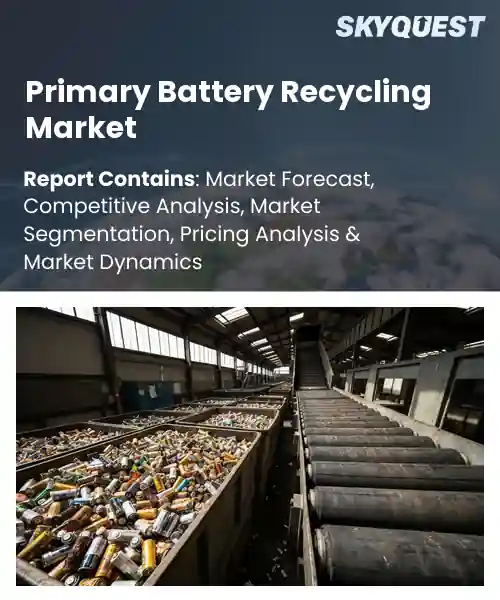
Primary Battery Recycling Market
Report ID: SQMIG55A2079
Report ID: SQMIG55A2079
[email protected]
USA +1 351-333-4748
Report ID:
SQMIG55A2079 |
Region:
Global |
Published Date: February, 2026
Pages:
157
|Tables:
63
|Figures:
75


Global Primary Battery Recycling Market size was valued at USD 1.4 Million in 2024 and is poised to grow from USD 1.51 Million in 2025 to USD 2.82 Million by 2033, growing at a CAGR of 8.1% during the forecast period (2026-2033).
Increasing regulatory pressure for safe battery disposal, increasing scarcity of raw materials such as zinc, manganese, and lithium, and growing environmental concerns regarding soil and water contamination are anticipated to drive the demand for primary battery recycling going forward.
Extended producer responsibility policies are further strengthening the market by making manufacturers accountable for end-of-life battery management, thereby increasing investments in recycling infrastructure. Moreover, the growing trend towards the use of sophisticated technology, like mechanical separation, hydrometallurgy, and optical sorting, is helping to increase the efficiency of the recycling process, thus lowering the cost of processing. In addition, the involvement of municipalities and consumer electronics programs is ensuring a continuous supply of materials to be recycled, while pilot plants in new growing markets are helping to increase recycling capabilities on a global scale. Growing depletion of critical raw materials and increasing demand for sustainable sourcing are also promoting recycling of non-rechargeable batteries such as alkaline, zinc-carbon, and primary lithium units. Rising enforcement of environmental regulations and increasing emphasis on circular economy practices are expected to primarily drive primary battery recycling market growth.
On the contrary, high capital and operational costs, limited consumer awareness and participation in collection programs, lack of uniform regulations across regions, and technical complexities in recycling mixed battery chemistries are anticipated to slow down primary battery recycling market penetration across the forecast period.
How is AI Transforming the Primary Battery Recycling Process?
The recycling of primary batteries is being transformed by AI, which helps to better identify, sort, and process single-use batteries. This includes the use of computer vision in reading the labels on the batteries, machine learning in classifying the batteries, and anomaly detection in detecting defective batteries. This aids in the automation of the sorting of batteries, thus making it safer. This also aids in the prediction of preprocessing. This means that the recycling industry is shifting from informal recycling to formal collection.
In April 2024, AMP Robotics received funding from the U.S. Department of Energy to demonstrate automated battery sorting within e-waste. This initiative uses AI to improve sorting accuracy, increase safety, and scale battery collection and material recovery, thereby supporting market growth and operational efficiency.
Market snapshot - (2026-2033)
Global Market Size
USD 1.4 Million
Largest Segment
Dry Primary Battery Recycling
Fastest Growth
Dry Primary Battery Recycling
Growth Rate
8.1% CAGR
To get more insights on this market click here to Request a Free Sample Report
Global primary battery recycling market is segmented by type, application, and region. Based on type, the market is segmented into wet primary battery recycling and dry primary battery recycling. Based on application, the market is segmented into consumer electronics, automotive, industrial, and others. Based on region, the market is segmented into North America, Europe, Asia Pacific, Latin America, and Middle East & Africa.
The wet primary battery recycling segment is predicted to account for the highest global primary battery recycling market share going forward. Wet hydrometallurgical processes can selectively dissolve and recover multiple battery chemistries from heterogeneous primary battery waste, which helps this segment maintain its dominance. Regulatory guidelines for the safe neutralization of hazardous materials, as well as established infrastructure for industrial-scale processing, have made wet processing more popular, which in turn has increased investment and integration with existing metal refining infrastructure, reducing environmental risks and improving value realization for recyclers and material purchasers.
However, dry primary battery recycling is witnessing the strongest growth as per this primary battery recycling market forecast. Mechanical and thermal methods avoid water use and support modular processing, which helps this segment gain traction in the future. The advancement of automation technologies facilitates the efficient sorting of scattered small format batteries from emerging applications, which will facilitate retail and onsite collection strategies, as well as rapid facility roll-outs to expand recycling access.
The automotive segment is forecasted to lead the global primary battery recycling market revenue generation across the study period. Adoption of specific primary battery chemistries in vehicles and vehicle components are helping this segment hold sway over others. Extensive use in service, in-service OEM parts flow, and end-of-life dismantling – all these help in efficient collection and feedstock flow to recyclers. Good stewardship by manufacturers, safe regulatory protocols based on regulations, and future demand for recovered specialty materials help in investing in dedicated lines to process these materials, which in turn benefits the economy and quality of material recovered.
Consumer electronics is the fastest-growing application area due to the increasing number of portable devices that generate many small primary batteries. Retail takeback schemes and improvements in technology for automated disassembly and sorting will continue to increase the efficiency of collection and provide opportunities for specialized processing of collected waste.
To get detailed segments analysis, Request a Free Sample Report
Robust manufacturing strength, technology leadership, and integrated supply chain ecosystems are helping this region lead the global demand for primary battery recycling going forward. With significant amounts of primary batteries being produced along with related electronics, there is ample feedstock for large investments in technologically advanced recycling facilities and materials recovery technologies. Additionally, strong relationships between OEMs, recyclers, and refined metal producers create new opportunities for critical materials to be captured for reuse; established logistics and collection networks also increase feedstock quality. Many of the regional policy and regulatory frameworks/standards promote circularity and safe handling, enabling modernizations of the private sector. Rising investments in innovation and R&D of novel separating and processing technologies are also expected to cement the dominance of this region in the long run.
Presence of a mature industrial infrastructure, coordinated policy frameworks, and established collection networks are supporting primary battery recycling demand in Japan. Manufacturers and recyclers cooperate in terms of material recovery techniques and quality standards. Similarly, in terms of the adoption of technology, there is a focus on safe handling and recapturing resources. Consumer awareness and the takeback system by retailers ensure the availability of feedstock to domestic players to optimize their processes.
Rise in integration between advanced manufacturing and electronics sectors and efficient waste management systems are also boosting the adoption of primary battery recycling going forward. Investment opportunities are available for facility modernization, process innovations, and safe logistics of hazardous components. Joint research efforts are improving techniques of separation, while retail and municipal collection schemes are improving feedstock qualities. This helps recyclers to boost yield rates and compliance across South Korea.
Imposition of stringent environmental regulations, extended producer responsibility frameworks, and a strong policy emphasis on circular economy are shaping primary battery recycling adoption in the region. Clear policies are attracting new investments in specialized recycling facilities and are encouraging producers to take into account product recyclability. An effective municipal collection system and retail take-back initiatives are providing access to spent batteries. Collaboration between technology suppliers, oil refineries, and research organizations is fueling the development of efficient recycling technology. The high level of environmental awareness among people and the sustainability initiatives in industries are acting as boosters to the growth of the recycling market in Europe. Favorable trade conditions and transportation infrastructure are allowing European recyclers to access value from different feedstock sources. Significant investments are being made by both traditional and new entrant players to develop recycling capacity. Backing of public and private funded initiatives is also creating a new business scope.
Primary battery recycling demand in Germany is augmented by regulatory framework, advanced industrial recycling capacity, and a dense network of municipal collection points. Social acceptance of these solutions and technical knowledge are critical to processing hazardous materials effectively, further entrenching Germany's position as the main hub for battery materials recycling in Europe. Cooperation between vehicle manufacturers and electronics producers/recyclers is driving the adoption of technologies to separate and refine materials.
Expansion of policy support, growing collection infrastructure, and investments in R&D of advanced recovery methods boost primary battery recycling demand in the United Kingdom. Availability of spent batteries is enhanced by retail and municipal take-back schemes, while cooperation between research organizations and industry promotes the commercialization of processes. Emphasis on safety, traceability, and integration with other waste streams ensures reliability, with the United Kingdom becoming an emerging center for specialized recycling expertise in Europe.
High emphasis on building advanced recovery methods are shaping primary battery recycling demand in France. Efforts to enhance collection systems and develop capacity in recycling facilities are improving feedstock availability, while research collaborations are improving techniques in separating and refining recyclables. Focus on industrial integration, quality, and sustainable supply chain credentials is driving growth in this market and attracting new entrants to make France one of the fastest-growing markets in Europe.
Coordinated industry investment, technology development, and expanding collection systems are forecasted to create new business scope for primary battery recycling companies going forward. Industry leadership from companies in the primary battery sector and waste management companies is driving the implementation of advanced processing facilities and innovative separation technologies, as retailers and municipalities increase collection system take-backs to secure a reliable supply. Governmental interest in the safe handling and classification of hazardous waste is also driving improvements in logistics and treatment processes. Industry partnerships between research organizations, industrial recyclers, and refiners are accelerating the commercialization of advanced recovery technologies. High emphasis on improving domestic material security and reducing its dependence on foreign supply chains are also creating new business scope.
Expansion of collection and processing infrastructure by manufacturers and waste service providers are boosting primary battery recycling demand in the United States. Sustainability commitments and takeback programs provide higher feedstocks for scaling up local industrial region recycling operations. Technology development has shifted more focus to efficient material separation for recovery, with collaborative research and public-private sector partnership. The emphasis on regulations on hazardous waste management and product stewardship has improved standards on safe transportation.
Steady demand exists in the Canadian market due in part to provincial programs, industry partnerships, and investment in collection networks. Research centers and pilot plants work towards optimizing separation methods depending on the characteristics of the feedstocks. Collaboration between governments and the private sector is helping to expand recycling capacities to become a contributor to North American recycling initiatives.
To know more about the market opportunities by region and country, click here to
Buy The Complete Report
Rising Environmental Regulations
Stringent regulations regarding the environment have prompted the need to create a regulatory environment that requires manufacturers, consumers, and waste managers to focus on the recycling of primary batteries rather than their disposal. This regulatory push acts as a catalyst to create a predictable compliance environment that requires investment in recycling services. Manufacturers who are concerned about the end-of-life responsibility of their products are prompted to invest in a reverse supply chain that recycles primary batteries, while government initiatives to support recycling efforts help to prevent contamination of resources, thus providing a strong case for recycling.
Growing Portable Device Usage
The increased number of portable devices and off-grid equipment using primary batteries increases the number of batteries that are nearing the end of their life cycle, thereby ensuring a continuous supply of feedstocks for recycling services. As consumers and producers continue to use disposable power sources for convenience and efficiency, the collection infrastructure becomes more viable and financially appealing to recyclers. The continuous supply of end-of-life batteries encourages recycler services to expand their processing capabilities, thereby improving the feasibility of secondary raw materials markets.
Diverse Battery Chemistries
The various types of primary battery chemistries and forms make collection, sorting, and processing more complicated, which has a negative impact on the efficiency of recycling processes. The recycling process involves using various methods or investing in advanced technologies to process heterogeneous materials, which are often required to be handled carefully. This makes recycling processes less efficient, thereby creating limitations on the expansion of recycling operations. This makes recycling processes less efficient, thereby creating limitations on the expansion of global primary battery recycling market outlook.
Limited Collection Infrastructure
The lack of proper collection infrastructure and low household participation also affect the availability of end-of-life primary batteries in recycling channels. This leads to high reliance on informal waste channels. This problem occurs when there is a lack of convenient drop-off points and low participation in formal collection channels. This makes the recycling process difficult and discouraging. This problem creates logistical issues that limit the rate at which recycling networks can expand. This also limits the potential market size.
Request Free Customization of this report to help us to meet your business objectives.
The competitive landscape in global primary battery recycling market is shaped by consolidation through strategic acquisitions and regional partnerships, targeted technology grants to scale separation processes, and operators forming processing alliances to secure feedstock and downstream offtake. For example, corporate acquisitions and the Hydrovolt Northvolt partnership demonstrate MandA and joint venture moves, while public funded RandD collaborations are advancing separation innovations.
SkyQuest’s ABIRAW (Advanced Business Intelligence, Research & Analysis Wing) is our Business Information Services team that Collects, Collates, Correlates, and Analyses the Data collected by means of Primary Exploratory Research backed by robust Secondary Desk research.
As per SkyQuest analysis, rising regulatory pressure for safe battery disposal, increasing scarcity of raw materials, and growing emphasis on circular economy practices are anticipated to drive the demand for primary battery recycling going forward. However, high processing costs, low collection rates, and technological challenges in efficient material recovery are slated to slow down the adoption of primary battery recycling in the future. Europe is slated to spearhead the demand for primary battery recycling owing to strong battery disposal regulations and presence of an established recycling infrastructure. Development of AI-powered sorting systems and integration of advanced hydrometallurgical recycling technologies are anticipated to be key trends driving the primary battery recycling sector over the coming years.
| Report Metric | Details |
|---|---|
| Market size value in 2024 | USD 1.4 Million |
| Market size value in 2033 | USD 2.82 Million |
| Growth Rate | 8.1% |
| Base year | 2024 |
| Forecast period | (2026-2033) |
| Forecast Unit (Value) | USD Million |
| Segments covered |
|
| Regions covered | North America (US, Canada), Europe (Germany, France, United Kingdom, Italy, Spain, Rest of Europe), Asia Pacific (China, India, Japan, Rest of Asia-Pacific), Latin America (Brazil, Rest of Latin America), Middle East & Africa (South Africa, GCC Countries, Rest of MEA) |
| Companies covered |
|
| Customization scope | Free report customization with purchase. Customization includes:-
|
To get a free trial access to our platform which is a one stop solution for all your data requirements for quicker decision making. This platform allows you to compare markets, competitors who are prominent in the market, and mega trends that are influencing the dynamics in the market. Also, get access to detailed SkyQuest exclusive matrix.
Table Of Content
Executive Summary
Market overview
Parent Market Analysis
Market overview
Market size
KEY MARKET INSIGHTS
COVID IMPACT
MARKET DYNAMICS & OUTLOOK
Market Size by Region
KEY COMPANY PROFILES
Methodology
For the Primary Battery Recycling Market, our research methodology involved a mixture of primary and secondary data sources. Key steps involved in the research process are listed below:
1. Information Procurement: This stage involved the procurement of Market data or related information via primary and secondary sources. The various secondary sources used included various company websites, annual reports, trade databases, and paid databases such as Hoover's, Bloomberg Business, Factiva, and Avention. Our team did 45 primary interactions Globally which included several stakeholders such as manufacturers, customers, key opinion leaders, etc. Overall, information procurement was one of the most extensive stages in our research process.
2. Information Analysis: This step involved triangulation of data through bottom-up and top-down approaches to estimate and validate the total size and future estimate of the Primary Battery Recycling Market.
3. Report Formulation: The final step entailed the placement of data points in appropriate Market spaces in an attempt to deduce viable conclusions.
4. Validation & Publishing: Validation is the most important step in the process. Validation & re-validation via an intricately designed process helped us finalize data points to be used for final calculations. The final Market estimates and forecasts were then aligned and sent to our panel of industry experts for validation of data. Once the validation was done the report was sent to our Quality Assurance team to ensure adherence to style guides, consistency & design.
Analyst Support
Customization Options
With the given market data, our dedicated team of analysts can offer you the following customization options are available for the Primary Battery Recycling Market:
Product Analysis: Product matrix, which offers a detailed comparison of the product portfolio of companies.
Regional Analysis: Further analysis of the Primary Battery Recycling Market for additional countries.
Competitive Analysis: Detailed analysis and profiling of additional Market players & comparative analysis of competitive products.
Go to Market Strategy: Find the high-growth channels to invest your marketing efforts and increase your customer base.
Innovation Mapping: Identify racial solutions and innovation, connected to deep ecosystems of innovators, start-ups, academics, and strategic partners.
Category Intelligence: Customized intelligence that is relevant to their supply Markets will enable them to make smarter sourcing decisions and improve their category management.
Public Company Transcript Analysis: To improve the investment performance by generating new alpha and making better-informed decisions.
Social Media Listening: To analyze the conversations and trends happening not just around your brand, but around your industry as a whole, and use those insights to make better Marketing decisions.
REQUEST FOR SAMPLE
 REQUEST FREE CUSTOMIZATION
Global Primary Battery Recycling Market size was valued at USD 1.4 Million in 2024 and is poised to grow from USD 1.51 Million in 2025 to USD 2.82 Million by 2033, growing at a CAGR of 8.1% during the forecast period (2026-2033).
The competitive landscape in global primary battery recycling is shaped by consolidation through strategic acquisitions and regional partnerships, targeted technology grants to scale separation processes, and operators forming processing alliances to secure feedstock and downstream offtake. For example, corporate acquisitions and the Hydrovolt Northvolt partnership demonstrate M and A and joint venture moves, while public funded R and D collaborations are advancing separation innovations. 'Battery Solutions LLC', 'Call2Recycle Inc.', 'EnerSys', 'Exide Technologies', 'Gravita India Ltd.', 'Johnson Controls International Plc', 'Umicore', 'Redivivo', 'BatteryRecyclers', 'GRS Batteries Foundation', 'American Manganese Inc.', 'Veolia Environnement', 'EcoBattery', 'Battery Resource', 'TerraCycle', 'Li-Cycle', 'Recupyl', 'Aqua Metals', 'Call2Recycle Canada', 'Umicore Battery Recycling'
Stricter environmental regulations and policy frameworks compel manufacturers, consumers, and waste managers to prioritize recovery of primary batteries rather than disposal, increasing demand for recycling infrastructure and services. Regulatory pressure creates predictable compliance requirements that encourage investment in collection systems, reverse logistics, and processing technologies. Producers facing end-of-life responsibilities are motivated to design supply chains that return spent batteries, while public authorities support programs to prevent contamination and conserve resources, thereby strengthening the business case for expanding recycling operations across the value chain.
Regulatory Alignment Accelerating Adoption: Governments and industry regulators are converging on clearer producer responsibility frameworks and standardized recycling criteria, reducing legal uncertainty and encouraging investment in end to end recycling capabilities. Harmonized permitting pathways and compliance expectations make expansion more predictable, enabling firms to plan long term infrastructure, technology deployment, and predictable timelines. This regulatory clarity fosters cross border collaboration while prompting manufacturers to embed collection and remanufacturing into product strategies, strengthening the primary battery circular ecosystem. Stakeholder certainty catalyzes innovation and investment.
Robust manufacturing strength, technology leadership, and integrated supply chain ecosystems are helping the Asia pacific region lead the global demand for primary battery recycling going forward.


Want to customize this report? This report can be personalized according to your needs. Our analysts and industry experts will work directly with you to understand your requirements and provide you with customized data in a short amount of time. We offer $1000 worth of FREE customization at the time of purchase.
Feedback From Our Clients


 USA (+1) 351-333-4748

