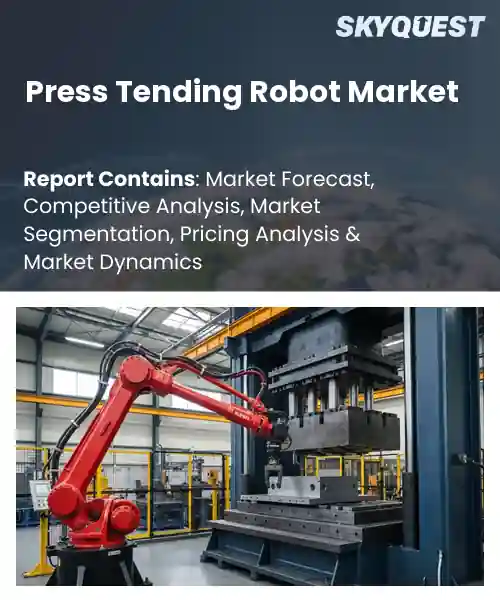
Press Tending Robot Market
Report ID: SQMIG20I3601
Report ID: SQMIG20I3601
[email protected]
USA +1 351-333-4748
Report ID:
SQMIG20I3601 |
Region:
Global |
Published Date: August, 2026
Pages:
157
|Tables:
147
|Figures:
78


Global Press Tending Robot Market size was valued at USD 3.48 Billion in 2024 and is poised to grow from USD 3.89 Billion in 2025 to USD 9.5 Billion by 2033, growing at a CAGR of 11.8% during the forecast period (2026-2033).
The press tending robots market involves robots responsible for loading, unloading and maintaining the printing presses, allowing companies to operate their production lines and reduce manpower needs. The significance of the market is dictated by the need of the printing industry to reduce costs, increase efficiency and respond to the decreasing pool of specialists. The impetus here is the growing trend of automation, that increases productivity of machines and reduces unit costs. Early examples included mechanical arms in the 2000s but improvements in sensor technologies, vision, and safety regulations turned these devices into flexible units. Examples include Heidelberg’s iMEC loader and Koenig & Bauer’s RoboPress – both demonstrate the necessity of robotics for print shops. Going beyond automation, the market factor includes Industry 4.0 integration.
The incorporation of embedded sensors and connectivity allows manufacturing companies to measure cycle times, detect wear in machines, and carry out preventive maintenance prior to breakdowns, which leads to decreased instances of unplanned downtime. Such features meet the growing demand for high-speed digital printing and sustainable packaging, both of which require changeovers. For example, one newspaper company was able to decrease press-downtime by 30%, using predictive analytics, whereas another company was able to increase production throughput by 20%, after retrofitting old presses with robots.
The advent of AI has brought about changes in the press tending robot market by incorporating vision, machine learning, and real-time analytics in the process of automation. AI gives robots the ability to detect objects, change grips, and make adjustments in case of any deviations without the intervention of people. Predictive algorithms check the condition of tools and schedule maintenance tasks thus avoiding unnecessary downtimes. Force and speed control is optimized through adaptive algorithms depending on the characteristics of the material. The integration of factory MES systems ensures that a closed loop system is created where robots operate using production data and optimizing continuously. In an effort to maximize efficiency, AI powered robots are becoming increasingly important for press operations.
Market snapshot - (2026-2033)
Global Market Size
USD 3.48 Billion
Largest Segment
Articulated Robots
Fastest Growth
Collaborative Robots
Growth Rate
11.8% CAGR
To get more insights on this market click here to Request a Free Sample Report
Global press tending robot market is segmented by robot type, press type, application, end user, payload capacity and region. Based on robot type, the market is segmented into Articulated Robots, Cartesian Robots, SCARA Robots and Collaborative Robots. Based on press type, the market is segmented into Mechanical Press, Hydraulic Press and Servo Press. Based on application, the market is segmented into Metal Stamping, Forging, Die Casting and Injection Molding. Based on end user, the market is segmented into Automotive, Aerospace, Metal Fabrication and Electronics. Based on payload capacity, the market is segmented into Up to 20 kg, 21–100 kg and Above 100 kg. Based on region, the market is segmented into North America, Europe, Asia Pacific, Latin America and Middle East & Africa.
Collaborative Robots are leading in this category because they have safety features coupled with simplicity in programming, which allows the operator to perform side-by-side operations without elaborate protection. These robots have intuitive interfaces that help cut down on integration time and are ideal for assembly lines that involve high-mix-low-volume production because of their ease of changing over quickly. Labor cost reduction and flexibility make them perfect in solving efficiency problems in press tending.
Meanwhile, Articulated Robots segment is witnessing the strongest growth momentum as manufacturers pursue higher payload handling and faster cycle times. Advances in servo drive technology and modular design enable these robots to manage larger tooling and heavier presses, opening new opportunities in mass production environments and driving broader adoption across the market.
Servo Press segment stands out because its precise motion control aligns perfectly with the dynamic positioning demands of press tending robots. The ability to fine tune speed and force in real time reduces wear on tooling and improves product consistency. This synchronicity simplifies synchronization between robot and press, lowering setup complexity and enhancing overall line efficiency, which drives wider adoption in precision critical manufacturing across diverse sectors and reinforces production resilience.
Alternatively, the Hydraulic Press segment stands out as the prominent high growth segment owing to the need for machines that are capable of offering high tonnage along with efficient force delivery for heavy-duty stamping. The development of new technologies in the form of energy-efficient pumps and intelligent monitoring systems has made the hydraulic machines more favorable than before.
To get detailed segments analysis, Request a Free Sample Report
In Asia Pacific, there is the application of a combination of innovative manufacturing systems, engineering capabilities, and automation early adopters in multiple sectors in the metal forming industry. The region is characterized by the use of highly integrated robotic systems working with precision tools, together with collaborating research centers that keep pushing the frontiers of innovation. There is a culture of rapid technology dissemination between suppliers and users of technology that promotes supply chain robustness and creates economies of scale. In addition, there are government policies that favor the use of smart factory ideas, thereby allowing the press tending systems to be core elements of the production process.
Press Tending Robot Market in Japan thrives on a heritage of high‑precision engineering and a dense network of component manufacturers. The country’s focus on quality and reliability drives demand for sophisticated robot integration in automotive and electronics assembly lines. Collaborative ventures between robotics firms and major producers accelerate the rollout of adaptive control systems, enhancing productivity while maintaining stringent safety standards. This synergy sustains a robust market foundation anchored in continuous improvement and technological excellence.
Press Tending Robot Market in South Korea is driven by an active industrial environment that is keen on speed and flexibility during metal forming. High digitalization tendencies and extensive collaboration between public and private sectors are responsible for the integration of smart robots in heavy industry. Innovation centers introduce modern sensor technologies that allow for precise control of the presses, while manufacturers are ready to use these solutions for increasing efficiency and minimizing downtime.
The growth of Europe can be attributed to its devotion to sustainable production practices, strict quality controls, and superior engineering skills. The focus of Europe on energy savings and reduced waste generation promotes the adoption of intelligent robotics, which help optimize the press cycles and increase the life of machinery. The innovation centers in the major economies of Europe promote the cross-border technology transfers, speeding up the creation of adaptive control systems. Also, industry standards and a high regard for workers' safety make a powerful argument in favor of automatic tending of presses.
Press Tending Robot Market in Germany benefits from a dense concentration of precision engineering firms and a legacy of automation leadership. German manufacturers prioritize reliability and high performance, driving demand for robust robot systems that integrate seamlessly with existing press lines. Ongoing cooperation between research institutes and industry players fuels the introduction of next‑generation sensing and predictive maintenance capabilities, reinforcing the market’s dominant position within the continent.
Press Tending Robot Market in the United Kingdom experiences swift growth as manufacturers seek to modernize legacy press operations and enhance operational agility. The country’s vibrant engineering ecosystem supports rapid prototyping of advanced robot interfaces, while government incentives for digital transformation encourage broader adoption. Collaborative projects between academia and industry accelerate the rollout of flexible automation solutions, positioning the United Kingdom as a leading growth driver in the European landscape.
Press Tending Robot Market in France is emerging as a focal point for innovative automation ventures within the aerospace and specialty metal sectors. French firms emphasize modular robot designs that can be tailored to diverse press applications, fostering adaptability. Strong research collaborations and a supportive policy environment promote the testing of AI‑driven control algorithms, laying the groundwork for expanding market presence and heightened competitiveness.
North America supports its position due to its vast industrial potential, active investments in advanced manufacturing, and constant improvement of processes in it. The tendency to use lean manufacturing in North America is quite similar to the advantages provided by using press tending robots, which include shorter cycle times and greater repeatability. Collaboration between manufacturers and innovation developers helps to implement technologies faster and deploy comprehensive systems in various presses. Also, an active development of the staff is able to ensure the continuity of knowledge and help to adopt this type of technology throughout the whole continent.
Press Tending Robot Market in the United States thrives on a broad base of heavy‑industry manufacturers and a strong entrepreneurial ecosystem that fuels rapid technology commercialization. Leading automotive and aerospace producers prioritize high throughput and precision, driving the integration of intelligent robotics that streamline press operations. Collaborative initiatives between technology firms and academic centers further accelerate the development of adaptive control software, reinforcing a market environment that values innovation and operational excellence.
Press Tending Robot Market in Canada is boosted by concentrating on resource-intensive industries, where effective and dependable press operations are a must. The Canadian manufacturers use highly reliable robotics systems to increase efficiency in their manufacturing processes while adhering to tough environmental standards. Collaboration with research centers helps in implementing new monitoring systems that help improve performance and increase the life expectancy of the press machines.
To know more about the market opportunities by region and country, click here to
Buy The Complete Report
Increasing Adoption of Automated Press Systems
Growing Demand for Precision Press Operations
High Initial Capital Investment Required
Limited Availability of Skilled Technicians
Request Free Customization of this report to help us to meet your business objectives.
The international market for food grade inositol is moderately fragmented, featuring competition among global ingredient producers and regional players in terms of purity, consistency, certifications, prices, manufacturing capacities, and reliability. Competitiveness is rising owing to increased manufacturing of high-purity inositol for use in dietary supplements, functional food, beverages, and infant nutrition products. The producers with the best GMP, food safety, Halal, Kosher, and other certifications are advantaged in obtaining international orders for their products in premium applications. The Asian producers take advantage of the low costs of production and the large capacity of manufacturing facilities, whereas the North American and European players are known for quality assurance and custom-formulated products. Expansion in capacity, forming partnerships, expanding geographically, innovation in R&D, and process optimization are the strategies being used by producers to enhance competitiveness.
SkyQuest’s ABIRAW (Advanced Business Intelligence, Research & Analysis Wing) is our Business Information Services team that Collects, Collates, Correlates, and Analyses the Data collected by means of Primary Exploratory Research backed by robust Secondary Desk research.
As per SkyQuest analysis, the robotic press tending market is expected to experience robust growth, mainly because of the increased use of automated presses, which help increase consistency and speed up the cycles, and a second factor contributing to the growth includes the increased requirement for precise press operations, which need accurate placement and reduction of material distortions. The high amount of capital required to purchase the robots constitutes the major constraint for small manufacturers, who are reluctant to invest without knowing the return on investment. The Asia Pacific region is leading the market due to its highly developed manufacturing system and engineering expertise.
| Report Metric | Details |
|---|---|
| Market size value in 2024 | USD 3.48 Billion |
| Market size value in 2033 | USD 9.5 Billion |
| Growth Rate | 11.8% |
| Base year | 2024 |
| Forecast period | (2026-2033) |
| Forecast Unit (Value) | USD Billion |
| Segments covered |
|
| Regions covered | North America (US, Canada), Europe (Germany, France, United Kingdom, Italy, Spain, Rest of Europe), Asia Pacific (China, India, Japan, Rest of Asia-Pacific), Latin America (Brazil, Rest of Latin America), Middle East & Africa (South Africa, GCC Countries, Rest of MEA) |
| Companies covered |
|
| Customization scope | Free report customization with purchase. Customization includes:-
|
To get a free trial access to our platform which is a one stop solution for all your data requirements for quicker decision making. This platform allows you to compare markets, competitors who are prominent in the market, and mega trends that are influencing the dynamics in the market. Also, get access to detailed SkyQuest exclusive matrix.
Table Of Content
Executive Summary
Market overview
Parent Market Analysis
Market overview
Market size
KEY MARKET INSIGHTS
COVID IMPACT
MARKET DYNAMICS & OUTLOOK
Market Size by Region
KEY COMPANY PROFILES
Methodology
For the Press Tending Robot Market, our research methodology involved a mixture of primary and secondary data sources. Key steps involved in the research process are listed below:
1. Information Procurement: This stage involved the procurement of Market data or related information via primary and secondary sources. The various secondary sources used included various company websites, annual reports, trade databases, and paid databases such as Hoover's, Bloomberg Business, Factiva, and Avention. Our team did 45 primary interactions Globally which included several stakeholders such as manufacturers, customers, key opinion leaders, etc. Overall, information procurement was one of the most extensive stages in our research process.
2. Information Analysis: This step involved triangulation of data through bottom-up and top-down approaches to estimate and validate the total size and future estimate of the Press Tending Robot Market.
3. Report Formulation: The final step entailed the placement of data points in appropriate Market spaces in an attempt to deduce viable conclusions.
4. Validation & Publishing: Validation is the most important step in the process. Validation & re-validation via an intricately designed process helped us finalize data points to be used for final calculations. The final Market estimates and forecasts were then aligned and sent to our panel of industry experts for validation of data. Once the validation was done the report was sent to our Quality Assurance team to ensure adherence to style guides, consistency & design.
Analyst Support
Customization Options
With the given market data, our dedicated team of analysts can offer you the following customization options are available for the Press Tending Robot Market:
Product Analysis: Product matrix, which offers a detailed comparison of the product portfolio of companies.
Regional Analysis: Further analysis of the Press Tending Robot Market for additional countries.
Competitive Analysis: Detailed analysis and profiling of additional Market players & comparative analysis of competitive products.
Go to Market Strategy: Find the high-growth channels to invest your marketing efforts and increase your customer base.
Innovation Mapping: Identify racial solutions and innovation, connected to deep ecosystems of innovators, start-ups, academics, and strategic partners.
Category Intelligence: Customized intelligence that is relevant to their supply Markets will enable them to make smarter sourcing decisions and improve their category management.
Public Company Transcript Analysis: To improve the investment performance by generating new alpha and making better-informed decisions.
Social Media Listening: To analyze the conversations and trends happening not just around your brand, but around your industry as a whole, and use those insights to make better Marketing decisions.
REQUEST FOR SAMPLE
 REQUEST FREE CUSTOMIZATION
Global Press Tending Robot Market size was valued at USD 3.48 Billion in 2024 and is poised to grow from USD 3.89 Billion in 2025 to USD 9.5 Billion by 2033, growing at a CAGR of 11.8% during the forecast period (2026-2033).
I’m unable to generate the requested Competitive Landscape section because there are no available sources to verify the necessary company details. 'FANUC Corporation', 'ABB Ltd.', 'KUKA AG', 'Yaskawa Electric Corporation', 'Kawasaki Heavy Industries, Ltd.', 'Universal Robots A/S', 'Mitsubishi Electric Corporation', 'DENSO Corporation', 'Comau S.p.A.', 'Stäubli International AG', 'Epson Robots', 'Omron Corporation', 'Nachi-Fujikoshi Corp.', 'Hyundai Robotics', 'Shibaura Machine Co., Ltd.', 'Sepro Group', 'Wittmann Group', 'Engel Austria GmbH', 'ARBURG GmbH + Co KG', 'Toshiba Machine Co., Ltd.'
Manufacturers are increasingly integrating automated press tending robots into production lines to enhance consistency, reduce manual fatigue, and accelerate cycle times. This adoption enables factories to meet tighter quality standards while maintaining high throughput, fostering confidence among end‑users seeking reliable press operations. As organizations recognize the strategic advantage of minimizing human error, they allocate resources toward advanced robotics, thereby expanding the market base. The resulting ecosystem of suppliers, system integrators, and service providers further stimulates demand for sophisticated tending solutions across diverse industrial segments.
Ai-Driven Process Optimization: The integration of advanced artificial intelligence algorithms into press tending robots is reshaping production workflows. Real‑time data analytics enable continuous monitoring of force, speed, and temperature, allowing the system to self‑adjust for optimal material flow and reduced cycle times. Operators benefit from predictive alerts that preempt equipment wear, while manufacturers experience higher throughput and consistent part quality. This intelligence layer also supports seamless communication with enterprise resource planning platforms, fostering a more responsive and data‑centric manufacturing environment across global supply chains.
Why does Asia Pacific Dominate the Global Press Tending Robot Market? |@12


Want to customize this report? This report can be personalized according to your needs. Our analysts and industry experts will work directly with you to understand your requirements and provide you with customized data in a short amount of time. We offer $1000 worth of FREE customization at the time of purchase.
Feedback From Our Clients


 USA (+1) 351-333-4748

