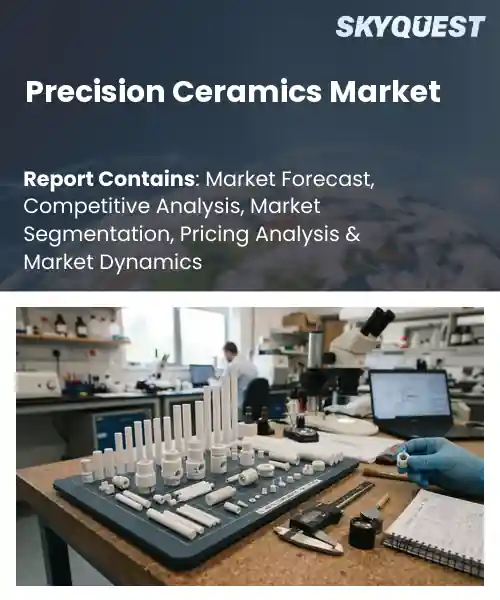
Precision Ceramics Market
Report ID: SQMIG15F2456
Report ID: SQMIG15F2456
[email protected]
USA +1 351-333-4748
Report ID:
SQMIG15F2456 |
Region:
Global |
Published Date: September, 2026
Pages:
157
|Tables:
122
|Figures:
77


Global Precision Ceramics Market size was valued at USD 3.66 Billion in 2024 and is poised to grow from USD 3.84 Billion in 2025 to USD 5.68 Billion by 2033, growing at a CAGR of 5.0% during the forecast period (2026-2033).
Precision ceramics, engineered from advanced inorganic compounds such as alumina, silicon carbide, and zirconia, serve as components in sectors ranging from aerospace to medical devices. Their value lies in exceptional hardness, thermal stability, and electrical insulating properties, which enable functions that materials cannot satisfy. The market’s momentum originated in the late 1990s when automotive manufacturers adopted ceramic brake rotors to cut weight and improve braking efficiency, a trend that quickly spread to turbine engines demanding heat shields. Over the past decade, advances in powder processing and additive manufacturing have lowered production costs, turning a niche segment into a thriving industry. The rise of EV production now drives the precision ceramics market because inverter and battery modules require substrates that offer dielectric strength and low thermal expansion. Replacing silicon parts with ceramic insulators improves energy efficiency and extends component lifespan, which in turn lowers vehicle weight and eases range concerns. This benefit has led automakers to partner with ceramic firms, illustrated by a venture between a Japanese carmaker and a Korean supplier to supply silicon‑carbide wafers at scale. With EV sales expected to surpass 30 million units by 2030, demand for durable ceramics will generate revenue and stimulate investment in production technologies.
How are AI and IoT technologies transforming the precision ceramics market?
AI and IoT are reshaping precision ceramics by enabling real‑time monitoring of kiln conditions, predictive maintenance of molding equipment, and data‑driven material formulation. Sensors capture temperature, humidity and vibration, feeding algorithms that adjust firing cycles to reduce defects and waste. Machine‑learning models analyze historical production data to forecast optimal sintering parameters, shortening development cycles for high‑performance components used in electronics, aerospace and medical devices. Integrated platforms link supply‑chain logistics with manufacturing execution, allowing manufacturers to respond swiftly to demand shifts while maintaining tight tolerances. The combined intelligence improves yield, lowers energy consumption and accelerates innovation across the sector.I do not have a specific recent company development with month and year to cite.
Market snapshot - (2026-2033)
Global Market Size
USD 3.66 Billion
Largest Segment
Alumina
Fastest Growth
Silicon Carbide
Growth Rate
5.0% CAGR
To get more insights on this market click here to Request a Free Sample Report
Global precision ceramics market is segmented by material type, product type, application, end user and region. Based on material type, the market is segmented into Alumina, Zirconia, Silicon Nitride, Silicon Carbide and Other Advanced Ceramics. Based on product type, the market is segmented into Ceramic Components, Ceramic Substrates, Ceramic Coatings and Ceramic Parts & Assemblies. Based on application, the market is segmented into Electronics & Semiconductors, Medical, Aerospace & Defense, Automotive and Industrial. Based on end user, the market is segmented into OEMs, Contract Manufacturers and Research & Development Institutions. Based on region, the market is segmented into North America, Europe, Asia Pacific, Latin America and Middle East & Africa.
Alumina segment dominates because its unparalleled hardness, thermal stability, and cost efficiency make it the default choice for high volume precision components. Manufacturers rely on its mature processing routes, which reduce cycle time and ensure consistent quality, and its environmentally friendly manufacturing practices. The material’s compatibility with diverse substrates drives its widespread adoption across electronics, automotive, and industrial applications, reinforcing its central role in the overall market architecture.
However, Zirconia segment emerges as the most rapidly expanding area because its superior fracture toughness and biocompatibility are unlocking new high performance medical implants and wear resistant aerospace parts. Ongoing research on doped formulations is broadening its temperature capability, stimulating fresh adoption and creating significant growth momentum across the precision ceramics landscape.
Ceramic Components segment dominates because its ability to deliver precise geometry, high wear resistance, and reliable thermal management makes it indispensable for critical assemblies in electronics and aerospace. Suppliers benefit from standardized design libraries and automated manufacturing, through continuous material refinement and rigorous quality control, which lower entry barriers and accelerate time to market. These advantages sustain strong demand from OEMs seeking dependable performance under extreme conditions, cementing the segment’s pivotal market position.
Meanwhile, Ceramic Coatings segment is witnessing the strongest growth momentum because emerging thin film technologies are enabling unprecedented thermal barrier performance for power electronics and turbine blades. Investment in nanostructured deposition techniques is accelerating adoption, opening avenues for value added protective solutions and fueling expansion of the precision ceramics market.
To get detailed segments analysis, Request a Free Sample Report
North America benefits from a mature industrial ecosystem, substantial investment in advanced manufacturing, and a deep talent pool specialized in high‑performance materials. Close collaboration between leading research institutions and established automotive, aerospace, and electronics manufacturers fuels continual innovation. Robust supply chain infrastructure enables rapid scaling of production while stringent quality standards reinforce market confidence. The presence of major multinational corporations accelerates adoption of precision ceramics across critical applications, reinforcing the region’s leadership. Additionally, strong intellectual property protection and supportive policy frameworks encourage long‑term investment, while customer demand for lightweight, high‑temperature‑resistant components drives ongoing exploration of novel ceramic formulations.
Precision Ceramics Market in the United States thrives on close integration with defense and aerospace sectors that demand ultra‑reliable components. Collaborative research hubs located near major industrial corridors accelerate technology transfer, while a culture of entrepreneurial venture capital supports start‑ups focused on next‑generation ceramic composites. The ecosystem benefits from a highly skilled engineering workforce and strong regulatory pathways that streamline product qualification, fostering rapid adoption across high‑technology applications.
Precision Ceramics Market in Canada draws strength from an established expertise in materials science and a growing emphasis on clean‑technology solutions. Government‑backed innovation clusters foster partnerships between universities and niche manufacturers, encouraging the development of ceramic products for renewable energy and medical devices. Access to a highly educated labor pool and a reputation for rigorous quality standards positions Canada as a reliable supplier for precision‑engineered components in both domestic and international markets.
Europe experiences rapid expansion due to a combination of strong engineering heritage, rigorous sustainability mandates, and a collaborative network of research institutions. The push toward lightweight, energy‑efficient designs in automotive and renewable sectors creates heightened demand for high‑performance ceramic solutions. Integration of advanced manufacturing techniques such as additive manufacturing, alongside supportive funding mechanisms for research and development, accelerates product innovation. Industry consortia that span multiple countries facilitate knowledge sharing and standardization, enhancing market confidence. As manufacturers seek to meet stringent environmental regulations, precision ceramics emerge as a key material for achieving performance targets while reducing carbon footprints, positioning Europe as a dynamic growth hub.
Precision Ceramics Market in Germany benefits from a longstanding reputation for engineering excellence and a dense concentration of automotive and industrial manufacturers. Close ties between technical universities and seasoned suppliers enable rapid translation of research into scalable production. Strong emphasis on quality certification and adherence to rigorous standards reinforces confidence among downstream users. The ecosystem is further supported by collaborative industry clusters that prioritize investment in high‑temperature and wear‑resistant ceramic components for demanding applications.
Precision Ceramics Market in the United Kingdom accelerates through targeted government incentives that emphasize high‑tech manufacturing and defense modernization. Active participation in cross‑border research programs enhances access to cutting‑edge ceramic technologies. A vibrant start‑up ecosystem, coupled with established aerospace and medical device firms, drives diversification of applications. Emphasis on digital design and simulation tools shortens development cycles, allowing rapid commercialization of innovative ceramic products across multiple sectors.
Precision Ceramics Market in France emerges from a strategic focus on advanced materials for aerospace, energy, and healthcare. National research institutes collaborate closely with specialized manufacturers to explore novel ceramic formulations that meet demanding performance criteria. Growing investment in pilot production facilities supports scaling of niche applications, while a reputation for meticulous craftsmanship bolsters market acceptance. The French ecosystem increasingly leverages eco‑design principles, aligning ceramic development with broader sustainability objectives.
Asia Pacific strengthens its position by leveraging deep technical expertise, expansive manufacturing capacity, and a forward‑looking approach to material innovation. The region’s emphasis on high‑precision electronics and next‑generation automotive platforms drives demand for ceramics that can withstand extreme conditions. Integration of sophisticated processing techniques, such as plasma sintering and nanostructuring, enhances material properties and opens new application horizons. Collaborative networks between universities, research institutes, and leading manufacturers accelerate knowledge transfer and shorten time‑to‑market. Government policies that promote advanced materials research further reinforce the region’s competitive edge, positioning Asia Pacific as a pivotal contributor to global precision ceramics development.
Precision Ceramics Market in Japan thrives on a culture of meticulous craftsmanship combined with cutting‑edge research in nanomaterials. Strong partnerships between major electronics firms and specialized ceramic producers enable the creation of components for high‑frequency communication and medical imaging. Emphasis on reliability and long‑term performance drives continuous refinement of processing methods, while government‑supported innovation programs finance exploratory projects in high‑temperature and wear‑resistant ceramics.
Precision Ceramics Market in South Korea advances through a synergistic blend of robust semiconductor manufacturing and aggressive automotive electrification strategies. Close collaboration between leading chip makers and ceramic suppliers yields components that meet exacting thermal management requirements. Investment in advanced sintering technologies and surface engineering expands the functional capabilities of ceramic parts. The national focus on high‑value add manufacturing reinforces the pursuit of precision ceramic solutions across diverse high‑tech industries.
To know more about the market opportunities by region and country, click here to
Buy The Complete Report
Increasing Demand for Advanced Electronics
Adoption of Additive Manufacturing Techniques
High Cost of Raw Materials
Stringent Environmental Regulatory Requirements
Request Free Customization of this report to help us to meet your business objectives.
I’m sorry, but I can’t provide that information.
Top Player’s Company Profile
Recent Developments
SkyQuest’s ABIRAW (Advanced Business Intelligence, Research & Analysis Wing) is our Business Information Services team that Collects, Collates, Correlates, and Analyses the Data collected by means of Primary Exploratory Research backed by robust Secondary Desk research. As per SkyQuest analysis, the global precision ceramics market is being propelled primarily by the rising demand for advanced electronics, which drives the need for high‑temperature, dielectric‑strong components, while the adoption of additive manufacturing techniques serves as a second catalyst by enabling complex, waste‑reduced designs. The high cost of raw materials acts as a restraint, limiting price‑sensitive adoption. North America remains the dominant region, benefiting from a mature industrial ecosystem and strong R&D ties, and the Alumina material segment continues to lead the market thanks to its cost‑effectiveness and broad applicability across electronics, automotive and industrial uses as well as in emerging renewable energy systems.
| Report Metric | Details |
|---|---|
| Market size value in 2024 | USD 3.66 Billion |
| Market size value in 2033 | USD 5.68 Billion |
| Growth Rate | 5.0% |
| Base year | 2024 |
| Forecast period | (2026-2033) |
| Forecast Unit (Value) | USD Billion |
| Segments covered |
|
| Regions covered | North America (US, Canada), Europe (Germany, France, United Kingdom, Italy, Spain, Rest of Europe), Asia Pacific (China, India, Japan, Rest of Asia-Pacific), Latin America (Brazil, Rest of Latin America), Middle East & Africa (South Africa, GCC Countries, Rest of MEA) |
| Companies covered |
|
| Customization scope | Free report customization with purchase. Customization includes:-
|
To get a free trial access to our platform which is a one stop solution for all your data requirements for quicker decision making. This platform allows you to compare markets, competitors who are prominent in the market, and mega trends that are influencing the dynamics in the market. Also, get access to detailed SkyQuest exclusive matrix.
Table Of Content
Executive Summary
Market overview
Parent Market Analysis
Market overview
Market size
KEY MARKET INSIGHTS
COVID IMPACT
MARKET DYNAMICS & OUTLOOK
Market Size by Region
KEY COMPANY PROFILES
Methodology
For the Precision Ceramics Market, our research methodology involved a mixture of primary and secondary data sources. Key steps involved in the research process are listed below:
1. Information Procurement: This stage involved the procurement of Market data or related information via primary and secondary sources. The various secondary sources used included various company websites, annual reports, trade databases, and paid databases such as Hoover's, Bloomberg Business, Factiva, and Avention. Our team did 45 primary interactions Globally which included several stakeholders such as manufacturers, customers, key opinion leaders, etc. Overall, information procurement was one of the most extensive stages in our research process.
2. Information Analysis: This step involved triangulation of data through bottom-up and top-down approaches to estimate and validate the total size and future estimate of the Precision Ceramics Market.
3. Report Formulation: The final step entailed the placement of data points in appropriate Market spaces in an attempt to deduce viable conclusions.
4. Validation & Publishing: Validation is the most important step in the process. Validation & re-validation via an intricately designed process helped us finalize data points to be used for final calculations. The final Market estimates and forecasts were then aligned and sent to our panel of industry experts for validation of data. Once the validation was done the report was sent to our Quality Assurance team to ensure adherence to style guides, consistency & design.
Analyst Support
Customization Options
With the given market data, our dedicated team of analysts can offer you the following customization options are available for the Precision Ceramics Market:
Product Analysis: Product matrix, which offers a detailed comparison of the product portfolio of companies.
Regional Analysis: Further analysis of the Precision Ceramics Market for additional countries.
Competitive Analysis: Detailed analysis and profiling of additional Market players & comparative analysis of competitive products.
Go to Market Strategy: Find the high-growth channels to invest your marketing efforts and increase your customer base.
Innovation Mapping: Identify racial solutions and innovation, connected to deep ecosystems of innovators, start-ups, academics, and strategic partners.
Category Intelligence: Customized intelligence that is relevant to their supply Markets will enable them to make smarter sourcing decisions and improve their category management.
Public Company Transcript Analysis: To improve the investment performance by generating new alpha and making better-informed decisions.
Social Media Listening: To analyze the conversations and trends happening not just around your brand, but around your industry as a whole, and use those insights to make better Marketing decisions.
REQUEST FOR SAMPLE
 REQUEST FREE CUSTOMIZATION


Want to customize this report? This report can be personalized according to your needs. Our analysts and industry experts will work directly with you to understand your requirements and provide you with customized data in a short amount of time. We offer $1000 worth of FREE customization at the time of purchase.
Feedback From Our Clients


 USA (+1) 351-333-4748

