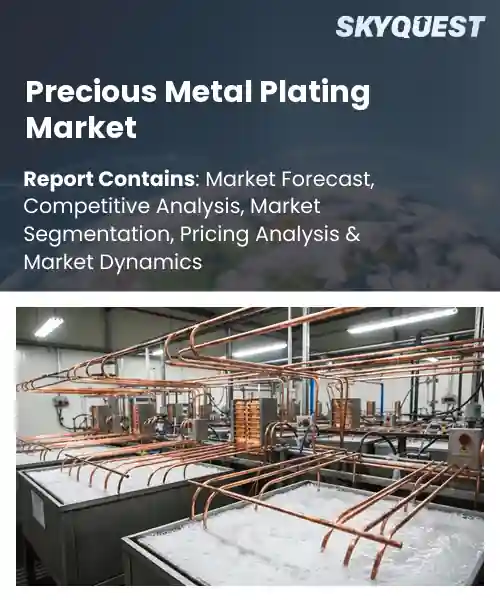
Precious Metal Plating Market
Report ID: SQMIG15E3706
Report ID: SQMIG15E3706
[email protected]
USA +1 351-333-4748
Report ID:
SQMIG15E3706 |
Region:
Global |
Published Date: June, 2026
Pages:
157
|Tables:
116
|Figures:
77


Global Precious Metal Plating Market size was valued at USD 211.9 Million in 2024 and is poised to grow from USD 228.2 Million in 2025 to USD 412.77 Million by 2033, growing at a CAGR of 7.69% during the forecast period (2026-2033).
The primary driver of the precious metal plating market as demand for enhanced functionality and aesthetics in electronics and luxury goods, which has evolved from decorative gilding to sophisticated thin-film processes. Precious metals plating includes depositing gold, silver, palladium, rhodium or platinum onto substrate materials to provide enhanced conductivity, corrosion resistance, solderability and aesthetics; important due to the dependency of product life cycle and supply chain on consistent surface property condition. The precious metals plating industry has evolved from manually applying these metals onto substrates to automated methods of electroplating and electroless techniques over the decades.
A principal factor shaping global market dynamics is technological miniaturization in consumer electronics, which causes manufacturers to demand thinner, uniform precious metal layers to maintain conductivity and reliability, thereby driving investment in advanced plating baths and pulse-plating equipment. The increased number of electrical contacts means that more manufacturers will want to adopt the use of silver and palladium plating for high-current connectors, which leads to economies of scale that lower the cost of plated substrates and allow companies to start recycling plated substrates from their products. As regulations limit the use of hazardous chemistries in manufacturing, suppliers are developing new types of greener electroless solutions that will help attract OEM contracts and expand the market for medical implants, precision sensors, and renewable energy hardware.
How is AI Improving Process Control in the Precious Metal Plating Market?
AI is improving process control in precious metal plating by pairing richer sensor data with machine learning driven analytics to keep bath chemistry, temperature and current density within narrow windows. Today's techniques apply virtual measurements and digital assets to forecast and propose corrective measures while avoiding production failures. This method of procedure transforms inspection from a traditional method to an ongoing process which maintains quality and decreases waste. The value of these newly developed capabilities comes in light of the current high cost of precious metals and consumers' requirement for consistent eco-friendly finished products. Traditional chemistries, machinery and software platforms are offering quick start-up times while enabling repeatable production between parts and families of metals.
In April 2026, Umicore announced a rollout of electroforming as a service for decorative precious metal components which underscores the need for tight process control. AI enabled analytics and digital process control can support such services by predicting bath drift and guiding automated adjustments to maintain consistent karat and wall thickness while cutting waste.
Market snapshot - (2026-2033)
Global Market Size
USD 211.9 Million
Largest Segment
Gold Plating
Fastest Growth
Silver Plating
Growth Rate
7.69% CAGR
To get more insights on this market click here to Request a Free Sample Report
Global precious metal plating market is segmented by plating type, application, end user industry, methodology and region. Based on plating type, the market is segmented into gold plating, silver plating and platinum plating. Based on application, the market is segmented into electronics, jewelry and automotive. Based on end user industry, the market is segmented into consumer goods, aerospace and medical devices. Based on methodology, the market is segmented into electroplating and chemical plating. Based on region, the market is segmented into North America, Europe, Asia Pacific, Latin America and Middle East & Africa.
Gold plating segment dominates because its superior corrosion resistance and excellent electrical conductivity make it the preferred choice for high reliability contacts and connectors in precision assemblies. Long standing industry trust and well established process controls reduce failure risks, encouraging designers to specify gold finishes. Because suppliers want to sell as much as possible with regard to their preferred supplier of quality assurance, custom alloy design will continue being the market leader because it has a record of being reliable, requires less maintenance than others, and makes simpler designs than most other suppliers.
However, silver plating is the most rapidly expanding area as its strong conductivity and lower material expense drive broader adoption in connectors and decorative uses. Improved process chemistries and compliance friendly formulations enable suppliers to offer cost effective, high performance finishes that open new application areas and accelerate product development across consumer products.
Electroplating segment leads because it offers highly controllable deposition on conductive parts, enabling consistent layer thickness and reliable adhesion across a wide range of metals, which supports high volume manufacturing. Proven technology to provide standard, controlled, and efficient processes leads to an increase in manufacturing output, with resulting reductions in rework and yield loss. Consequently, these advantages render electroplating as the most appropriate candidate for use in high-importance applications where suppliers choose to support their products based on repeatability, process integration and economically viable manufacturing scale.
Meanwhile, chemical plating is emerging as the fastest growing approach because its electroless deposition enables uniform coatings on complex or nonconductive substrates, expanding application scope. The adoption of new bath chemicals and greener formulations to manufacture medical components and high-performance assemblies allows suppliers to plate composite materials in order to meet specialized demands that traditional processes are unable to accommodate.
To get detailed segments analysis, Request a Free Sample Report
Asia Pacific dominates due to concentrated manufacturing ecosystems, advanced electronics and automotive supply chains, and strong supplier networks that support large scale plating operations. The strong demand from the semiconductor and consumer electronics industries for specialized electroplating services is driving innovation in the way manufacturers can control processes and develop multiple alloy formulations in their operations. Having close access to suppliers who can provide raw materials to the manufacturers and integrated logistics results in less lead time for working with suppliers and greater cost effectiveness in production. Additionally, investments by companies and other entities in developing specialized plating equipment, skilled technical workforce, and collaboration between the two through research/information sharing will yield high-quality service and enable the rapid adoption of new plating chemistries.
Precious metal plating market in Japan is characterized by precision engineering, advanced process controls, and strong integration with value electronics and automotive manufacturers. Development of fine pitch plating, film finishes and high reliability coatings is supported by a culture of continual quality improvement and close collaboration between the plating specialists and OEMs. A strong emphasis on technical training, modernizing equipment and demanding quality standards provides a competitive differentiated service that focuses on performance and consistency.
Precious metal plating market in South Korea is driven by strong integration with semiconductor fabrication and advanced consumer electronics producers, resulting in demand for high precision plating and specialty surface finishes. A dynamic regional supplier base and emphasis on rapid process iteration enable adoption of tailored chemistries and fine feature plating. Industry dynamics based on collaborations, investing in automated solutions, applying quality rigor to manufactured products will continue to provide customers with consistent delivery of products and responsiveness to OEM's specifications.
Europe rapid expansion is propelled by a confluence of advanced manufacturing demand, strong automotive and industrial machinery sectors, and regulatory emphasis on material stewardship and environmental performance. National centers for excellence in precision engineering and surface treatment provide valuable plate services. These centers provide plate services that meet the strict specifications of the automotive and aerospace industries. By providing increased coordination between original equipment manufacturers, specialized plating shops, and research institutions, regional developments of compliant chemical and recovery technologies will be able to continue at an accelerated rate. Supply chain resilience initiatives and the trend towards nearshoring sourcing close to the consumer will help encourage more regional sourcing rather than outsourcing of plating services. At the same time, the growth in demand for specialized finishes in both industrial electronics and luxury goods will continue to support enhanced service offerings.
Precious metal plating market in Germany is anchored by involvement with automotive suppliers, machinery, and precision engineering firms that demand stringent plating performance and traceable processes. A mature network of specialist platers and OEM technical teams supports complex surface treatments and certification services. Emphasis on industrial standards, supplier audits, and integration with advanced manufacturing systems promotes consistent quality, process validation, and supply chain reliability for domestic and export customers broadly.
Precious metal plating market in United Kingdom is characterized by agile service providers, strong links to electronics design and specialist aerospace suppliers and rapid process development. Mid sized platers work closely with OEM design teams to qualify specialized finishes and meet bespoke performance criteria. The push for technological consulting, sustainability efforts and concentrated investments into automation encourages higher rates of adoption surrounding new chemistries and speciality related platings designed to meet changing customer needs.
Precious metal plating market in France is emerging with growing specialization in luxury finishes, precision medical components, and electronics applications. A group of plating workshops and technical plating companies is currently modifying their production processes to provide more decorative coatings as well as higher reliable coatings due to increased demand from customers. As part of this effort, both research institutions and manufacturers located near each other are working together to create and refine new plating formulas and recycling practices.
North America is strengthening its role through strategic alignment of industrial demand, technological upgrades, and a focus on supply chain resilience that favors regional plating capability. Investment in advanced processes, automation, and recovery of materials provides new opportunities to create an end market for manufacturers in the aerospace, defense, high-end electronics, and automobile sectors. Better collaboration between original equipment manufacturers procurement departments and domestic plating service providers helps expedite the process of qualifying new advanced finishes and enforcing strict quality control systems. Policy incentives, procurement preferences and increased scrutiny of supplier traceability create opportunities to expand capacity and develop technical talent within the U.S. Industry consortia, targeted workforce training programs, and alignment with international standards help smaller companies build capabilities so they can scale up to meet the requirements of complex OEMs.
Precious metal plating market in United States is shaped by demand from aerospace, defense, semiconductor, and advanced electronics manufacturers that require certified processes and traceable supply chains. A range of providers offering scalable plating, reclamation, and inspection capabilities exist that comply with strict qualification regimes. Collaborative programs between industry, laboratories and procurement facilitate process validation, environmental compliance and automated surface treatment systems to support complex OEM specifications in a responsive manner.
Precious metal plating market in Canada is building capability around niches including aerospace components, medical devices, and equipment that require surface finishes and environmental stewardship. Regional plating houses and technical consultancies support qualification of tailored chemistries and reclamation practices. Concentration of the provider on developing its workforce skills, following government's enforcement of environmental guidelines, and collaborating with its purchasing stakeholders helps local suppliers and enables providers to meet unique product design requirements for OEMs through demonstrable process control and traceability.
To know more about the market opportunities by region and country, click here to
Buy The Complete Report
Rising Demand In Electronics
Growth In Automotive Applications
High Precious Metal Costs
Stringent Environmental Compliance Requirements
Request Free Customization of this report to help us to meet your business objectives.
The competitive landscape in the global precious metal plating market outlook is shaped by consolidation, electronics miniaturization and sustainability rules that pressure suppliers to reduce precious metal usage while maintaining performance. Incumbents deploy concrete tactics such as strategic acquisitions to secure chemistry and equipment portfolios, supplier traceability partnerships to certify recycled gold content, and targeted equipment innovation to enable thinner, high-reliability finishes.
Top Player’s Company Profile
Recent Developments
SkyQuest’s ABIRAW (Advanced Business Intelligence, Research & Analysis Wing) is our Business Information Services team that Collects, Collates, Correlates, and Analyses the Data collected by means of Primary Exploratory Research backed by robust Secondary Desk research.
As per SkyQuest analysis, a key driver is rising demand for miniaturized, high-performance electronics that require thin, reliable precious metal finishes, and a second driver is automotive electrification increasing plated contacts per vehicle. A restraint is high precious metal prices and supply volatility that raise costs and slow capacity expansion. The dominating region is Asia Pacific owing to concentrated electronics and automotive manufacturing ecosystems. The dominant segment in the market is gold plating due to its proven track record of resistance to corrosion and reliable electrical performance when used to produce high-reliability contacts. These two factors create a perfect combination that supports the investment in advanced plating baths, AI-based process controls and circular recovery strategies to provide a balance between cost and sustainability.
| Report Metric | Details |
|---|---|
| Market size value in 2024 | USD 211.9 Million |
| Market size value in 2033 | USD 412.77 Million |
| Growth Rate | 7.69% |
| Base year | 2024 |
| Forecast period | (2026-2033) |
| Forecast Unit (Value) | USD Million |
| Segments covered |
|
| Regions covered | North America (US, Canada), Europe (Germany, France, United Kingdom, Italy, Spain, Rest of Europe), Asia Pacific (China, India, Japan, Rest of Asia-Pacific), Latin America (Brazil, Rest of Latin America), Middle East & Africa (South Africa, GCC Countries, Rest of MEA) |
| Companies covered |
|
| Customization scope | Free report customization with purchase. Customization includes:-
|
To get a free trial access to our platform which is a one stop solution for all your data requirements for quicker decision making. This platform allows you to compare markets, competitors who are prominent in the market, and mega trends that are influencing the dynamics in the market. Also, get access to detailed SkyQuest exclusive matrix.
Table Of Content
Executive Summary
Market overview
Parent Market Analysis
Market overview
Market size
KEY MARKET INSIGHTS
COVID IMPACT
MARKET DYNAMICS & OUTLOOK
Market Size by Region
KEY COMPANY PROFILES
Methodology
For the Precious Metal Plating Market, our research methodology involved a mixture of primary and secondary data sources. Key steps involved in the research process are listed below:
1. Information Procurement: This stage involved the procurement of Market data or related information via primary and secondary sources. The various secondary sources used included various company websites, annual reports, trade databases, and paid databases such as Hoover's, Bloomberg Business, Factiva, and Avention. Our team did 45 primary interactions Globally which included several stakeholders such as manufacturers, customers, key opinion leaders, etc. Overall, information procurement was one of the most extensive stages in our research process.
2. Information Analysis: This step involved triangulation of data through bottom-up and top-down approaches to estimate and validate the total size and future estimate of the Precious Metal Plating Market.
3. Report Formulation: The final step entailed the placement of data points in appropriate Market spaces in an attempt to deduce viable conclusions.
4. Validation & Publishing: Validation is the most important step in the process. Validation & re-validation via an intricately designed process helped us finalize data points to be used for final calculations. The final Market estimates and forecasts were then aligned and sent to our panel of industry experts for validation of data. Once the validation was done the report was sent to our Quality Assurance team to ensure adherence to style guides, consistency & design.
Analyst Support
Customization Options
With the given market data, our dedicated team of analysts can offer you the following customization options are available for the Precious Metal Plating Market:
Product Analysis: Product matrix, which offers a detailed comparison of the product portfolio of companies.
Regional Analysis: Further analysis of the Precious Metal Plating Market for additional countries.
Competitive Analysis: Detailed analysis and profiling of additional Market players & comparative analysis of competitive products.
Go to Market Strategy: Find the high-growth channels to invest your marketing efforts and increase your customer base.
Innovation Mapping: Identify racial solutions and innovation, connected to deep ecosystems of innovators, start-ups, academics, and strategic partners.
Category Intelligence: Customized intelligence that is relevant to their supply Markets will enable them to make smarter sourcing decisions and improve their category management.
Public Company Transcript Analysis: To improve the investment performance by generating new alpha and making better-informed decisions.
Social Media Listening: To analyze the conversations and trends happening not just around your brand, but around your industry as a whole, and use those insights to make better Marketing decisions.
REQUEST FOR SAMPLE
 REQUEST FREE CUSTOMIZATION
Global Precious Metal Plating Market size was valued at USD 211.9 Million in 2024 and is poised to grow from USD 228.2 Million in 2025 to USD 412.77 Million by 2033, growing at a CAGR of 7.69% during the forecast period (2026-2033).
The competitive landscape in the global precious metal plating market is shaped by consolidation, electronics miniaturization and sustainability rules that pressure suppliers to reduce precious metal usage while maintaining performance. Incumbents deploy concrete tactics such as strategic acquisitions to secure chemistry and equipment portfolios, supplier traceability partnerships to certify recycled gold content, and targeted equipment innovation to enable thinner, high-reliability finishes. 'Johnson Matthey', 'Heraeus', 'precious metals group', 'A.P. Pharma', 'Platit AG', 'Technic Inc.', 'Electroless Nickel Plating Inc.', 'PPF Inc.', 'Specialty Coating Systems', 'Galvotec Alloys', 'Pure Metal Technology', 'A&A Plating', 'Morgal', 'Advanced Plating Technologies', 'Bahd's Plating', 'Chrome Deposit Corporation', 'Plating Technology', 'S + P GmbH', 'TMT Coatings', 'Spectra Coating'
Rising demand for miniaturized and high performance electronic devices has increased reliance on precious metal plating for reliable conductive and corrosion resistant finishes, driving adoption across multiple industries. Manufacturers favor plating processes to maintain signal integrity, thermal management, and long term durability, which supports product performance in demanding environments. This preference encourages investment in plating technologies and supplier partnerships, expands production capacity, and stimulates innovation in plating chemistries and processes that can meet evolving requirements, thereby positively influencing overall market growth and vendor competitiveness.
Advanced Surface Functionalization: Manufacturers are prioritizing multifunctional plating solutions that combine electrical conductivity, corrosion resistance and tailored surface chemistry to meet evolving product requirements across electronics, medical devices and industrial components. Development of hybrid deposition techniques and tailored post-treatment processes enables precise control of layer thickness, adhesion and surface energy, supporting miniaturization and enhanced device reliability. Collaboration between material suppliers, OEMs and contract processors accelerates adoption of application-specific finishes, driving demand for flexible plating lines and expertise in surface analytics and process reproducibility.
Why does Asia Pacific Dominate the Global Precious Metal Plating Market? |@12


Want to customize this report? This report can be personalized according to your needs. Our analysts and industry experts will work directly with you to understand your requirements and provide you with customized data in a short amount of time. We offer $1000 worth of FREE customization at the time of purchase.
Feedback From Our Clients


 USA (+1) 351-333-4748

