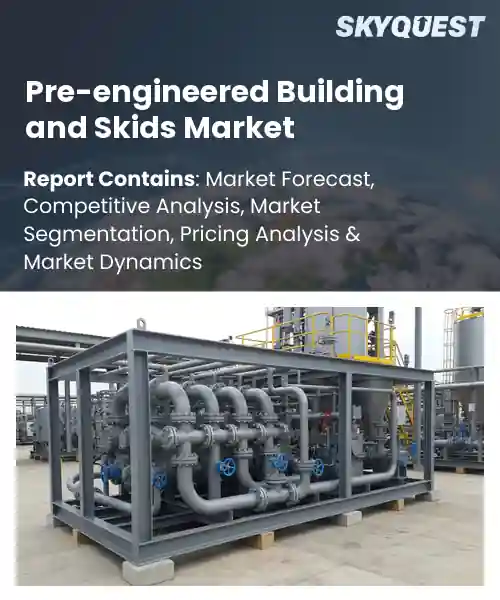
Pre-engineered Building and Skids Market
Report ID: SQMIG20C2196
Report ID: SQMIG20C2196
[email protected]
USA +1 351-333-4748
Report ID:
SQMIG20C2196 |
Region:
Global |
Published Date: March, 2026
Pages:
157
|Tables:
117
|Figures:
77


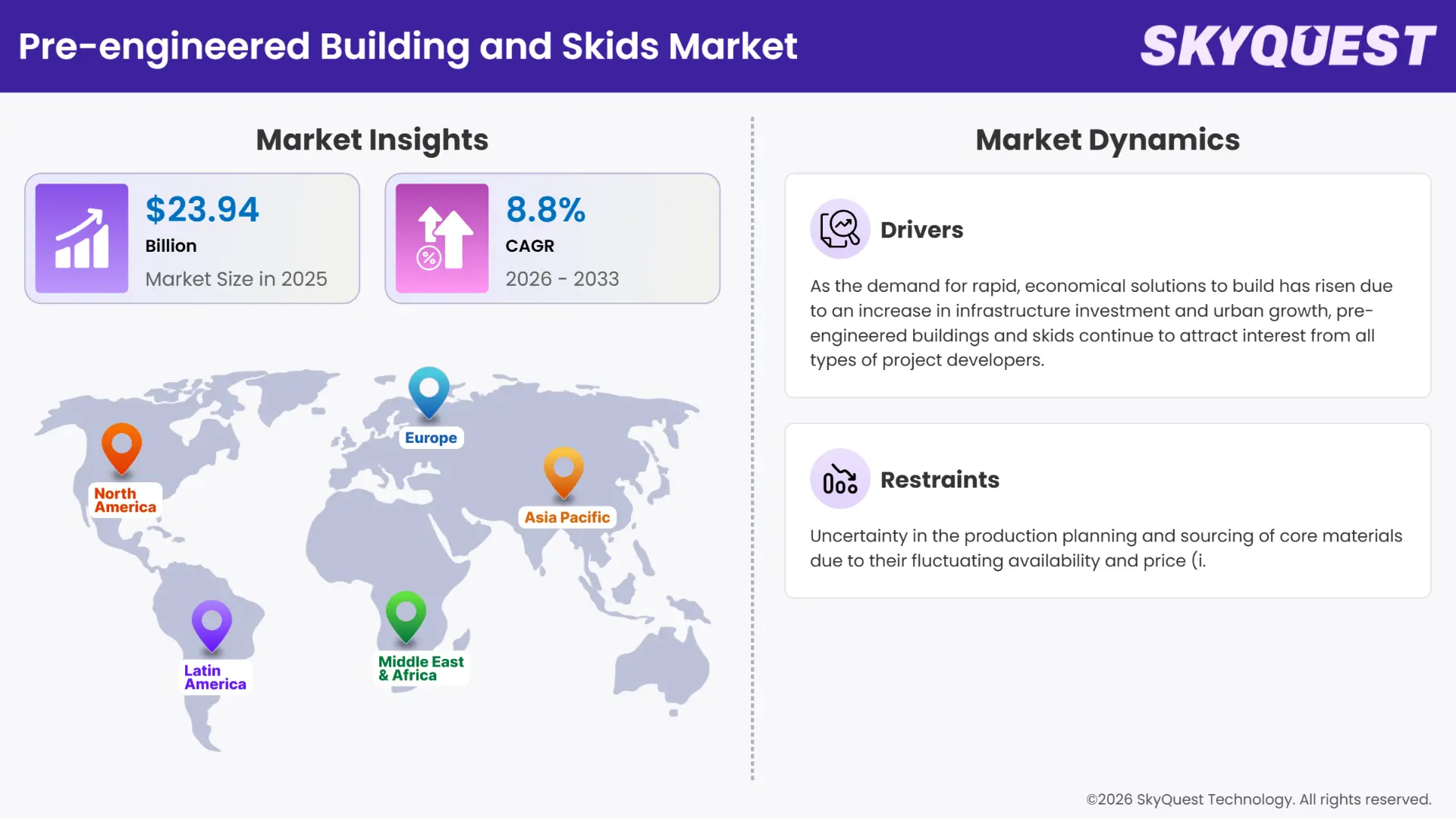
Global Pre-Engineered Building and Skids Market size was valued at USD 22.0 Billion in 2024 and is poised to grow from USD 23.94 Billion in 2025 to USD 47.0 Billion by 2033, growing at a CAGR of 8.8% during the forecast period (2026-2033).
Key Takeaways: Market Trends & Insights
Two significant trends are increasing the global pre-engineered building and skids market growth. There has been a growing need for rapid, lower cost, and higher quality construction solutions due to an increase in demand for industrial, commercial, and energy-related projects. The accelerated adoption of modular manufacturing techniques and associated digital design tools that produce repetitive, high-quality products in a factory setting (rather than in the field) because of improvements in steel production methods, digital design methods, and global supply chains.
PEBs and skids utilize the rapid build qualities of modular manufacturing combined with the efficiencies of digital design tools that allow for high volume production over a shorter period. Thus, allowing manufacturers to scale their respective PEB or skid product lines and allowing their end customers (i.e., retailers and utilities) to meet their respective market demands for shorter turn-around times.
How is IoT Improving Operational Efficiency in the Pre-engineered Buildings And Skids Market?
IoT improves the efficiency of operations within a pre-engineered structures e.g. building and skid by connecting cloud-based platform services with remote monitoring, remote predictive maintenance services and energy functions. Pre-engineered structures are manufactured as factory prefabricated modules with telemetry increasing speed of commissioning and continue quality across the supply of the structure. The field team has real-time visibility of the condition of the equipment, providing timely logistics and environmental data reducing the amount of unplanned shutdowns and shortening the total amount of time required for handover. Integrating BIM solutions and digital twin workflows with IoT to digital construction designs to deliver solutions within BIM and to support intelligent lifecycle management.
Alfa Laval in June 2025, unveiled plug and play IoT pump skids that include vibration analytics remote firmware updates and open APIs which enable remote commissioning and predictive maintenance and thus support faster start up and lower field costs. They help prefab suppliers scale deliveries, and operators reduce downtime across brown field and green field projects.
To get more insights on this market click here to Request a Free Sample Report
Global pre-engineered building and skids market is segmented into structure type, component category, skid application, end-use industry and region. Based on structure type, the market is segmented into clear span PEB frames, multi-span rigid frames and industrial skids. Based on component category, the market is segmented into primary frames, secondary members and roof & wall cladding. Based on skid application, the market is segmented into oil & gas metering/pumping skids, chemical injection skids and water treatment/filtration skids. Based on end-use industry, the market is segmented into logistics & warehousing, energy & power generation and manufacturing & infrastructure. Based on region, the market is segmented into North America, Europe, Asia Pacific, Latin America and Middle East & Africa.
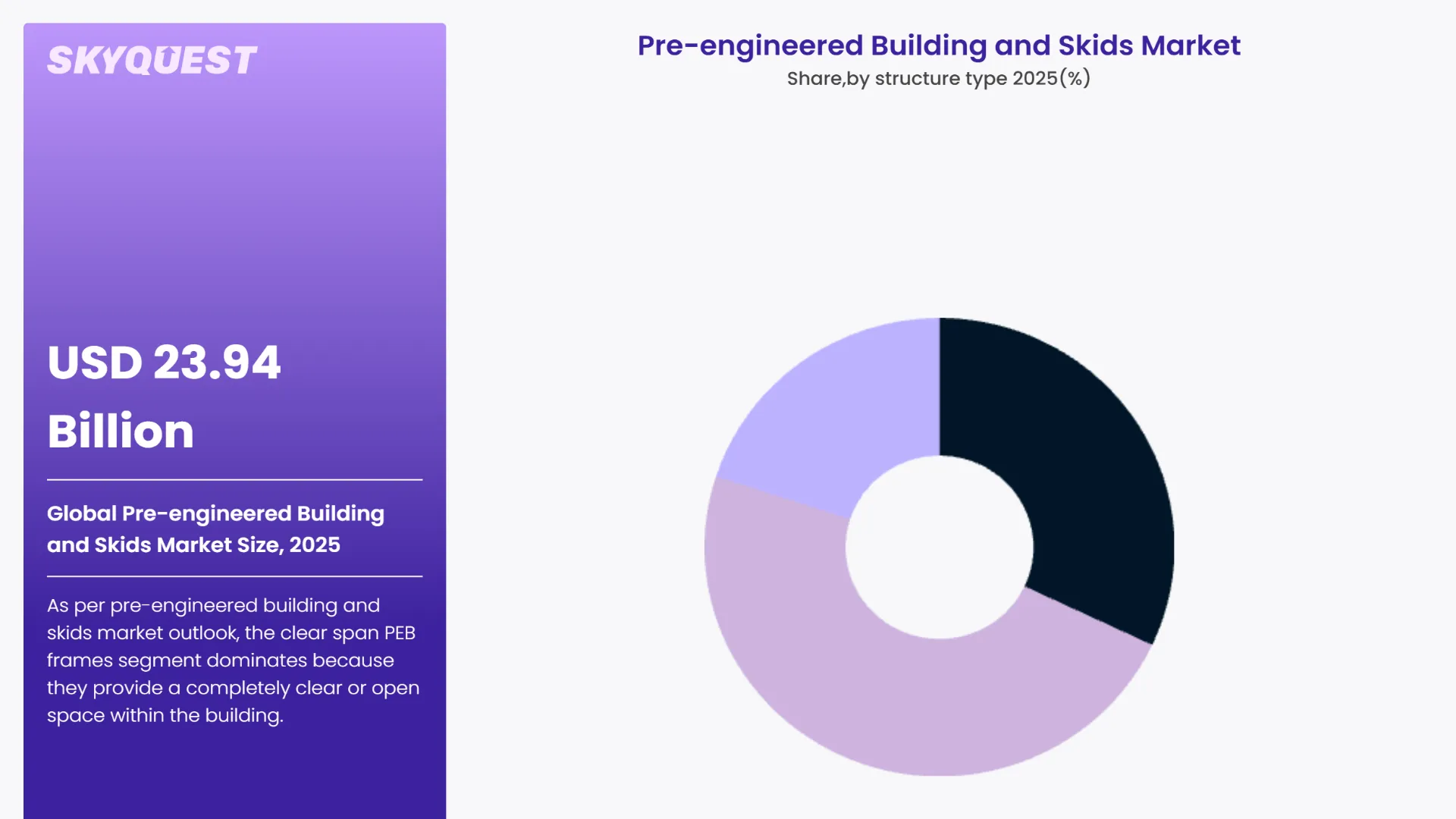
As per pre-engineered building and skids market outlook, the clear span PEB frames segment dominates because they provide a completely clear or open space within the building. A major advantage to clear span frames is that their factory-based, standardized geometry allows for the simplification of the fabrication and erection processes; resulting in significantly less interference between different pieces of process equipment and skid layouts at the time of installation. This clarity in the layout significantly decreases the amount of coordination that will be required; which contributes to a shorter project timeline and provides the flexibility to be reconfigured to meet changes in the facility's use. The clear span frame is the frame system of choice for projects involving high efficiency pre engineered buildings and skids because of these advantages.
As per pre-engineered building and skids market analysis, multi span rigid frames are growing at the fastest rate because the column spacing and bay configurations allow these types of frames to support much heavier roof loads and also accommodate more complex operational requirements associated with multiple bay operations. Furthermore, increasing levels of advancement in fabrication technology, as well as growing demand for consolidated facilities, are creating new opportunities for "custom" pre-engineered building and skid solutions to be developed that will support the continuing evolution of industrial workflow processes.
Chemical injection skids are leading with pre-engineered building and skids market share now as engineered injection packages offer precise dosages, incorporated safety controls and compact designs simplifying installation into both modular buildings and adjoining utilities. Ready-to-test assemblies reduce complexity during the commissioning phase and provide a means to comply with the safe handling of chemicals by operators. Therefore, operators are using these "turnkey" chemical injection skid units as dependable methods for conditioning feedstocks. Risk of operations is mitigated along with increased utilization within process driven facilities in the pre-engineered building and skids market because of this operator preference.
As per pre-engineered building and skids market forecast, multi-span rigid frames are emerging as the most rapidly expanding segment because their bay configuration supports heavier roof loads and complex multi bay operations, enabling integrated process routes and mezzanine installations. The development of modular filtration units enables fast deployment and easier retrofitting on both industrial and municipal sites. The advancement of membrane technologies and the development of smart monitoring technology expand the applications for these products leading to many new project opportunities as well as deeper integration with pre-engineered buildings and skid solutions.
To get detailed segments analysis, Request a Free Sample Report
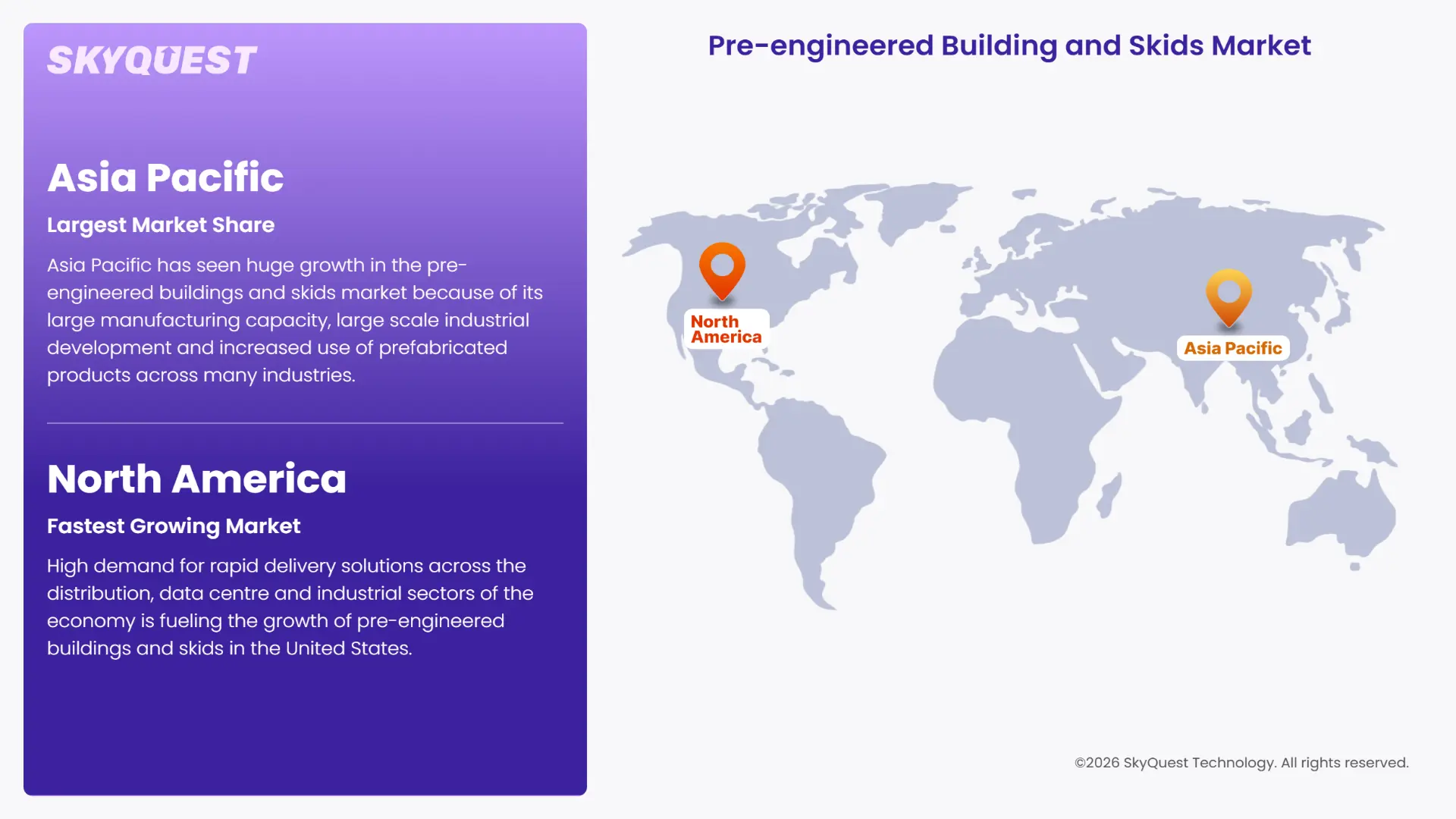
Asia Pacific has seen huge growth in the pre-engineered buildings and skids market because of its large manufacturing capacity, large scale industrial development and increased use of prefabricated products across many industries. Ease of making pre-engineered buildings and skids, the proximity of suppliers for pre-engineered building components, and the competitive cost of fabricating pre-engineered buildings and skids all contribute to the growth of this market in the Asia Pacific region. The urbanization of the region's population and the demand for logistics, manufacturing and energy facilities are also driving the growth of the pre-engineered building market and creating a need for flexibility, modular construction.
Japan's expansion of its pre-engineered buildings and skids market continues to move forward because of advanced manufacturing processes, an emphasis on quality, and seismic resiliency. Opportunities for growth are created by the need for precision assembly and performance of pre-engineered buildings and skids within industrial and logistics markets. Local suppliers are developing sophisticated fabricating methods, compact designs, and high-quality materials, which allow them to create reliable, value-added modular systems that meet specific regulatory and operational needs.
The pre-engineered buildings and skids market in South Korea has continued to grow because of the availability of advanced fabrication methods, access to dependable steel supply chains, and the emphasis on modular solutions for the following sectors, heavy manufacturing, shipbuilding, and semiconductor facilities. The collaborations between the fabricators and engineers have allowed the production of reliable, compact, high-quality pre-engineered buildings and skids with flexibility in their arrangement.
Rapid growth is occurring in North America as pre-engineered solutions are steadily gaining acceptance as methods for reducing on-site labor requirements, shortening project duration, and providing predictable costs. Logistics, manufacturing, data centres and energy infrastructure are strong markets driving the demand for modular buildings and skid systems. The established fabrication networks and logistics capabilities of the marketplace provide a solid base for effectively moving large modules to the job site. Engineering firms have built this foundation by establishing standardized designs for modular building and skid systems that can be modified or customized to meet the functional challenges of various clients.
High demand for rapid delivery solutions across the distribution, data centre and industrial sectors of the economy is fueling the growth of pre-engineered buildings and skids in the United States. To meet the needs of clients, fabricators are designing modular buildings and skid systems that incorporate multiple levels of code compliance, as well as interoperability with HVAC systems, to meet the complex and diverse needs of clients. Furthermore, clients often prefer turnkey procurement methods where engineering, fabrication, and installation are bundled together for ease of execution.
Canada pre-engineered buildings and skids market is centred around providing solutions for remote locations and harsh environments or site conditions, as well as a higher level of regulatory scrutiny regarding environmental performance. On-site labour costs have been minimized by fabricators designing modular buildings and skid systems that consider transportation limitations and are designed to be assembled off-site from prefabricated components and by utilizing durable materials.
Europe is enhancing its competitive position through some combination of regulatory requirements to create efficiency, advanced engineering capabilities of the European building sector, and the targeted adoption of modular building systems for both new construction and retrofit projects. The specification of quality materials, integrated systems, and energy-efficient components is strongly influenced by regulatory agencies requiring environmental performance and safety. Therefore, in pre-engineered buildings and skid systems, high quality products will be specified as an enhancement of environment and safety. The fabrication industry and engineering consulting firms will invest in digital design tools as well as the use of prefabricated construction methods to maximize off-site assembly of buildings and minimize disruption of construction activities in urban locations that have a high concentration of activities.
The Germany pre-engineered building and skids market demonstrates the engineering discipline, advanced manufacturing and quality fabrication. The manufacture of modular systems for both heavy duties, such as those found in the automotive industry, and for lighter duty, such as those found in chemical plants, will be completed by a variety of fabricators who operate in a highly regulated environment. Complex skid systems can be manufactured using advanced processing and automated manufacturing techniques; similarly, precast building systems will be manufactured to meet the unique requirements of each process within manufacturing. Fabricators work closely with design engineers to support the testing, certification, and coordination associated with specific project requirements in manufacturing and engineering.
The pre-engineered building and skids market in the United Kingdom is highly dependent on urban regeneration, off-site construction and the regulations concerning the energy performance of structures. In this regard, fabricators manufacture modular buildings and skid systems as per the needs of restricted sites and product mobility of portable products. The manufacture of pre-engineered buildings and skid systems, therefore, requires close collaboration between fabricators, architects and contractors in order to develop integrated design solutions that have a focus on speed of delivery, flexibility of design and sustainable solutions with regard to materials and construction methods. The availability of reputable contractors and their respective supply-chain networks as well as the recent investment in digital engineering provide the opportunity to develop precise fabrication techniques and ensure site-readiness and successful installation of commercial and infrastructure projects.
The pre-engineered building and skids market in France brings together architectural sensitivity with industrial fabrication know-how to service the logistics and chemical industries. The manufacturers of pre-engineered buildings and skid systems, as well as the engineering firms responsible for their design, place a high degree of emphasis on modular systems, which integrate architectural finishes, regulatory compliance and sustainability objectives. The use of off-site prefabricated systems is intended to limit the impacts of on-site construction disruption. Therefore, a significant focus is placed on the quality of the materials used as well as the integration of systems in the manufacture of pre-engineered skid assemblies and building envelopes. Through close collaboration between designers, contractors and fabricators, customized solutions are developed for technically complex projects.
To know more about the market opportunities by region and country, click here to
Buy The Complete Report
Rising Infrastructure Development
As the demand for rapid, economical solutions to build has risen due to an increase in infrastructure investment and urban growth, pre-engineered buildings and skids continue to attract interest from all types of project developers. The flexibility about different project site conditions, combined with the ability to easily incorporate modular systems, makes pre-engineered buildings and skids more appealing to project developers who are looking for predictable construction schedules and predictable construction processes. As a result, supply chains and contractors are also increasingly selecting these types of building systems for use in the construction of warehouses, industrial facilities, and commercial facilities, thereby enhancing the long-term growth of this market.
Increasing Focus on Prefabricated Building Solutions
The increased emphasis on sustainable building and resource efficiency has led many stakeholders to use pre-engineered building and skid solutions that recognize this value proposition by minimizing waste and optimizing the use of various resources during construction processes. Manufacturers are now able to use recyclable materials and to arrange their fabrication processes to minimize the level of material handling, making them very appealing to project developers that are looking for environmentally friendly construction options and life cycle-based building options. By using controlled manufacturing environments, these manufacturers produce consistent quality products that can be easily designed with energy-efficient systems.
Volatile Raw Material Prices
Uncertainty in the production planning and sourcing of core materials due to their fluctuating availability and price (i.e. steel, insulation, etc.) is common for pre-engineered building and skid manufacturers. When sourcing materials becomes unpredictable; it puts pressure on manufacturers' margins and may force them to delay orders or change design specifications. A more complex procurement process will likely increase lead time to complete, and increase complexity in coordinating with suppliers, thus reducing the value of rapid delivery and cost control. If these pressures are present over time, then project stakeholders will be less likely to commit to a large-scale adoption of pre-engineered buildings and skids, slowing the momentum of the market.
Building Code and Permit Challenges
Across different jurisdictions; there are many differences between building codes; how to approve plans and what permits are required. As a result of compliance with building codes also requiring additional design reviews and documentation, thereby negatively impacting the speed advantage of prefabricated projects. Furthermore; navigating through all of the different regulatory agencies will result in the need for companies to develop different customized solutions for different jurisdictions and therefore decreasing the economies of scale; which raises project costs. Consequently, many investors and project owners will be discouraged by the regulatory friction, therefore limiting the adoption of pre-engineered buildings and skids in the overall market.
Request Free Customization of this report to help us to meet your business objectives.
Competition in the global pre-engineered building and skids industry has intensified due to consolidation, strategic investments, and rapid technology adoption. Acquirers are increasing their fabrication capabilities through acquisitions like Trachte's acquisition of MakoRabco, while investors have supported modular cleanroom and cGMP specialists like CUBE. Along with new entrants and legacy companies, manufacturers of both are using digital twin and Echo type platforms to reduce lead times and secure large scale integrated projects, creating fierce competition for suppliers in the pre-engineered building and skid manufacturing industry.
SkyQuest’s ABIRAW (Advanced Business Intelligence, Research & Analysis Wing) is our Business Information Services team that Collects, Collates, Correlates, and Analyses the Data collected by means of Primary Exploratory Research backed by robust Secondary Desk research.
As per SkyQuest analysis, the global pre-engineered building and skids industry is driven primarily by the growing need for faster, cost-effective construction solutions that shorten project schedules and improve cost predictability, supported further by the convergence of modular manufacturing and digital design tools which enable repeatable quality and faster delivery. Volatile raw material prices pose a key restraint by squeezing margins and complicating procurement. Asia Pacific currently dominates the market due to extensive fabrication capacity, strong steel supply chains and large industrial demand, while Clear Span PEB Frames remain the leading segment because their unobstructed interiors simplify fabrication, installation and flexible operations for logistics and industrial users.
| Report Metric | Details |
|---|---|
| Market size value in 2024 | USD 22.0 Billion |
| Market size value in 2033 | USD 47.0 Billion |
| Growth Rate | 8.8% |
| Base year | 2024 |
| Forecast period | 2026-2033 |
| Forecast Unit (Value) | USD Billion |
| Segments covered |
|
| Regions covered | North America (US, Canada), Europe (Germany, France, United Kingdom, Italy, Spain, Rest of Europe), Asia Pacific (China, India, Japan, Rest of Asia-Pacific), Latin America (Brazil, Rest of Latin America), Middle East & Africa (South Africa, GCC Countries, Rest of MEA) |
| Companies covered |
|
| Customization scope | Free report customization with purchase. Customization includes:-
|
To get a free trial access to our platform which is a one stop solution for all your data requirements for quicker decision making. This platform allows you to compare markets, competitors who are prominent in the market, and mega trends that are influencing the dynamics in the market. Also, get access to detailed SkyQuest exclusive matrix.
Table Of Content
Executive Summary
Market overview
Parent Market Analysis
Market overview
Market size
KEY MARKET INSIGHTS
COVID IMPACT
MARKET DYNAMICS & OUTLOOK
Market Size by Region
KEY COMPANY PROFILES
Methodology
For the Pre-engineered Building and Skids Market, our research methodology involved a mixture of primary and secondary data sources. Key steps involved in the research process are listed below:
1. Information Procurement: This stage involved the procurement of Market data or related information via primary and secondary sources. The various secondary sources used included various company websites, annual reports, trade databases, and paid databases such as Hoover's, Bloomberg Business, Factiva, and Avention. Our team did 45 primary interactions Globally which included several stakeholders such as manufacturers, customers, key opinion leaders, etc. Overall, information procurement was one of the most extensive stages in our research process.
2. Information Analysis: This step involved triangulation of data through bottom-up and top-down approaches to estimate and validate the total size and future estimate of the Pre-engineered Building and Skids Market.
3. Report Formulation: The final step entailed the placement of data points in appropriate Market spaces in an attempt to deduce viable conclusions.
4. Validation & Publishing: Validation is the most important step in the process. Validation & re-validation via an intricately designed process helped us finalize data points to be used for final calculations. The final Market estimates and forecasts were then aligned and sent to our panel of industry experts for validation of data. Once the validation was done the report was sent to our Quality Assurance team to ensure adherence to style guides, consistency & design.
Analyst Support
Customization Options
With the given market data, our dedicated team of analysts can offer you the following customization options are available for the Pre-engineered Building and Skids Market:
Product Analysis: Product matrix, which offers a detailed comparison of the product portfolio of companies.
Regional Analysis: Further analysis of the Pre-engineered Building and Skids Market for additional countries.
Competitive Analysis: Detailed analysis and profiling of additional Market players & comparative analysis of competitive products.
Go to Market Strategy: Find the high-growth channels to invest your marketing efforts and increase your customer base.
Innovation Mapping: Identify racial solutions and innovation, connected to deep ecosystems of innovators, start-ups, academics, and strategic partners.
Category Intelligence: Customized intelligence that is relevant to their supply Markets will enable them to make smarter sourcing decisions and improve their category management.
Public Company Transcript Analysis: To improve the investment performance by generating new alpha and making better-informed decisions.
Social Media Listening: To analyze the conversations and trends happening not just around your brand, but around your industry as a whole, and use those insights to make better Marketing decisions.
REQUEST FOR SAMPLE
 REQUEST FREE CUSTOMIZATION
Global Pre-Engineered Building And Skids Market size was valued at USD 22.0 Billion in 2024 and is poised to grow from USD 23.94 Billion in 2025 to USD 47.0 Billion by 2033, growing at a CAGR of 8.8% during the forecast period (2026-2033).
The competitive landscape for global pre engineered buildings and skids is marked by consolidation, strategic investments and rapid tech adoption. Acquirers expand fabrication capacity through deals such as Trachte acquiring MakoRabco, while investors back modular cleanroom and cGMP specialists such as C CUBE. Startups and incumbents deploy digital twin and Echo style platforms to shorten lead times and win large integrated projects, intensifying supplier rivalry. 'Jindal Buildsys Limited', 'Interarch Building Products', 'BlueScope Steel', 'Lloyd Insulations', 'Kirby Building Systems', 'Zamil Steel', 'Nucor Building Systems', 'Butler Buildings', 'Tiger Steel Engineering', 'Modular Engineering Co.', 'Panel Built Inc.', 'DENIOS Inc.', 'Rhino Steel Building Systems', 'Future Buildings', 'Duro Steel', 'Easi-Set Buildings', 'Armstrong Metal Buildings', 'Worldwide Steel Buildings', 'Enerpan Building Systems', 'Flexospan Steel Buildings'
Rising infrastructure investment and urban expansion have expanded demand for fast, cost-effective building solutions, making pre-engineered buildings and skids attractive for a range of projects. The factory fabrication approach reduces on-site work and coordination complexity, enabling quicker project delivery and simpler logistics. This adaptability to different site conditions and integration with modular systems supports adoption by developers seeking predictable schedules and controlled construction processes. Consequently, supply chains and contractors increasingly prefer these systems for building warehouses, industrial facilities, and commercial spaces, reinforcing market growth prospects.
Digital Design And Prefab Integration: Adoption of advanced digital tools, including advanced design platforms and BIM workflows, is accelerating coordination between engineering, fabrication and on-site assembly, enabling more predictable project outcomes and shorter delivery cycles. Manufacturers and contractors leverage virtual prototyping and prefabrication to reduce rework, improve quality control and manage complex interfaces across trades. This trend fosters stronger collaboration across supply chains, supports customization at scale and enhances lifecycle planning for pre-engineered buildings and skids, delivering value to clients.
Asia Pacific Dominate the Global Pre-engineered Building and Skids Market.
Pre-engineered buildings are gaining popularity because they reduce construction time, lower labor costs, improve structural efficiency, and provide flexible design customization for industrial and commercial projects.
Clear Span PEB Frames are expected to witness significant demand due to their ability to provide large column-free spaces suitable for warehouses, manufacturing plants, logistics centers, and aircraft hangars.
Technological advancements such as Building Information Modeling (BIM), digital design platforms, automation in fabrication, and smart monitoring systems are improving project efficiency, precision, and lifecycle management.


Want to customize this report? This report can be personalized according to your needs. Our analysts and industry experts will work directly with you to understand your requirements and provide you with customized data in a short amount of time. We offer $1000 worth of FREE customization at the time of purchase.
Feedback From Our Clients


 USA (+1) 351-333-4748

