Pranlukast Market
Report ID: SQMIG35I2590
Report ID: SQMIG35I2590
[email protected]
USA +1 351-333-4748
Report ID:
SQMIG35I2590 |
Region:
Global |
Published Date: March, 2026
Pages:
157
|Tables:
143
|Figures:
78


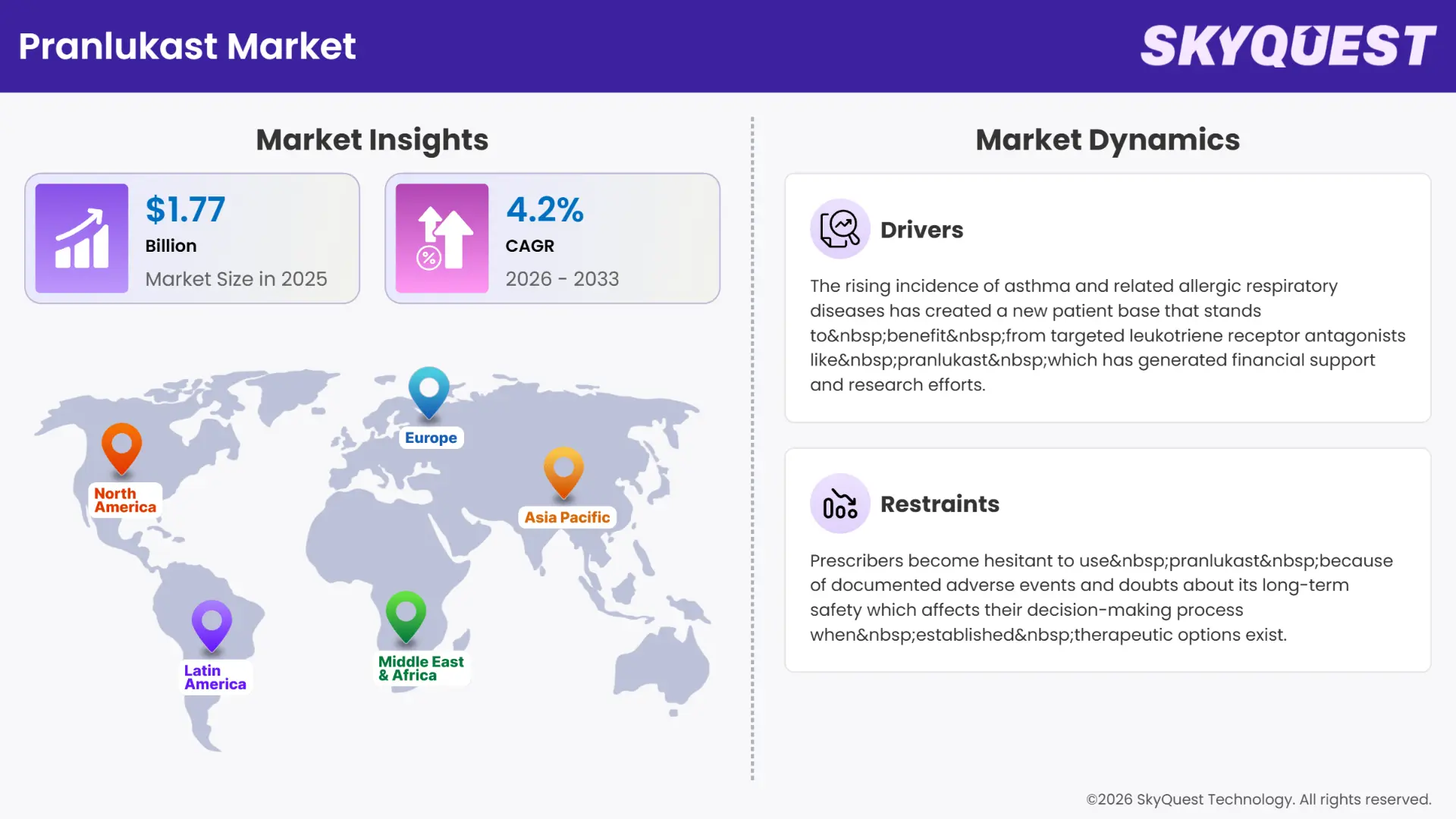
Global Pranlukast Market size was valued at USD 1.7 Billion in 2024 and is poised to grow from USD 1.77 Billion in 2025 to USD 2.46 Billion by 2033, growing at a CAGR of 4.2% during the forecast period (2026-2033).
Key Takeaways: Market Trends & Insights
The global pranlukast market growth is driven because patients with chronic respiratory diseases and allergic conditions require oral leukotriene receptor antagonists for their outpatient treatment needs. The market comprises branded and generic pranlukast products which treat asthma and allergic rhinitis, whereas oral therapy helps patients comply with treatment requirements because inhaler use may result in limited therapy results and health systems prioritize affordable maintenance medications. The adoption of the product has evolved from Asian markets toward wider generic distribution since its market introduction which hospitals and clinics use to determine medication accessibility based on clinical guidelines and pricing changes.
Moreover, the global pranlukast market penetration depends on genericization to which patent expirations and local production create price reduction forces that lead to enhanced payer coverage and increased doctor acceptance of oral leukotriene treatments as replacements for complicated inhalation therapies. The outpatient clinics and primary care institutions start using pranlukast to treat patients who have difficulties following treatment and who are children or elderly people which leads to an increased product volume and creates business prospects for fixed-dose combinations and pediatric formulations and distribution partnerships. Emerging market manufacturers use their production capacity to expand operations while they conduct clinical studies for new product labels and obtain tender agreements which help them achieve business growth.
How is AI Transforming R&D and Commercialization in the Pranlukast Market?
AI is changing how research and development and commercial activities are conducted in the pranlukast industry because it makes the discovery process more focused on testing research hypotheses and it increases the efficiency of product development work. The key elements of the system consist of machine learning systems that generate compound design solutions which help in choosing analogues, predictive models which help manufacturers reduce both safety and formulation risks, and AI systems which assist in designing delivery methods that will enhance patient adherence. AI develops market boundaries through its digital promotional content to doctors and through its ability to gather real-world data which supports label extensions of products. The current market operates under a new system that moves away from traditional oral products toward specialized delivery systems and product life cycle management methods, while AI helps companies decrease their decision-making time and safeguard their market position through better clinical performance assessment. The pranlukast market analysis published by ProMarket Reports in January 2026 showed how strategic partnerships and innovative delivery systems are being developed in the industry. The report demonstrates that companies are using AI discovery platforms together with commercial analytic tools to accelerate their research development process and their market introduction sequence, which enables them to compete in the market against generic products.
To get more insights on this market click here to Request a Free Sample Report
The global pranlukast market is segmented based on dosage strength, formulation, patient demographics, therapeutic use, distribution channel, and region. By dosage strength, the market includes 75 mg, 150 mg, and 300 mgvariants. In terms of formulation, it is categorized into tablets, inhalers, and other forms. Based on patient demographics, the market is divided into pediatric, adult, and geriatric populations. By therapeutic use, it covers asthma and chronic obstructive pulmonary disease (COPD). In terms of distribution channel, the market comprises hospital pharmacies, retail pharmacies, and online pharmacies. Geographically, the market spans North America, Europe, Asia Pacific, Latin America, and the Middle East and Africa.
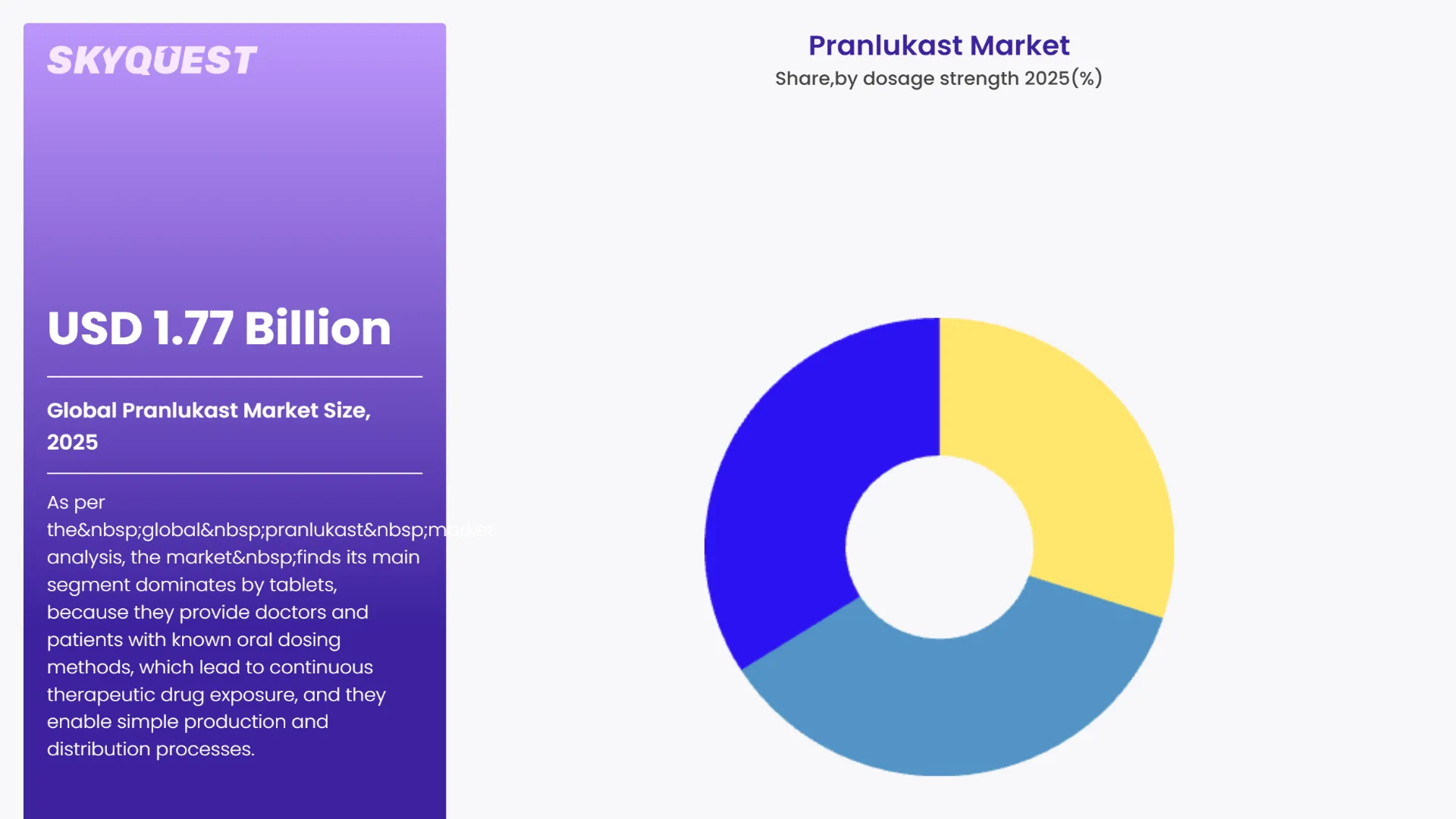
As per the global pranlukast market analysis, the market finds its main segment dominates by tablets, because they provide doctors and patients with known oral dosing methods, which lead to continuous therapeutic drug exposure, and they enable simple production and distribution processes. The drug's stability together with its affordable production costs and simple administration method leads doctors to prescribe it, which results in its inclusion on formularies that make the medication widely accessible at various treatment centers to help patients maintain their prescribed daily routines, which doctors consider effective for managing their conditions over time.
However, the newest product development field for inhalers has emerged because researchers develop better targeted pulmonary delivery systems while their work on device design enhancements leads to better patient adherence and they both explore new methods to deliver pranlukast directly into the lungs, which results in better symptom management. The market expansion creates new product opportunities, which drive device development partnerships between pharmaceutical companies and device manufacturers, while opening new specialized medical applications in the field of respiratory treatments.
According to the global pranlukast market forecast, Retail pharmacies lead the market because they establish direct customer access to pranlukast through their established distribution systems, which include pharmacist counseling and their participation in outpatient treatment programs that help patients begin treatment and maintain their adherence. Companies achieve product turnover through its inventory systems and patient loyalty initiatives and its relationships with doctors, while its storefronts allow customers to easily obtain prescription refills and real-world patient assistance, which is essential for ongoing treatment of chronic respiratory diseases.
Whereas the online pharmacies category is anticipated to have the largest pranlukast market share because they use digital prescription systems to process orders and provide customers with home delivery options, which enables them to receive replenishment through subscription services that link with telehealth systems for quick access to pranlukast. The digital channel helps acquire new patients, while it enables programs that use data to improve treatment adherence, and it establishes new commercial connections which create growth opportunities for focused marketing and personalized patient engagement in respiratory care.
To get detailed segments analysis, Request a Free Sample Report
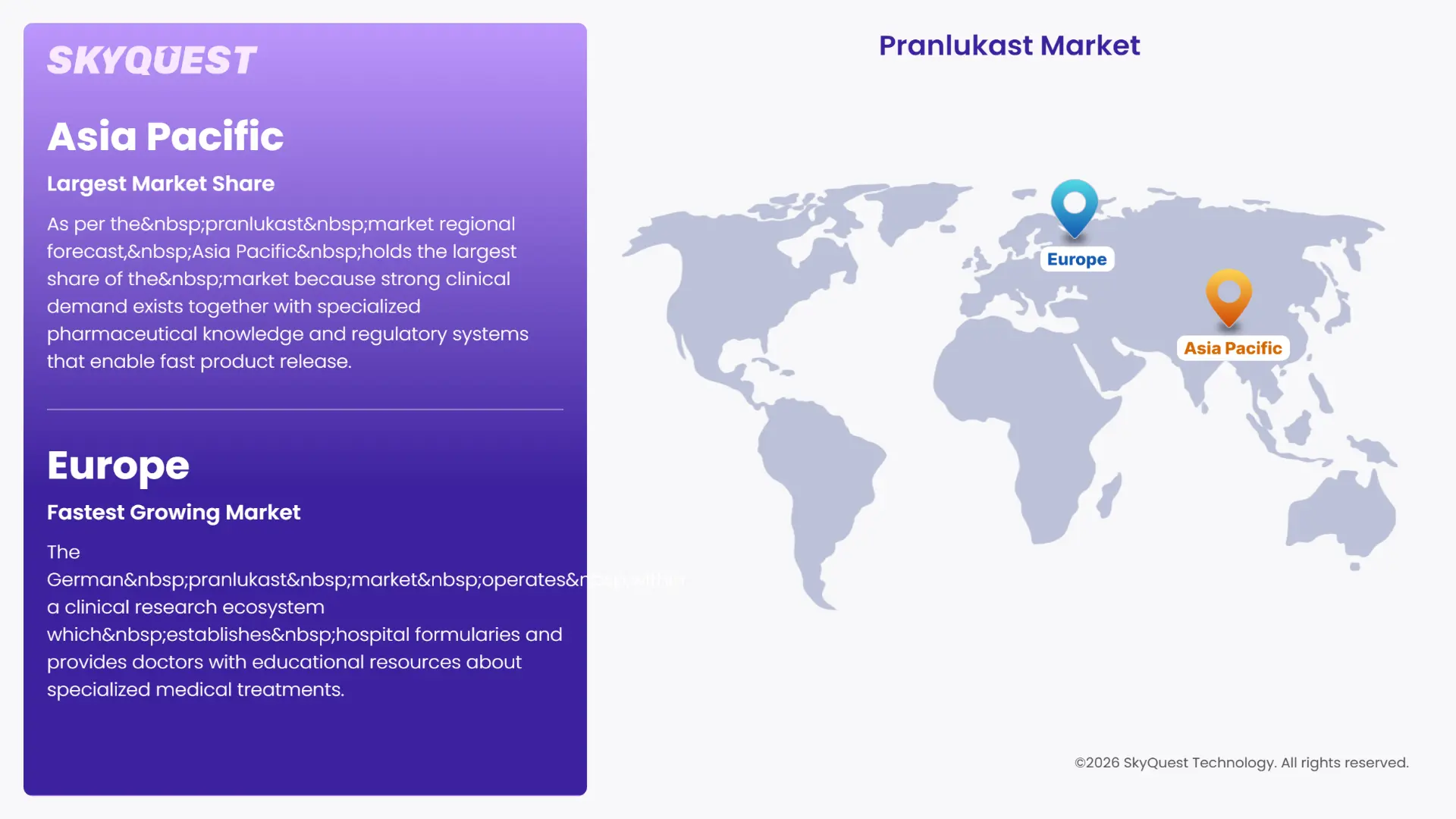
As per the pranlukast market regional forecast, Asia Pacific holds the largest share of the market because strong clinical demand exists together with specialized pharmaceutical knowledge and regulatory systems that enable fast product release. The established respiratory care protocols together with the integrated healthcare delivery system create a foundation for long term management solutions which help to attainhigh clinical adoption rates. The combination of existing manufacturing capacity together with multinational and regional company partnerships improves both supply chain reliability and development of local innovations. The active physician involvement together with patient knowledge growth and national health commercialization strategies build market access which helps to place pranlukast in various healthcare environments. The clinical research activities together with the real-world evidence generation investments strengthen prescriber confidence as supply chain improvements and localized patient support initiatives enhance patient adherence and persistence in therapy across both urban and regional locations.
The regulation framework and clinical practice standards and industry-academia partnerships enable the Japanese market to achieve successful drug approval for pranlukast. The distribution network supports regular product availability because doctors understand how to use leukotriene receptor antagonists. The local research initiatives and patient support programs help to improve treatment uptake across all hospital and outpatient settings while they also contribute to the training materials doctors need to continue their education.
The South Korean pranlukast industry shows active adoption patterns from professionals who treat respiratory conditions because these standards work together with local manufacturers and global partners. The combination of clinical guideline adherence and doctor outreach activities helps doctors to make better prescribing choices while the reimbursement systems and patient engagement initiatives support ongoing treatment. The post-market research and community awareness programs work together to improve treatment acceptance in both high-level medical facilities and basic healthcare systems throughout the country.
The European pranlukast market experiences fast growth because people have started to realize its clinical value and healthcare systems have begun using it and specialty societies have developed treatment guidelines. The market dynamics get support through multiple commercialization methods which need to adjust their approach according to each country's unique prescription customs and reimbursement practices to increase access across different treatment environments. International pharmaceutical companies form strategic partnerships with local distributors to create customized product launches and educational initiatives. The investment in clinical training and real-world evidence development improves prescriber confidence while the patient's advocacy and awareness programs boost patient involvement. The market entry process gets expedited through active regulator discussions and productive payer negotiations while healthcare systems share knowledge about their best operations with each other across multiple countries.
The German pranlukast market operates within a clinical research ecosystem which establishes hospital formularies and provides doctors with educational resources about specialized medical treatments. The collaboration between academic respiratory centers and industry leads to the creation of treatment protocols which undergo rigorous clinical studies and subsequent distribution. The reimbursement system enables medical practices to use chronic care treatments with reliable supply from the distributors who have industry experience. The combination of evidence of generation and physician engagement and organized payer dialogue functions as the foundation for efficient adoption of tertiary care services.
The UK pranlukast market operates through active primary care networks which direct clinical guidelines to create commissioning systems that enhance their ability to make quick prescribing choices. The healthcare system enables doctors to provide different delivery methods through their partnerships with innovators. The outreach programs for patients together with the adherence initiatives help to maintaintherapy continuity while the health technology discussions between organizations assist with the process of creating standard respiratory care practices for both urban and regional healthcare systems and advocacy work.
The French pranlukast market shows development through its focused partnerships with specialty organizations and its targeted training of medical professionals and its testing programs in regional medical networks. The medical field supports evidence-based movement toward clinical practice change through its emphasis on integrating real-world medical evidence into treatment guidelines. The collaboration between manufacturers and distributors who work in specific markets enables companies to develop unique market entrances which operate according to the current standards of the hospital system for patient education and hospital system support services throughout the country.
North America has established a stronger position in the pranlukast market through dedicated efforts in clinical development and payer engagement and commercial optimization which improved both access and usage of the drug. The process of developing real world evidence occurs through post market studies which build the prescriber trust that results from domestic companies working with international partners who help them expand their distribution networks and manufacturing capabilities. The integrated care models and specialist organizations and specialized medical training programs enable clinicians to make correct treatment decisions while patient support programs and digital solutions for adherence tracking enable patients to maintain their treatment process. The combination of direct communication with regulatory bodies and reimbursement organizations together with tailored market introduction techniques enables healthcare providers to achieve synchronized market access in various healthcare delivery environments. The expansion of telemedicine services together with specialty networks enables better access to remote areas while payers require evidence of value to enable reimbursement processes and formulary access. Academic health systems work with researchers to conduct studies while implementing manufacturing facilities that deliver secured supply for product launch operations.
The United States Pranlukast Market utilizes its advanced clinical research system and its network of specialized clinicians and its efficient business operations to provide prescribers with evidence-based treatment information. The development of real-world evidence together with focused educational programs for clinicians builds prescriber confidence while distribution partnerships enable companies to expand their product availability and improve their supply chain management. Digital adherence programs and patient assistance services create continuous care solutions for patients while payer outreach activities help health systems adopt their services throughout the country from hospitals to community treatment centers.
The Canadian Pranlukast Market benefits from collaborative care systems and active partnerships between local distributors and international developers who establish provincial drug formularies. The promotion of guideline-based care together with targeted clinician outreach efforts leads specialists to make informed prescribing decisions which primary care providers should follow. The patient education programs together with support services enable patients to stay committed to their treatment process which the organization accomplishes by establishing payer relationships and health authority dialogues that create access to treatment for all urban and regional healthcare systems.
To know more about the market opportunities by region and country, click here to
Buy The Complete Report
Rising Prevalence of Asthma
The rising incidence of asthma and related allergic respiratory diseases has created a new patient base that stands to benefit from targeted leukotriene receptor antagonists like pranlukast which has generated financial support and research efforts. Clinicians now assess treatment options through the lens of their patients' needs, thereby considering medications with distinct mechanisms of action as potential alternatives for patients who do not respond adequately to standard therapies. The growing clinical demand drives research activities which enable market entry and increase healthcare professional awareness thereby creating higher demand and continuous market growth for pranlukast products.
Advancements in Drug Delivery
The development of new formulation technologies together with targeted delivery methods now enables the practical administration of pranlukast in forms that doctors and patients prefer for their convenient and easily tolerated treatments. Superior delivery solutions enable healthcare practitioners to enhance medication distribution, which diminishes local discomfort while achieving maximum medical benefits at specific airway locations. The advancements create easier integration pathways into treatment protocols which drive development partnerships and support commercialization initiatives that enhance market acceptance while establishing optimal conditions for at-home use of pranlukast among various care environments.
Safety Concerns and Side Effects
Prescribers become hesitant to use pranlukast because of documented adverse events and doubts about its long-term safety which affects their decision-making process when established therapeutic options exist. Safety factors affect clinical choices because they require additional surveillance and risk management controls which result in treatment barriers for patient subsets. The reduced prescribing rate among clinicians and patients leads to decreased market growth, which forces manufacturers to complete safety assessments and educational outreach before their products can achieve market acceptance.
High Regulatory Approval Barriers
The stringent criteria established by regulatory authorities require clinical evidence and manufacturing quality standards and post market monitoring activities which extend the time required for products to enter the market and create more complex development processes that deter smaller companies from entering the market and restrict their available resources. The complete safety and effectiveness of data requirements combined with the need to meet changing standards requires organizations to allocate substantial financial resources while executing strategic resource management activities. The regulatory obstacles create product launch delays which obstruct market distribution in particular areas, thus hindering the introduction of new formulations and indications while reducing the overall growth of the worldwide pranlukast market.
Request Free Customization of this report to help us to meet your business objectives.
The global pranlukast market experiences competitive rivalry through capacity expansion activities, licensing partnership agreements, and formulation technology development which companies use to safeguard their market share against generic products and different delivery methods. The Japanese facility expansion helped Ono Pharmaceutical to enhance pranlukast production capacity while the Deciphera acquisition allowed the company to build its development capabilities through M&A activities. Kyorin developed a partnership with an Indian generic manufacturer to create pediatric pranlukast formulations. The company IntelGenx introduced oral film delivery for leukotriene antagonists which serves as a new method to deliver these drugs.
Precision Medicine Integration: Pharmacogenomic and biomarker-driven strategies are prompting closer alignment of pranlukast therapy with individual patient profiles. The combination of diagnostic tools with digital adherence programs permits clinicians to find patients who will derive maximum benefit from leukotriene receptor antagonism while they determine the proper dosage and track patient progress. The partnership between drug developers and diagnostics companies enables both parties to improve label descriptions and create marketing materials that focus on specific customer groups. Personalized methods lead to better clinical results, which help doctors make better drug choices while creating unique medical value that enables pricing strategies and contract agreements with specific customer groups.
Emerging Market Expansion: Companies expand their operations into new markets through strategic alliances with local production facilities and distribution networks and healthcare organizations to increase the distribution of pranlukast. Companies use tailored pricing models together with flexible licensing agreements and capacity-building programs to handle various reimbursement situations and purchasing methods. Adoption receives support from physician education efforts together with real-world evidence of generation activities and the inclusion of evidence in clinical guidelines. Manufacturers investigate new product formulas together with patient support programs to solve problems that hinder drug adherence and patient access, which helps them reach more markets and achieve enduring success in diverse healthcare environments.
SkyQuest’s ABIRAW (Advanced Business Intelligence, Research & Analysis Wing) is our Business Information Services team that Collects, Collates, Correlates, and Analyses the Data collected by means ofPrimary Exploratory Research backed by robust Secondary Desk research.
As per SkyQuest analysis, the global pranlukast market experiences growth because chronic respiratory and allergic diseases create increasing demand for oral leukotriene receptor antagonists, but doctor usage suffers due to safety issues and adverse effects. Asia Pacific leads the market, while tablets serve as the market's main segment because local manufacturers produce oral doses, and the region has establisheditself as a dominant market. The second driver of the market occurs when generic products become available, which results in price reductions that increase payer access to a wider range of medications used in outpatient settings. The market experiences growth because healthcare providers now have better access to healthcare services, which they can deliver through advanced delivery systems, while prescribers and payers require more safety data to establish confidence in their products.
| Report Metric | Details |
|---|---|
| Market size value in 2024 | USD 1.7 Billion |
| Market size value in 2033 | USD 2.46 Billion |
| Growth Rate | 4.2% |
| Base year | 2024 |
| Forecast period | 2026-2033 |
| Forecast Unit (Value) | USD Billion |
| Segments covered |
|
| Regions covered | North America (US, Canada), Europe (Germany, France, United Kingdom, Italy, Spain, Rest of Europe), Asia Pacific (China, India, Japan, Rest of Asia-Pacific), Latin America (Brazil, Rest of Latin America), Middle East & Africa (South Africa, GCC Countries, Rest of MEA) |
| Companies covered |
|
| Customization scope | Free report customization with purchase. Customization includes:-
|
To get a free trial access to our platform which is a one stop solution for all your data requirements for quicker decision making. This platform allows you to compare markets, competitors who are prominent in the market, and mega trends that are influencing the dynamics in the market. Also, get access to detailed SkyQuest exclusive matrix.
Table Of Content
Executive Summary
Market overview
Parent Market Analysis
Market overview
Market size
KEY MARKET INSIGHTS
COVID IMPACT
MARKET DYNAMICS & OUTLOOK
Market Size by Region
KEY COMPANY PROFILES
Methodology
For the Pranlukast Market, our research methodology involved a mixture of primary and secondary data sources. Key steps involved in the research process are listed below:
1. Information Procurement: This stage involved the procurement of Market data or related information via primary and secondary sources. The various secondary sources used included various company websites, annual reports, trade databases, and paid databases such as Hoover's, Bloomberg Business, Factiva, and Avention. Our team did 45 primary interactions Globally which included several stakeholders such as manufacturers, customers, key opinion leaders, etc. Overall, information procurement was one of the most extensive stages in our research process.
2. Information Analysis: This step involved triangulation of data through bottom-up and top-down approaches to estimate and validate the total size and future estimate of the Pranlukast Market.
3. Report Formulation: The final step entailed the placement of data points in appropriate Market spaces in an attempt to deduce viable conclusions.
4. Validation & Publishing: Validation is the most important step in the process. Validation & re-validation via an intricately designed process helped us finalize data points to be used for final calculations. The final Market estimates and forecasts were then aligned and sent to our panel of industry experts for validation of data. Once the validation was done the report was sent to our Quality Assurance team to ensure adherence to style guides, consistency & design.
Analyst Support
Customization Options
With the given market data, our dedicated team of analysts can offer you the following customization options are available for the Pranlukast Market:
Product Analysis: Product matrix, which offers a detailed comparison of the product portfolio of companies.
Regional Analysis: Further analysis of the Pranlukast Market for additional countries.
Competitive Analysis: Detailed analysis and profiling of additional Market players & comparative analysis of competitive products.
Go to Market Strategy: Find the high-growth channels to invest your marketing efforts and increase your customer base.
Innovation Mapping: Identify racial solutions and innovation, connected to deep ecosystems of innovators, start-ups, academics, and strategic partners.
Category Intelligence: Customized intelligence that is relevant to their supply Markets will enable them to make smarter sourcing decisions and improve their category management.
Public Company Transcript Analysis: To improve the investment performance by generating new alpha and making better-informed decisions.
Social Media Listening: To analyze the conversations and trends happening not just around your brand, but around your industry as a whole, and use those insights to make better Marketing decisions.
REQUEST FOR SAMPLE
 REQUEST FREE CUSTOMIZATION
Global Pranlukast Market size was valued at USD 1.7 Billion in 2024 and is poised to grow from USD 1.77 Billion in 2025 to USD 2.46 Billion by 2033, growing at a CAGR of 4.2% during the forecast period (2026-2033).
Competitive rivalry in the global pranlukast market centers on capacity expansion, licensing partnerships, and formulation technology to protect share against generics and alternative delivery routes. Ono Pharmaceutical increased pranlukast production capacity through a Japan facility expansion and pursued M&A to strengthen development capabilities via the Deciphera acquisition. Kyorin forged a partnership with an Indian generic manufacturer to develop pediatric pranlukast formulations. IntelGenx demonstrated oral film delivery for leukotriene antagonists as a concrete route innovation. 'Mylan', 'Teva Pharmaceuticals', 'Cipla', 'Sun Pharmaceutical Industries', 'Aurobindo Pharma', 'Hikma Pharmaceuticals', 'Sandoz', 'Zydus Cadila', 'Amgen', 'GSK', 'Roche', 'AbbVie', 'Pfizer', 'Merck & Co.', 'Johnson & Johnson', 'Novartis', 'Sanofi', 'Bayer', 'Eli Lilly', 'Boehringer Ingelheim'
The growing prevalence of asthma and related allergic respiratory conditions has expanded the pool of patients who could benefit from targeted leukotriene receptor antagonists such as pranlukast, encouraging investment and therapeutic focus. Clinicians increasingly seek alternatives where standard therapies provide suboptimal control, prompting consideration of medications that offer different mechanisms of action. This rising clinical need stimulates research activity, supports market introduction efforts, and fosters broader awareness among healthcare professionals, thereby contributing to stronger demand and sustained market expansion for pranlukast related products.
Precision Medicine Integration: Pharmacogenomic and biomarker-driven strategies are prompting closer alignment of pranlukast therapy with individual patient profiles. Integration of diagnostic tools and digital adherence programs enables clinicians to identify patients most likely to benefit from leukotriene receptor antagonism, optimize dosing and monitor response. Collaboration between drug developers and diagnostics firms supports label refinement and targeted marketing. This personalized approach can enhance clinical outcomes, improve prescribing confidence among physicians, and create differentiated value propositions that support strategic pricing and contracting in targeted segments.
Asia Pacific Dominate the Global Pranlukast Market.
The 75 MG segment currently holds the largest market share due to its widespread prescription for asthma and allergy management, supported by established treatment guidelines and strong physician preference.
The 150 MG segment is anticipated to witness the fastest growth during the forecast period, driven by increasing adoption in moderate-to-severe respiratory conditions and ongoing formulation developments.
Artificial intelligence is transforming drug discovery, formulation optimization, predictive safety analysis, and commercialization strategies. AI-powered analytics are also supporting personalized treatment approaches and improving patient adherence programs.


Want to customize this report? This report can be personalized according to your needs. Our analysts and industry experts will work directly with you to understand your requirements and provide you with customized data in a short amount of time. We offer $1000 worth of FREE customization at the time of purchase.
Feedback From Our Clients


 USA (+1) 351-333-4748

