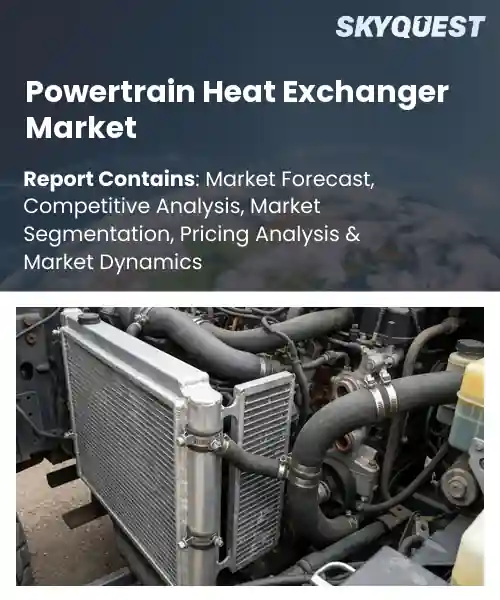
Powertrain Heat Exchanger Market
Report ID: SQMIG20I2711
Report ID: SQMIG20I2711
[email protected]
USA +1 351-333-4748
Report ID:
SQMIG20I2711 |
Region:
Global |
Published Date: February, 2026
Pages:
157
|Tables:
113
|Figures:
77


Global Powertrain Heat Exchanger Market size was valued at USD 799.2 Million in 2024 and is poised to grow from USD 845.55 Million in 2025 to USD 1327.48 Million by 2033, growing at a CAGR of 5.8% during the forecast period (2026-2033).
The global powertrain heat exchanger market growth is driven because internal combustion and electrified powertrain systems need better thermal performance and lower emissions, which leads manufacturers to introduce new thermal management technologies. Powertrain heat exchangers move thermal energy between engine and transmission and battery and coolant systems, which determines vehicle fuel efficiency and mechanical lifetime and design capacity. The market progressed during the last ten years from basic radiators and charge-air coolers to compact brazed plate and microchannel designs because turbocharging and downsizing and hybridization became more common, which led to integrated charge-air coolers becoming standard equipment in European diesel and gasoline engines.
In addition, the global powertrain heat exchanger market penetration develops through plate-fin and liquid-cooled cold plate systems, which enable growth in demand for battery cooling solutions that emerge from electrification and charge-air and compact exchanger design advancements. The combination of rising EV range and charging speed development requires suppliers to supply high surface-area density solutions that bring low pressure-drop benefits, which allows OEMs to charge their batteries at fast C-rates while avoiding thermal runaway situations. The real-world applications of Chinese and European EV models use modular liquid-cooled battery packs while production partnerships develop lightweight aluminum brazed units that meet stricter emissions and efficiency targets while remaining scalable.
How is AI Optimizing Efficiency In The Powertrain Heat Exchanger Market?
AI technology boosts powertrain heat exchanger market efficiency through its ability to create better connections between design simulation and actual performance assessments. The essential elements of thermal behavior prediction depend on machine learning and digital twins support virtual testing at high speeds, while AI topology design helps control system weight and size. Suppliers construct data-driven models to develop faster design processes that help them reduce prototyping needs while improving control methods for coolant flow and fan operation. The primary temperature control requirements for motors and power electronics equipment drive current market demand. AI-powered fan blade designs and compact thermal modules from OEMs and tier one suppliers.
MAHLE, in January 2025, showcased AI-driven bionic fan blades together with a compact thermal management system that developed better cooling features while it decreased pressure losses, which allowed electric powertrains to achieve both quicker development processes and higher operational efficiency.
Market snapshot - (2026-2033)
Global Market Size
USD 799.2 Million
Largest Segment
Liquid Coolers
Fastest Growth
Liquid Coolers
Growth Rate
5.8% CAGR
To get more insights on this market click here to Request a Free Sample Report
The global powertrain heat exchanger market is segmented into type of heat exchanger, application, material type, design type, and region. Based on the type of heat exchanger, the market is divided into air coolers and liquid coolers. By application, it is segmented into automotive and industrial. Based on material type, the market includes aluminum and copper. In terms of design type, the market is categorized into crossflow and counterflow. Regionally, the market is analyzed across North America, Europe, Asia Pacific, Latin America, and Middle East & Africa.
As per the global powertrain heat exchanger market analysis, Air Coolers dominate the market because their direct air-to-gas heat rejection feature and compact frontal-area design match powertrain systems that need fast charge air cooling and efficient thermal systems. Their intake system applications create operational benefits through their simple system design, which eliminates unnecessary weight and maintenance requirements while maintaining operational reliability in forced-induction engines and turbocharged hybrids. The thermal management systems of OEMs depend on established manufacturing methods, which create a strong dependency on existing thermal management system components.
Liquid Coolers have become the fastest growing solution in the market because electrified powertrains and high performance powertrains require cooling systems that deliver higher thermal capacity and improved cooling system control. Microchannel cores that combine with integrated coolant circuits to develop compact systems create thermal capacity advantages which enable multiple system cooling operations, thus allowing suppliers to develop modular designs that they can use in engines and e motors and power electronics.
According to the global powertrain heat exchanger market forecast, Aluminum dominates the market because its exceptional thermal conductivity and lightweight characteristics enable the design of compact exchanger cores that meet the needs of modern powertrain space limitations. The production process requires lower complexity because extrusion and brazing work together with thin wall designs, which allow the creation of lightweight products that retain their original heat transfer properties. OEMs choose aluminum materials because of their resistance to corrosion and ability to be recycled, which leads to design solutions that streamline supply chain operations and manufacturing processes.
Whereas the copper segment is anticipated to achieve the majority of powertrain heat exchanger market share because powertrain systems require components that handle extreme heat conditions while maintaining stable thermal properties throughout their operational lifetime. Its inherent conductivity plus its capabilities to withstand fatigue make it possible to create high-capacity power electronics cores that power engines with high output. The market for premium high-performance solutions for suppliers and their integration partners expands through new joining technologies and surface treatment advancements.
To get detailed segments analysis, Request a Free Sample Report
As per the powertrain heat exchanger market regional forecast, the market in Asia Pacific exceeds all other regions because of its strong manufacturing systems and extensive supplier networks and clustered automotive manufacturing centers. The component design process enables quick adoption of new materials and compact designs because it requires high technological development for design work and OEMs and tier suppliers need to work together and metalworking and thermal management module supply chain networks are already established. The market needs various products because it includes passenger vehicles and commercial vehicles, and electrified platforms. The region gains competitive advantages through its policy frameworks which establish vehicle production systems and component sourcing networks. The establishment of advanced testing facilities together with local engineering expertise creates speedy innovation development. Cost-effective production and logistics operations help businesses maintain profitability, which leads to continuous investment and strategic alliances throughout their entire operational process. The market leadership position becomes stronger through research projects which involve teamwork and supplier networks that create product clusters.
The powertrain heat exchanger sector in Japan benefits from strong engineering heritage, precision manufacturing, and close OEM supplier integration. The product depends on lightweight materials which engineers developed to build compact thermal solutions for high performance engines while advanced quality control systems help deliver dependable products. The local market requires technological improvements for export needs, which leads to ongoing product development work. Cross disciplinary collaboration between materials scientists and thermal engineers sustains innovation and maintains Japan as a center for advanced heat exchanger design.
The powertrain heat exchanger industry in South Korea expands because of its combined automotive production facilities and strong supplier network and advanced materials development efforts. The partnership between OEMs and component specialists leads to the creation of compact thermal modules which operate at high efficiency for multiple powertrain configurations. The engineering process uses system integration to prepare for quick transformations which will improve both performance and electrified vehicle platforms. South Korea establishes itself as a major regional center for heat exchanger innovation through its export manufacturers who use high quality control methods.
The demand for powertrain heat exchangers in Europe is growing quickly because vehicle emissions and efficiency standards and electrification rules now control vehicle design processes. The engineering centers together with the automotive OEMs and specialized suppliers who operate in the region enable quick product development and technology transfer between companies. The investment in lightweight materials and compact heat transfer designs and electrified drivetrains will support multiple application requirements. The testing facilities enable advanced manufacturing capabilities which help businesses differentiate themselves from their market competitors. The region establishes commercialization pathways for novel thermal management solutions through its combination of industry consortia and cross border supplier networks which ensure product safety and quality requirements are met. The region develops customized material solutions through its strong research networks and specialized metallurgy skills while aftermarket and retrofit demand create market opportunities to reach different vehicle segments.
The powertrain heat exchanger market in Germany depends on its strong industrial base and precise production capabilities and its close ties to major OEM engineering needs. The product development process focuses on creating strong thermal modules because they need to work with complex engine systems and hybrid engine systems. The research teams and supplier networks which work together create the necessary resources to implement new design concepts. Germany functions as the main center for fixing advanced heat exchangers through its quality control process which includes extensive product testing and validation.
The Powertrain Heat Exchanger Market in the United Kingdom is growing through dedicated funding for lightweight technology and modular thermal systems and the partnership between startups and established suppliers. The company strengths include flexible engineering approaches which help different clients while testing and validation capabilities expand their testing ability and testing capabilities. The domestic programs which target niche performance markets establish operational links with advanced research institutions to create a complete product development system that enables fast commercial product introduction.
The powertrain heat exchanger market in France experiences fast innovation because of its research institutions and component manufacturers who develop compact thermal solutions for electrified drivetrains. The market grows because advanced composite materials and heat recovery systems and customized design solutions for various applications exist. The technology providers who create public private initiatives in clusters work together to advance prototyping and expand technical capabilities. The business gains a competitive edge through its focus on sustainable products which people use throughout their lifecycle as domestic products and export products.
North America enhances its position through strategic financial backing of advanced thermal management research and production capacity growth and partnerships among original equipment manufacturers and their suppliers and research organizations. Modular designs that can be used with internal combustion engines hybrid systems and fully electric powertrains create possibilities for multiple platform uses. Companies can now respond to market changes better because they have built stronger supplier networks and they have returned vital component manufacturing back to domestic locations and they have made manufacturing processes more automated. Universities and national laboratories partner with our organization to create new materials and testing procedures for material validation. The growing aftermarket and retrofit ecosystems create new paths for technology to spread while the emphasis on sustainable product lifecycles and dependable supply chains enables regional vehicle programs to remain competitive for extended periods.
The powertrain heat exchanger market in the United States depends on three main factors which include original equipment manufacturer programs and manufacturing process automation and supplier base expansion. Designers who create modular thermal systems with flexible thermal distribution capabilities which can connect with both traditional systems and electric systems enable designers to create systems that work with both kinds of technologies. The combined efforts of research institutions and industrial partners help create new materials and testing procedures which improve validation processes. The combined efforts of research institutions and industrial partners help create new materials and testing procedures which improve validation processes. The expanded aftermarket networks and service capabilities enable customers to install retrofits while the supply chain operations and quality control systems help domestic manufacturers and export organizations maintain their competitive edge.
The powertrain heat exchanger market in Canada benefits from materials research, specialized testing capabilities, and ties to regional manufacturing clusters. The development of tailored solutions for light commercial vehicles and electrified applications requires protecting solutions which address our need for extended operational efficiency and ability to withstand all climatic conditions. Technology centers work together with component suppliers to create prototypes which they will then test to confirm their performance in real-world situations. The manufacturing practices which promote sustainability together with supply chain systems that maintain operational stability make Canada an essential partner for North American development initiatives in heat exchanger technology.
To know more about the market opportunities by region and country, click here to
Buy The Complete Report
Stricter Emissions Regulations
The automotive industry requires heat exchangers with high performance because advanced emissions standards force manufacturers to improve both engine performance and electrified powertrain efficiency. Improved thermal management enables tighter combustion control, exhaust aftertreatment effectiveness, and battery temperature regulation, which supports compliance with regulatory limits. Advanced heat exchange solutions have become essential in vehicle platforms because they offer the durability needed to meet efficiency standards which require additional research to improve design parameters across all vehicle categories to achieve higher fuel efficiency and base regulatory standards.
Electrification Of Vehicle Platforms
The growing market for electrified vehicles requires special thermal management systems which prevent battery degradation and ensure powertrain systems work at their peak, creating a higher demand for dedicated heat exchangers. The essential need for effective cooling systems and heat recovery systems arises from the requirement to maintain temperature control for battery systems and power electronic devices and electric motor components, which enables devices to function properly throughout various driving situations. Manufacturers now produce dedicated heat exchange modules together with compact high-efficiency designs which help the market for components grow while suppliers work together to solve packaging and cooling issues that arise in electrified vehicle designs.
High Component Complexity
The process of developing complex thermal management systems requires detailed engineering together with system integration across all powertrain components, which leads to extended development periods because it makes vehicle assembly operations more difficult. The need for compact packaging, compatibility with diverse powertrain configurations, and coordination with suppliers can deter rapid adoption and raise barriers for smaller manufacturers. The product development process requires testing and validation of new technologies which extends development cycles while advanced heat exchanger designs show better performance than existing designs, yet maintenance needs increase when using these new technologies.
Raw Material Price Volatility
The unpredictable changes in metal prices and specialized material availability for heat exchanger production create challenges that obstruct suppliers from executing their production schedules and maintaining their profit margins. The rising unpredictability of input prices leads OEMs and component manufacturers to delay their investments in new designs while they focus on reducing expenses and exploring different materials which results in prolonged technology adoption times. The process of acquiring materials together with the changes which supply chains experience because of material volatility creates greater difficulties for organizations that need to implement advanced heat exchanger systems across their vehicle development efforts which limits their ability to expand into new markets.
Request Free Customization of this report to help us to meet your business objectives.
The global powertrain heat exchanger market exhibits a competitive environment which organizations use to establish market dominance through acquisition activities and partnerships with suppliers and their technological breakthroughs. The combination of Dana's acquisition of Modine's light-vehicle thermal business together with OEM partnerships for developing EV thermal modules has created new vendor relationships through tier one agreements and business divestiture activities. The company develops EV specific exchangers and hydrogen-ready systems to secure OEM platform agreements.
SkyQuest’s ABIRAW (Advanced Business Intelligence, Research & Analysis Wing) is our Business Information Services team that Collects, Collates, Correlates, and Analyses the Data collected by means of Primary Exploratory Research backed by robust Secondary Desk research.
As per SkyQuest analysis, the global powertrain heat exchanger market will experience continuous growth because vehicle electrification creates a higher need for battery and power electronics cooling while stricter emissions standards require better thermal management solutions. Air coolers currently dominate the market because their small size fits well with OEM needs while Asia Pacific leads the market through its extensive manufacturing hubs and supplier distribution capabilities. High component complexity serves as the main obstacle because it leads to longer development periods and creates difficulties when trying to connect different powertrain systems. The market will favor suppliers who provide modular solutions with lightweight attributes and high efficiency because they will capture all new OEM and aftermarket business growth.
| Report Metric | Details |
|---|---|
| Market size value in 2024 | USD 799.2 Million |
| Market size value in 2033 | USD 1327.48 Million |
| Growth Rate | 5.8% |
| Base year | 2024 |
| Forecast period | (2026-2033) |
| Forecast Unit (Value) | USD Million |
| Segments covered |
|
| Regions covered | North America (US, Canada), Europe (Germany, France, United Kingdom, Italy, Spain, Rest of Europe), Asia Pacific (China, India, Japan, Rest of Asia-Pacific), Latin America (Brazil, Rest of Latin America), Middle East & Africa (South Africa, GCC Countries, Rest of MEA) |
| Companies covered |
|
| Customization scope | Free report customization with purchase. Customization includes:-
|
To get a free trial access to our platform which is a one stop solution for all your data requirements for quicker decision making. This platform allows you to compare markets, competitors who are prominent in the market, and mega trends that are influencing the dynamics in the market. Also, get access to detailed SkyQuest exclusive matrix.
Table Of Content
Executive Summary
Market overview
Parent Market Analysis
Market overview
Market size
KEY MARKET INSIGHTS
COVID IMPACT
MARKET DYNAMICS & OUTLOOK
Market Size by Region
KEY COMPANY PROFILES
Methodology
For the Powertrain Heat Exchanger Market, our research methodology involved a mixture of primary and secondary data sources. Key steps involved in the research process are listed below:
1. Information Procurement: This stage involved the procurement of Market data or related information via primary and secondary sources. The various secondary sources used included various company websites, annual reports, trade databases, and paid databases such as Hoover's, Bloomberg Business, Factiva, and Avention. Our team did 45 primary interactions Globally which included several stakeholders such as manufacturers, customers, key opinion leaders, etc. Overall, information procurement was one of the most extensive stages in our research process.
2. Information Analysis: This step involved triangulation of data through bottom-up and top-down approaches to estimate and validate the total size and future estimate of the Powertrain Heat Exchanger Market.
3. Report Formulation: The final step entailed the placement of data points in appropriate Market spaces in an attempt to deduce viable conclusions.
4. Validation & Publishing: Validation is the most important step in the process. Validation & re-validation via an intricately designed process helped us finalize data points to be used for final calculations. The final Market estimates and forecasts were then aligned and sent to our panel of industry experts for validation of data. Once the validation was done the report was sent to our Quality Assurance team to ensure adherence to style guides, consistency & design.
Analyst Support
Customization Options
With the given market data, our dedicated team of analysts can offer you the following customization options are available for the Powertrain Heat Exchanger Market:
Product Analysis: Product matrix, which offers a detailed comparison of the product portfolio of companies.
Regional Analysis: Further analysis of the Powertrain Heat Exchanger Market for additional countries.
Competitive Analysis: Detailed analysis and profiling of additional Market players & comparative analysis of competitive products.
Go to Market Strategy: Find the high-growth channels to invest your marketing efforts and increase your customer base.
Innovation Mapping: Identify racial solutions and innovation, connected to deep ecosystems of innovators, start-ups, academics, and strategic partners.
Category Intelligence: Customized intelligence that is relevant to their supply Markets will enable them to make smarter sourcing decisions and improve their category management.
Public Company Transcript Analysis: To improve the investment performance by generating new alpha and making better-informed decisions.
Social Media Listening: To analyze the conversations and trends happening not just around your brand, but around your industry as a whole, and use those insights to make better Marketing decisions.
REQUEST FOR SAMPLE
 REQUEST FREE CUSTOMIZATION
Global Powertrain Heat Exchanger Market size was valued at USD 799.2 Million in 2024 and is poised to grow from USD 845.55 Million in 2025 to USD 1327.48 Million by 2033, growing at a CAGR of 5.8% during the forecast period (2026-2033).
Competitive landscape in the global powertrain heat exchanger market is defined by consolidation through targeted M&A, supplier partnerships, and rapid technical innovation. Tier one deals and divestitures such as Dana’s acquisition of Modine’s light-vehicle thermal business and OEM collaborations to co-develop EV thermal modules are reshaping supplier scope. Firms are also launching specialized EV grade exchangers and hydrogen capable units to win OEM platforms. 'Valeo', 'Hanon Systems', 'Modine Manufacturing Company', 'Mahle', 'Denso Corporation', 'Eberspächer', 'T RAD', 'Continental AG', 'Calsonic Kansei Corporation', 'ZF Friedrichshafen AG', 'Behr Hella Service', 'BorgWarner', 'Sogefi Group', 'Auer Precision', 'JTEKT Corporation', 'Johnson Electric', 'Delphi Technologies', 'Vitesco Technologies', 'Gentherm', 'Nissens'
Advanced emissions standards compel automakers and suppliers to optimize engine and electrified powertrain performance, increasing demand for efficient heat exchangers. Improved thermal management enables tighter combustion control, exhaust aftertreatment effectiveness, and battery temperature regulation, which supports compliance with regulatory limits. As a result, vehicle platforms are integrating more sophisticated heat exchange solutions to meet durability and efficiency requirements, prompting investment in design innovation and higher adoption across vehicle segments where regulatory compliance and fuel economy priorities necessitate enhanced thermal systems.
Electrified Thermal Management: Growth of electrified drivetrains is shifting thermal management requirements toward precise, multi-domain cooling of batteries, power electronics and motors. Suppliers are developing integrated exchanger solutions optimized for compact packaging, reduced thermal gradients and responsive control strategies. Emphasis on reliability, system-level simulation and manufacturability is driving closer collaboration between OEMs and component manufacturers. The market favors adaptable designs that support varied vehicle architectures and enable rapid validation, accelerating adoption of novel materials, advanced manufacturing methods and holistic thermal system engineering approaches.
Why does Asia Pacific Dominate the Global Powertrain Heat Exchanger Market?


Want to customize this report? This report can be personalized according to your needs. Our analysts and industry experts will work directly with you to understand your requirements and provide you with customized data in a short amount of time. We offer $1000 worth of FREE customization at the time of purchase.
Feedback From Our Clients


 USA (+1) 351-333-4748

