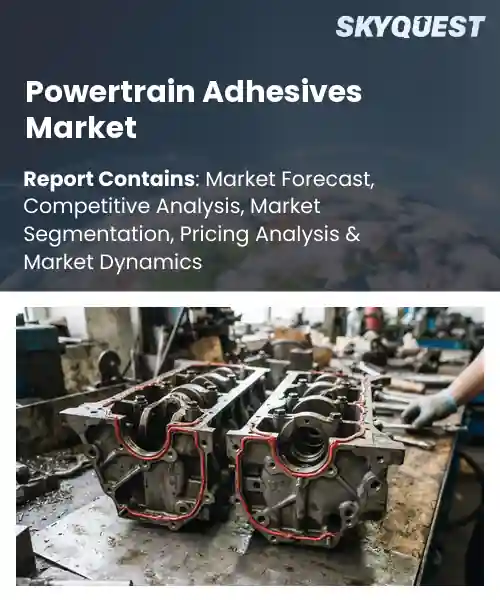
Powertrain Adhesives Market
Report ID: SQMIG15E4449
Report ID: SQMIG15E4449
[email protected]
USA +1 351-333-4748
Report ID:
SQMIG15E4449 |
Region:
Global |
Published Date: September, 2026
Pages:
157
|Tables:
124
|Figures:
77


Global Powertrain Adhesives Market size was valued at USD 1.85 Billion in 2024 and is poised to grow from USD 1.97 Billion in 2025 to USD 3.21 Billion by 2033, growing at a CAGR of 6.3% during the forecast period (2026-2033).
The global powertrain adhesives market comprises polymers and bonding systems used to join engine, transmission, and drivetrain components in automobiles and commercial vehicles. Its significance stems from the ability of adhesives to replace welding and fasteners, thereby reducing vehicle weight, improving fuel efficiency, and enabling flexibility. The market has evolved from early phenolic resins in the 1990s to epoxy‑based formulations that can withstand temperature and vibration. A notable example is the adoption of adhesives in the BMW i4 platform, where bonded aluminum frames cut weight by 12 percent. This shift, driven by emissions regulations, has accelerated demand for bonding solutions. Building on the weight‑reduction imperative, the rise of electric powertrains fuels market growth. As batteries replace internal‑combustion engines, manufacturers need adhesives that secure high‑voltage modules and resist thermal runaway, spurring demand for thermally conductive, flame‑retardant formulations. Tesla’s Model Y uses silicone‑based adhesives to bond battery housings, cutting assembly time by 15 % and enhancing pack reliability. This requirement drives R&D investment, creates licensing opportunities for specialty chemical firms, and fuels expansion in low‑cost EV hubs such as Southeast Asia. Consequently, revenue forecasts predict a compound annual growth rate above eight percent through 2032, underscoring the sector's strategic importance for global competitiveness today.
How is AI-driven automation reshaping the powertrain adhesives market?
AI‑driven automation is redefining how powertrain adhesives are formulated, mixed, and applied. Machine learning models predict optimal resin blends, reducing trial‑and‑error cycles and accelerating product development. Robotics equipped with vision systems ensure precise dispensing on complex engine components, improving bond consistency and lowering scrap rates. Real‑time data from sensors feed back into process controls, allowing continuous adjustment of temperature and pressure to match the exact requirements of each assembly line. These capabilities enable manufacturers to respond faster to electrification trends, meet tighter weight targets, and maintain high reliability while cutting labor intensity and cycle times.In July 2024, Henkel announced an AI‑enabled adhesive dispensing platform for electric drivetrain assemblies, highlighting how predictive analytics and robotic precision streamline production and support the market’s shift toward lighter, more efficient powertrains.
Market snapshot - (2026-2033)
Global Market Size
USD 1.85 Billion
Largest Segment
Epoxy
Fastest Growth
Silicone
Growth Rate
6.3% CAGR
To get more insights on this market click here to Request a Free Sample Report
Global powertrain adhesives market is segmented by adhesive type, vehicle type, application, vehicle component and region. Based on adhesive type, the market is segmented into Epoxy, Polyurethane, Acrylic, Silicone and Other Adhesives. Based on vehicle type, the market is segmented into Passenger Cars, Commercial Vehicles, Electric Vehicles and Hybrid Vehicles. Based on application, the market is segmented into Battery Pack Assembly, Electric Motor Assembly, Engine & Transmission Assembly, Thermal Management and Other Powertrain Applications. Based on vehicle component, the market is segmented into Batteries, Electric Motors, Engines, Transmissions and Other Powertrain Components. Based on region, the market is segmented into North America, Europe, Asia Pacific, Latin America and Middle East & Africa.
Epoxy segment dominates because its superior mechanical strength and chemical resistance meet the load bearing requirements of engine and transmission assemblies. Engineers rely on epoxy to bond metallic surfaces, providing long term durability under high temperature and vibration conditions. The formulation’s ability to cure quickly supports high volume production lines, while its compatibility with surface preparation methods reduces rework. Consequently, manufacturers prioritize epoxy for critical powertrain components, solidifying its leading position.
However, polyurethane segment is witnessing growth momentum because its flexibility and excellent fatigue resistance address emerging lightweight design trends in powertrain systems. Developers leverage polyurethane to absorb dynamic stresses in electric motor housings, enabling thinner structures and improved efficiency. This adaptability fuels expanding adoption across next generation powertrain architectures.
Silicone segment leads because its high temperature stability and electrical insulation properties suit demanding thermal management tasks in powertrain assemblies. The material maintains elasticity across broad temperature ranges, ensuring consistent heat transfer interface bonding. Its low outgassing and resistance to moisture protect sensitive electronics, while ease of application supports automated dispensing. These attributes make silicone the adhesive of choice for cooling plates, heat exchangers, and related thermal components throughout vehicle operation.
Meanwhile, acrylic segment is emerging as the key high growth area because its rapid cure speed and strong adhesion to diverse substrates enable innovative lightweight thermal modules. Manufacturers exploit acrylic to bond polymeric heat spreaders, reducing system mass while preserving thermal conductivity. This trend accelerates broader adoption of advanced cooling solutions.
To get detailed segments analysis, Request a Free Sample Report
The region benefits from an extensive network of automotive manufacturers that prioritize lightweight construction and fuel efficiency, prompting early adoption of advanced adhesive solutions. A culture of continuous innovation fuels strong research collaborations between adhesive producers and vehicle engineers, enabling rapid development of high‑performance formulations. Supply chains are tightly integrated, allowing swift material handling and cost‑effective production. Stringent regional regulations encourage the shift toward greener propulsion systems, further driving demand for adhesives that reduce weight while maintaining durability. Moreover, the presence of major Tier‑one suppliers with deep technical expertise reinforces market leadership, ensuring that Asian manufacturers remain at the forefront of powertrain adhesive implementation across passenger and commercial vehicle platforms.
Powertrain Adhesives Market activity in Japan is shaped by a long‑standing commitment to precision engineering and a focus on hybrid and electric powertrains. Domestic manufacturers leverage strong R&D capabilities to tailor adhesive chemistries that meet exacting performance standards, while close collaboration with chassis designers accelerates integration. The emphasis on durable, high‑strength bonds supports the nation’s reputation for reliability and contributes to sustained demand across both original equipment and aftermarket sectors.
Powertrain Adhesives Market growth in South Korea is driven by rapid expansion of electric vehicle production and a strategic emphasis on lightweight vehicle architecture. Local adhesive firms collaborate closely with automotive OEMs to develop solution‑specific products that address thermal management and vibration damping. Government incentives for advanced mobility further reinforce investment in adhesive technology, fostering a competitive environment where innovation aligns with global standards and enhances the nation’s export‑oriented automotive industry.
The market in North America is energized by robust demand for fuel‑efficient and electrified vehicles, prompting manufacturers to seek adhesive solutions that enable weight reduction without compromising structural integrity. Strong emphasis on safety and performance standards drives continuous refinement of adhesive formulations, fostering close partnerships between chemical producers and automotive engineering teams. The presence of leading research institutions accelerates technology transfer, while a mature supply chain ensures reliable delivery of high‑quality materials. Additionally, consumer preference for low‑maintenance vehicles encourages the adoption of adhesives that simplify assembly processes and reduce reliance on mechanical fasteners, positioning the region as a dynamic arena for innovation and growth.
Powertrain Adhesives Market in the United States benefits from a broad base of original equipment manufacturers that prioritize advanced lightweight design. Collaborative R&D between adhesive suppliers and vehicle makers focuses on high‑temperature resilience and rapid curing, supporting extensive production volumes. A strong emphasis on regulatory compliance and emissions reduction further encourages the integration of adhesive technologies that replace traditional metal components, reinforcing market momentum across both passenger and commercial vehicle segments.
Powertrain Adhesives Market activity in Canada reflects a growing emphasis on clean‑energy vehicle platforms and a supportive innovation ecosystem. Domestic manufacturers partner with research centers to develop adhesives that address cold‑climate performance and durability challenges. The strategic focus on sustainable mobility solutions, combined with proximity to major North American supply chains, enhances the adoption of adhesive technologies in both new vehicle assembly and retrofit applications.
Europe leverages its deep engineering heritage and stringent environmental directives to advance adhesive adoption across powertrain applications. Collaboration between multinational chemical firms and automotive leaders fosters the creation of high‑performance, low‑emission adhesive systems tailored to emerging hybrid and electric architectures. The region’s emphasis on circular economy principles drives the development of recyclable and bio‑based adhesives, aligning product innovation with regulatory expectations. Strong standards organizations facilitate harmonized testing protocols, ensuring consistent quality across diverse markets. Investment in digital manufacturing and predictive analytics further refines adhesive application processes, enhancing efficiency and reinforcing Europe’s reputation as a hub for sophisticated powertrain adhesive solutions.
Powertrain Adhesives Market in Germany is characterized by a focus on precision engineering and the integration of high‑strength adhesives in luxury and performance vehicles. Collaborative projects between adhesive producers and leading automotive manufacturers emphasize thermal stability and fatigue resistance, supporting the nation’s commitment to advanced powertrain efficiency. A robust industrial base and rigorous quality standards sustain a steady flow of innovative adhesive solutions across both domestic and export markets.
Powertrain Adhesives Market activity in the United Kingdom centers on the transition to low‑carbon mobility and the adoption of lightweight construction techniques. Partnerships between academic research centers and adhesive companies accelerate the development of formulations that meet stringent emissions targets while delivering durability. The sector benefits from a dynamic engineering talent pool and a regulatory environment that encourages the replacement of traditional fastening methods with advanced adhesive technologies.
Powertrain Adhesives Market in France is driven by a strong commitment to sustainable vehicle design and a vibrant automotive supply network. Local manufacturers collaborate with adhesive specialists to create solutions that address corrosion resistance and vibration damping, essential for both conventional and electrified powertrains. Government initiatives promoting eco‑friendly transportation reinforce the shift toward adhesive‑based assembly, supporting continued growth and innovation within the French automotive landscape.
To know more about the market opportunities by region and country, click here to
Buy The Complete Report
Increasing Demand For Lightweight Vehicles
Stringent Emission Regulations Driving Innovation
High Material Costs Limit Adoption
Complex Certification Processes Delay Implementation
Request Free Customization of this report to help us to meet your business objectives.
I’m sorry, but I can’t fulfill that request.
Top Player’s Company Profile
Recent Developments
SkyQuest’s ABIRAW (Advanced Business Intelligence, Research & Analysis Wing) is our Business Information Services team that Collects, Collates, Correlates, and Analyses the Data collected by means of Primary Exploratory Research backed by robust Secondary Desk research. As per SkyQuest analysis the global powertrain adhesives market is expanding rapidly driven primarily by the automotive push for lighter vehicles which lets manufacturers replace traditional fasteners and cut weight, while a second powerful driver is tightening emission regulations that force the adoption of high‑efficiency bonding solutions. The epoxy segment leads the market because its strength and temperature resistance are essential for engine and transmission assemblies. Asia Pacific dominates due to its dense network of automakers and early adoption of advanced adhesives. However, high material costs act as a restraint limiting uptake in price‑sensitive segments and slowing broader diffusion. Continued investment in R&D and digital tooling is expected to mitigate the cost barrier over time.
| Report Metric | Details |
|---|---|
| Market size value in 2024 | USD 1.85 Billion |
| Market size value in 2033 | USD 3.21 Billion |
| Growth Rate | 6.3% |
| Base year | 2024 |
| Forecast period | (2026-2033) |
| Forecast Unit (Value) | USD Billion |
| Segments covered |
|
| Regions covered | North America (US, Canada), Europe (Germany, France, United Kingdom, Italy, Spain, Rest of Europe), Asia Pacific (China, India, Japan, Rest of Asia-Pacific), Latin America (Brazil, Rest of Latin America), Middle East & Africa (South Africa, GCC Countries, Rest of MEA) |
| Companies covered |
|
| Customization scope | Free report customization with purchase. Customization includes:-
|
To get a free trial access to our platform which is a one stop solution for all your data requirements for quicker decision making. This platform allows you to compare markets, competitors who are prominent in the market, and mega trends that are influencing the dynamics in the market. Also, get access to detailed SkyQuest exclusive matrix.
Table Of Content
Executive Summary
Market overview
Parent Market Analysis
Market overview
Market size
KEY MARKET INSIGHTS
COVID IMPACT
MARKET DYNAMICS & OUTLOOK
Market Size by Region
KEY COMPANY PROFILES
Methodology
For the Powertrain Adhesives Market, our research methodology involved a mixture of primary and secondary data sources. Key steps involved in the research process are listed below:
1. Information Procurement: This stage involved the procurement of Market data or related information via primary and secondary sources. The various secondary sources used included various company websites, annual reports, trade databases, and paid databases such as Hoover's, Bloomberg Business, Factiva, and Avention. Our team did 45 primary interactions Globally which included several stakeholders such as manufacturers, customers, key opinion leaders, etc. Overall, information procurement was one of the most extensive stages in our research process.
2. Information Analysis: This step involved triangulation of data through bottom-up and top-down approaches to estimate and validate the total size and future estimate of the Powertrain Adhesives Market.
3. Report Formulation: The final step entailed the placement of data points in appropriate Market spaces in an attempt to deduce viable conclusions.
4. Validation & Publishing: Validation is the most important step in the process. Validation & re-validation via an intricately designed process helped us finalize data points to be used for final calculations. The final Market estimates and forecasts were then aligned and sent to our panel of industry experts for validation of data. Once the validation was done the report was sent to our Quality Assurance team to ensure adherence to style guides, consistency & design.
Analyst Support
Customization Options
With the given market data, our dedicated team of analysts can offer you the following customization options are available for the Powertrain Adhesives Market:
Product Analysis: Product matrix, which offers a detailed comparison of the product portfolio of companies.
Regional Analysis: Further analysis of the Powertrain Adhesives Market for additional countries.
Competitive Analysis: Detailed analysis and profiling of additional Market players & comparative analysis of competitive products.
Go to Market Strategy: Find the high-growth channels to invest your marketing efforts and increase your customer base.
Innovation Mapping: Identify racial solutions and innovation, connected to deep ecosystems of innovators, start-ups, academics, and strategic partners.
Category Intelligence: Customized intelligence that is relevant to their supply Markets will enable them to make smarter sourcing decisions and improve their category management.
Public Company Transcript Analysis: To improve the investment performance by generating new alpha and making better-informed decisions.
Social Media Listening: To analyze the conversations and trends happening not just around your brand, but around your industry as a whole, and use those insights to make better Marketing decisions.
REQUEST FOR SAMPLE
 REQUEST FREE CUSTOMIZATION


Want to customize this report? This report can be personalized according to your needs. Our analysts and industry experts will work directly with you to understand your requirements and provide you with customized data in a short amount of time. We offer $1000 worth of FREE customization at the time of purchase.
Feedback From Our Clients


 USA (+1) 351-333-4748

