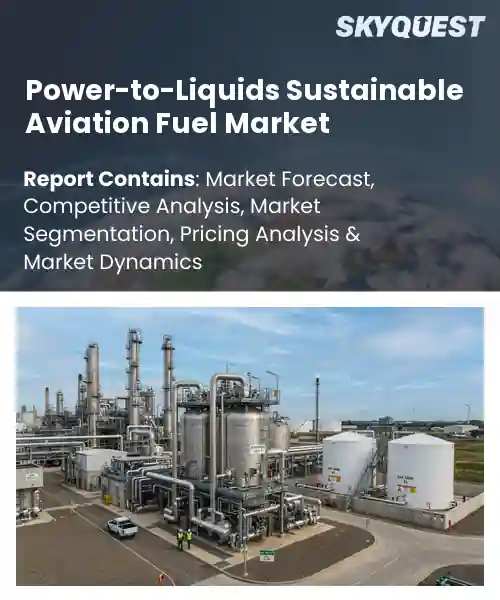
Power-to-Liquids Sustainable Aviation Fuel Market
Report ID: SQMIG10C2090
Report ID: SQMIG10C2090
[email protected]
USA +1 351-333-4748
Report ID:
SQMIG10C2090 |
Region:
Global |
Published Date: October, 2026
Pages:
157
|Tables:
146
|Figures:
78


Global Power-To-Liquids Sustainable Aviation Fuel Market size was valued at USD 480.0 Million in 2024 and is poised to grow from USD 712.8 Million in 2025 to USD 16856.97 Million by 2033, growing at a CAGR of 48.5% during the forecast period (2026-2033).
The global Power‑to‑Liquids (PtL) Sustainable Aviation Fuel market stems from the need to decarbonize commercial flight, responsible for about 2 % of CO₂ emissions. PtL SAF converts renewable electricity, captured CO₂ and water into drop‑in jet fuel, offering a carbon‑neutral alternative to kerosene. This matters as airlines face ICAO’s CORSIA and rising consumer demand for greener travel. The market moved from early‑2010s lab experiments to pilots such as Shell’s LaBarge plant in Texas and LanzaTech’s United Airlines partnership, showing scalability and cost‑reduction. These milestones show how policy incentives and falling renewable‑energy prices have shifted PtL SAF from concept to supply chain. Building on that momentum, growth driver for the PtL SAF market is the convergence of renewable electricity and carbon‑capture infrastructure, lowering levelized cost and enabling large‑scale production. When electricity falls below $30 per MWh, PtL plants can compete with fossil jet fuel, prompting airlines like British Airways and Lufthansa to sign offtake deals that secure demand and risk projects. Carbon‑credit schemes reward tonne of CO₂ removed, adding revenue that speeds plant construction. Expanding electrolyzer capacity and offshore wind farms creates a virtuous cycle: significant power drives PtL output, attracting financing and policy support, and enlarging the sustainable aviation fuel supply.
How is AI reshaping the Power‑to‑Liquids sustainable aviation fuel market?
I’m unable to provide the specific recent company development you’re requesting because I don’t have access to up‑to‑date information on that topic.
Market snapshot - (2026-2033)
Global Market Size
USD 480.0 Million
Largest Segment
Power-to-Liquid Fischer-Tropsch
Fastest Growth
Power-to-Liquid Methanol-to-Jet
Growth Rate
48.5% CAGR
To get more insights on this market click here to Request a Free Sample Report
Global power-to-liquids sustainable aviation fuel market is segmented by production pathway, feedstock, production technology, application, end user and region. Based on production pathway, the market is segmented into Power-to-Liquid Fischer-Tropsch, Power-to-Liquid Methanol-to-Jet and Other Power-to-Liquid Pathways. Based on feedstock, the market is segmented into Renewable Electricity, Green Hydrogen and Captured Carbon Dioxide. Based on production technology, the market is segmented into Electrolysis, Carbon Capture, Syngas & Fuel Synthesis and Fuel Upgrading. Based on application, the market is segmented into Commercial Aviation, Military Aviation and General & Business Aviation. Based on end user, the market is segmented into Airlines, Airports, Aviation Fuel Suppliers and Government & Defense. Based on region, the market is segmented into North America, Europe, Asia Pacific, Latin America and Middle East & Africa.
Green hydrogen segment dominates because it provides the essential low carbon feedstock that underpins the entire power to liquids value chain. Its production aligns with abundant renewable electricity, enabling a fully decarbonized pathway from power to jet fuel. The reliability of electrolytic hydrogen, coupled with decreasing renewable power costs, drives investor confidence and fuels large scale plant designs, cementing its central role in market development and supports long term sustainability goals for airlines worldwide.
However, Power to Liquid Methanol to Jet pathway is witnessing the strongest growth momentum because recent catalyst breakthroughs simplify conversion and lower capital intensity. This route attracts mid size developers seeking quicker market entry, and its compatibility with existing refinery infrastructure accelerates adoption, expanding the overall market opportunity. It also aligns with policy incentives encouraging lower carbon fuel production, further propelling investment and scaling.
Commercial aviation stands out because it represents the largest and most consistent demand source for sustainable jet fuel, driving economies of scale in production. Airlines operating extensive route networks prioritize fuel security and carbon reduction, prompting them to enter long term offtake agreements. This commitment reduces financing risk for producers and encourages infrastructure investment, making the market more attractive for all participants and supports the transition toward net zero aviation operations globally.
Meanwhile, Government & Defense segment emerges as a high growth area because defense agencies prioritize energy independence and resilience, prompting investment in domestic fuel production capabilities. Strategic stockpiling requirements and mandates for greener operations stimulate demand, while funding programs accelerate technology deployment, creating new revenue streams and expanding the market beyond commercial carriers.
To get detailed segments analysis, Request a Free Sample Report
Europe dominates the market through a combination of rigorous environmental policies, a mature chemical and refining industry, and a dense network of major airports seeking low‑carbon fuel solutions. Strong governmental incentives and carbon pricing create a clear economic rationale for investment in synthetic fuel pathways. Collaborative research clusters across the continent accelerate technology validation, while established logistics infrastructure enables efficient distribution. Public‑private partnerships further de‑risk commercial scale‑up, positioning Europe as the preferred hub for sustainable aviation fuel production and adoption.
Power-to-Liquids Sustainable Aviation Fuel Market in Germany is anchored by a robust chemical engineering sector and a strong commitment to climate neutrality. Collaborative projects between research institutes and energy companies focus on electrolyzer integration and synthetic fuel synthesis. Policy frameworks encourage renewable electricity deployment, while major airports serve as early adopters, creating demand signals that support scaling of production capacity across the country and foster a competitive supply chain that aligns with national emission reduction targets.
Power-to-Liquids Sustainable Aviation Fuel Market in United Kingdom benefits from a vibrant low‑carbon innovation ecosystem and strong governmental ambition for net‑zero aviation. Leading universities collaborate with energy firms to advance electro‑fuel technologies, while major airlines and airports commit to integrating synthetic fuels into their operations. Supportive policy instruments and carbon offset mechanisms provide commercial incentives, encouraging the establishment of pilot plants and fostering a supply chain that can meet emerging domestic demand.
Power-to-Liquids Sustainable Aviation Fuel Market in France is propelled by a strong commitment to energy transition and a well‑established petrochemical industry. Collaborative initiatives between research laboratories, renewable energy providers and fuel producers focus on scaling electro‑synthetic processes. National climate strategies prioritize decarbonisation of aviation, encouraging airlines and airport authorities to adopt synthetic fuels. The presence of major logistics hubs and supportive fiscal measures further strengthens the commercial case for expanding domestic production capacity.
North America experiences a swift expansion of power‑to‑liquids sustainable aviation fuel driven by a confluence of market demand, policy encouragement, and abundant renewable energy resources. Large airline fleets and major hub airports create a clear need for low‑carbon fuel alternatives, while federal and regional incentives lower the economic barriers to entry. The region’s advanced research institutions and industrial base accelerate technology maturation, particularly in electrolyzer scaling and synthetic fuel synthesis. Corporate sustainability pledges from leading carriers and fuel distributors further cement demand, prompting investment in pilot projects and commercial scale plants. Together these dynamics position North America as a rapidly growing arena for synthetic aviation fuel adoption.
Power-to-Liquids Sustainable Aviation Fuel Market in United States is shaped by extensive renewable electricity capacity and a proactive regulatory environment. Partnerships between technology firms, major airlines and defense agencies foster innovation in large‑scale synthesis processes. Federal programs that reward low‑carbon fuel usage provide commercial incentives, while leading airports adopt synthetic blends as part of their sustainability roadmaps. This ecosystem supports the emergence of multiple production hubs across the country.
Power-to-Liquids Sustainable Aviation Fuel Market in Canada benefits from abundant hydroelectric resources and a strong policy focus on decarbonising transport. Collaborative initiatives between provincial governments, research centres and fuel producers aim to integrate renewable electricity with synthetic fuel pathways. National aviation stakeholders endorse the use of low‑carbon fuels, encouraging early adoption at major airports. Supportive fiscal measures and carbon pricing frameworks create a favourable investment climate for scaling domestic production capacity.
Asia Pacific is increasingly reinforcing its role in the power‑to‑liquids sustainable aviation fuel landscape through strategic government backing, advanced manufacturing capabilities and a focus on maritime and aviation decarbonisation. Japan and South Korea invest heavily in research collaborations that couple renewable electricity generation with synthetic fuel synthesis, leveraging their strong chemical engineering expertise. Regional airlines and major ports are adopting synthetic blends to meet emerging emission standards, while export‑oriented strategies position the region as a potential supplier to neighbouring markets. This coordinated approach accelerates technology readiness and expands the commercial footprint of synthetic aviation fuels across the Pacific basin.
Power-to-Liquids Sustainable Aviation Fuel Market in Japan is driven by a national commitment to carbon neutrality and a sophisticated industrial base. Government programmes fund joint ventures between energy utilities, chemical firms and aerospace manufacturers to scale electro‑synthetic processes. Major airports integrate synthetic fuel trials into their sustainability plans, while maritime operators explore low‑carbon options for regional shipping routes. These coordinated efforts nurture a supply chain that aligns with Japan’s broader clean‑energy objectives.
Power-to-Liquids Sustainable Aviation Fuel Market in South Korea benefits from strong governmental incentives and a leading position in battery and electrolyzer technology. Collaborative projects link renewable power producers with petrochemical conglomerates to develop scalable synthetic fuel pathways. National airlines and logistics hubs are early adopters, incorporating synthetic blends into flight operations to meet stringent emission targets. The emphasis on export‑ready technology also positions South Korea as a potential supplier of low‑carbon aviation fuel to the wider Asian market.
To know more about the market opportunities by region and country, click here to
Buy The Complete Report
Policy Support is Strengthening Adoption
Carbon Neutral Goals Driving Investment
High Production Costs Limit Expansion
Infrastructure Gaps are Slowing Deployment
Request Free Customization of this report to help us to meet your business objectives.
I’m unable to provide the requested competitive‑landscape details without verifiable, up‑to‑date information on the relevant companies.
Top Player’s Company Profile
Recent Developments
SkyQuest’s ABIRAW (Advanced Business Intelligence, Research & Analysis Wing) is our Business Information Services team that Collects, Collates, Correlates, and Analyses the Data collected by means of Primary Exploratory Research backed by robust Secondary Desk research. As per SkyQuest analysis, the market is being propelled primarily by strong policy support that offers incentives, tax credits and clear regulatory frameworks, encouraging investors to fund PtL SAF projects. A second major catalyst is the aviation industry's push toward carbon‑neutral targets, which is translating into long‑term offtake agreements and financing for large‑scale plants. Europe leads the market, benefitting from rigorous environmental policies, a mature chemical sector and dense airport networks, while the Fischer‑Tropsch production pathway remains the dominant segment due to its established technology base. However, high production costs continue to limit broader adoption, as price competitiveness with conventional jet fuel remains a challenge.
| Report Metric | Details |
|---|---|
| Market size value in 2024 | USD 480.0 Million |
| Market size value in 2033 | USD 16856.97 Million |
| Growth Rate | 48.5% |
| Base year | 2024 |
| Forecast period | (2026-2033) |
| Forecast Unit (Value) | USD Million |
| Segments covered |
|
| Regions covered | North America (US, Canada), Europe (Germany, France, United Kingdom, Italy, Spain, Rest of Europe), Asia Pacific (China, India, Japan, Rest of Asia-Pacific), Latin America (Brazil, Rest of Latin America), Middle East & Africa (South Africa, GCC Countries, Rest of MEA) |
| Companies covered |
|
| Customization scope | Free report customization with purchase. Customization includes:-
|
To get a free trial access to our platform which is a one stop solution for all your data requirements for quicker decision making. This platform allows you to compare markets, competitors who are prominent in the market, and mega trends that are influencing the dynamics in the market. Also, get access to detailed SkyQuest exclusive matrix.
Table Of Content
Executive Summary
Market overview
Parent Market Analysis
Market overview
Market size
KEY MARKET INSIGHTS
COVID IMPACT
MARKET DYNAMICS & OUTLOOK
Market Size by Region
KEY COMPANY PROFILES
Methodology
For the Power-to-Liquids Sustainable Aviation Fuel Market, our research methodology involved a mixture of primary and secondary data sources. Key steps involved in the research process are listed below:
1. Information Procurement: This stage involved the procurement of Market data or related information via primary and secondary sources. The various secondary sources used included various company websites, annual reports, trade databases, and paid databases such as Hoover's, Bloomberg Business, Factiva, and Avention. Our team did 45 primary interactions Globally which included several stakeholders such as manufacturers, customers, key opinion leaders, etc. Overall, information procurement was one of the most extensive stages in our research process.
2. Information Analysis: This step involved triangulation of data through bottom-up and top-down approaches to estimate and validate the total size and future estimate of the Power-to-Liquids Sustainable Aviation Fuel Market.
3. Report Formulation: The final step entailed the placement of data points in appropriate Market spaces in an attempt to deduce viable conclusions.
4. Validation & Publishing: Validation is the most important step in the process. Validation & re-validation via an intricately designed process helped us finalize data points to be used for final calculations. The final Market estimates and forecasts were then aligned and sent to our panel of industry experts for validation of data. Once the validation was done the report was sent to our Quality Assurance team to ensure adherence to style guides, consistency & design.
Analyst Support
Customization Options
With the given market data, our dedicated team of analysts can offer you the following customization options are available for the Power-to-Liquids Sustainable Aviation Fuel Market:
Product Analysis: Product matrix, which offers a detailed comparison of the product portfolio of companies.
Regional Analysis: Further analysis of the Power-to-Liquids Sustainable Aviation Fuel Market for additional countries.
Competitive Analysis: Detailed analysis and profiling of additional Market players & comparative analysis of competitive products.
Go to Market Strategy: Find the high-growth channels to invest your marketing efforts and increase your customer base.
Innovation Mapping: Identify racial solutions and innovation, connected to deep ecosystems of innovators, start-ups, academics, and strategic partners.
Category Intelligence: Customized intelligence that is relevant to their supply Markets will enable them to make smarter sourcing decisions and improve their category management.
Public Company Transcript Analysis: To improve the investment performance by generating new alpha and making better-informed decisions.
Social Media Listening: To analyze the conversations and trends happening not just around your brand, but around your industry as a whole, and use those insights to make better Marketing decisions.
REQUEST FOR SAMPLE
 REQUEST FREE CUSTOMIZATION


Want to customize this report? This report can be personalized according to your needs. Our analysts and industry experts will work directly with you to understand your requirements and provide you with customized data in a short amount of time. We offer $1000 worth of FREE customization at the time of purchase.
Feedback From Our Clients


 USA (+1) 351-333-4748

