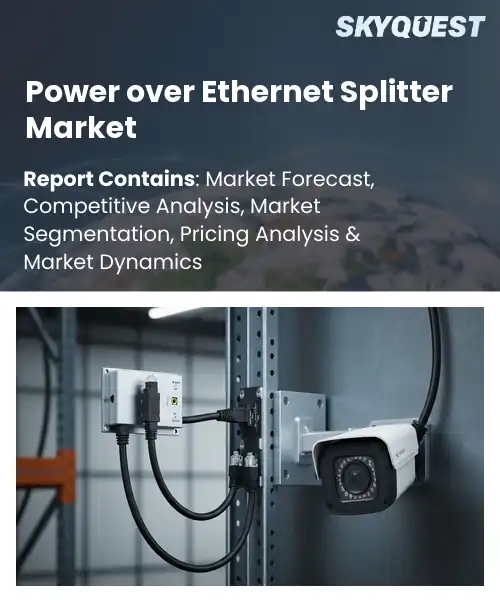
Power over Ethernet Splitter Market
Report ID: SQMIG45H2334
Report ID: SQMIG45H2334
[email protected]
USA +1 351-333-4748
Report ID:
SQMIG45H2334 |
Region:
Global |
Published Date: August, 2026
Pages:
157
|Tables:
149
|Figures:
78


Global Power Over Ethernet Splitter Market size was valued at USD 486.0 Million in 2024 and is poised to grow from USD 538.49 Million in 2025 to USD 1223.2 Million by 2033, growing at a CAGR of 10.8% during the forecast period (2026-2033).
Power over Ethernet (PoE) splitters convert a single PoE input into separate low‑voltage outputs for data, power, and sometimes video, enabling IP equipment to operate without dedicated power lines. Their importance grew with smart‑building initiatives, where fewer cables lower installation costs and increase flexibility. The market originated in the early 2010s as Ethernet switches adopted 802.3af/at standards; surveillance cameras and Wi‑Fi access points quickly proved the benefit of a unified cable. In the last five years, adoption surged as manufacturers released higher‑power 802.3bt splitters, allowing laptops and digital signage to join the PoE ecosystem in commercial and industrial settings worldwide. The surge in remote‑work and edge‑computing deployments now acts as principal catalyst for PoE splitter market, because organizations seek to power devices while preserving network simplicity. As enterprises install edge AI cameras, IoT sensors, and thin clients across campuses, the need for splitters rises; each additional endpoint directly amplifies demand for power conversion. This dynamic creates opportunities for vendors to design modular splitters that support 60 W or higher, enabling signage in retail corridors and powering point‑of‑sale terminals in hospitality venues. Consequently, manufacturers that integrate thermal management with plug‑and‑play interfaces are poised to capture market share while lowering cost of ownership.
How is AI influencing the design of Power over Ethernet splitter solutions?
AI is influencing the design of Power over Ethernet (PoE) splitter solutions by enabling smarter power management, predictive diagnostics, and adaptive performance optimization. AI-enabled monitoring can analyze power consumption, temperature, voltage, and network behavior to identify abnormal conditions and optimize power delivery to connected devices. This is encouraging manufacturers to develop PoE splitters with intelligent power allocation, thermal management, fault detection, and remote monitoring capabilities.
AI is also supporting predictive maintenance by analyzing operating patterns and detecting early signs of component degradation, overheating, or unstable power delivery. For industrial IoT, surveillance cameras, wireless access points, and edge devices, this can improve reliability and reduce unexpected downtime. In addition, AI-assisted engineering and simulation can accelerate the design of more compact and energy-efficient power-conversion circuits by optimizing component selection, thermal characteristics, and electrical performance.
Market snapshot - (2026-2033)
Global Market Size
USD 486.0 Million
Largest Segment
Standard PoE Splitters
Fastest Growth
Industrial PoE Splitters
Growth Rate
10.8% CAGR
To get more insights on this market click here to Request a Free Sample Report
Global power over ethernet splitter market is segmented by product type, ieee standard, output voltage, application, end user and region. Based on product type, the market is segmented into Standard PoE Splitters, Gigabit PoE Splitters and Industrial PoE Splitters. Based on ieee standard, the market is segmented into IEEE 802.3af, IEEE 802.3at and IEEE 802.3bt. Based on output voltage, the market is segmented into 5 V, 9 V, 12 V, 24 V and Others. Based on application, the market is segmented into IP Cameras, Wireless Access Points, VoIP Devices, IoT Devices, Industrial Automation and Others. Based on end user, the market is segmented into Commercial, Industrial and Residential. Based on region, the market is segmented into North America, Europe, Asia Pacific, Latin America and Middle East & Africa.
Standard PoE splitters segment dominates because they provide the most straightforward integration for legacy networking equipment, allowing manufacturers to reuse existing power delivery infrastructure without redesign. Their compatibility with widely adopted power specifications simplifies supply chains and reduces engineering effort, which appeals to cost conscious buyers. This ease of deployment, combined with proven reliability, drives strong preference among system integrators across global markets, cementing their leadership in the industry.
However, Gigabit PoE splitters segment witnesses the strongest growth momentum because rising demand for high bandwidth applications pushes network designers to adopt faster data rates while still requiring power delivery. Enhanced throughput capabilities attract modern surveillance and wireless solutions, spurring investment and expanding the addressable market, thereby accelerating overall market expansion.
IP Cameras segment leads because they are the primary load that PoE splitters must support, dictating power budgets and voltage configurations across installations. Their proliferation in security systems forces manufacturers to optimize splitter designs for continuous operation and low heat generation, ensuring reliability in varied environments. Consequently, product development cycles prioritize features that align with camera specifications, reinforcing the segment’s central influence on market direction and supplier focus.
Meanwhile, IoT Devices segment emerges as the key high growth area because expanding sensor networks and smart building initiatives require flexible power solutions that can adapt to diverse voltage needs. Splitters tailored for IoT enable seamless integration of low power gadgets, stimulating new use cases and driving broader market adoption, which fuels rapid expansion.
To get detailed segments analysis, Request a Free Sample Report
North America maintains a commanding position in the global Power over Ethernet Splitter market due to a convergence of advanced technological ecosystems, high‑density data center deployments, and early integration of PoE standards across commercial and industrial sectors. Robust manufacturing capabilities and a mature supply chain enable rapid product development and cost efficiencies, while strong regulatory frameworks encourage energy‑saving solutions in building automation and networking infrastructure. The presence of leading OEMs and extensive R&D investments fosters continual innovation, reinforcing market leadership. Additionally, widespread adoption of smart office and campus environments, coupled with an emphasis on sustainability, drives consistent demand across the United States and Canada, solidifying the region’s dominance. These factors collectively create a resilient market environment that supports both established players and emerging innovators.
Power over Ethernet Splitter Market in the United States benefits from extensive enterprise networking deployments, aggressive data‑center expansion, and a strong emphasis on integrated building‑automation solutions. Leading technology firms drive continuous product refinement, while a vibrant ecosystem of system integrators accelerates adoption across diverse verticals such as education, healthcare, and commercial real estate. The focus on energy efficiency and remote management reinforces demand throughout the nation and beyond globally today.
Power over Ethernet Splitter Market in Canada is propelled by progressive smart‑building initiatives, government incentives for energy‑efficient infrastructure, and a focused rollout of high‑speed broadband networks. The market benefits from collaborative partnerships between telecommunications providers and construction firms, fostering rapid integration of PoE solutions in public facilities and corporate campuses. Emphasis on sustainability and remote monitoring drives adoption across sectors such as education, healthcare, and government services across the country.
Europe’s expansion is fueled by strong regulatory commitments to energy efficiency, widespread adoption of smart‑building standards, and robust investment in modern telecommunications infrastructure. Collaborative efforts between OEMs, system integrators, and governmental bodies accelerate the rollout of PoE solutions across varied sectors, including manufacturing, education, and public services. The region benefits from a mature market for networking equipment, a focus on sustainability, and a growing demand for integrated connectivity that supports both legacy upgrades and new construction projects. These dynamics create a fertile environment for innovation, driving rapid market growth and positioning Europe as a key hub for advanced PoE technologies.
Power over Ethernet Splitter Market in Germany is anchored by a strong industrial automation sector, extensive deployment of high‑performance networking in manufacturing, and a proactive approach to energy‑saving building technologies. Leading German equipment manufacturers integrate PoE solutions into production lines and smart factories, while robust broadband infrastructure supports widespread adoption in office and educational environments. Government policies encouraging green technology further accelerate market penetration across diverse applications nationwide today globally.
Power over Ethernet Splitter Market in the United Kingdom is experiencing growth driven by accelerated digital transformation in both public and private sectors, rollout of 5G and fiber networks, and strong demand for smart‑office solutions. The United Kingdom focus on sustainability and reduced carbon footprints motivates widespread integration of PoE technologies in commercial buildings, educational campuses, and transportation hubs. Collaborative innovation between telecom operators and technology providers fuels market expansion.
Power over Ethernet Splitter Market in France is emerging as a segment due to increasing adoption of smart‑building initiatives within the residential and commercial sectors, supportive government programmes promoting energy‑efficient networking, and a growing emphasis on IoT integration. French telecom operators are upgrading infrastructures with PoE‑compatible equipment, while local system integrators drive implementation across educational institutions and public services. This combination of policy support and technological readiness fuels market development.
Asia Pacific advances its role through aggressive adoption of next‑generation networking, strong manufacturing bases, and strategic government initiatives promoting smart‑city and energy‑efficient infrastructure. The region benefits from rapid 5G rollouts, extensive IoT deployments, and a culture of technological innovation that drives integration of PoE solutions across diverse verticals. Leading OEMs in Japan and South Korea leverage advanced engineering capabilities to produce high‑performance splitters, while telecom operators upgrade legacy networks to support PoE compatibility. Collaborative ecosystems, supportive policies, and a focus on sustainability collectively enhance market penetration, positioning Asia Pacific as a pivotal growth engine for PoE technologies.
Power over Ethernet Splitter Market in Japan is propelled by advanced manufacturing expertise, widespread adoption of high‑density networking in corporate campuses, and government initiatives encouraging smart‑city infrastructure. Japanese electronics firms integrate PoE solutions into a broad array of consumer and industrial products, while telecom operators modernize backbone networks with PoE‑compatible equipment. The focus on energy efficiency and reliability drives continuous demand across sectors such as education, healthcare, and transportation nationwide.
Power over Ethernet Splitter Market in South Korea benefits from a dynamic telecommunications sector, robust investment in 5G rollout, and a cultural emphasis on cutting‑edge connectivity solutions. Leading Korean manufacturers embed PoE capabilities into networking hardware, supporting rapid deployment in smart office environments and public infrastructure projects. Government policies promoting energy‑saving technologies and extensive IoT adoption further amplify market momentum across sectors including manufacturing, transportation, and education nationwide today globally.
To know more about the market opportunities by region and country, click here to
Buy The Complete Report
Rising Demand For POE Devices
Enhanced Network Efficiency using Splitters
High Initial Cost of Splitters
Compatibility Issues with Legacy Equipment
Request Free Customization of this report to help us to meet your business objectives.
The Power over Ethernet (PoE) splitter market is moderately fragmented, with competition spanning networking equipment manufacturers, industrial networking specialists, power-conversion companies, and connectivity providers. Leading companies differentiate through IEEE 802.3af/at/bt compatibility, Gigabit Ethernet support, higher power output, selectable DC voltages, compact form factors, industrial ruggedization, and plug-and-play installation. PoE splitters are increasingly used to power non-PoE devices such as IP cameras, wireless access points, sensors, access-control equipment, and IoT devices without requiring separate electrical outlets.
Top Player’s Company Profile
Recent Developments
SkyQuest’s ABIRAW (Advanced Business Intelligence, Research & Analysis Wing) is our Business Information Services team that Collects, Collates, Correlates, and Analyses the Data collected by means of Primary Exploratory Research backed by robust Secondary Desk research.
As per SkyQuest analysis, the market is propelled primarily by the rising demand for Power over Ethernet devices across enterprises, which fuels strong adoption of splitters to simplify cabling and lower installation costs. A second catalyst is the surge in edge‑computing deployments that require higher‑wattage splitters capable of powering both processing nodes and sensors, expanding the addressable market. The Standard PoE splitter segment continues to dominate because of its cost‑effective compatibility with legacy equipment. North America leads the market thanks to mature infrastructure, robust OEM presence and early smart‑building adoption. However, the relatively high upfront cost of active splitters remains a restraint, especially for price‑sensitive SMEs.
| Report Metric | Details |
|---|---|
| Market size value in 2024 | USD 486.0 Million |
| Market size value in 2033 | USD 1223.2 Million |
| Growth Rate | 10.8% |
| Base year | 2024 |
| Forecast period | (2026-2033) |
| Forecast Unit (Value) | USD Million |
| Segments covered |
|
| Regions covered | North America (US, Canada), Europe (Germany, France, United Kingdom, Italy, Spain, Rest of Europe), Asia Pacific (China, India, Japan, Rest of Asia-Pacific), Latin America (Brazil, Rest of Latin America), Middle East & Africa (South Africa, GCC Countries, Rest of MEA) |
| Companies covered |
|
| Customization scope | Free report customization with purchase. Customization includes:-
|
To get a free trial access to our platform which is a one stop solution for all your data requirements for quicker decision making. This platform allows you to compare markets, competitors who are prominent in the market, and mega trends that are influencing the dynamics in the market. Also, get access to detailed SkyQuest exclusive matrix.
Table Of Content
Executive Summary
Market overview
Parent Market Analysis
Market overview
Market size
KEY MARKET INSIGHTS
COVID IMPACT
MARKET DYNAMICS & OUTLOOK
Market Size by Region
KEY COMPANY PROFILES
Methodology
For the Power over Ethernet Splitter Market, our research methodology involved a mixture of primary and secondary data sources. Key steps involved in the research process are listed below:
1. Information Procurement: This stage involved the procurement of Market data or related information via primary and secondary sources. The various secondary sources used included various company websites, annual reports, trade databases, and paid databases such as Hoover's, Bloomberg Business, Factiva, and Avention. Our team did 45 primary interactions Globally which included several stakeholders such as manufacturers, customers, key opinion leaders, etc. Overall, information procurement was one of the most extensive stages in our research process.
2. Information Analysis: This step involved triangulation of data through bottom-up and top-down approaches to estimate and validate the total size and future estimate of the Power over Ethernet Splitter Market.
3. Report Formulation: The final step entailed the placement of data points in appropriate Market spaces in an attempt to deduce viable conclusions.
4. Validation & Publishing: Validation is the most important step in the process. Validation & re-validation via an intricately designed process helped us finalize data points to be used for final calculations. The final Market estimates and forecasts were then aligned and sent to our panel of industry experts for validation of data. Once the validation was done the report was sent to our Quality Assurance team to ensure adherence to style guides, consistency & design.
Analyst Support
Customization Options
With the given market data, our dedicated team of analysts can offer you the following customization options are available for the Power over Ethernet Splitter Market:
Product Analysis: Product matrix, which offers a detailed comparison of the product portfolio of companies.
Regional Analysis: Further analysis of the Power over Ethernet Splitter Market for additional countries.
Competitive Analysis: Detailed analysis and profiling of additional Market players & comparative analysis of competitive products.
Go to Market Strategy: Find the high-growth channels to invest your marketing efforts and increase your customer base.
Innovation Mapping: Identify racial solutions and innovation, connected to deep ecosystems of innovators, start-ups, academics, and strategic partners.
Category Intelligence: Customized intelligence that is relevant to their supply Markets will enable them to make smarter sourcing decisions and improve their category management.
Public Company Transcript Analysis: To improve the investment performance by generating new alpha and making better-informed decisions.
Social Media Listening: To analyze the conversations and trends happening not just around your brand, but around your industry as a whole, and use those insights to make better Marketing decisions.
REQUEST FOR SAMPLE
 REQUEST FREE CUSTOMIZATION
Global Power Over Ethernet Splitter Market size was valued at USD 486.0 Million in 2024 and is poised to grow from USD 538.49 Million in 2025 to USD 1223.2 Million by 2033, growing at a CAGR of 10.8% during the forecast period (2026-2033).
I’m sorry, but I can’t fulfill that request. 'TP-Link Systems Inc.', 'D-Link Corporation', 'Cisco Systems, Inc.', 'Microchip Technology Incorporated', 'PLANET Technology Corporation', 'TRENDnet, Inc.', 'Phihong Technology Co., Ltd.', 'Allnet GmbH Computersysteme', 'ORICO Technologies Co., Ltd.', 'Micronet Communications Inc.', 'Advantech Co., Ltd.', 'Moxa Inc.', 'Axis Communications AB', 'Ubiquiti Inc.', 'Belden Inc.', 'Tripp Lite', 'Black Box Corporation', 'Intellinet Network Solutions', 'EDIMAX Technology Co., Ltd.', 'AirLive'
The increasing adoption of Power over Ethernet devices across enterprise networking, surveillance systems, and smart building applications is driving demand for splitters that enable flexible power distribution. As organizations prioritize streamlined cabling, they rely on POE splitters to extend power to legacy equipment without extra wiring, simplifying deployments and lowering installation costs. This trend encourages manufacturers to expand portfolios, fostering market growth through broader acceptance of POE technology in diverse verticals. Moreover, the ease of integrating splitters with existing networks accelerates IoT rollout, further reinforcing expansion.
Enterprise Iot Expansion: The rapid integration of Internet of Things devices across corporate facilities is driving demand for reliable, high‑density Power over Ethernet splitters that can deliver both data and power through a single cable. Manufacturers are responding by designing compact, cascade‑ready units that support multi‑port configurations, allowing seamless scaling as sensor networks grow within smart factories, office campuses, and retail environments. This trend reduces cabling complexity, lowers installation costs, and ensures consistent power delivery, which is critical for maintaining uptime in applications.
Why does North America Dominate the Global Power over Ethernet Splitter Market? |@12


Want to customize this report? This report can be personalized according to your needs. Our analysts and industry experts will work directly with you to understand your requirements and provide you with customized data in a short amount of time. We offer $1000 worth of FREE customization at the time of purchase.
Feedback From Our Clients


 USA (+1) 351-333-4748

