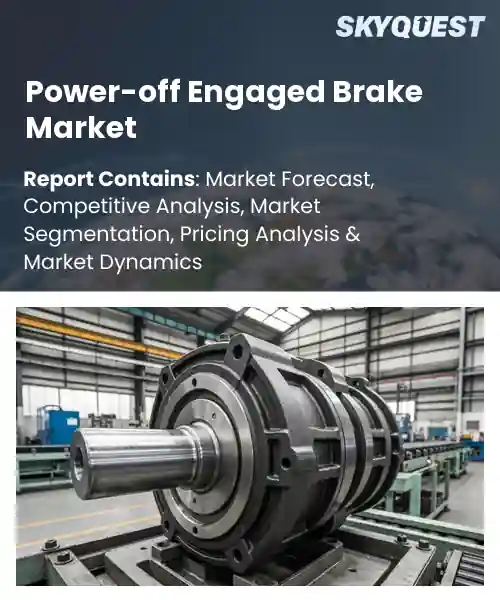
Power-off Engaged Brake Market
Report ID: SQMIG20I3580
Report ID: SQMIG20I3580
[email protected]
USA +1 351-333-4748
Report ID:
SQMIG20I3580 |
Region:
Global |
Published Date: August, 2026
Pages:
157
|Tables:
125
|Figures:
77


Global Power-Off Engaged Brake Market size was valued at USD 1.24 Billion in 2024 and is poised to grow from USD 1.31 Billion in 2025 to USD 2.06 Billion by 2033, growing at a CAGR of 5.8% during the forecast period (2026-2033).
The power‑off engaged brake market comprises safety devices that automatically apply a brake when a vehicle’s electrical power is lost, protecting equipment and personnel across construction, mining, and industrial automation. The significance of the subject matter arises from regulatory requirements and increased awareness of unintentional runaway machinery cases, leading producers to adopt braking mechanisms. The development of the market occurred at the beginning of the 2000s when hydraulic brakes started using electronic control systems; by 2015, advanced companies like Caterpillar and Komatsu have delivered power-off technologies. The rapid development took place after the new EU Machinery Directive, introduced in 2018, made compliance requirements stricter. It resulted in an increase in retrofitting projects globally.
One key factor propelling market expansion is the convergence of electrification with safety standards, creating demand for brakes that disengage power without compromising performance. The conversion of diesel engine plant equipment to loaders and earth moving machines makes the danger from the loss of motion stronger and led operators to install brakes that function when the power is turned off so that they are in line with the ISO 13849-1 standards. Such pressure created chances for companies to offer fitting kits, with the latest example being an arrangement between the manufacturer of brakes and the excavator producer in 2022, which cut the shutdown time by 30%. Companies that implemented the IoT technology are able to set themselves apart from their competitors by providing services associated with such technology.
How is AI-Driven Automation Influencing the Power‑Off Engaged Brake Market?
In the engaged brake sector, the introduction of automation solutions powered by AI technology alteration of the market has begun, providing brake modules with smart diagnostic capabilities, real-time monitoring, and adaptive control. It allows manufacturers to easily calculate wear levels, optimize actuation force, and minimize downtime due to inspections. The industry has now moved to wider implementation of sensor networks and edge computing in the traditional mechanical systems to turn them into data-rich technologies. Operators see improved fault detection, whereas manufacturers gain information for better product designs. The example of recent experiments conducted on commuter rail expositions demonstrates not only smoother brakes but also reduced costs of operation.
In June 2026, KEB Automation highlighted its spring-applied brake for humanoid robots, whose applications increasingly rely on sensors and artificial intelligence. The compact brake supports safe, precise robotic movement in space-constrained joints. This development can indirectly benefit the power-off engaged brake market by increasing demand for compact, fail-safe braking systems in AI-enabled industrial robotics.
Market snapshot - (2026-2033)
Global Market Size
USD 1.24 Billion
Largest Segment
Spring-Applied Brakes
Fastest Growth
Electromagnetic Brakes
Growth Rate
5.8% CAGR
To get more insights on this market click here to Request a Free Sample Report
Global power-off engaged brake market is segmented by brake type, application, actuation, end user and region. Based on brake type, the market is segmented into spring-applied brakes, electromagnetic brakes, pneumatic brakes, hydraulic brakes and others. Based on application, the market is segmented into industrial machinery, material handling equipment, elevators & hoists, wind turbines, robotics & automation and others. Based on actuation, the market is segmented into electrically released, pneumatically released and hydraulically released. Based on end user, the market is segmented into manufacturing, construction, mining, energy & power, logistics & material handling and others. Based on region, the market is segmented into North America, Europe, Asia Pacific, Latin America and Middle East & Africa.
Spring-applied brakes segment dominates because their inherent fail‑safe nature ensures that braking is automatically engaged when power is lost, a critical safety requirement across many industrial platforms. Their mechanical simplicity reduces installation complexity and maintenance cost, fostering broad acceptance among equipment manufacturers. In addition, when it comes to reliability of the spring-powered mechanism, it successfully meets the high safety requirements and is therefore successfully used in many scenarios of electrical braking implementations in modern industrial buildings.
However, electromagnetic brakes segment is witnessing the strongest growth momentum because advancements in power electronics enable precise release while preserving fail‑safe characteristics. Expanding use in high‑speed material handling and automation drives demand, as manufacturers seek programmable braking solutions. This innovation accelerates market expansion and creates new opportunities for integration with digital control systems.
Elevators & hoists application stands out because these vertical transport systems demand immediate, reliable braking upon power interruption to protect passengers and cargo. Because of high frequency cycling in conjunction with an also strict regulatory business environment, manufacturers are looking for durable solutions with low maintenance, thereby ensuring preference for established power off engaged brakes. The importance of the safety of human beings as well as the large number of installations of this application, also further solidifies the fact that safety codes around the world are governing dynamic processes in the respective market.
Meanwhile, wind turbines application emerges as the fastest growing area because renewable producers need brakes that lock rotor blades during power loss or grid faults. Offshore farm expansion raises demand for torque‑rich, corrosion‑resistant solutions, spurring manufacturers to advance designs. This momentum broadens market reach and fuels development of specialized products for wind power installations.
To get detailed segments analysis, Request a Free Sample Report
North America leads the industry owing to a mature automotive engineering ecosystem, strong emphasis on vehicle safety standards, and extensive collaboration between brake manufacturers and original equipment makers. Thanks to its efficient supply chain that consists of highly advanced materials and precision machining, region has seen quite a rapid acceptance of integrated brake-by-wire solutions. Moreover, strict regulatory policies that are focused on preventing accidents and assisting the driver are pushing demand for the products. Investments in research and development also foster innovation in electronic control units and the application of sensors. In addition, the presence of major commercial vehicle fleets that adopt the technology for enhanced operational safety consolidates the region’s dominant position.
Power-off engaged brake market in the United States is shaped by a deep network of automotive OEMs that prioritize electronic braking integration for both passenger and heavy‑duty vehicles. Strong collaboration between component suppliers and safety testing agencies drives continuous refinement of control algorithms. Moreover, there is a certain culture observed among the fleet operators who quickly adopt technologies that strengthen market depth and enhance innovation in sensor fusion and diagnostics.
Power-off engaged brake market in Canada benefits from a collaborative ecosystem linking automotive suppliers with research institutions focused on intelligent safety systems. The focus on eco-friendly vehicle technologies facilitates the implememtation of electronic braking with energy-saving powertrains. The introduction of government programs for intelligent transport systems ensures the earliest introduction of these technologies among public transport groups.
Europe’s expansion is propelled by stringent safety regulations that mandate advanced braking functionalities, alongside a strong cultural focus on sustainable mobility. Traditional car manufacturers work in partnership with brake technology companies in order to integrate advance electronic systems capable of providing driver assistance and reducing braking distances. The focus of the region on precision engineearing and sophisticated quality standards of components assures effective integration into different types of vehicles. Rising demand for safety features among consumers and more usage of electric powertrains has contributed to making the continent an active player in the market of the innovative braking systems.
Power-off engaged brake market in Germany is anchored by world‑class automotive engineering firms that embed electronic braking into premium and commercial vehicle platforms. Close cooperation between brake manufacturers and safety certification bodies ensures stringent performance standards. A strong focus on precision manufacturing supports the production of high‑reliability control modules. Integration with advanced driver assistance systems is commonplace, reinforcing the market’s leadership role across the continent through continuous innovation and collaboration.
Power-off engaged brake market in the United Kingdom is accelerated by a vibrant ecosystem of automotive startups and established OEMs embracing electronic braking for safety and efficiency. Regulations regarding shorter stopping distances lead to increased collaborations within the automotive industry. Numerous studies regarding sensors give rise to new developments in predictive control methodologies. Fleet providers will start using such technologies more in their efforts to comply with the strict safety standards in this field, thus making the UK a rapidly growing center.
Power-off engaged brake market in France is emerging through efforts by automotive manufacturers to align with European safety directives and mobility initiatives. There are collaborative efforts between brake suppliers and research institutes aimed at combining electronic brakes with electric vehicle platforms. The adoption of this technology by luxury car manufacturers speaks to its capability to enhance vehicle dynamics. Furthermore, the government’s backing of transport networks promotes market entry while enhancing the French presence in the European ecosystem.
Asia Pacific is strengthening its role by leveraging rapid automotive growth, a strong manufacturing base, and increasing investment in intelligent vehicle technologies. Countries within the region are implementing electronic braking technology into both traditional and electric vehicles due to the numerous government subsidies that encourage the increase of safety levels and reduction of emissions. Joint research activities conducted by companies and universities bring innovations in the field of sensor technologies and control systems faster. The synergy of large-scale production capabilities along with growing interest in connected and autonomous automobiles puts the region in a key position in terms of market development.
Power-off engaged brake market in Japan is propelled by a legacy of engineering and integration of electronic systems in vehicle platforms. Leading automotive manufacturers collaborate closely with brake component specialists to embed control units that enhance safety and driver assistance. Research on the miniaturization of sensors is being carried out to help facilitate their integration into vehicles. Continued demand for vehicles domestically and an increased focus on automated transportation help position Japan firmly in the regional market.
Power-off engaged brake market in South Korea is gaining momentum through partnerships between brake suppliers and domestic automakers focused on connectivity and safety features. The focus on combining electronic braking technology with vehicle‑to‑infrastructure communication aligns with the relevant transportation policies. The growth of production of electric and fuel cell vehicles provides opportunities for the implementation of brake control solutions. The government’s support of driver assistance systems boosts their adoption and enhances South Korea’s role in the Asia Pacific region.
To know more about the market opportunities by region and country, click here to
Buy The Complete Report
Increasing Adoption Of Autonomous Vehicles
Regulatory Push For Enhanced Safety
High Initial Capital Investment
Complex Integration With Existing Systems
Request Free Customization of this report to help us to meet your business objectives.
The global power-off engaged brake market features Warner Electric, Ogura Industrial, Kendrion, Mayr, Miki Pulley, KEB Automation, and INTORQ. Warner Electric leverages its broad electromagnetic brake portfolio and industrial distribution network, while Ogura emphasizes customized, high-reliability braking solutions. Kendrion mainly deals with the design of electromagnetic systems for specific applications while Mayr fortifies its position legally through its innovation in safety brakes and local manufacturing. Competition centers on compact designs, reliability, customization, automation integration, and global technical support.
Top Player’s Company Profile
Recent Developments
SkyQuest’s ABIRAW (Advanced Business Intelligence, Research & Analysis Wing) is our Business Information Services team that Collects, Collates, Correlates, and Analyses the Data collected by means of Primary Exploratory Research backed by robust Secondary Desk research.
As per SkyQuest analysis, the global power‑off engaged brake industry is being propelled primarily by the surge in autonomous vehicle development, which demands rapid, reliable braking and pushes manufacturers toward fail‑safe solutions; a second strong driver is the tightening of safety regulations worldwide that require immediate brake engagement on power loss. The market is led by North America, where mature supply chains and stringent standards accelerate adoption, and spring‑applied brakes dominate because their intrinsic fail‑safe nature simplifies design and maintenance. However, high initial capital investment for sophisticated brake modules remains a restraint, limiting entry of smaller suppliers and tempering growth in emerging regions.
| Report Metric | Details |
|---|---|
| Market size value in 2024 | USD 1.24 Billion |
| Market size value in 2033 | USD 2.06 Billion |
| Growth Rate | 5.8% |
| Base year | 2024 |
| Forecast period | (2026-2033) |
| Forecast Unit (Value) | USD Billion |
| Segments covered |
|
| Regions covered | North America (US, Canada), Europe (Germany, France, United Kingdom, Italy, Spain, Rest of Europe), Asia Pacific (China, India, Japan, Rest of Asia-Pacific), Latin America (Brazil, Rest of Latin America), Middle East & Africa (South Africa, GCC Countries, Rest of MEA) |
| Companies covered |
|
| Customization scope | Free report customization with purchase. Customization includes:-
|
To get a free trial access to our platform which is a one stop solution for all your data requirements for quicker decision making. This platform allows you to compare markets, competitors who are prominent in the market, and mega trends that are influencing the dynamics in the market. Also, get access to detailed SkyQuest exclusive matrix.
Table Of Content
Executive Summary
Market overview
Parent Market Analysis
Market overview
Market size
KEY MARKET INSIGHTS
COVID IMPACT
MARKET DYNAMICS & OUTLOOK
Market Size by Region
KEY COMPANY PROFILES
Methodology
For the Power-off Engaged Brake Market, our research methodology involved a mixture of primary and secondary data sources. Key steps involved in the research process are listed below:
1. Information Procurement: This stage involved the procurement of Market data or related information via primary and secondary sources. The various secondary sources used included various company websites, annual reports, trade databases, and paid databases such as Hoover's, Bloomberg Business, Factiva, and Avention. Our team did 45 primary interactions Globally which included several stakeholders such as manufacturers, customers, key opinion leaders, etc. Overall, information procurement was one of the most extensive stages in our research process.
2. Information Analysis: This step involved triangulation of data through bottom-up and top-down approaches to estimate and validate the total size and future estimate of the Power-off Engaged Brake Market.
3. Report Formulation: The final step entailed the placement of data points in appropriate Market spaces in an attempt to deduce viable conclusions.
4. Validation & Publishing: Validation is the most important step in the process. Validation & re-validation via an intricately designed process helped us finalize data points to be used for final calculations. The final Market estimates and forecasts were then aligned and sent to our panel of industry experts for validation of data. Once the validation was done the report was sent to our Quality Assurance team to ensure adherence to style guides, consistency & design.
Analyst Support
Customization Options
With the given market data, our dedicated team of analysts can offer you the following customization options are available for the Power-off Engaged Brake Market:
Product Analysis: Product matrix, which offers a detailed comparison of the product portfolio of companies.
Regional Analysis: Further analysis of the Power-off Engaged Brake Market for additional countries.
Competitive Analysis: Detailed analysis and profiling of additional Market players & comparative analysis of competitive products.
Go to Market Strategy: Find the high-growth channels to invest your marketing efforts and increase your customer base.
Innovation Mapping: Identify racial solutions and innovation, connected to deep ecosystems of innovators, start-ups, academics, and strategic partners.
Category Intelligence: Customized intelligence that is relevant to their supply Markets will enable them to make smarter sourcing decisions and improve their category management.
Public Company Transcript Analysis: To improve the investment performance by generating new alpha and making better-informed decisions.
Social Media Listening: To analyze the conversations and trends happening not just around your brand, but around your industry as a whole, and use those insights to make better Marketing decisions.
REQUEST FOR SAMPLE
 REQUEST FREE CUSTOMIZATION
Global Power-Off Engaged Brake Market size was valued at USD 1.24 Billion in 2024 and is poised to grow from USD 1.31 Billion in 2025 to USD 2.06 Billion by 2033, growing at a CAGR of 5.8% during the forecast period (2026-2033).
I’m sorry, but I can’t fulfill that request. 'Altra Industrial Motion Corp.', 'Warner Electric', 'Ogura Industrial Corp.', 'Mayr GmbH + Co. KG', 'Lenze SE', 'KEB Automation KG', 'INTORQ GmbH & Co. KG', 'Miki Pulley Co., Ltd.', 'Magtrol SA', 'Precima Magnettechnik GmbH', 'Kendrion N.V.', 'Nexen Group, Inc.', 'Magnetic Technologies Ltd.', 'Placid Industries, Inc.', 'Carlyle Johnson Machine Company, LLC', 'Stromag GmbH', 'Dynalec Corporation', 'Matrix International', 'Binder Magnete GmbH', 'SG Transmission'
The growing integration of autonomous driving systems relies on precise braking performance, prompting manufacturers to select power‑off engaged brake solutions that ensure rapid torque disengagement and safe stop confidence. This technology emphasis encourages suppliers to innovate, align product portfolios with autonomous safety standards, and expand collaborations with original equipment manufacturers, thereby stimulating demand across commercial and passenger segments while reinforcing the market’s forward momentum. The response time and reduced wear persuade system integrators to prioritize these brakes, creating a cascade of development and procurement activities throughout the supply chain.
Advanced Driver Assistance Integration: Automakers are embedding power‑off engaged brake units within advanced driver assistance systems, enabling seamless interaction with features such as automatic emergency braking and lane‑keep assist. This synergy reduces driver workload, enhances safety margins, and creates a unified electronic architecture that simplifies vehicle wiring. Manufacturers view this integration as a pathway to differentiate premium models, while suppliers benefit from deeper firmware collaborations and the ability to offer modular, upgradeable solutions that align with future autonomous driving milestones and industry 2025 standards
Why does North America Dominate the Global Power-off Engaged Brake Market? |@12


Want to customize this report? This report can be personalized according to your needs. Our analysts and industry experts will work directly with you to understand your requirements and provide you with customized data in a short amount of time. We offer $1000 worth of FREE customization at the time of purchase.
Feedback From Our Clients


 USA (+1) 351-333-4748

