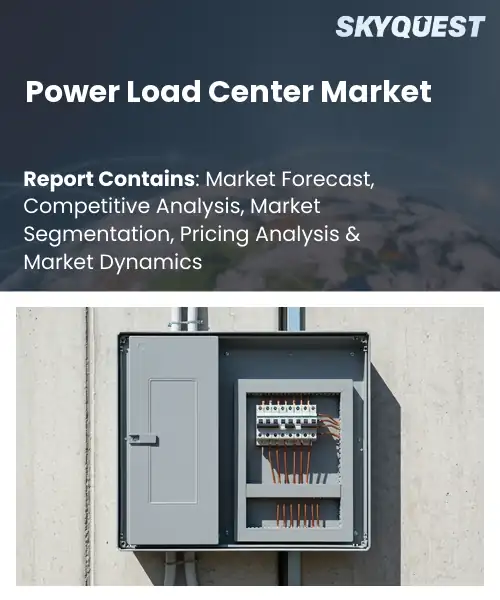
Power Load Center Market
Report ID: SQMIG20D2521
Report ID: SQMIG20D2521
[email protected]
USA +1 351-333-4748
Report ID:
SQMIG20D2521 |
Region:
Global |
Published Date: February, 2026
Pages:
157
|Tables:
147
|Figures:
78


Global Power Load Center Market size was valued at USD 2.8 Billion in 2024 and is poised to grow from USD 3.02 Billion in 2025 to USD 5.6 Billion by 2033, growing at a CAGR of 8.0% during the forecast period (2026-2033).
Growing electrification across residential and commercial infrastructures, rising EV adoption, increasing distributed energy generation, and stricter electrical safety regulations are driving sales of power load centers.
Growing demand for reliable power distribution systems coupled with the shift toward smart and energy-efficient buildings are slated to bolster the global power load center market growth through 2033. The increasing rates of urbanization, modernization of infrastructure, and stringent safety standards are all contributing to the replacement of conventional breaker panels with modular, communication-enabled breaker panels. The progress from conventional breaker panels to modular and combination meter/main units can be attributed to the advancement of technology and the focus on energy efficiency and grid resilience. Furthermore, the incentives for retrofitting and the integration of digital monitoring solutions are driving the industry to offer bundled solutions for the installation of new and existing buildings, thereby reducing peak demand charges.
On the contrary, high initial installation and upgrade costs, lack of standardization across regions, technical integration complexities with legacy electrical systems, and concerns regarding cybersecurity risks in smart load centers are forecasted to slow down power load center market penetration over the coming years.
How is IoT Enables Real-time Monitoring for Power Load Centers?IoT is enabling real-time monitoring in power load centers by combining distributed sensors, constant connectivity, edge computing, and cloud analytics. Continuous data from breakers and bus connections allows for better alerts and easy integration with distributed energy resources. Through the interconnection of various data sources at the device level, these systems are able to offer more proactive operations, greater system resiliency, as well as enhanced customer service. The use of smarter panels that offer a wide range of services such as remote diagnostics, predictive maintenance, as well as coordinated load management is expected to be quite popular among consumers.
Market snapshot - 2026-2033
Global Market Size
USD 2.8 Billion
Largest Segment
Standard Load Centers
Fastest Growth
Smart Load Centers
Growth Rate
8.0% CAGR
To get more insights on this market click here to Request a Free Sample Report
Global power load center market is segmented by product type, material type, voltage rating, application, end-user industry, and region. Based on product type, the market is segmented into indoor power load centers, outdoor power load centers, smart load centers, and standard load centers. Based on voltage rating, the market is segmented into low voltage load centers, medium voltage load centers, and high voltage load centers. Based on material type, the market is segmented into metal load centers, plastic load centers, and composite load centers. Based on application, the market is segmented into residential applications, commercial applications, industrial applications, and utility applications. Based on end-user industry, the market is segmented into residential sector, commercial sector, manufacturing sector, and transportation sector. Based on region, the market is segmented into North America, Europe, Asia Pacific, Latin America, and Middle East & Africa.
The smart load centers segment is slated to spearhead the global power load center market revenue generation in the long run. The dominance of this segment is attributed to the fact that they have the capabilities for monitoring, control, and communication, which have all been integrated into a single platform. The capabilities ensure that there is a reduction in downtime and that there is optimal consumption, which translates into cost savings. The focus that has been put on the need for grid modernization and the inclusion of distributed energy resources also contributes to the dominance, as smart centers help with the integration and maintenance.
However, standard load centers are experiencing a robust growth in demand as per this power load center industry analysis. Availability of proven designs and lower procurement cost are helping create new business scope in the long run. Retrofit activity and contractor familiarity speed installations, while compatibility with legacy breakers and streamlined approvals unlock steady demand in cost sensitive projects and near term market opportunities.
The metal load centers segment is estimated to account for the highest global power load center market share going forward. Rugged construction and superior heat dissipation capabilities of these type of power load centers is helping them hold sway over others. Metal’s robustness supports heavy duty enclosures, easier grounding and proven fire resistance, making metal centers the preferred choice for industrial and utility applications. Emphasis on adherence to strict guidelines, along with the provision for standard mounting and customization, also adds to the appeal, as engineers prefer products that offer a known lifespan with consistent exposure to operational conditions.
On the other hand, composite load centers are seeing the highest growth rate, owing to improvements in polymer science that provide resistance to corrosion and lower weight. In addition, the growing need for lighter, non-conductive enclosures for transportation and coastal environments, along with manufacturing improvements, ensures that this product type has the highest potential for creating new markets.
To get detailed segments analysis, Request a Free Sample Report
Asia Pacific leads the global power load center market through a combination of expansive infrastructure development, concentrated manufacturing capability, and proactive technology adoption. Regional momentum is driven by strong industrial and commercial electrification needs, aggressive deployment of renewable generation and storage, and the emergence of smart grid and building automation initiatives that increase demand for advanced distribution solutions. The local supply chain supports cost-effective production and aftermarket servicing, while the regulatory systems and standards enable safe and efficient upgrade routes. The operational needs of multinational corporations and regional companies drive innovation development. High levels of investment in research and development, engineering talent pools, and close cooperation between the utility industry and manufacturers facilitate product customization and commercialization. Exports offer economies of scale, and robust servicing networks create value to the end user, particularly in urban projects. The end markets, which range from heavy industry to high growth urban residential, offer continuous demand.
Surge in demand for compact, high quality distribution equipment tailored to dense urban and industrial environments is shaping procurement of power load centers in Japan. Preference for power load centers built using precision engineering and having long-term service agreements is high in the country. Sales of modular power load centers that are customizable are expected to be driven by retrofit activity, energy efficiency programs, and collaborations between utilities and manufacturers.
Presence of advanced electronics manufacturing, smart factory systems, and grid modernization initiatives are shaping power load center adoption in South Korea. Industrial facilities and commercial enterprises require consistent demand for distribution systems with connectivity features due to the high after-sales services and market presence. Local suppliers provide compact systems with digital monitoring features and customization capabilities for high-tech projects in industrial and urban environments.
Launch of new efforts to modernize aging grid infrastructure and emphasis on improving resilience and efficiency of energy grids are driving consistent power load center demand in this region. Smart building and grid technologies are increasingly being used to facilitate the distribution and monitoring of loads. Emphasis on interoperability, standards compliance, and support from suppliers for the lifecycle helps to solidify the region’s position. Stakeholders seek solutions to minimize downtime and enable flexible integration of renewables and storage. Utilities, equipment manufacturers, and technology vendors work closely together to innovate quickly. Increasing demand for aftermarket services and digital monitoring supports long-term adoption. Project completion and alignment with evolving reliability standardsM are expedited by modularity and scalability.
Majority of power load center demand in the United States is led by utilities, data center operators, and commercial projects. Power load center companies are heavily investing in R&D to improve modularity, flexibility, and monitoring capabilities of their offerings. Aftermarket services, retrofit programs, and partnerships between manufacturers and system integrators are expected to be highly essential for companies looking ot make a mark in the United States going forward.
Rising investments in utility grid modernization and growing mining operations are supporting power load center demand in Canada. Demand for power load centers with weather-resistant enclosures is high among end users in the country due to its extreme cold climate. Incentivized upgrade strategies and service capabilities drive the retrofit business. Joint efforts by manufacturers and utilities help to create solutions that meet the needs of the regions.
Regulatory emphasis on promoting energy efficiency and launch of new energy transition initiatives is forecasted to boost the demand for advanced power load centers in Europe. Digital transformation initiatives, including grid edge monitoring and predictive maintenance, will help operators optimize load distribution and reduce equipment downtime. An increase in renewable integration, storage deployment, and smart building initiatives across European countries is also boosting the sales of power load centers. Growing collaborative efforts of suppliers and their customers leads to new materials and compact architecture adoption and, suppliers' focus on lifecycle service supporting border deployment of existing solutions will ensure ongoing operational continuity.
High engineering standards, a strong industrial base, and high expectations for energy efficiency are shaping the procurement of power load centers in Germany. power load center companies are heavily investing in precise designs, high-quality construction, and integration with industrial automation systems and renewable energy systems to stand out from the competition. Power load centers designed specifically for industrial applications are expected to be highly popular among end users in the country.
Intensive retrofit activity, urban infrastructure upgrades, and strong demand from data centers are boosting sales of power load centers in the United Kingdom. Adoption of flexible designs, compact designs, and high standards of safety and compatibility is high among power load center companies in the country. Fast delivery, serviceability, and high standards of regulatory compliance are key factors influencing procurement of power load centers in the country going forward.
Preference for energy efficient, adaptable designs that conform to national safety and interoperability standards is high in France. High industrial demand and emphasis on improving grid resilience are shaping power load center adoption. Increase in retrofit activity across commercial and residential sectors is also slated to open up new avenues of business for power load center vendors across France over the coming years.
To know more about the market opportunities by region and country, click here to
Buy The Complete Report
Increasing Renewable Energy Integration
With the trend of integrating renewable sources of energy, there is an increased need to have distributed power management and distribution of loads. The use of load centers allows for flexible interfaces, which can be easily accommodated to handle variable sources of energy. This, in turn, promotes the procurement of intelligent power distribution units, as utilities and suppliers work together to ensure the development of robust configurations that can handle variable sources of power, including solar and wind, to ensure the supply of power to commercial and industrial customers.
Expansion Of Smart Grid Adoption
Surge in deployment of smart grid technology creates high demand for centralized power load management solutions that can accommodate monitoring, control, and protection needs. Power load centers offer an opportunity for aggregating telemetry and control capabilities to respond to varying power loads efficiently. power load center also improve operational efficiency and reduce power outages. As the energy industry continues to evolve towards digitalization, the power load center market outlook is slated to get stronger in the future.
High Initial Capital Requirements
Need for high upfront investments in designing, procurement, and commissioning of advanced power load centers can slow down their sales. The restraint is especially prominent for smaller end users and slow the pace of large-scale implementations. The high level of initial investment necessary for power load centers is an important factor in the purchase decisions made by users. This is because the high level of initial investment necessary for power load centers can lead users to focus on basic configurations.
Regulatory Fragmentation Across Regions
The varied regulatory models and differing safety and certification standards from one place to another pose challenges for manufacturers and system integrators, making it a cumbersome process to implement standardized power load center solutions efficiently. Adhering to multiple standards may force companies to redesign or customize the solutions, making the entire process complicated and deterring companies from achieving economies of scale. This diversity poses operational risks for companies and buyers, making them reluctant to adopt innovative architectures due to the ambiguity of regulatory approvals and subsequent compliance requirements.
Request Free Customization of this report to help us to meet your business objectives.
Competitive landscape in the global power load center market is defined by incumbents using acquisitions and targeted partnerships to add circuit level intelligence while agile entrants pursue modular and mobile distribution solutions. For example Legrand has used acquisitions to broaden smart building portfolios and SPAN has partnered with national labs and utilities to validate grid services making M&A partnerships and product innovation primary competitive levers.
Renewable and Microgrid Integration: Integration of renewable energy sources and local energy storage with main grids is helping boost adoption of power load centers. Vendors emphasize modular designs, adaptable bus architectures, and simplified commissioning to shorten deployment cycles, which bolsters the importance of this power load center market trend in the future. This is creating new service opportunities for the commercial and industrial markets.
Digitalization And Remote Monitoring: Power load centers are integrating advanced sensors, edge computing and cloud connectivity to stay ahead of the competitive curve. Rise in popularity of smart technologies and growing demand for predictive maintenance are also making this a prominent power load center industry trend in the long run. OEMs are now including cybersecurity solutions and offering software subscription models to deliver analytics and firmware updates to customers.
SkyQuest’s ABIRAW (Advanced Business Intelligence, Research & Analysis Wing) is our Business Information Services team that Collects, Collates, Correlates, and Analyses the Data collected by means of Primary Exploratory Research backed by robust Secondary Desk research.
As per SkyQuest analysis, rising electrification across residential, commercial, and industrial infrastructures along with growing adoption of electric vehicles and distributed energy systems are anticipated to drive the demand for power load centers going forward. However, high initial installation and upgrade costs coupled with technical integration complexities with legacy electrical infrastructure are slated to slow down the adoption of advanced power load centers in the future. North America is slated to spearhead the demand for power load centers owing to rapid infrastructure modernization, strict electrical safety codes, and early adoption of smart building technologies. Development of modular, communication-enabled load centers and integration with energy storage systems and demand response platforms are anticipated to be key trends driving the power load center sector going forward.
| Report Metric | Details |
|---|---|
| Market size value in 2024 | USD 2.8 Billion |
| Market size value in 2033 | USD 5.6 Billion |
| Growth Rate | 8.0% |
| Base year | 2024 |
| Forecast period | 2026-2033 |
| Forecast Unit (Value) | USD Billion |
| Segments covered |
|
| Regions covered | North America (US, Canada), Europe (Germany, France, United Kingdom, Italy, Spain, Rest of Europe), Asia Pacific (China, India, Japan, Rest of Asia-Pacific), Latin America (Brazil, Rest of Latin America), Middle East & Africa (South Africa, GCC Countries, Rest of MEA) |
| Companies covered |
|
| Customization scope | Free report customization with purchase. Customization includes:-
|
To get a free trial access to our platform which is a one stop solution for all your data requirements for quicker decision making. This platform allows you to compare markets, competitors who are prominent in the market, and mega trends that are influencing the dynamics in the market. Also, get access to detailed SkyQuest exclusive matrix.
Table Of Content
Executive Summary
Market overview
Parent Market Analysis
Market overview
Market size
KEY MARKET INSIGHTS
COVID IMPACT
MARKET DYNAMICS & OUTLOOK
Market Size by Region
KEY COMPANY PROFILES
Methodology
For the Power Load Center Market, our research methodology involved a mixture of primary and secondary data sources. Key steps involved in the research process are listed below:
1. Information Procurement: This stage involved the procurement of Market data or related information via primary and secondary sources. The various secondary sources used included various company websites, annual reports, trade databases, and paid databases such as Hoover's, Bloomberg Business, Factiva, and Avention. Our team did 45 primary interactions Globally which included several stakeholders such as manufacturers, customers, key opinion leaders, etc. Overall, information procurement was one of the most extensive stages in our research process.
2. Information Analysis: This step involved triangulation of data through bottom-up and top-down approaches to estimate and validate the total size and future estimate of the Power Load Center Market.
3. Report Formulation: The final step entailed the placement of data points in appropriate Market spaces in an attempt to deduce viable conclusions.
4. Validation & Publishing: Validation is the most important step in the process. Validation & re-validation via an intricately designed process helped us finalize data points to be used for final calculations. The final Market estimates and forecasts were then aligned and sent to our panel of industry experts for validation of data. Once the validation was done the report was sent to our Quality Assurance team to ensure adherence to style guides, consistency & design.
Analyst Support
Customization Options
With the given market data, our dedicated team of analysts can offer you the following customization options are available for the Power Load Center Market:
Product Analysis: Product matrix, which offers a detailed comparison of the product portfolio of companies.
Regional Analysis: Further analysis of the Power Load Center Market for additional countries.
Competitive Analysis: Detailed analysis and profiling of additional Market players & comparative analysis of competitive products.
Go to Market Strategy: Find the high-growth channels to invest your marketing efforts and increase your customer base.
Innovation Mapping: Identify racial solutions and innovation, connected to deep ecosystems of innovators, start-ups, academics, and strategic partners.
Category Intelligence: Customized intelligence that is relevant to their supply Markets will enable them to make smarter sourcing decisions and improve their category management.
Public Company Transcript Analysis: To improve the investment performance by generating new alpha and making better-informed decisions.
Social Media Listening: To analyze the conversations and trends happening not just around your brand, but around your industry as a whole, and use those insights to make better Marketing decisions.
REQUEST FOR SAMPLE
 REQUEST FREE CUSTOMIZATION
Global Power Load Center Market size was valued at USD 2.8 Billion in 2024 and is poised to grow from USD 3.02 Billion in 2025 to USD 5.6 Billion by 2033, growing at a CAGR of 8.0% during the forecast period (2026-2033).
Competitive landscape in the global power load center market is defined by incumbents using acquisitions and targeted partnerships to add circuit level intelligence while agile entrants pursue modular and mobile distribution solutions. For example Legrand has used acquisitions to broaden smart building portfolios and SPAN has partnered with national labs and utilities to validate grid services making M&A partnerships and product innovation primary competitive levers. 'Schneider Electric', 'Eaton Corporation', 'Siemens AG', 'ABB Ltd.', 'General Electric', 'Rockwell Automation', 'Mitsubishi Electric', 'Emerson Electric', 'Rittal GmbH & Co. KG', 'Delta Electronics', 'S&C Electric Company', 'Vertiv Holdings', 'Legrand', 'Leviton', 'NSM Energy', 'Panasonic Corporation', 'Crouse-Hinds', 'Powercon', 'WEG Industries', 'NHP Electrical Engineering Products'
Increasing integration of renewable energy sources into power systems creates a stronger requirement for distributed power management and load distribution infrastructure. Load centers offer flexible interfaces that accommodate variable generation profiles and enable smoother supply and demand balancing across sites, supporting broader deployment of solar and wind assets. This drives procurement of intelligent power distribution units and fosters collaboration between utilities and equipment providers, as stakeholders prioritize resilient configurations that can absorb intermittent inputs while maintaining reliable operations for commercial and industrial consumers.
Renewable Microgrid Integration: Power load centers are evolving to integrate distributed renewable sources and local energy storage, enabling reliable islanding and prioritized power for critical operations. Vendors emphasize modular designs, adaptable bus architectures, and simplified commissioning to shorten deployment cycles. This trend positions load centers as central orchestration platforms for customer focused renewable energy strategies, enabling resilient onsite power management and new service models across commercial and industrial applications. Stakeholders collaborate on standardized interfaces and intelligent controls to enhance interoperability and scalability industrywide.
Asia Pacific Dominate the Global Power Load Center Market?


Want to customize this report? This report can be personalized according to your needs. Our analysts and industry experts will work directly with you to understand your requirements and provide you with customized data in a short amount of time. We offer $1000 worth of FREE customization at the time of purchase.
Feedback From Our Clients


 USA (+1) 351-333-4748

