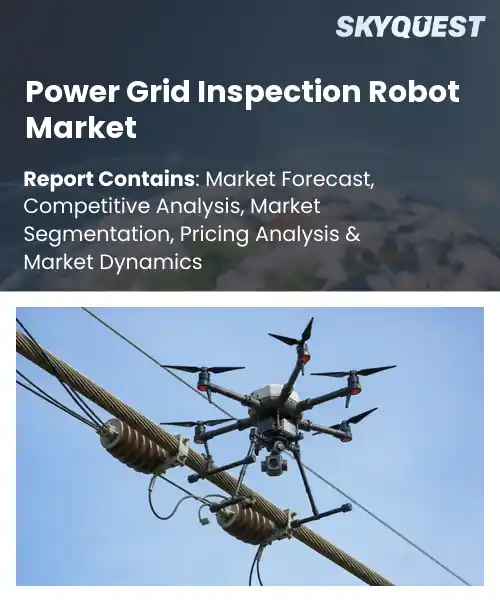
Power Grid Inspection Robot Market
Report ID: SQMIG20E2224
Report ID: SQMIG20E2224
[email protected]
USA +1 351-333-4748
Report ID:
SQMIG20E2224 |
Region:
Global |
Published Date: June, 2026
Pages:
157
|Tables:
174
|Figures:
79


Global Power Grid Inspection Robot Market size was valued at USD 1847.3 Million in 2024 and is poised to grow from USD 2150.26 Million in 2025 to USD 7246.27 Million by 2033, growing at a CAGR of 16.4% during the forecast period (2026-2033).
High investments in power grid modernization, increasing adoption of predictive maintenance, rising deployment of smart grid infrastructure, advancements in robotic inspection technologies, and growing emphasis on grid reliability are driving sales of power grid inspection robots.
Increased need for efficient inspection of aging power transmission and distribution infrastructure, coupled with increasing demand to improve worker safety and reduce maintenance costs, is expected to primarily drive power grid inspection robot market growth. In addition, the escalating adoption of remote operated robotic inspection systems integrated with the use of LiDAR sensors, thermal imaging, high-definition cameras, and AI based defect detection systems are further expected to enable utility companies to detect equipment failures at a much earlier stage of deterioration and reduce chances of unpredicted outages. The rising investments towards smart grids, digital asset management and condition-based maintenance systems are also propelling industry growth. Furthermore, the constant innovations in autonomous navigation systems, edge computing devices, and real time analytics are resulting in improved inspection precision and operational efficiency. Additionally, the ongoing investments toward renewable energy integration and transmission system upgrades are projected to generate new opportunities for the industry to flourish on a global scale.
In contrast, high deployment and maintenance costs, complex integration with existing grid infrastructure, cybersecurity concerns, and limited availability of skilled personnel are anticipated to slow down power grid inspection robot market penetration across the study period.
How are AI and IoT Enhancing Operational Efficiency of Power Grid Inspection Robots?
Artificial Intelligence (AI) is helping to modernize the power grid inspection robot market through improved accuracy, automation and maintenance capabilities. Machine learning systems can quickly analyze high resolution images and sensor data in real time to identify issues like hotspots, corrosion, damaged equipment and other faults without requiring manual inspection. Interconnected Internet of Things (IoT) enabled inspection machines can relay data back to a remote monitoring platform, allowing for predictive maintenance, remote diagnosis and operation, and improved fleet management.
Market snapshot - (2026-2033)
Global Market Size
USD 1847.3 Million
Largest Segment
Fastest Growth
Growth Rate
16.4% CAGR
To get more insights on this market click here to Request a Free Sample Report
Global power grid inspection robot market is segmented by robot type, application, component, end user, inspection technology, deployment type, and region. Based on robot type, the market is segmented into ground inspection robots, climbing inspection robots, aerial inspection robots, and others. Based on application, the market is segmented into transmission line inspection, substation inspection, distribution network inspection, and others. Based on component, the market is segmented into hardware, software, and services. Based on end user, the market is segmented into electric utilities, grid operators, industrial power networks, and others. Based on inspection technology, the market is segmented into visual inspection, thermal inspection, multi-sensor inspection, and others. Based on deployment type, the market is segmented into new deployment and retrofit deployment. Based on region, the market is segmented into North America, Europe, Asia Pacific, Latin America, and Middle East & Africa.
The autonomous mobile robots segment is projected to lead the global power grid inspection robot market revenue generation through 2033. They bring together ground navigation agility with integrated sensor systems, an ability to perform comprehensive line pole and transformer inspections without human input. Their ability to traverse long distances, mixed terrain and reliable power systems cater to the need for reliability from grid operators. Progressive software updates and modular design add to their flexibility making them the first choice for scheduled maintenance and fault detection on high volumes of distribution networks in both system wide and strategic planning.
However, drone‑based robots segment is witnessing the strongest growth momentum as aerial platforms provide fast access to difficult-to-reach transmission lines and substations, decreasing inspection time and crew exposure. The development of lighter weight composite frames and high-resolution visual sensors improve efficiency and increases the demand for the platform, offering opportunities to new service models for predictive maintenance.
The thermal imaging segment is slated to account for the highest global power grid inspection robot market share going forward. It directly uncovers the temperature anomalies in the conductors and equipment; thus the hot spots, overloads, and loose connections can be detected early. The technology is the most reliable monitoring of continuous operation in lowlight conditions and deals with the presently used robot platform, even more indispensable in ongoing reliability monitoring. Operators highly appreciate it's the diagnostic accuracy confirmed by the tests, and the minimized number of unplanned power outages, and its compatible way for regulation compliance throughout the grid ecosystem during daily operations and planning.
Meanwhile, hyperspectral imaging emerges as the key high‑growth subsegment as per this power grid inspection robot industry analysis, as it records spectral profile of dead insulation, rust and vegetation growth providing greater insight into condition assessment than simple temperature monitoring. Its use is becoming broader with enhanced algorithms and breakthroughs in the application of data stored for integrated grid health management. This is attracting more investment and new service offerings.
To get detailed segments analysis, Request a Free Sample Report
Advanced manufacturing capabilities, strong emphasis on smart infrastructure, and supportive governmental policies that encourage automation in energy utilities help cement the dominance of this region. The dense configuration of existing high voltage transmission lines in this region requires safe and efficient inspection methods. Countries with developed research ecosystems have expertise in the robotics and electronics fields. This situation continues to drive innovation. The relationship between utility companies, technology vendors, and academic institutions provides a mechanism to quickly adopt new technologies. Many of these countries have similar objectives regarding the reduction of operational risk and the enhancement of reliability, and their focus on energy security and sustainability strengthens their role as the main source of momentum in this market.
Power Grid Inspection Robot Market in Japan is shaped by a long history of precision engineering and a proactive regulatory environment that promotes digital transformation of utilities. Industry leaders leverage domestic expertise in sensor integration and autonomous navigation to develop solutions tailored for complex grid topologies. Partnerships between power companies and robotics firms encourage rapid field trials, while a strong emphasis on safety standards drives demand for inspection robots that minimize human exposure to high‑voltage environments.
Power grid inspection robot demand in South Korea benefits from robust government incentives that prioritize smart grid development and advanced manufacturing. The heavy focus on high-tech research is leading to the development of innovative designs that use artificial intelligence integrated with robust hardware in harsh transmission corridor environments. Collaboration between the top power utilities and tech startups enhances the development of these products. The emphasis on energy efficiency and reliability is likely to boost demand for robotic inspections among utility managers.
Strong commitment to modernizing aging grid infrastructure and enhancing worker safety are helping support sales of power grid inspection robot across the region. The utilities are adopting automation more rapidly to deal with large, complex transmission networks and meet the necessary requirements for high levels of reliability. North America has a well-developed technology ecosystem which allows the use of advanced technologies such as robotics, artificial intelligence, and data analytics to perform predictive maintenance and real-time monitoring. The partnership between governments, research organizations and private industry promotes innovation, accelerates the regulatory process, and develops new standards to minimize outage duration and operational costs. All these factors are driving the adoption of robotic inspection solutions, making North America an active growth area for these technologies.
Power grid inspection robot demand in United States reflects a proactive approach to grid resilience, supported by extensive research funding and a vibrant ecosystem of technology providers. Service providers leading the race to deploy autonomous inspection systems to reduce reliance on human labor and traverse a variety of terrains. Adoption of sophisticated analytics on robotic data streams further improves decision-making ability with experimental test pilots and industry-industry collaboration, bridge the gap to real-world adoption, spurring a culture of openness to safety-oriented innovations.
Power grid inspection robot market in Canada is influenced by the nation’s expansive transmission corridors and a regulatory climate that emphasizes environmental stewardship and worker protection. Utilities utilize robotic inspection in remote and severe environments to substitute crews. The advent of partnership with homegrown technology enables targeted innovation for cold environments and severe terrain applications. The focus on outage impact mitigation and enhanced maintenance efficiency drives the power industry's increasing adoption of robotic inspection.
Coordinated investment in digital grid initiatives and a strong regulatory focus on safety and sustainability are projected to help create new opportunities in the region. Standardization in the region is highlighted with a focus on cross-border collaboration and the smooth application of robotic inspection technology. The combination of established industrial infrastructure and leading research centers creates a consistent cycle of continuous improvement in sensor accuracy, autonomous navigation, and data analytics. By establishing standards and policies supportive of decarbonization and modernization of the grid, an environment is created that encourages and facilitates adoption of automation technologies. Working together on collaborative projects to promote the rapid sharing of knowledge through utilities, technology companies, and higher education institutions has resulted in an accelerated implementation of inspection robots in Europe, further enhancing Europe's capabilities as an innovative market for advanced grid technology solutions.
Power grid inspection robot demand in Germany benefits from a well‑established engineering tradition and a strategic focus on renewable integration, which demands reliable grid monitoring. Strong collaboration between utility companies and specialized robotics manufacturers yields customized solutions for high‑voltage networks. Government programs that support digitalization and safety improvements encourage widespread adoption of autonomous inspection tools. Emphasis on precision and efficiency aligns with Germany’s broader objectives of maintaining a resilient and sustainable energy infrastructure.
Power grid inspection robot sales in United Kingdom are propelled by a concerted effort to modernize legacy grid assets while meeting stringent safety regulations. Research institutions are taking a more active role by designing advanced navigation and imaging platforms tailored for challenging urban and rural settings. Power developers teaming up with new startups are working on robotic systems, which minimize downtime, facilitate more intelligent predictive maintenance and incentivize policy focused on grid stability to promote investment in inspection automation.
Power grid inspection robot adoption in France reflects a strategic alignment of national energy transition goals with advanced grid management practices. The partnership between large utility operators and technology clusters concentrates on the development of strong robotic equipments that can operate within different climate zones. High maintenance and operation costs and reduction of the operational risk are the key factors behind the development of autonomous inspection systems. Friendly regulatory policies and research investments contribute to an enabling environment.
To know more about the market opportunities by region and country, click here to
Buy The Complete Report
Increasing Grid Automation Adoption
Enhanced Safety Through Remote Inspection
High Initial Capital Investment
Complex Integration With Legacy Systems
Request Free Customization of this report to help us to meet your business objectives.
The power grid inspection robot market is intensifying as firms secure sizable funding and accelerate technology rollouts. Energy Robotics’ recent $13.5 million Series A and Bubble Robotics’ $5 million pre‑seed illustrate aggressive capital deployment, while collaborations with utility partners enable rapid field trials. These moves sharpen competitive dynamics, prompting rivals to pursue M&A and advanced AI‑based inspection solutions.
SkyQuest’s ABIRAW (Advanced Business Intelligence, Research & Analysis Wing) is our Business Information Services team that Collects, Collates, Correlates, and Analyses the Data collected by means of Primary Exploratory Research backed by robust Secondary Desk research.
As per SkyQuest analysis, increasing adoption of predictive maintenance, and rising deployment of smart grid infrastructure are anticipated to drive the demand for power grid inspection robots going forward. However, high deployment and maintenance costs and complex integration with existing grid infrastructure are slated to slow down the adoption of power grid inspection robots in the future. Asia Pacific is estimated to spearhead the demand for power grid inspection robots owing to extensive investments in grid modernization, aging transmission infrastructure, widespread adoption of smart grid technologies, and the presence of leading utility and robotics companies. AI-powered defect detection and integration of IoT-enabled predictive maintenance platforms are anticipated to be key trends driving the power grid inspection robot sector in the long run.
| Report Metric | Details |
|---|---|
| Market size value in 2024 | USD 1847.3 Million |
| Market size value in 2033 | USD 7246.27 Million |
| Growth Rate | 16.4% |
| Base year | 2024 |
| Forecast period | (2026-2033) |
| Forecast Unit (Value) | USD Million |
| Segments covered |
|
| Regions covered | North America (US, Canada), Europe (Germany, France, United Kingdom, Italy, Spain, Rest of Europe), Asia Pacific (China, India, Japan, Rest of Asia-Pacific), Latin America (Brazil, Rest of Latin America), Middle East & Africa (South Africa, GCC Countries, Rest of MEA) |
| Companies covered |
|
| Customization scope | Free report customization with purchase. Customization includes:-
|
To get a free trial access to our platform which is a one stop solution for all your data requirements for quicker decision making. This platform allows you to compare markets, competitors who are prominent in the market, and mega trends that are influencing the dynamics in the market. Also, get access to detailed SkyQuest exclusive matrix.
Table Of Content
Executive Summary
Market overview
Parent Market Analysis
Market overview
Market size
KEY MARKET INSIGHTS
COVID IMPACT
MARKET DYNAMICS & OUTLOOK
Market Size by Region
KEY COMPANY PROFILES
Methodology
For the Power Grid Inspection Robot Market, our research methodology involved a mixture of primary and secondary data sources. Key steps involved in the research process are listed below:
1. Information Procurement: This stage involved the procurement of Market data or related information via primary and secondary sources. The various secondary sources used included various company websites, annual reports, trade databases, and paid databases such as Hoover's, Bloomberg Business, Factiva, and Avention. Our team did 45 primary interactions Globally which included several stakeholders such as manufacturers, customers, key opinion leaders, etc. Overall, information procurement was one of the most extensive stages in our research process.
2. Information Analysis: This step involved triangulation of data through bottom-up and top-down approaches to estimate and validate the total size and future estimate of the Power Grid Inspection Robot Market.
3. Report Formulation: The final step entailed the placement of data points in appropriate Market spaces in an attempt to deduce viable conclusions.
4. Validation & Publishing: Validation is the most important step in the process. Validation & re-validation via an intricately designed process helped us finalize data points to be used for final calculations. The final Market estimates and forecasts were then aligned and sent to our panel of industry experts for validation of data. Once the validation was done the report was sent to our Quality Assurance team to ensure adherence to style guides, consistency & design.
Analyst Support
Customization Options
With the given market data, our dedicated team of analysts can offer you the following customization options are available for the Power Grid Inspection Robot Market:
Product Analysis: Product matrix, which offers a detailed comparison of the product portfolio of companies.
Regional Analysis: Further analysis of the Power Grid Inspection Robot Market for additional countries.
Competitive Analysis: Detailed analysis and profiling of additional Market players & comparative analysis of competitive products.
Go to Market Strategy: Find the high-growth channels to invest your marketing efforts and increase your customer base.
Innovation Mapping: Identify racial solutions and innovation, connected to deep ecosystems of innovators, start-ups, academics, and strategic partners.
Category Intelligence: Customized intelligence that is relevant to their supply Markets will enable them to make smarter sourcing decisions and improve their category management.
Public Company Transcript Analysis: To improve the investment performance by generating new alpha and making better-informed decisions.
Social Media Listening: To analyze the conversations and trends happening not just around your brand, but around your industry as a whole, and use those insights to make better Marketing decisions.
REQUEST FOR SAMPLE
 REQUEST FREE CUSTOMIZATION
Global Power Grid Inspection Robot Market size was valued at USD 1847.3 Million in 2024 and is poised to grow from USD 2150.26 Million in 2025 to USD 7246.27 Million by 2033, growing at a CAGR of 16.4% during the forecast period (2026-2033).
The power grid inspection robot market is intensifying as firms secure sizable funding and accelerate technology rollouts. Energy Robotics’ recent $13.5 million Series A and Bubble Robotics’ $5 million pre‑seed illustrate aggressive capital deployment, while collaborations with utility partners enable rapid field trials. These moves sharpen competitive dynamics, prompting rivals to pursue M&A and advanced AI‑based inspection solutions. 'ABB Ltd.', 'Siemens AG', 'Hitachi Energy Ltd.', 'Schneider Electric SE', 'State Grid Corporation of China Robotics Division', 'China Southern Power Grid Technology Co., Ltd.', 'Shanghai Electric Group Co., Ltd.', 'Siasun Robot & Automation Co., Ltd.', 'Deep Robotics Co., Ltd.', 'Unitree Robotics', 'ANYbotics AG', 'Boston Dynamics, Inc.', 'QYSEA Technology Co., Ltd.', 'Hangzhou Guozi Robot Technology Co., Ltd.', 'Shenzhen Langchao Robot Co., Ltd.', 'Tianjin Electric Power Research Institute Robotics Unit', 'Gridbots Technologies Pvt. Ltd.', 'Inuktun Services Ltd.', 'SuperDroid Robots, Inc.', 'Waygate Technologies'
The shift toward automated grid management is prompting utilities to seek robotic inspection solutions that can operate continuously, reducing reliance on manual labor and enhancing safety. By integrating advanced sensors and AI-driven analytics, these robots provide real‑time condition monitoring, enabling proactive maintenance decisions that protect critical infrastructure. This operational efficiency supports broader digital transformation initiatives, encouraging investment in inspection robots as a core component of modernized power distribution networks. The reliability gains also foster regulatory confidence, which further accelerates adoption across diverse geographic regions.
Autonomous Navigation Advances: The integration of sophisticated SLAM algorithms, multi-sensor fusion, and real-time obstacle avoidance is enabling inspection robots to operate without human pilots across complex grid environments. These capabilities reduce deployment time, expand coverage of remote substations, and improve safety by limiting personnel exposure to high‑voltage zones. As manufacturers refine compact power budgets and ruggedized platforms, operators are adopting fully autonomous fleets that can schedule inspections, adapt routes on the fly, and return detailed condition data with minimal supervision.
Why does Asia Pacific Dominate the Global Power Grid Inspection Robot Market? |@12


Want to customize this report? This report can be personalized according to your needs. Our analysts and industry experts will work directly with you to understand your requirements and provide you with customized data in a short amount of time. We offer $1000 worth of FREE customization at the time of purchase.
Feedback From Our Clients


 USA (+1) 351-333-4748

