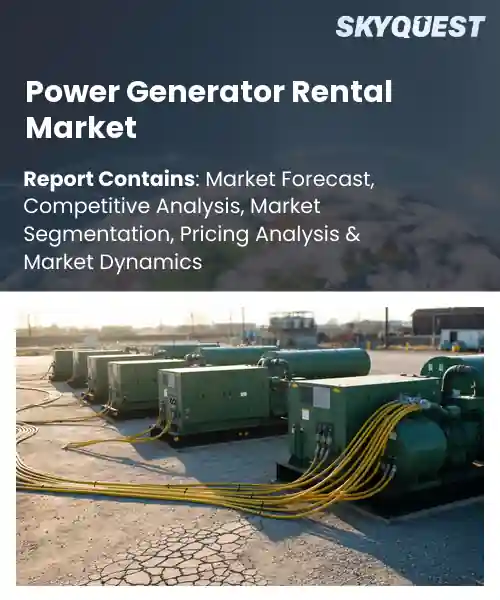
Power Generator Rental Market
Report ID: SQMIG20F2062
Report ID: SQMIG20F2062
[email protected]
USA +1 351-333-4748
Report ID:
SQMIG20F2062 |
Region:
Global |
Published Date: May, 2026
Pages:
157
|Tables:
154
|Figures:
78


Global Power Generator Rental Market size was valued at USD 6.2 Billion in 2024 and is poised to grow from USD 6.49 Billion in 2025 to USD 9.37 Billion by 2033, growing at a CAGR of 4.7% during the forecast period (2026-2033).
The global power generator rental market provides temporary electricity using on-demand diesel, gas, and hybrid sets, for construction, events, disaster relief, and those industrial peak moments. The main reason people rent rather than own is that reliable power is needed when the grid supply fails, or when ownership is just not practical, like at all. It matters because companies want immediate capacity, without that huge upfront capital spending, and the sector sort of grew from small local suppliers into global fleets now, with quieter units and everything. Over the years, storm recovery in the United States, short-term mines in Australia, and big city projects across Asia show a pattern too: projects get more temporary, outages become more climate-linked, and industry keeps expanding, so demand shifts toward flexible rental services, not permanent installations.
A major driver for the power generator rental market growth is the regulatory pressure plus corporate sustainability objectives, which push operators to swap old diesel fleets for cleaner options, hybrid systems, and fuel-efficient models. And since rental firms typically put money into cleaner technology, they can then deliver compliant capacity fast, which helps them land contracts with utilities, events, and data centers. For instance, when some European cities created low-emission zones, festival organisers went with hybrid generators to stay within limits, instead of buying totally new equipment. In the same way, telecom businesses in sub-Saharan Africa often select rented generator packages with remote monitoring, because downtime there is not really negotiable. Rental providers usually bundle fuel management as well, which reduces day-to-day complexity and adds more recurring revenue across regions.
IoT improves operational efficiency in this rental power market by turning separate units into data-backed assets. You get sensors for runtime hours and fuel, telemetry that supports remote monitoring, and cloud analytics for predictive maintenance, so operators can act earlier rather than wait for problems. Right now, many rental companies use that visibility to reduce the whole surprise failure situation, optimise dispatch, and even plan service before faults turn into emergencies. As the market is built around flexible and dependable uptime for events, construction, and backup during outages, IoT also helps balance supply with demand. It can cut down on unnecessary site visits, extend equipment life, and keep customer operations running, more or less, without interruptions.
Market snapshot - (2026-2033)
Global Market Size
USD 6.2 Billion
Largest Segment
Short-Term Rental
Fastest Growth
Long-Term Rental
Growth Rate
4.7% CAGR
To get more insights on this market click here to Request a Free Sample Report
The global power generator rental market is segmented by rental type, generator type, power rating, application, end-use industry and region. Based on rental type, the market is segmented into Short-Term Rental and Long-Term Rental. Based on generator type, the market is segmented into Diesel Generators, Gas Generators, Hybrid Generators, Renewable/Battery-Integrated Generators and Others. Based on power rating, the market is segmented into Up to 75 kVA, 76–375 kVA, 376–750 kVA and Above 750 kVA. Based on application, the market is segmented into Prime/Continuous Power, Standby Power and Peak Shaving Power. Based on end-use industry, the market is segmented into Construction, Oil & Gas, Mining, Utilities, Manufacturing, Events & Entertainment, Data Centers, Telecommunications, Marine & Ports, Healthcare and Others. Based on region, the market is segmented into North America, Europe, Asia Pacific, Latin America and Middle East & Africa.
As per the power generator rental market analysis, the diesel generators segment dominates, because rental customers like proven reliability, fuel flexibility, and also high power density, which fit a lot of different temporary power needs. Moreover, there are established maintenance routines and lots of spare parts on hand, so downtime stays lower and deployment can be quick for construction, industrial, and even emergency sites. When operators are already familiar with the machines, and the units keep performing in harsh conditions, the rental fleet tends to concentrate more, utilization goes up, and lifecycle management stays more predictable, which makes providers lean toward diesel assets and service models.
Whereas the Hybrid generators category is still emerging as the fastest growing offering, though, since they mix engines with battery storage to reduce both fuel use and emissions. They run quietly and dispatch in flexible ways, so events and data users are interested. And because the setups are modular, providers can package greener solutions as a value-added deal that pulls in new demand, like a new stream that did not exist before.
According to the power generator rental market forecast, the Renewable battery integrated generators segment leads, since combined generation plus storage matches the rising need for low-carbon, quiet, and modular power in critical applications. They can deliver instant backup, handle peak shaving, and act as green prime power too, without heavy fuel logistics, so operational complexity drops and sustainability-minded clients get attracted. Also, tech is mature enough, equipment costs are lower, so rental providers feel comfortable growing clean fleets, forming new service models, and earning recurring revenue.
Meanwhile, the gas generator category is predicted to have the largest power generator rental market share, because customers are looking for lower emissions and quieter alternatives compared to traditional diesel. Fuel availability has improved in many markets, and gas engine efficiency is better, so longer rentals become practical for urban and industrial uses. That pushes providers to expand gas fleets, which can meet stricter regulations and corporate sustainability expectations, and it also helps unlock additional contract opportunities.
To get detailed segments analysis, Request a Free Sample Report
As per the power generator rental market regional forecast, North America leads the market, largely because the infrastructure is mature, industry activity is varied, and everyone keeps talking about business continuity, plus disaster resilience. Temporary power is being used a lot in construction, events, and emergency response, which feels very normal now, and it’s backed by rental networks that are already in place. Those service ecosystems tend to focus on quick deployment, then the boring part, maintenance, and somehow it all works in practice. Also, solid financing choices and longer-term contract setups help suppliers grow and modernize their fleets. On top of that, regulatory clarity and the whole “grid reliability” angle make customers more open to pairing rentals with distributed generation and hybrid configurations. Expectations from clients are high, so vendors keep pushing for newer equipment, remote monitoring, and fuel-efficient setups, which basically gives them a leg up on other regions for service quality and day-to-day readiness.
United States Power Generator Rental Market
The Power Generator Rental sector in the United States is mostly shaped by a strong rental culture, with customers spread across industrial, commercial, and emergency services. Logistics and maintenance networks are already established, so mobilization can happen fast when there are outages or planned work. Providers usually push reliability, modern control systems, and fuel compatibility. There’s also demand for turnkey arrangements, so many suppliers offer full-service packages, like site assessment, installation, and deployment help, which keeps rental fleet utilization consistently high.
Canada Power Generator Rental Market
The Power Generator Rental Market in Canada leans hard on remote infrastructure needs, and resilience planning that keeps demand for rental power ticking along. Operators tend to maintain modular fleets and wide coverage, since work sites are dispersed, and resource sectors need support without delay. Environmental goals and efficiency expectations keep nudging the market toward lower emission choices and hybrid configurations. Suppliers working alongside utilities help create situational flexibility, which then supports rental contracts tailored for seasonal fluctuations and emergency power demand.
Europe is witnessing rapid power generator rental market penetration because grid modernization is ramping up, infrastructure renewal is moving forward, and businesses and public sector organizations are more concerned with energy security. Urban development and major events keep increasing the need for temporary power, while stricter emissions rules and efficiency requirements push providers toward cleaner, quieter, more modular units. Maintenance and certification expectations are also getting more sophisticated, which supports professional rental services and even cross-border fleet moves. People are getting interested in hybridization and compatibility with renewable sources, so rentals look like a practical bridge during transitions. Competition among vendors and differentiation via remote monitoring and customized contracts also make adoption easier across different local markets. In many places, strong industrial bases and service networks create “growth pockets” that anchor regional momentum.
Germany Power Generator Rental Market
The Power Generator Rental industry in Germany rests on a strong industrial foundation and regulatory standards that basically steer customers toward high-quality rental solutions. Providers stress technical dependability, emissions compliance, and smooth integration with onsite energy management systems. As service networks are dense and engineering talent is available, response times for industrial needs or event-related work can be quick. Rental solutions also often include customization and long-term support, showing a market that values performance, certification, and real technical collaboration.
United Kingdom Power Generator Rental Market
The Power Generator Rental Market in the United Kingdom has fast-moving demand across construction, events, and technology infrastructure, and that drives expansion. Agile suppliers deploy modular fleets and use inventive service models, especially for urban sites and live operations. There’s a noticeable focus on low noise, emissions reduction, and compatibility with battery systems, which helps the offerings stand out. Customers looking for flexibility during infrastructure upgrades, or just during peak periods, often respond well to competitive rental terms paired with prompt maintenance and contracts that are adapted to the specific job.
France Power Generator Rental Market
Power Generator Rental Market in France is growing, with more interest coming from infrastructure refurbishment, events, and hospitality businesses that need power options without long commitments. Suppliers highlight acoustic performance, emissions mitigation, and bundled service packages that can handle the tight realities of city constraints. Integration with renewable generation and battery systems is also becoming more common among forward-minded operators. Local rental companies often work with engineers to deliver certification, plus maintenance, so these rentals start looking like practical replacements for permanent installations when the timing is right.
Asia Pacific is slowly, but steadily, tightening its grip on the power generator rental market by mixing advanced engineering know-how with specific infrastructure spend, plus more attention on disaster readiness in the areas that tend to get hit hardest. A lot of the regional demand is tied to solid manufacturing skills and component supply lines that help keep rental sets durable and dependable. Meanwhile, fast urbanization and the constant expansion of digital infrastructure create uneven demand patterns, so customers often want something more flexible than buying outright. More suppliers now bundle things together, like monitoring, remote diagnostics, and hybrid setups, so it fits local energy priorities better. Local rental companies working closely with global OEMs help speed up technology transfer, and with broader service networks, the whole thing improves asset uptime, which in turn raises customer confidence, and this supports a stronger position for the region over time. On top of that, targeted fleet modernization and operator training push up operational standards, while tailored financing and contract approaches make rental solutions easier to reach for both corporate users and public sector buyers.
Japan Power Generator Rental Market
In Japan, the power generator rental market leans on advanced engineering, tough quality expectations, and a clear focus on disaster preparedness, things that keep demand steady for reliable temporary power. Vendors typically supply low-noise units with smart control systems, and many also support integration with battery solutions. Maintenance, certification, and compliance standards are high, so service packages tend to be broad and very complete. Rental firms collaborating with technology providers help keep innovation moving and ensure dependable support for industrial customers as well as for critical infrastructure users, even when conditions get complicated.
South Korea Power Generator Rental Market
In South Korea, the power generator rental market mirrors a technology-driven manufacturing base, which supports high-quality rental fleets. Operators and providers often bring in upgraded control systems, digital monitoring, and fuel-efficient designs that work well for strict industrial needs and busy urban environments. Strategic partnerships with equipment makers and specialists also help with quick deployment and more rigorous maintenance routines. The overall direction is toward innovation and customization, so rental offerings can become the more preferred option for construction timelines, technology infrastructure rollouts, and emergency preparedness scenarios where time matters.
To know more about the market opportunities by region and country, click here to
Buy The Complete Report
Drivers
Rising Demand For Temporary Power
Increasing Industrial and commercial Needs
Restraints
High Operational Costs and Maintenance
Regulatory Compliance and environmental Concerns
Request Free Customization of this report to help us to meet your business objectives.
The global power generator rental market is basically moving because of decarbonisation rules and relentless cost pressure, which sort of nudges incumbents toward tech tie-ups, targeted buyouts, and more alternative fuel experiments. On one side, United Rentals is expanding what it can offer by grabbing big specialty fleets, while Aggreko has been piloting hydrogen gensets alongside technology collaborators. Meanwhile, newer players are rolling out battery native mobile microgrids and orchestration software, which can quietly edge out diesel-based rentals in the field.
Top Player’s Company Profile
Recent Developments in the Power Generator Rental Market
SkyQuest’s ABIRAW (Advanced Business Intelligence, Research & Analysis Wing) is our Business Information Services team that Collects, Collates, Correlates, and Analyses the Data collected by means of Primary Exploratory Research backed by robust Secondary Desk research.
As per SkyQuest analysis, the global power generator rental market is driven mainly by rising demand for temporary power solutions that allow quick deployment without the heavy capital expenditure, and second, there is increasing regulatory pressure and corporate sustainability goals that speed up the adoption of lower-emission and hybrid units. A key restraint still shows up as high operational costs, including fuel transport and maintenance, and this can make longer rentals less economical. North America currently leads the market, backed by mature rental networks and disaster-response readiness, while diesel generators remain the dominating segment due to proven reliability, fuel flexibility, and straightforward servicing. Going forward, continued digital integration and modular hybridization will guide future fleet modernization, even if adoption happens in phases.
| Report Metric | Details |
|---|---|
| Market size value in 2024 | USD 6.2 Billion |
| Market size value in 2033 | USD 9.37 Billion |
| Growth Rate | 4.7% |
| Base year | 2024 |
| Forecast period | (2026-2033) |
| Forecast Unit (Value) | USD Billion |
| Segments covered |
|
| Regions covered | North America (US, Canada), Europe (Germany, France, United Kingdom, Italy, Spain, Rest of Europe), Asia Pacific (China, India, Japan, Rest of Asia-Pacific), Latin America (Brazil, Rest of Latin America), Middle East & Africa (South Africa, GCC Countries, Rest of MEA) |
| Companies covered |
|
| Customization scope | Free report customization with purchase. Customization includes:-
|
To get a free trial access to our platform which is a one stop solution for all your data requirements for quicker decision making. This platform allows you to compare markets, competitors who are prominent in the market, and mega trends that are influencing the dynamics in the market. Also, get access to detailed SkyQuest exclusive matrix.
Table Of Content
Executive Summary
Market overview
Parent Market Analysis
Market overview
Market size
KEY MARKET INSIGHTS
COVID IMPACT
MARKET DYNAMICS & OUTLOOK
Market Size by Region
KEY COMPANY PROFILES
Methodology
For the Power Generator Rental Market, our research methodology involved a mixture of primary and secondary data sources. Key steps involved in the research process are listed below:
1. Information Procurement: This stage involved the procurement of Market data or related information via primary and secondary sources. The various secondary sources used included various company websites, annual reports, trade databases, and paid databases such as Hoover's, Bloomberg Business, Factiva, and Avention. Our team did 45 primary interactions Globally which included several stakeholders such as manufacturers, customers, key opinion leaders, etc. Overall, information procurement was one of the most extensive stages in our research process.
2. Information Analysis: This step involved triangulation of data through bottom-up and top-down approaches to estimate and validate the total size and future estimate of the Power Generator Rental Market.
3. Report Formulation: The final step entailed the placement of data points in appropriate Market spaces in an attempt to deduce viable conclusions.
4. Validation & Publishing: Validation is the most important step in the process. Validation & re-validation via an intricately designed process helped us finalize data points to be used for final calculations. The final Market estimates and forecasts were then aligned and sent to our panel of industry experts for validation of data. Once the validation was done the report was sent to our Quality Assurance team to ensure adherence to style guides, consistency & design.
Analyst Support
Customization Options
With the given market data, our dedicated team of analysts can offer you the following customization options are available for the Power Generator Rental Market:
Product Analysis: Product matrix, which offers a detailed comparison of the product portfolio of companies.
Regional Analysis: Further analysis of the Power Generator Rental Market for additional countries.
Competitive Analysis: Detailed analysis and profiling of additional Market players & comparative analysis of competitive products.
Go to Market Strategy: Find the high-growth channels to invest your marketing efforts and increase your customer base.
Innovation Mapping: Identify racial solutions and innovation, connected to deep ecosystems of innovators, start-ups, academics, and strategic partners.
Category Intelligence: Customized intelligence that is relevant to their supply Markets will enable them to make smarter sourcing decisions and improve their category management.
Public Company Transcript Analysis: To improve the investment performance by generating new alpha and making better-informed decisions.
Social Media Listening: To analyze the conversations and trends happening not just around your brand, but around your industry as a whole, and use those insights to make better Marketing decisions.
REQUEST FOR SAMPLE
 REQUEST FREE CUSTOMIZATION
Global Power Generator Rental Market size was valued at USD 6.2 Billion in 2024 and is poised to grow from USD 6.49 Billion in 2025 to USD 9.37 Billion by 2033, growing at a CAGR of 4.7% during the forecast period (2026-2033).
The competitive landscape of the global power generator rental market is driven by decarbonisation rules and cost pressure that push incumbents into tech partnerships, targeted acquisitions and alternative fuel pilots. United Rentals expanded fleet capability through large specialty acquisitions, Aggreko piloted hydrogen gensets with technology partners, and new entrants offer battery native mobile microgrids and orchestration software to displace diesel-based rentals. 'Aggreko', 'Caterpillar', 'Cummins', 'United Rentals', 'Ashtead Group', 'Atlas Copco', 'APR Energy', 'Herc Rentals', 'Kohler Energy', 'Generac Power Systems', 'Himoinsa', 'Mitsubishi Heavy Industries Engine & Turbocharger', 'Wärtsilä', 'Speedy Hire', 'AKSA Power Generation', 'Power Electrics', 'Trinity Power Rentals', 'Sudhir Power', 'Shenton Group', 'Rental Solutions & Services'
The widespread preference for renting power generation assets stems from the flexibility it offers organizations facing temporary or seasonal energy needs, emergency response situations, and remote project sites. Renting allows rapid deployment and avoids long-term capital commitment while enabling operators to match capacity to project timelines. Service providers often include installation and support, reducing operational burden for users and making rental an attractive option for businesses that require scalable, short-term power solutions without owning and maintaining equipment over prolonged periods.
Digital Platform Integration: Adoption of digital platforms is reshaping rental workflows by enabling seamless booking, remote monitoring and data driven fleet management. Service providers leverage connected telematics and cloud based portals to offer transparent availability, condition reporting and predictive support, improving uptime and customer satisfaction. Marketplaces and subscription models simplify procurement and contract flexibility while analytics inform asset deployment and lifecycle decisions. Digital interfaces also facilitate coordination with service partners and create opportunities for value added services that deepen client relationships and revenue.
Why does North America Dominate the Global Power Generator Rental Market? |@12


Want to customize this report? This report can be personalized according to your needs. Our analysts and industry experts will work directly with you to understand your requirements and provide you with customized data in a short amount of time. We offer $1000 worth of FREE customization at the time of purchase.
Feedback From Our Clients


 USA (+1) 351-333-4748

