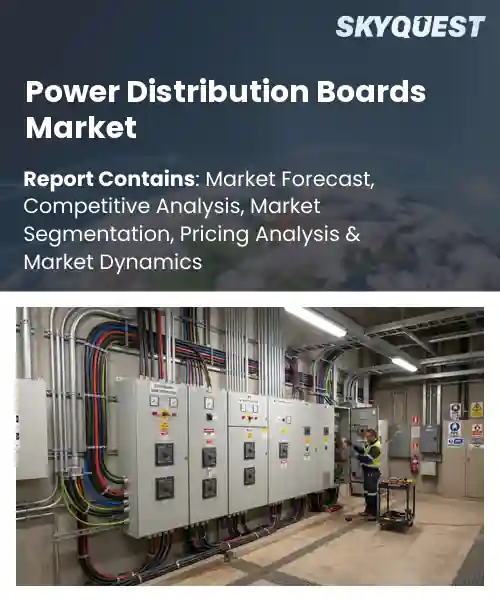
Power Distribution Boards Market
Report ID: SQMIG20D2920
Report ID: SQMIG20D2920
[email protected]
USA +1 351-333-4748
Report ID:
SQMIG20D2920 |
Region:
Global |
Published Date: September, 2026
Pages:
157
|Tables:
152
|Figures:
78


Global Power Distribution Boards Market size was valued at USD 65.2 Billion in 2024 and is poised to grow from USD 69.31 Billion in 2025 to USD 113.0 Billion by 2033, growing at a CAGR of 6.3% during the forecast period (2026-2033).
Power distribution boards (PDBs) serve as the central hub that allocates electrical energy to machines, lighting, and control systems across industrial, commercial, and residential settings. Their relevance stems from the need for reliable, safe, and efficient power management as electricity consumption intensifies worldwide. The primary driver of market expansion has been the rapid electrification of manufacturing processes, illustrated by automotive assembly lines shifting to automated robotics that require voltage regulation. Over the past decade, regulatory mandates for energy efficiency and the proliferation of renewable energy installations have further bolstered demand, prompting manufacturers to develop modular boards that integrate monitoring and fault‑diagnosis features.This foundation of regulatory pressure and electrification creates a cascade of growth opportunities that shape the global power distribution board market. The surge in data‑center construction, driven by cloud computing, demands high‑density PDBs able to handle redundant feeds, prompting vendors to offer scalable plug‑in modules that cut downtime. Simultaneously, electric‑vehicle charging infrastructure requires boards with integrated surge protection and IoT connectivity, enabling remote load monitoring. These applications stimulate investment in advanced materials such as flame‑retardant polymers, which improve safety while reducing system weight, thereby expanding the addressable market across automotive, renewable‑energy, and smart‑building sectors and emerging industrial automation projects worldwide.
How is AI improving safety and performance in the power distribution boards market?
Artificial intelligence is reshaping power distribution boards by adding continuous monitoring, automated fault detection and predictive maintenance. Sensors embedded in the panels feed data to edge processors that run machine learning models to spot abnormal currents, temperature spikes or insulation wear before a failure occurs. At the same time AI algorithms analyse historical load patterns to optimise routing and balance, which raises efficiency and lowers stress on components. Leading manufacturers are pairing these capabilities with cloud dashboards that give operators real time alerts and actionable recommendations. The result is a safer operating environment, fewer unplanned outages and longer equipment life, all of which are driving stronger demand for smarter boards.Schneider Electric announced in June 2024 an AI driven predictive maintenance platform for its power distribution boards, the system continuously analyses sensor data to predict faults and automatically isolates compromised sections, improving safety and keeping performance stable while reducing maintenance trips and supporting overall grid reliability through advanced analytics methods.
Market snapshot - (2026-2033)
Global Market Size
USD 65.2 Billion
Largest Segment
Main Distribution Boards
Fastest Growth
Motor Control Boards
Growth Rate
6.3% CAGR
To get more insights on this market click here to Request a Free Sample Report
Global power distribution boards market is segmented by board type, voltage, mounting, application, end-use industry and region. Based on board type, the market is segmented into Main Distribution Boards, Sub-Distribution Boards, Motor Control Boards, Power Control Boards and Others. Based on voltage, the market is segmented into Low Voltage, Medium Voltage and High Voltage. Based on mounting, the market is segmented into Wall-Mounted, Floor-Mounted, Free-Standing and Others. Based on application, the market is segmented into Residential, Commercial, Industrial, Infrastructure and Others. Based on end-use industry, the market is segmented into Power & Utilities, Construction, Manufacturing, Commercial Buildings, Infrastructure and Others. Based on region, the market is segmented into North America, Europe, Asia Pacific, Latin America and Middle East & Africa.
Main Distribution Boards segment dominates because they serve as the primary hub for routing electrical power throughout facilities, ensuring safety and reliability across all downstream equipment. Their universal compatibility with a wide range of voltage classes and mounting configurations makes them indispensable for both new installations and retrofit projects. Moreover, stringent regulatory standards prioritize robust protection mechanisms that are most readily achieved with mainstream distribution solutions and cost effective maintenance practices.
Meanwhile, Motor Control Boards segment is witnessing the strongest growth momentum because automation advances and the shift toward energy efficient drives increase demand for dedicated motor protection and control. Integration with smart sensors and IoT connectivity enables predictive maintenance, appealing to manufacturers seeking reduced downtime. This uptake drives market expansion and opens opportunities for new board designs.
Residential application segment dominates because housing constructions and upgrades continuously require reliable power distribution to meet everyday electrical needs. Homeowners prioritize safety, ease of installation, and compliance with building codes, which drives preference for standardized boards that integrate seamlessly with low voltage systems. Additionally, the proliferation of smart home devices increases demand for distribution solutions that support scalable connectivity while maintaining simplicity and cost efficiency and long term reliability.
On the other hand, Infrastructure application segment is emerging as the key high growth area because large scale projects such as smart grids, transit systems, and renewable energy installations require robust, high capacity distribution boards. The push for grid modernization and resilience encourages adoption of advanced boards capable of handling medium and high voltage levels, creating expansive opportunities and driving future market acceleration.
To get detailed segments analysis, Request a Free Sample Report
The Asia Pacific region benefits from a confluence of advanced manufacturing capabilities, extensive industrial networks, and a cultural emphasis on technological innovation. Robust supply chains and a deep pool of engineering talent enable rapid product development and customization, meeting the nuanced needs of diverse sectors such as automotive, electronics, and heavy industry. Governmental frameworks encourage investment in smart grid infrastructure and energy efficiency, fostering an environment where modern distribution solutions thrive. Additionally, the region’s commitment to integrating renewable energy sources drives demand for sophisticated board designs that can handle variable inputs while maintaining reliability. This blend of technical expertise, supportive policy, and market demand creates a resilient ecosystem that consistently positions Asia Pacific at the forefront of the global power distribution landscape.
Power Distribution Boards Market in Japan is shaped by a legacy of precision engineering and stringent safety standards that demand high‑quality components. The nation’s focus on smart manufacturing and automation fuels continuous upgrades to distribution solutions, ensuring seamless integration with cutting‑edge production lines. Strong collaboration between manufacturers and research institutions accelerates innovation, while regulatory emphasis on energy efficiency drives adoption of advanced board technologies across industrial and commercial sectors.
Power Distribution Boards Market in South Korea is propelled by a dynamic electronics and automotive sector that requires reliable and compact distribution solutions. Government incentives supporting digital transformation encourage the deployment of intelligent board systems that enhance operational visibility. The country’s rapid adoption of Industry 4.0 principles and a skilled engineering workforce further reinforce the market’s growth, positioning South Korea as a pivotal hub for high‑performance distribution technologies.
Europe’s expansion is underpinned by a strong regulatory focus on energy efficiency and sustainability, compelling industries to modernize their electrical infrastructure. The region’s deep engineering heritage and emphasis on high‑quality standards foster the development of sophisticated distribution solutions that meet rigorous safety and performance criteria. Growing investment in renewable energy integration and smart grid initiatives creates a demand for boards capable of handling diverse power sources while ensuring stability. Additionally, the push toward digitalization across manufacturing and building sectors encourages the adoption of intelligent distribution platforms that support real‑time monitoring and predictive maintenance. This combination of regulatory impetus, technical expertise, and a transition toward greener energy systems fuels Europe’s rapid market progression.
Power Distribution Boards Market in Germany benefits from a strong industrial base and a reputation for engineering excellence. The country’s focus on precision manufacturing and automation drives demand for highly reliable distribution solutions that can withstand rigorous operational conditions. Collaborative efforts between industry leaders and research institutes promote continuous innovation, while stringent safety regulations ensure that products meet the highest quality benchmarks across sectors.
Power Distribution Boards Market in the United Kingdom is experiencing accelerated growth due to heightened adoption of smart building technologies and renewable energy projects. The market responds to a regulatory environment that prioritizes energy efficiency and carbon reduction, prompting upgrades to modern distribution infrastructure. Emerging digital platforms enable real‑time monitoring and optimization, positioning the United Kingdom as a fast‑moving market for advanced board solutions.
Power Distribution Boards Market in France is emerging as a notable segment driven by national initiatives aimed at energy transition and sustainable development. The focus on integrating renewable sources into existing grids creates opportunities for innovative distribution designs that balance flexibility and reliability. Collaborative industry programs and a commitment to high safety standards support the gradual expansion of the market within the French industrial landscape.
North America reinforces its market position through a blend of extensive industrial activity, advanced technological adoption, and a proactive approach to safety and reliability. The region’s emphasis on digital transformation encourages the integration of smart distribution boards equipped with connectivity and analytics capabilities, enhancing operational efficiency. Strong demand from commercial construction, data centers, and renewable energy projects drives continuous innovation in board design and functionality. Collaborative ecosystems involving manufacturers, standards bodies, and end‑users ensure that solutions evolve to meet complex power management challenges. This strategic focus on modernization, coupled with a robust regulatory framework that emphasizes performance and safety, solidifies North America’s role as a leading contributor to the global power distribution landscape.
Power Distribution Boards Market in the United States is propelled by a vast construction sector and a high demand for reliable power management across industrial, commercial, and residential applications. The market benefits from a culture of innovation that embraces IoT‑enabled boards for real‑time monitoring and predictive maintenance. Stringent safety standards and a focus on energy efficiency drive continuous upgrades to distribution infrastructure, supporting the nation’s dynamic economic activities.
Power Distribution Boards Market in Canada reflects a growing emphasis on integrating renewable energy sources and addressing the unique challenges of cold‑climate operations. The market responds to national policies that promote sustainable power solutions and energy resilience. Collaborative initiatives between manufacturers and research institutions foster the development of robust, high‑performance distribution boards tailored to the diverse needs of Canadian industry and infrastructure.
To know more about the market opportunities by region and country, click here to
Buy The Complete Report
Increasing Renewable Energy Integration
Growth In Smart Grid Adoption
Stringent Safety Certification Requirements
High Initial Capital Expenditure
Request Free Customization of this report to help us to meet your business objectives.
The competitive landscape is shaped by large incumbents expanding portfolios through strategic M&A, such as Siemens’ acquisition of industrial automation specialist Innomotics, and partnerships like Schneider Electric’s alliance with Siemens for smart grid integration, while tech innovation drives differentiation, exemplified by ABB’s launch of AI‑enabled distribution board monitoring and Eaton’s rollout of modular, IoT‑connected panels.
Top Player’s Company Profile
Recent Developments
SkyQuest’s ABIRAW (Advanced Business Intelligence, Research & Analysis Wing) is our Business Information Services team that Collects, Collates, Correlates, and Analyses the Data collected by means of Primary Exploratory Research backed by robust Secondary Desk research. As per SkyQuest analysis the global power distribution boards market is propelled primarily by the surge in renewable energy integration, which pushes manufacturers to create modular panels capable of handling variable power flows, while a second strong catalyst is the rapid adoption of smart‑grid technologies that demand real‑time communication and predictive maintenance features. The main distribution boards segment leads the market because it serves as the primary hub for routing electricity across facilities, and Asia Pacific dominates the landscape thanks to its advanced manufacturing base and supportive policies. However, stringent safety certification requirements act as a restraint, adding costly testing and approval steps that can slow product launches and limit entry for smaller players.
| Report Metric | Details |
|---|---|
| Market size value in 2024 | USD 65.2 Billion |
| Market size value in 2033 | USD 113.0 Billion |
| Growth Rate | 6.3% |
| Base year | 2024 |
| Forecast period | (2026-2033) |
| Forecast Unit (Value) | USD Billion |
| Segments covered |
|
| Regions covered | North America (US, Canada), Europe (Germany, France, United Kingdom, Italy, Spain, Rest of Europe), Asia Pacific (China, India, Japan, Rest of Asia-Pacific), Latin America (Brazil, Rest of Latin America), Middle East & Africa (South Africa, GCC Countries, Rest of MEA) |
| Companies covered |
|
| Customization scope | Free report customization with purchase. Customization includes:-
|
To get a free trial access to our platform which is a one stop solution for all your data requirements for quicker decision making. This platform allows you to compare markets, competitors who are prominent in the market, and mega trends that are influencing the dynamics in the market. Also, get access to detailed SkyQuest exclusive matrix.
Table Of Content
Executive Summary
Market overview
Parent Market Analysis
Market overview
Market size
KEY MARKET INSIGHTS
COVID IMPACT
MARKET DYNAMICS & OUTLOOK
Market Size by Region
KEY COMPANY PROFILES
Methodology
For the Power Distribution Boards Market, our research methodology involved a mixture of primary and secondary data sources. Key steps involved in the research process are listed below:
1. Information Procurement: This stage involved the procurement of Market data or related information via primary and secondary sources. The various secondary sources used included various company websites, annual reports, trade databases, and paid databases such as Hoover's, Bloomberg Business, Factiva, and Avention. Our team did 45 primary interactions Globally which included several stakeholders such as manufacturers, customers, key opinion leaders, etc. Overall, information procurement was one of the most extensive stages in our research process.
2. Information Analysis: This step involved triangulation of data through bottom-up and top-down approaches to estimate and validate the total size and future estimate of the Power Distribution Boards Market.
3. Report Formulation: The final step entailed the placement of data points in appropriate Market spaces in an attempt to deduce viable conclusions.
4. Validation & Publishing: Validation is the most important step in the process. Validation & re-validation via an intricately designed process helped us finalize data points to be used for final calculations. The final Market estimates and forecasts were then aligned and sent to our panel of industry experts for validation of data. Once the validation was done the report was sent to our Quality Assurance team to ensure adherence to style guides, consistency & design.
Analyst Support
Customization Options
With the given market data, our dedicated team of analysts can offer you the following customization options are available for the Power Distribution Boards Market:
Product Analysis: Product matrix, which offers a detailed comparison of the product portfolio of companies.
Regional Analysis: Further analysis of the Power Distribution Boards Market for additional countries.
Competitive Analysis: Detailed analysis and profiling of additional Market players & comparative analysis of competitive products.
Go to Market Strategy: Find the high-growth channels to invest your marketing efforts and increase your customer base.
Innovation Mapping: Identify racial solutions and innovation, connected to deep ecosystems of innovators, start-ups, academics, and strategic partners.
Category Intelligence: Customized intelligence that is relevant to their supply Markets will enable them to make smarter sourcing decisions and improve their category management.
Public Company Transcript Analysis: To improve the investment performance by generating new alpha and making better-informed decisions.
Social Media Listening: To analyze the conversations and trends happening not just around your brand, but around your industry as a whole, and use those insights to make better Marketing decisions.
REQUEST FOR SAMPLE
 REQUEST FREE CUSTOMIZATION


Want to customize this report? This report can be personalized according to your needs. Our analysts and industry experts will work directly with you to understand your requirements and provide you with customized data in a short amount of time. We offer $1000 worth of FREE customization at the time of purchase.
Feedback From Our Clients


 USA (+1) 351-333-4748

