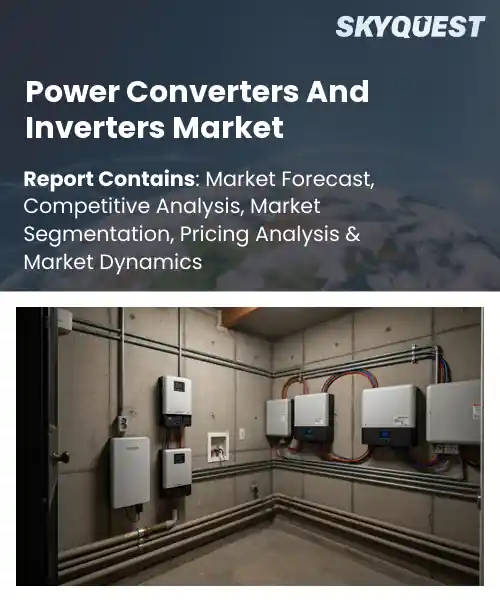
Power Converters And Inverters Market
Report ID: SQMIG45K2235
Report ID: SQMIG45K2235
[email protected]
USA +1 351-333-4748
Report ID:
SQMIG45K2235 |
Region:
Global |
Published Date: February, 2026
Pages:
157
|Tables:
149
|Figures:
78


Global Power Converters and Inverters Market size was valued at USD 66.3 Billion in 2024 and is poised to grow from USD 71.27 Billion in 2025 to USD 127.11 Billion by 2033, growing at a CAGR of 7.5% during the forecast period (2026-2033).
Rapid industrial electrification is creating new opportunities for the global power converters and inverters market due to increased adoption of renewable energy systems, more emphasis on energy conservation and efficiency, and rising demand for energy management technologies. The need to transform electrical power to other forms using power converters and inverters is creating stable and reliable power sources in various types of applications (e.g., consumer electronics, industrial automation, electric vehicles (EV), solar photovoltaic (PV) systems, and uninterruptible power supplies (UPS)). The growth in renewable energy sources (e.g., solar and wind) requiring advanced inverters for grid-connected applications is driving sales of power converters and inverters. The expansion of electric and hybrid vehicles is also increasing the need for efficient power conversion systems for battery charging, motor control, and energy distribution.
The emergence of new technologies (e.g., development of high-performance, energy-efficient, and reliable silicon carbide (SiC) and gallium nitride (GaN) semiconductor devices) will allow for continued growth of the market as they enable smaller, more efficient, and more reliable power conversion products. Furthermore, smart grid development, government incentives for the use of clean energy technologies, and increases in capital investment in power backup solutions are further promoting global power converters and inverters market growth.
How is AI Improving Efficiency and Reliability in the Power Converters and Inverters Market?
AI is enhancing the efficiency and reliability of power converters and inverters by using smart controls and predictive analytics within their key functions. Some of the major developments that have resulted from this integration of AI into power conversion and inverter operations include adaptive control, machine learning for early detection of component failure; and Data-driven coordination with energy management systems (EMS) that smooth out fluctuations in output. Currently, vendors are embedding AI technology into Inverter firmware and EMS to reduce downtime and extend the life of the equipment. As the industry continues to face increased levels of distributed generation and higher levels of reliability from the grid, these new capabilities will facilitate the integration of energy storage systems (ESS) on the grid, managing the variability of energy produced with renewable sources, and providing a more resilient source of electricity to consumers. An example of this functionality includes intelligent control of multiple inverters that will optimize the output of individual PV modules and coordinate with other inverters as part of an EMS to improve the overall performance of the grid.
Market snapshot - 2026-2033
Global Market Size
USD 66.3 Billion
Largest Segment
AC to DC Converter
Fastest Growth
DC to AC Converter
Growth Rate
7.5% CAGR
To get more insights on this market click here to Request a Free Sample Report
Global power converters and inverters market is segmented into type, product, output voltage, application, end-use industry and region. Based on type, the market is segmented into AC to DC Converter, DC to AC converter, DC to DC converter, and AC to AC converter. Based on product, the market is segmented into string inverters, micro inverters, and central inverters. Based on output voltage, the market is segmented into low, medium, and high. Based on application, the market is segmented into renewable energy, consumer electronics, medical equipment, electric vehicles, and others. Based on end-use industry, the market is segmented into residential, commercial, industrial, utility, and automotive. Based on region, the market is segmented into North America, Europe, Asia Pacific, Latin America and Middle East & Africa.
The DC to AC converter segment dominates the market. In renewable energy, a lot of the electricity generated by solar photovoltaic (PV) systems is in DC form; so, a converter is needed to change it to AC for distribution over the grid; so that it can be used either in homes, or for industrial applications. In addition, inverters are also used in uninterruptible power supplies (UPS), electric vehicles (EVs), and as part of backup power systems. The rapid growth of solar projects and the increasing number of EVs being acquired will continue to drive the dominance of this market segment.
As per global power converters and inverters market analysis, the DC-to-DC converter segment is expected to grow the fastest. There has been an increase in the number of uses for DC-DC converters; including in the applications of electric vehicles, battery management systems, telecommunications infrastructures, data centers, and portable electronics. With the electrification of transportation and the increasing installation of energy storage systems, there is a tremendous increase in the demand for efficient DC voltage regulation solutions.
As per global power converters and inverters market outlook, the string inverter segment currently dominates the market. The string inverter is used in most residential (R) and commercial (C) solar systems because of the relative balance it provides between cost, reliability, and scalability. For this reason, string inverters are the typical choice for residential and commercial mid-sized solar systems; their relatively easy installation and maintenance make them especially attractive among contractors.
As per global power converters and inverters market forecast, micro inverters are emerging as the fastest-growing segment market. Installed on an individual panel basis, they allow for greater performance optimization, increased energy yield, and greater monitoring capabilities. As consumer demand for rooftop solar continues to increase, along with a preference for systems with greater flexibility and energy efficiency, micro inverters are expected to experience rapid growth.
To get detailed segments analysis, Request a Free Sample Report
As per global power converters and inverters industry analysis, the presence of strong manufacturing ecosystems, extensive electronics supply chains and large-scale demand for products within both industrial and consumer segments continue to establish Asia Pacific’s leadership position in power converters and inverters. The region has significant strengths in semiconductor manufacturing and innovation related to power devices that aid in accelerating the adoption of advanced converter topologies and wide bandgap technologies. This will continue the sustained demand for converters in grid, renewable energy and transportation applications based on large scale electrification initiatives, rapid growth in electric mobility and expansion into distributed generation.
As per power converters and inverters market regional outlook, Japan is characterized by high levels of precision engineering, expectations for very high levels of reliability and a high level of integration between semiconductor vendors and the equipment manufacturers or system integrators. Japanese manufacturers focus on efficiency improvements, quality assurance to ensure long-life cycle performance in industrial applications as well as automotive applications. The collaboration between companies performing research and development and companies performing R&D, as well as institutions focused on developing new topologies and materials, continue to help to improve the design and performance of power converters over time.
As per power converters and inverters market regional forecast, South Korea realizes benefits from the strong cluster of electronics firms and automotive manufacturers that are rapidly integrating power conversion technologies into their vehicles and renewable energy systems. There has been a very strong focus on various aspects of component miniaturization, thermal management, and system integration, resulting in competitive and very high performance products. The creation of strategic alliances between large conglomerates and small, specialized suppliers has been an important contributor to accelerating the commercialization of new power converter technologies and associated system architectures.
North America’s growing market for power converters and inverters is driven by multiple factors, including technological advancements, modernization of the electric grid, and increased demand for converters in residential, commercial, and utility sectors. Start-up companies and established electronics companies are creating an incubator for prototype development and commercialization of advanced converter technologies. The focus on electric vehicles and energy storage integration is driving a significant need for specialized converter design and power management processes.
The value of the power converter and inverter market in the United States is driven by strong innovation ecosystems and increasing customer demand from the mobility, data centers, and renewable sectors. Availability of experienced engineers, specialized labs for testing and validating new product designs, and easy access to other organizations with similar core competencies are all factors that enable rapid development of new topologies and control software in the United States.
The Canada market is characterized by a focus on improving the resilience of the electric grid, integrating renewable sources of energy (such as solar and wind), and electrifying heavy industries. There is an environment of collaboration between utilities, research institutions, and manufacturers that produce pilot projects and early deployment of advanced converter technologies. There is also considerable demand for robust, cold-weather tolerant solutions produced by Canadian manufacturers and a high level of participation in cross-border projects, resulting in specialized skills and expertise in the design and engineering of power conversion products.
Through a combination of coordinated policy frameworks, investments into research, and a focus on decarbonization, Europe is strengthening its position and establishing the infrastructure to support an advanced technology power conversion industry that can encourage the adoption of new technologies for more energy-efficient power conversion design, improved system reliability, and compliance with new and more stringent grid codes, which helps manufacturers to build trust with utilities and industrial customers. Additionally, cross-border collaboration and standardization initiatives support the simplification of entry into the market as well as the ability to provide interoperability across borders. As such, public/private research consortiums are working together to accelerate the development of next-generation semiconductor materials and control strategies. Through supporting local manufacturing and supply chain resiliency, Europe creates a foundation for each continent's capability in both high volume and specialized segments, allowing Europe to play an important role in defining global technology direction and sustainable energy integration.
The Germany industry is experiencing a surge in demand due to increased activity from industrial manufacturers as well as an exponential increase in automotive electrification growth, highly regulated engineering standards, and the need for high-efficiency power conversion/inversion technologies for industrial drive systems, renewable energy interfaces, and electric vehicle charging infrastructure. Manufacturers have been focusing their efforts towards creating robust, high-efficiency solutions suitable for these three demanding markets and have developed strong collaborations with academic research institutions to facilitate innovative developments of both control algorithms as well as enhancement of hardware durability.
The UK industry continues to emphasize developing flexible software-centric solutions for addressing grid connectivity, renewable energy storage, and residential energy management. The startup community is very vibrant; thereby promoting fast-paced business development of modular and scalable converter topologies. The many available services offered by the UK Electrical Utility industry, along with capable systems integration services, enable their utility and commercial customers to tailor their deployments according to the customers' specific requirements. The focus is on interoperability of devices and digital control; facilitating quick adaptation to future changes in the market.
In France there is a concerted effort to employ integrated solutions for addressing the industrial electrification requirements of France's utilities, while concurrently addressing the integration of renewable power generation methods into the utility grid, along with the electrification of the transportation sector through means of automotive electrification. As such, French manufacturers have developed a high level of system reliability, compliance with all regulations/laws, and have made tremendous advancements in converter design through collaborations with energy providers and educational research institutions through various research and development initiatives.
To know more about the market opportunities by region and country, click here to
Buy The Complete Report
Rising Renewable Energy Integration
Advancements in Semiconductor Technologies
High Upfront System Costs
Regulatory and Interconnection Complexity
Request Free Customization of this report to help us to meet your business objectives.
For the global power converters and inverters market trends, intense competition is driven by incumbents using targeted mergers and acquisitions, strategic distribution partnerships, and platform level product innovation to secure channel reach and grid services capabilities. Examples include FIMER’s takeover of a major inverter line, Sungrow’s distributor and MOU activity in key regions, and Enphase’s rollout of grid forming microinverter and energy management software.
SkyQuest’s ABIRAW (Advanced Business Intelligence, Research & Analysis Wing) is our Business Information Services team that Collects, Collates, Correlates, and Analyses the Data collected by means of Primary Exploratory Research backed by robust Secondary Desk research.
As per SkyQuest analysis, the global market is currently being driven by the overall transition to renewables and electrification along with a secondary factor being advances in semiconductor technology allowing for new SiC/GaN based power conversion /inverter designs with significantly improved efficiency. The Asia-Pacific region has the largest global power converters and inverters market share due to strong manufacturing capabilities and a high level of electrification. Overall, these global power converters and inverters market trends indicate that the industry can expect continued growth as new technologies are developed, and the amount of installed renewable generation continues to grow.
| Report Metric | Details |
|---|---|
| Market size value in 2024 | USD 66.3 Billion |
| Market size value in 2033 | USD 127.11 Billion |
| Growth Rate | 7.5% |
| Base year | 2024 |
| Forecast period | 2026-2033 |
| Forecast Unit (Value) | USD Billion |
| Segments covered |
|
| Regions covered | North America (US, Canada), Europe (Germany, France, United Kingdom, Italy, Spain, Rest of Europe), Asia Pacific (China, India, Japan, Rest of Asia-Pacific), Latin America (Brazil, Rest of Latin America), Middle East & Africa (South Africa, GCC Countries, Rest of MEA) |
| Companies covered |
|
| Customization scope | Free report customization with purchase. Customization includes:-
|
To get a free trial access to our platform which is a one stop solution for all your data requirements for quicker decision making. This platform allows you to compare markets, competitors who are prominent in the market, and mega trends that are influencing the dynamics in the market. Also, get access to detailed SkyQuest exclusive matrix.
Table Of Content
Executive Summary
Market overview
Parent Market Analysis
Market overview
Market size
KEY MARKET INSIGHTS
COVID IMPACT
MARKET DYNAMICS & OUTLOOK
Market Size by Region
KEY COMPANY PROFILES
Methodology
For the Power Converters And Inverters Market, our research methodology involved a mixture of primary and secondary data sources. Key steps involved in the research process are listed below:
1. Information Procurement: This stage involved the procurement of Market data or related information via primary and secondary sources. The various secondary sources used included various company websites, annual reports, trade databases, and paid databases such as Hoover's, Bloomberg Business, Factiva, and Avention. Our team did 45 primary interactions Globally which included several stakeholders such as manufacturers, customers, key opinion leaders, etc. Overall, information procurement was one of the most extensive stages in our research process.
2. Information Analysis: This step involved triangulation of data through bottom-up and top-down approaches to estimate and validate the total size and future estimate of the Power Converters And Inverters Market.
3. Report Formulation: The final step entailed the placement of data points in appropriate Market spaces in an attempt to deduce viable conclusions.
4. Validation & Publishing: Validation is the most important step in the process. Validation & re-validation via an intricately designed process helped us finalize data points to be used for final calculations. The final Market estimates and forecasts were then aligned and sent to our panel of industry experts for validation of data. Once the validation was done the report was sent to our Quality Assurance team to ensure adherence to style guides, consistency & design.
Analyst Support
Customization Options
With the given market data, our dedicated team of analysts can offer you the following customization options are available for the Power Converters And Inverters Market:
Product Analysis: Product matrix, which offers a detailed comparison of the product portfolio of companies.
Regional Analysis: Further analysis of the Power Converters And Inverters Market for additional countries.
Competitive Analysis: Detailed analysis and profiling of additional Market players & comparative analysis of competitive products.
Go to Market Strategy: Find the high-growth channels to invest your marketing efforts and increase your customer base.
Innovation Mapping: Identify racial solutions and innovation, connected to deep ecosystems of innovators, start-ups, academics, and strategic partners.
Category Intelligence: Customized intelligence that is relevant to their supply Markets will enable them to make smarter sourcing decisions and improve their category management.
Public Company Transcript Analysis: To improve the investment performance by generating new alpha and making better-informed decisions.
Social Media Listening: To analyze the conversations and trends happening not just around your brand, but around your industry as a whole, and use those insights to make better Marketing decisions.
REQUEST FOR SAMPLE
 REQUEST FREE CUSTOMIZATION
Global Power Converters And Inverters Market size was valued at USD 66.3 Billion in 2024 and is poised to grow from USD 71.27 Billion in 2025 to USD 127.11 Billion by 2033, growing at a CAGR of 7.5% during the forecast period (2026-2033).
For the Global Power Converters and Inverters Market, intense competition is driven by incumbents using targeted mergers and acquisitions, strategic distribution partnerships, and platform level product innovation to secure channel reach and grid services capabilities. Examples include FIMER’s takeover of a major inverter line, Sungrow’s distributor and MOU activity in key regions, and Enphase’s rollout of grid forming microinverter and energy management software. 'ABB Group', 'Siemens AG', 'Schneider Electric', 'Delta Electronics', 'Emerson Electric', 'Eaton Corporation', 'General Electric', 'Mitsubishi Electric', 'Texas Instruments', 'Vicor Corporation', 'SMA Solar Technology AG', 'SUNGROW', 'Enphase Energy', 'Fimer Group', 'GOODWE', 'Huawei Technologies Co., Ltd', 'Growatt New Energy', 'Luminous India', 'KACO New Energy', 'SolarEdge Technologies'
Integration of renewable energy sources into grids and distributed systems increases demand for power converters and inverters because these devices enable efficient conversion, grid synchronization, and power quality management; manufacturers respond by focusing on inverter compatibility with variable generation, modular designs, and improved control algorithms, which supports broader deployment across residential, commercial, and utility segments, reduces installation complexity, and enhances system resilience, thereby directly driving market growth through expanded applications and higher adoption rates among project developers and system integrators.
Asia Pacific Dominates the Global Power Converters And Inverters Market


Want to customize this report? This report can be personalized according to your needs. Our analysts and industry experts will work directly with you to understand your requirements and provide you with customized data in a short amount of time. We offer $1000 worth of FREE customization at the time of purchase.
Feedback From Our Clients


 USA (+1) 351-333-4748

