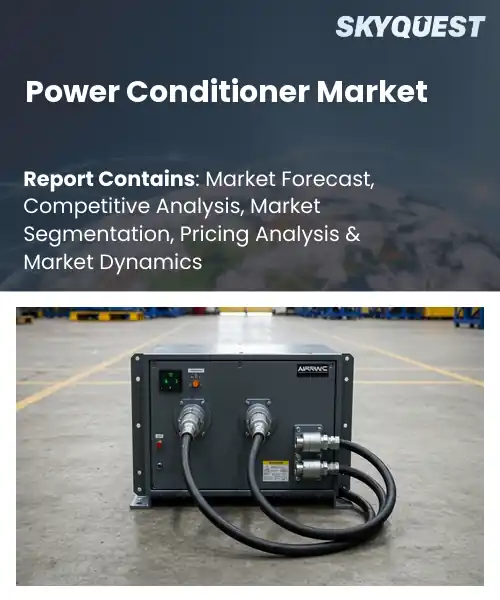
Power Conditioner Market
Report ID: SQMIG20D2727
Report ID: SQMIG20D2727
[email protected]
USA +1 351-333-4748
Report ID:
SQMIG20D2727 |
Region:
Global |
Published Date: July, 2026
Pages:
157
|Tables:
152
|Figures:
78


Global Power Conditioner Market size was valued at USD 7.2 Billion in 2024 and is poised to grow from USD 7.51 Billion in 2025 to USD 10.52 Billion by 2033, growing at a CAGR of 4.3% during the forecast period (2026-2033).
The primary driver of the power conditioner market as rising sensitivity of modern electronics to power quality disturbances. Power conditioners are devices that stabilize voltage, filter noise, and regulate frequency for industrial equipment, data centers, medical devices and consumer electronics, and their importance has grown as systems became more compact and digitally controlled. Historically the market evolved from passive surge protectors to sophisticated active conditioners and UPS-integrated solutions; telecom densification, stricter grid codes, and renewable integration accelerated adoption. For example, hospitals moved from simple isolation transformers to active conditioning to protect sensitive imaging equipment.
A key trend driving the global power conditioner sector growth is the accelerating integration of intermittent renewables and non-linear loads, which increase harmonic distortion and transient events, prompting facility managers to install conditioners. As wind and solar farms feed variable power, utilities and microgrids face voltage flicker that harms manufacturing and sensitive labs, so firms procure active voltage regulators and harmonic filters to maintain yield. Similarly, rapid expansion of hyperscale data centers drives demand for modular conditioned power architectures to guarantee five-nines availability, and widespread deployment of EV fast chargers creates harmonics that active conditioners mitigate, opening product and service opportunities for OEMs.
How is AI Optimizing Predictive Maintenance for Power Conditioners?
AI optimizes predictive maintenance for power conditioners by combining continuous sensor telemetry with machine learning that detects subtle anomalies in voltage, temperature, and vibration. Key aspects include condition based monitoring, anomaly detection, and automated diagnostics that translate raw signals into actionable alerts and work orders. The current state sees vendors integrating edge AI and cloud analytics so facilities can reduce unplanned outages and extend component life. Market demand is driven by data center growth and industrial electrification. Practical examples include remote diagnostics that pinpoint capacitor or cooling faults, and AI guided scheduling that shifts maintenance from reactive to planned intervention.
In January 2026, Vertiv announced its Next Predict AI powered predictive maintenance service that brings centralized condition intelligence across power systems. This innovation helps power conditioner operators by prioritizing repairs, reducing diagnostic cycles, and enabling more efficient maintenance planning which supports broader market adoption and operational resilience.
Market snapshot - (2026-2033)
Global Market Size
USD 7.2 Billion
Largest Segment
Voltage Regulator Power Conditioners
Fastest Growth
Active Power Conditioners
Growth Rate
4.3% CAGR
To get more insights on this market click here to Request a Free Sample Report
Global power conditioner market is segmented by type, phase, power rating, end user, application and region. Based on type, the market is segmented into constant voltage power conditioners, voltage regulator power conditioners, isolation transformer power conditioners, ferroresonant power conditioners, active power conditioners and others. Based on phase, the market is segmented into single phase and three phase. Based on power rating, the market is segmented into up to 10 kVA, 10–50 kVA, 50–150 kVA and above 150 kVA. Based on end user, the market is segmented into industrial, commercial and residential. Based on application, the market is segmented into manufacturing facilities, data centers, healthcare facilities, telecommunications, energy & utilities, commercial buildings, defense & aerospace and others. Based on region, the market is segmented into North America, Europe, Asia Pacific, Latin America and Middle East & Africa.
Based on the global power conditioner market growth, voltage regulator power conditioners segment dominates because these devices deliver precise voltage regulation that directly prevents equipment malfunctions and unplanned downtime, making them the default choice for environments with fluctuating supply. Their proven reliability, compatibility with a broad range of loads, and long operational life drive procurement by critical facilities. Manufacturers and facility engineers prefer the deterministic performance of voltage regulators, which simplifies system design and reduces maintenance costs while ensuring consistent power quality.
However, active power conditioners are emerging as the fastest growing area because they correct harmonic distortion and dynamic imbalances using adaptive real time control. Advances in power electronics and rising adoption for renewable integration and sensitive equipment are driving uptake, spawning modular offerings and service models that expand market opportunities.
Data Centers segment dominates because data centers impose the strictest uptime and power quality requirements, making advanced conditioners a procurement priority. Their dense racks and mission critical servers amplify the consequences of voltage disturbances, driving demand for robust conditioning technologies that integrate with UPS and power distribution strategies. Standards, service level agreements, and long equipment lifecycles compel operators to invest in power conditioners to protect assets and maintain continuous operations.
Meanwhile, healthcare facilities are emerging as the fastest growing area because diagnostic and life support equipment require ultra clean, uninterrupted power. Regulatory pressure and expansion of clinical technologies drive procurement of tailored conditioning solutions. This trend creates demand for specialized equipment and integrated power quality services focused on clinical risk mitigation.
To get detailed segments analysis, Request a Free Sample Report
As per the global power conditioner market share, Asia Pacific dominance is driven by a convergence of large manufacturing bases, deep electronics and semiconductor supply chains, and concentrated demand for reliable power in industrial and commercial applications. Regional strengths include extensive local component sourcing, competitive production costs, and a culture of rapid product development that supports tailored power conditioning solutions. High adoption in renewable energy integration and industrial automation fosters demand for grid support and power quality equipment. Strong presence of original equipment manufacturers and system integrators creates efficient distribution and service networks, enabling faster deployment and aftermarket support. Government initiatives encouraging infrastructure modernization and electrification further enhance market scale and technology adoption, positioning the region as both a production hub and innovation center for advanced power conditioning technologies.
Power conditioner market in Japan is defined by advanced industrial demand, high reliability expectations, and close collaboration between manufacturers and system integrators. Original equipment manufacturers prioritize quality and compact form factors suited to complex electronic environments. Strong focus on research and development and application in precision manufacturing and semiconductor fabrication fosters sophisticated product specifications. Aftermarket service networks emphasize preventive maintenance and integration with energy management systems to ensure continuous operation.
Power conditioner market in South Korea benefits from integration with electronics and automotive manufacturing ecosystems, driving demand for compact, high efficiency solutions. Collaboration between component suppliers and system OEMs accelerates product customization for factory automation and electric mobility. Emphasis on quality control and rapid deployment creates strong service networks and skilled installation partners. Policy alignment with industrial modernization encourages adoption of advanced power conditioning solutions across commercial and industrial segments.
Based on global power conditioner regional forecast, rapid expansion in North America stems from a combination of intensive infrastructure modernization, heightened demand from digital and critical facilities, and the ongoing integration of distributed energy resources. Utilities and large enterprise consumers prioritize power quality and resilience, encouraging deployment of sophisticated conditioning equipment. The market benefits from well developed aftermarket services, established channel partners, and a strong emphasis on system reliability within commercial and industrial procurement practices. Technological leadership and strategic partnerships between equipment manufacturers and solution providers accelerate product adaptation for data centers, healthcare, and manufacturing. Policy frameworks and incentive structures that reward reliability and grid stability also play a role, while urban and industrial renovation projects create steady retrofit demand for advanced power conditioning solutions. Investment in research and development supports integration with energy management platforms and enhances predictive maintenance capabilities.
Power conditioner market in United States is driven by demand from data centers, healthcare, and critical infrastructure requiring high reliability and rapid service response. Strong distributor networks enable wide deployment and maintenance coverage. Retrofit activity for older facilities and integration with energy management systems encourage modular and scalable solutions. Partnerships among equipment manufacturers, system integrators, and utilities support tailored implementations that address resilience, complex power quality requirements and uptime needs.
Power conditioner market in Canada reflects focus on grid resilience and adaptation to variable generation from distributed renewable sources across remote and urban areas. Collaboration between utilities and technology providers supports customized solutions for remote power systems and industrial operations. Emphasis on integration with microgrids and energy management platforms drives demand for adaptable, serviceable equipment. Local service providers facilitate timely maintenance and ensure alignment with regional reliability and sustainability priorities.
As per global power conditioner regional outlook, Europe is strengthening its industry position through a combination of regulatory harmonization, strong emphasis on energy efficiency, and active integration of renewable generation across interconnected grids. Grid code evolution and stricter power quality standards create demand for advanced conditioning solutions in both new installations and retrofit projects. Regional manufacturers and specialist integrators leverage deep expertise to tailor offerings for industrial, commercial, and utility applications, while cross border interconnections increase the need for coordinated power quality strategies. Investment in digitalization and predictive service models enhances lifecycle value and supports operator confidence. Sustainability priorities and procurement frameworks that favor efficient and resilient infrastructure further reinforce adoption of sophisticated power conditioning technologies across diverse end use sectors. Collaborative research programs and industry consortia also drive standard development and accelerate commercialization of next generation solutions.
Power conditioner market in Germany is driven by industrial automation, manufacturing, and rigorous focus on energy efficiency and reliability within utility networks. Domestic manufacturers and specialist integrators emphasize engineering quality and compliance with technical standards, producing robust solutions for new installations and retrofits. Demand is supported by interest in grid support functions and integration with renewable generation. Service ecosystems provide predictive maintenance and lifecycle management to optimize uptime and performance.
Power conditioner market in United Kingdom emphasizes urban infrastructure resilience, commercial building efficiency, and support for offshore and distributed generation. Integrators work with manufacturers to deliver tailored conditioning solutions that meet regulatory and performance expectations. Demand for retrofits and modern replacement systems is driven by the need to reduce operational disruption and enhance energy management. Integrated service frameworks, including monitoring and predictive maintenance, support asset reliability and strengthen customer confidence.
Power conditioner market in France is shaped by industrial demand, emphasis on energy transition, and modernization of utility infrastructure. Local manufacturers and engineering firms deliver bespoke solutions for manufacturing and transportation sectors. Integration with renewable generation and microgrid projects increases need for versatile conditioning equipment. Focus on operational efficiency drives uptake of service contracts and predictive maintenance. Collaborative programs between industry and utilities facilitate deployment and alignment with technical standards.
To know more about the market opportunities by region and country, click here to
Buy The Complete Report
Increasing Renewable Energy Integration
Rising Demand For Sensitive Equipment
High Initial Equipment Costs
Lack Of Standardized Regulations
Request Free Customization of this report to help us to meet your business objectives.
Competitive landscape in the global power conditioner market outlook is shaped by large incumbents using acquisitions and channel deals while deep tech entrants push device level innovation and software integration. Recent examples include Hitachi’s 2020 acquisition of ABB Power Grids for grid and power electronics scale, distribution partnerships like SurgeX with Accu Tech to expand channels, and startups such as Ionate commercializing Hybrid Intelligent Transformers for power quality.
Top Player’s Company Profile
Recent Developments
SkyQuest’s ABIRAW (Advanced Business Intelligence, Research & Analysis Wing) is our Business Information Services team that Collects, Collates, Correlates, and Analyses the Data collected by means of Primary Exploratory Research backed by robust Secondary Desk research.
As per SkyQuest analysis, rising sensitivity of modern electronics to power quality disturbances is a key driver of the global power conditioner industry, prompting adoption across data centers, healthcare and industrial sites. High initial equipment costs remain a primary restraint that slows uptake among cost-sensitive buyers. Asia Pacific dominates the market due to its manufacturing base, electronics supply chain and strong renewable integration. Voltage regulator power conditioners lead segmentally because of proven voltage stabilization and reliability for critical loads. A second driver accelerating growth is the increasing integration of intermittent renewables and non-linear loads which exacerbates harmonics and transients, driving demand for advanced active and hybrid conditioning solutions.
| Report Metric | Details |
|---|---|
| Market size value in 2024 | USD 7.2 Billion |
| Market size value in 2033 | USD 10.52 Billion |
| Growth Rate | 4.3% |
| Base year | 2024 |
| Forecast period | (2026-2033) |
| Forecast Unit (Value) | USD Billion |
| Segments covered |
|
| Regions covered | North America (US, Canada), Europe (Germany, France, United Kingdom, Italy, Spain, Rest of Europe), Asia Pacific (China, India, Japan, Rest of Asia-Pacific), Latin America (Brazil, Rest of Latin America), Middle East & Africa (South Africa, GCC Countries, Rest of MEA) |
| Companies covered |
|
| Customization scope | Free report customization with purchase. Customization includes:-
|
To get a free trial access to our platform which is a one stop solution for all your data requirements for quicker decision making. This platform allows you to compare markets, competitors who are prominent in the market, and mega trends that are influencing the dynamics in the market. Also, get access to detailed SkyQuest exclusive matrix.
Table Of Content
Executive Summary
Market overview
Parent Market Analysis
Market overview
Market size
KEY MARKET INSIGHTS
COVID IMPACT
MARKET DYNAMICS & OUTLOOK
Market Size by Region
KEY COMPANY PROFILES
Methodology
For the Power Conditioner Market, our research methodology involved a mixture of primary and secondary data sources. Key steps involved in the research process are listed below:
1. Information Procurement: This stage involved the procurement of Market data or related information via primary and secondary sources. The various secondary sources used included various company websites, annual reports, trade databases, and paid databases such as Hoover's, Bloomberg Business, Factiva, and Avention. Our team did 45 primary interactions Globally which included several stakeholders such as manufacturers, customers, key opinion leaders, etc. Overall, information procurement was one of the most extensive stages in our research process.
2. Information Analysis: This step involved triangulation of data through bottom-up and top-down approaches to estimate and validate the total size and future estimate of the Power Conditioner Market.
3. Report Formulation: The final step entailed the placement of data points in appropriate Market spaces in an attempt to deduce viable conclusions.
4. Validation & Publishing: Validation is the most important step in the process. Validation & re-validation via an intricately designed process helped us finalize data points to be used for final calculations. The final Market estimates and forecasts were then aligned and sent to our panel of industry experts for validation of data. Once the validation was done the report was sent to our Quality Assurance team to ensure adherence to style guides, consistency & design.
Analyst Support
Customization Options
With the given market data, our dedicated team of analysts can offer you the following customization options are available for the Power Conditioner Market:
Product Analysis: Product matrix, which offers a detailed comparison of the product portfolio of companies.
Regional Analysis: Further analysis of the Power Conditioner Market for additional countries.
Competitive Analysis: Detailed analysis and profiling of additional Market players & comparative analysis of competitive products.
Go to Market Strategy: Find the high-growth channels to invest your marketing efforts and increase your customer base.
Innovation Mapping: Identify racial solutions and innovation, connected to deep ecosystems of innovators, start-ups, academics, and strategic partners.
Category Intelligence: Customized intelligence that is relevant to their supply Markets will enable them to make smarter sourcing decisions and improve their category management.
Public Company Transcript Analysis: To improve the investment performance by generating new alpha and making better-informed decisions.
Social Media Listening: To analyze the conversations and trends happening not just around your brand, but around your industry as a whole, and use those insights to make better Marketing decisions.
REQUEST FOR SAMPLE
 REQUEST FREE CUSTOMIZATION
Global Power Conditioner Market size was valued at USD 7.2 Billion in 2024 and is poised to grow from USD 7.51 Billion in 2025 to USD 10.52 Billion by 2033, growing at a CAGR of 4.3% during the forecast period (2026-2033).
Competitive landscape in the global power conditioner market is shaped by large incumbents using acquisitions and channel deals while deep tech entrants push device level innovation and software integration. Recent examples include Hitachi’s 2020 acquisition of ABB Power Grids for grid and power electronics scale, distribution partnerships like SurgeX with Accu Tech to expand channels, and startups such as Ionate commercializing Hybrid Intelligent Transformers for power quality. 'Schneider Electric SE', 'Eaton Corporation plc', 'ABB Ltd.', 'Siemens AG', 'Emerson Electric Co.', 'Mitsubishi Electric Corporation', 'Fuji Electric Co., Ltd.', 'Toshiba Infrastructure Systems & Solutions Corporation', 'Legrand SA', 'Delta Electronics, Inc.', 'Socomec SAS', 'SolaHD (Emerson Electric Co.)', 'Advanced Energy Industries, Inc.', 'AMETEK, Inc.', 'MTE Corporation', 'Active Power, Inc.', 'Piller Power Systems GmbH', 'Cyber Power Systems, Inc.', 'Controlled Power Company', 'Hubbell Incorporated'
Integration of variable renewable energy sources into electricity grids increases demand for power conditioners because these devices condition fluctuating power quality, smooth voltage and frequency variations, and protect sensitive equipment. As renewable generation grows, grid operators and end users seek reliable conditioning to maintain stability and ensure uninterrupted operations, prompting investments in advanced power conditioning systems. Manufacturers respond by developing modular solutions with improved compatibility and resilience, which further stimulates market adoption across industrial, commercial, and utility segments where renewable penetration has changed power profiles.
Grid Edge Integration: Expansion of distributed generation and localized energy assets is shifting power conditioning needs to the grid edge. Utilities, microgrid developers, and commercial customers demand compact, interoperable conditioners that manage bi-directional flows, protect sensitive electronics, and enable seamless islanding. Emphasis on modular designs and communication-ready units supports flexible deployment and remote asset management. This trend favors vendors offering scalable, field-upgradable platforms and partnerships with system integrators to deliver end-to-end solutions that align with increasingly decentralized energy architectures globally.
Why does Asia Pacific Dominate the Global Power Conditioner Market? |@12


Want to customize this report? This report can be personalized according to your needs. Our analysts and industry experts will work directly with you to understand your requirements and provide you with customized data in a short amount of time. We offer $1000 worth of FREE customization at the time of purchase.
Feedback From Our Clients


 USA (+1) 351-333-4748

