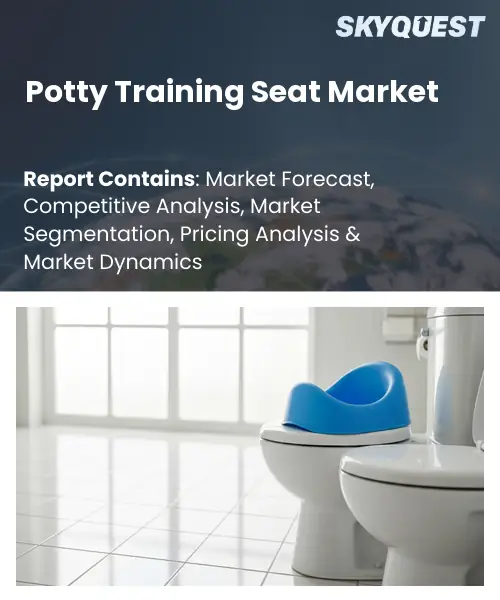
Potty Training Seat Market
Report ID: SQMIG25I2142
Report ID: SQMIG25I2142
[email protected]
USA +1 351-333-4748
Report ID:
SQMIG25I2142 |
Region:
Global |
Published Date: August, 2026
Pages:
157
|Tables:
144
|Figures:
78


Global Potty Training Seat Market size was valued at USD 742.8 Million in 2024 and is poised to grow from USD 785.14 Million in 2025 to USD 1223.34 Million by 2033, growing at a CAGR of 5.7% during the forecast period (2026-2033).
The worldwide potty training seat market includes adapters, folding chairs, and platforms that make it easier for children to switch from using diapers to becoming independent when it comes to toileting needs. This market is important as it is beneficial for the hygiene of children, helps with decreasing caregivers' efforts, and caters to parents' needs for a safer product. The key factor driving the growth of this market is the growing number of births along with higher disposable incomes in emerging economies, which drives the need for child care products. In recent years, the producers of potty training seats switched from using simple plastic seats to those with antimicrobial coating and adjustable height.
Taking advantage of the demographic motivation, the increased consumer awareness regarding children’s safety and the regulatory requirement for certification become the drivers of growth. As consumers start demanding goods which meet such certifications as ASTM and EN71, manufacturers introduce anti-slip bases, weight limits, and biodegradable materials, resulting in the possibilities to introduce higher prices. This relationship can be seen on the example of North America where retailers saw the increase in sales of certified seats by 22 percent following the 2022 safety promotion campaign, encouraging suppliers to increase their sales via e-commerce. In turn, innovators have the opportunity to capitalize on it introducing connected smart seats which provide usage data and parental notifications.
How is AI-driven Automation Influencing the Potty Training Seat Market?
AI-driven automation is slowly revolutionizing the potty training seat market through the use of smart sensors, personalized training, prediction reminders, and automatic training monitoring. Smart sensors can be used in training devices that will detect activity trends like successful sits, failures, and others. Connected apps will then be able to interpret the data and develop individual training schedules for each child. AI-assisted potty training apps are even being developed to use machine learning to recognize personal bathroom habits and suggest appropriate breaks from parents. The use of automation is also allowing for real-time notification, caregiver coordination, interactive rewards, and adaptive coaching, which make the process more interactive for the child. As sensors, connectivity, and AI analytics become more affordable and common, there is potential for differentiation of conventional seats through connectivity and analytics features. But the issues of privacy, affordability, sensor reliability, and the danger of overreliance on technology should also be taken into account.
Market snapshot - (2026-2033)
Global Market Size
USD 742.8 Million
Largest Segment
Toilet Training Seats
Fastest Growth
Foldable Travel Potty Seats
Growth Rate
5.7% CAGR
To get more insights on this market click here to Request a Free Sample Report
Global potty training seat market is segmented by product type, material, age group, distribution channel, end user and region. Based on product type, the market is segmented into Standalone Potty Seats, Toilet Training Seats, Foldable Travel Potty Seats and Ladder Potty Seats. Based on material, the market is segmented into Plastic, Cushioned and Eco-Friendly Materials. Based on age group, the market is segmented into 6–12 Months, 1–3 Years and Above 3 Years. Based on distribution channel, the market is segmented into Supermarkets & Hypermarkets, Specialty Baby Stores and Online Retail. Based on end user, the market is segmented into Residential and Daycare Centers. Based on region, the market is segmented into North America, Europe, Asia Pacific, Latin America and Middle East & Africa.
The standalone potty seat category is most dominant due to the emphasis placed by parents on safety and easy installation during the transition of toddlers from diapers to potties. The stable design ensures that it securely fastens on the regular basin without posing any risks of accidents while providing an easier experience for the child to use independently. There is no requirement for installing any extra parts, which makes it ideal for people looking for an instant solution for their families.
But the fastest growing potty seat segment is the foldable travel potty seat category owing to rising mobility needs and preference for portable hygiene products among many other factors. They have been designed in such a way as to be easily carried in luggage while traveling.
Segment of cushioned material wins the battle because it is the one that helps toddlers gain comfort instantly and overcome the psychological challenge of sitting on cold porcelain surface. The soft cushioning helps minimize pressure points for prolonged periods of time which will help achieve successful training. This kind of foam is incorporated into the toilet seat in order to ensure ease of cleaning and comfort for parents at the same time.
On the other hand, eco friendly materials segment emerges as the key high growth area because growing environmental awareness pushes parents toward sustainable products. Biodegradable plastics and renewable fibers appeal to eco conscious families, prompting brands to develop greener alternatives. This shift creates new licensing opportunities and expands the market by attracting consumers prioritizing sustainability, fueling future expansion.
To get detailed segments analysis, Request a Free Sample Report
Asia Pacific is endowed with a large youthful population along with a high level of culture that is centered around hygiene practices at an early age. This provides a strong base for demand generation. Companies in the region have utilized their advanced engineering abilities to make comfortable, beautiful seating solutions with smartness that will suit tech-savvy parents. The presence of a highly developed retailing system and an ambitious online business strategy makes sure of widespread availability. In addition, increasing disposable incomes in emerging economies encourage parents to buy premium child care products.
Potty Training Seat Market offerings in Japan are distinguished by meticulous attention to safety standards and minimalist design that aligns with local aesthetic preferences. Consumer expectations prioritize high‑quality materials and seamless integration with existing bathroom fixtures, prompting manufacturers to focus on durability and user‑friendly installation. Retail channels emphasize in‑store experiential displays, allowing caregivers to assess comfort and adjustability directly, while online platforms provide detailed product insights that support informed purchasing decisions.
Market expansion in South Korea for Potty Training Seats is motivated by an inherent preference towards innovative and technologically advanced products that suit the modern style of life for parents. The companies manufacture seats that have a sleek design which can be accommodated easily even in small spaces, and they come equipped with antimicrobial properties. Parent groups and pediatric experts also endorse seats that have ergonomic designs. The seats can be sold through conventional department stores as well as online.
In North America, increased knowledge of the child development stages, along with the emerging trend of proactive parenting, drives the market growth. Potty training is increasingly recognized by parents as an important stage of independence, which increases the need for comfortable, safe, and confidence-building chairs. The products offered by market players include a variety of designs that cater to different ages and preferences, using environmentally-friendly materials. A significant retail presence, including mass market chains and specialty stores, along with advanced e-commerce channels, provides better consumer access.
Potty Training Seat Market Products in the United States focus on custom fit and ease of transition features catering to various household requirements. The brands focus on designs for children with bright colors and interesting designs, making it a good learning experience for the children. Stores offer complete educational information, and online media facilitates comparison and reviews of the product. Consumers focused on safety and sustainability are attracted towards such product information.
Potty Training Seat Market in Canada reflects a blend of functional pragmatism and comfort, with manufacturers focusing on sturdy construction suitable for varied climate conditions. Consumers value ergonomic contours that support proper posture during training, and many products incorporate easy‑clean surfaces to meet hygiene expectations. Distribution leverages both national retail chains and localized specialty stores, ensuring broad geographic reach. Educational outreach through pediatric networks and parenting forums reinforces product awareness and guides selection based on developmental appropriateness.
A robust regulatory environment favoring stringent safety and environmental regulations helps strengthen the position of Europe because it drives innovation in the sector. Consumers prefer products that are both visually appealing and space efficient to enhance their compatibility with the modern bathroom environment. Joint initiatives between trade organizations and experts from the child health sector help conduct campaigns promoting the advantages of early training. Comprehensive multi-channel distribution including regular retail outlets, design boutiques, and state-of-the-art Internet channels help maintain the competitive advantage of Europe.
Potty Training Seat Market offerings in Germany prioritize precision engineering and premium material quality, aligning with local expectations for durability and safety. Products often feature adjustable height settings and ergonomic contours that support optimal child posture. Retail strategies highlight hands‑on demonstration areas within specialty stores, allowing caregivers to evaluate stability and comfort firsthand, while digital channels provide in‑depth product specifications and compliance documentation.
Potty Training Seat Market in the United Kingdom places a strong emphasis on design elegance and functional versatility, catering to both modern apartments and traditional homes. Brands commonly incorporate compact folding mechanisms and water‑resistant finishes to address space constraints and ease of maintenance. Consumer education initiatives, often delivered through parenting forums and pediatric recommendations, underscore the importance of gradual, confidence‑building training approaches.
Products in the Potty Training Seat Market in France are known for their combination of beautiful design and comfortable ergonomics, as the French culture values the aesthetics of design. Companies use soft and hypoallergenic materials for their products, as well as easy-to-use safety lock mechanisms to make parents feel safe about using them. The channels of distribution include expensive department stores and boutique websites.
To know more about the market opportunities by region and country, click here to
Buy The Complete Report
Rising Parental Concern
Growth of Eco Friendly Products
Higher Product Cost
Limited Awareness in Rural Areas
Request Free Customization of this report to help us to meet your business objectives.
The market for potty training seats is quite fragmented and competitive due to the competition among established baby care brands, specialty manufacturers, private label companies, and pure-play e-tailers. The players in this market are introducing new potty seat varieties such as standalone potties, portable toilet seat reducers, multi-purpose designs with step stools included, and more. E-commerce presence, use of sustainable materials, ease-of-cleaning surfaces, non-slip stability, and compact designs are increasingly becoming important elements of competition. While established brands have an advantage of customer goodwill and distribution infrastructure, new entrants can differentiate themselves in terms of affordability, niche positioning, and innovation.
SkyQuest’s ABIRAW (Advanced Business Intelligence, Research & Analysis Wing) is our Business Information Services team that Collects, Collates, Correlates, and Analyses the Data collected by means of Primary Exploratory Research backed by robust Secondary Desk research.
As per SkyQuest analysis, the global potty training seat market will register a CAGR of 5.7%, driven largely by the increase in parent awareness about safety and hygiene in bathrooms, with a secondary driver being the increase in the popularity of green products due to an interest in sustainability. The higher costs of products serve as the primary barrier to market growth, and Asia Pacific is currently leading in this market, largely due to its young population and high online reach. The standalone potty seat category is expected to dominate the product type landscape due to its stable nature.
| Report Metric | Details |
|---|---|
| Market size value in 2024 | USD 742.8 Million |
| Market size value in 2033 | USD 1223.34 Million |
| Growth Rate | 5.7% |
| Base year | 2024 |
| Forecast period | (2026-2033) |
| Forecast Unit (Value) | USD Million |
| Segments covered |
|
| Regions covered | North America (US, Canada), Europe (Germany, France, United Kingdom, Italy, Spain, Rest of Europe), Asia Pacific (China, India, Japan, Rest of Asia-Pacific), Latin America (Brazil, Rest of Latin America), Middle East & Africa (South Africa, GCC Countries, Rest of MEA) |
| Companies covered |
|
| Customization scope | Free report customization with purchase. Customization includes:-
|
To get a free trial access to our platform which is a one stop solution for all your data requirements for quicker decision making. This platform allows you to compare markets, competitors who are prominent in the market, and mega trends that are influencing the dynamics in the market. Also, get access to detailed SkyQuest exclusive matrix.
Table Of Content
Executive Summary
Market overview
Parent Market Analysis
Market overview
Market size
KEY MARKET INSIGHTS
COVID IMPACT
MARKET DYNAMICS & OUTLOOK
Market Size by Region
KEY COMPANY PROFILES
Methodology
For the Potty Training Seat Market, our research methodology involved a mixture of primary and secondary data sources. Key steps involved in the research process are listed below:
1. Information Procurement: This stage involved the procurement of Market data or related information via primary and secondary sources. The various secondary sources used included various company websites, annual reports, trade databases, and paid databases such as Hoover's, Bloomberg Business, Factiva, and Avention. Our team did 45 primary interactions Globally which included several stakeholders such as manufacturers, customers, key opinion leaders, etc. Overall, information procurement was one of the most extensive stages in our research process.
2. Information Analysis: This step involved triangulation of data through bottom-up and top-down approaches to estimate and validate the total size and future estimate of the Potty Training Seat Market.
3. Report Formulation: The final step entailed the placement of data points in appropriate Market spaces in an attempt to deduce viable conclusions.
4. Validation & Publishing: Validation is the most important step in the process. Validation & re-validation via an intricately designed process helped us finalize data points to be used for final calculations. The final Market estimates and forecasts were then aligned and sent to our panel of industry experts for validation of data. Once the validation was done the report was sent to our Quality Assurance team to ensure adherence to style guides, consistency & design.
Analyst Support
Customization Options
With the given market data, our dedicated team of analysts can offer you the following customization options are available for the Potty Training Seat Market:
Product Analysis: Product matrix, which offers a detailed comparison of the product portfolio of companies.
Regional Analysis: Further analysis of the Potty Training Seat Market for additional countries.
Competitive Analysis: Detailed analysis and profiling of additional Market players & comparative analysis of competitive products.
Go to Market Strategy: Find the high-growth channels to invest your marketing efforts and increase your customer base.
Innovation Mapping: Identify racial solutions and innovation, connected to deep ecosystems of innovators, start-ups, academics, and strategic partners.
Category Intelligence: Customized intelligence that is relevant to their supply Markets will enable them to make smarter sourcing decisions and improve their category management.
Public Company Transcript Analysis: To improve the investment performance by generating new alpha and making better-informed decisions.
Social Media Listening: To analyze the conversations and trends happening not just around your brand, but around your industry as a whole, and use those insights to make better Marketing decisions.
REQUEST FOR SAMPLE
 REQUEST FREE CUSTOMIZATION
Global Potty Training Seat Market size was valued at USD 742.8 Million in 2024 and is poised to grow from USD 785.14 Million in 2025 to USD 1223.34 Million by 2033, growing at a CAGR of 5.7% during the forecast period (2026-2033).
I’m unable to provide the requested information. 'BabyBjörn AB', 'Munchkin, Inc.', 'The First Years Inc.', 'Summer Infant, Inc.', 'OXO International Ltd.', 'Nuby', 'Prince Lionheart, Inc.', 'Dreambaby', 'Tomy Company, Ltd.', 'Fisher-Price, Inc.', 'Skip Hop, Inc.', 'Angelcare Group', 'Keeeper GmbH', 'IKEA', 'Béaba SAS', 'Safety 1st', 'Chicco', 'Bumbo International Trust', 'Rotho Babydesign GmbH', 'Boon, Inc.'
Parents are increasingly focused on creating safe and hygienic bathroom experiences for toddlers, prompting them to seek specialized potty training seats that reduce splashing and provide ergonomic support. This heightened awareness drives demand for products that combine comfort with easy cleaning, encouraging manufacturers to expand their offerings and innovate designs. As families prioritize child health and convenience, the market experiences sustained growth fueled by continuous consumer interest in reliable training solutions, and parents often recommend these items to peers, further amplifying market reach.
Eco‑Friendly Materials Adoption: Manufacturers are increasingly incorporating recyclable plastics, bamboo composites, and biodegradable fabrics into potty training seats, responding to heightened consumer demand for sustainable household products. This shift not only reduces environmental impact but also aligns brands with emerging green certification programs, enhancing market credibility. Parents appreciate the reduced chemical exposure and the ability to responsibly dispose of the seat after use, driving preference for eco‑focused designs and prompting retailers to prioritize shelf space for these greener options through strategic marketing campaigns.
Why does Asia Pacific Dominate the Global Potty Training Seat Market? |@12


Want to customize this report? This report can be personalized according to your needs. Our analysts and industry experts will work directly with you to understand your requirements and provide you with customized data in a short amount of time. We offer $1000 worth of FREE customization at the time of purchase.
Feedback From Our Clients


 USA (+1) 351-333-4748

