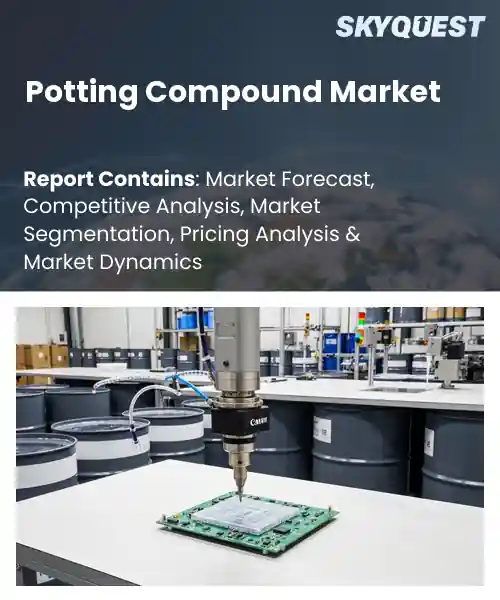
Potting Compound Market
Report ID: SQMIG15E3471
Report ID: SQMIG15E3471
[email protected]
USA +1 351-333-4748
Report ID:
SQMIG15E3471 |
Region:
Global |
Published Date: May, 2026
Pages:
157
|Tables:
181
|Figures:
79


Global Potting Compound Market size was valued at USD 3.17 Billion in 2024 and is poised to grow from USD 3.3 Billion in 2025 to USD 4.59 Billion by 2033, growing at a CAGR of 4.2% during the forecast period (2026-2033).
Miniaturization and increasing reliability demands in electronics constitute the primary driver of the potting compound market, as denser assemblies generate greater thermal stress, moisture ingress and vibration. Potting compounds, which encapsulate electronic components in resins like epoxy, silicone, and polyurethane, matter because they extend device lifetime and enable harsher operating environments. Historically the market evolved from basic moisture protection for transformers and relays to sophisticated formulations for LED lighting, automotive sensors, and telecommunications equipment, where thermal conductivity and low stress are critical. For example, silicone gels replaced rigid epoxies in sensitive optoelectronics to reduce mechanical strain and improve thermal dissipation.As electronics and power systems grow more compact, rising electrification and 5G deployment act as a key factor driving demand for advanced potting compounds because they create concentrated heat and stricter electromagnetic compatibility requirements. Electric vehicle power modules and BMS illustrate the effect; higher current densities cause thermal bottlenecks, which prompt adoption of thermally conductive epoxies and silicones to maintain reliability. Similarly, 5G radio units exposed to outdoor environments increase need for tough, UV-stable formulations that prevent corrosion and signal degradation. These cause manufacturers to invest in tailored chemistries and processes, creating opportunities for specialty suppliers and co-development partnerships globally.
How is AI enhancing quality control in the potting compound market?
AI is improving quality control in the potting compound market by combining smart sensing with advanced analytics. Key aspects include automated visual inspection that detects surface defects and voids, sensor driven monitoring of mixing and curing, and machine learning models that flag process drift and predict failures. Today manufacturers are adopting inline cameras, infrared and spectroscopy monitoring, and digital twins to standardize batches and reduce rework. These tools make qualification of new formulations more data driven and more predictable, which increases confidence among electronics and automotive customers who need consistent insulation and thermal performance.Henkel January 2026, announced a next generation polyurethane potting compound and AI enabled process analytics can pair with such launches to ensure batch consistency and speed qualification. That support helps the market by improving throughput and reducing costly rework and strengthens customer confidence in new formulations.
Market snapshot - (2026-2033)
Global Market Size
USD 3.17 Billion
Largest Segment
Epoxy
Fastest Growth
Silicone
Growth Rate
4.2% CAGR
To get more insights on this market click here to Request a Free Sample Report
Global potting compound market is segmented by product type, formulation type, curing method, application, end-use industry, distribution channel and region. Based on product type, the market is segmented into Epoxy Potting Compounds, Silicone Potting Compounds, Polyurethane Potting Compounds, Acrylic Potting Compounds, Polyester Potting Compounds and Others. Based on formulation type, the market is segmented into One-Component Potting Compounds and Two-Component Potting Compounds. Based on curing method, the market is segmented into Heat Cure, UV Cure and Room Temperature Cure. Based on application, the market is segmented into Encapsulation, Insulation, Vibration & Shock Protection, Moisture & Chemical Protection and Thermal Management. Based on end-use industry, the market is segmented into Electronics & Semiconductors, Automotive & EV, Industrial Equipment, Aerospace & Defense, Telecommunications, Energy & Power, Consumer Electronics, Medical Devices and Others. Based on distribution channel, the market is segmented into Direct Sales, Distributors & Specialty Suppliers and Online Sales. Based on region, the market is segmented into North America, Europe, Asia Pacific, Latin America and Middle East & Africa.
Epoxy Potting Compounds segment dominates because epoxy resins provide superior mechanical rigidity, chemical resistance and durable electrical insulation that protect sensitive components against harsh operating conditions. Their strong adhesion to diverse substrates and excellent thermal stability reduce failure modes associated with mechanical stress and environmental exposure, prompting designers to specify epoxies for long-life assemblies. Stringent reliability requirements and broad applicability across electronics and industrial equipment drive consistent preference for epoxy-based potting.
However, Silicone Potting Compounds are witnessing the strongest growth momentum because their inherent flexibility and thermal cycling resilience suit applications with vibration and thermal mismatch concerns. Ongoing innovations in silicone chemistries and improved adhesion and thermal conductivity options expand their use in automotive electrification and power electronics, enabling designers to address mechanical stress while unlocking new application areas and faster qualification pathways.
Room Temperature Cure segment leads because formulations that harden without external heat allow safe processing of heat sensitive components and substrates while simplifying production workflows. Eliminating elevated cure temperatures reduces thermal stress, lowers equipment needs and supports diverse assembly setups, making these systems attractive for complex, mixed-technology manufacturing. Demand for gentle, energy efficient processing and compatibility with delicate semiconductors and sensors drives widespread adoption of room temperature curing solutions.
However, UV Cure potting compounds are emerging as the most rapidly expanding area given their rapid, on-demand curing and compatibility with automated production lines. Advances in photoinitiator systems and LED curing technology enable localized, fast cures that shorten cycle times and support precision applications in consumer electronics and telecom, creating new process efficiencies and opening opportunities for high-volume, tightly controlled manufacturing.
To get detailed segments analysis, Request a Free Sample Report
Asia Pacific dominates the global potting compound market due to concentrated electronics manufacturing clusters, deep supplier ecosystems and specialized material producers across the region. High demand for reliable electronics protection in consumer devices, automotive modules and industrial equipment drives adoption of advanced encapsulation solutions. Japan and South Korea contribute strong research and development capabilities, high quality standards and tight integration between resin suppliers and original equipment manufacturers, accelerating product innovation. Cost competitive manufacturing and established supply chains enable rapid scale up and customization for diverse end uses. Supportive regulatory frameworks for electronics reliability and proximity to component suppliers further strengthen regional resilience. Mature aftermarket and repair networks enable feedback loops that refine potting compound specifications.
Potting Compound Market in Japan benefits from dense clusters of precision electronics and automotive suppliers, driving demand for high reliability formulations. Manufacturers emphasize research, quality control and compatibility with small semiconductor assemblies. Close collaboration between material scientists and original equipment manufacturers yields specialized compounds tailored to stringent performance and thermal management requirements. A robust testing and certification ecosystem supports qualification, reinforcing preference for premium potting solutions within domestic export industries.
Potting Compound Market in South Korea is driven by a strong semiconductor manufacturing base that demands high performance encapsulation. Suppliers focus on thermal management, low stress formulations and compatibility with advanced packaging and display assemblies. Collaboration between material developers and manufacturers accelerates custom formulation adoption for automotive electronics and industrial modules. Process integration and emphasis on reliability testing promote product qualification and sustained procurement by major domestic and regional customers.
North America experiences rapid expansion in the potting compound market fueled by a diverse industrial manufacturing base and strong demand for durable electronics across automotive, aerospace and industrial sectors. OEM focus on reliability and long service life for power electronics promotes adoption of advanced encapsulants with tailored thermal and mechanical properties. Close collaboration between material suppliers and system integrators enables fast customization for harsh environment applications, including mobility and infrastructure equipment. Regulatory emphasis on safety and environmental compliance motivates development of lower emission and higher performance formulations. Research institutions and universities work with industry to refine formulations and accelerate qualification cycles. Investment in electric vehicle charging infrastructure and grid modernization further increases need for robust potting solutions across power electronic applications.
Potting Compound Market in United States is driven by large automotive, aerospace and industrial original equipment manufacturers demanding high reliability encapsulants. Suppliers create formulations for harsh environments, thermal management and electromagnetic compatibility. Strong ties between material producers and defense contractors accelerate product qualification and bespoke solutions. Extensive testing infrastructure and regulatory focus support adoption for electric mobility, power conversion and mission critical equipment across multiple industrial segments and commercial applications.
Potting Compound Market in Canada emphasizes ruggedized solutions for harsh climate applications. Demand comes from automotive supply chains, power generation and resource electronics requiring durable encapsulation and thermal resilience. Suppliers favor environmentally compliant formulations and collaborate with system integrators to address field service needs. Proximity to North America OEMs and an established distribution network enable targeted deployment of specialized potting solutions across regional industries. Local research hubs support material development.
Europe is strengthening its position in the potting compound market through a combination of advanced materials expertise, cross border industrial collaboration and stringent regulatory standards that demand high reliability and environmental performance. Key manufacturing clusters drive demand from automotive electrification, industrial automation and renewable energy sectors, prompting suppliers to develop low emission and high durability encapsulants. Strong chemical industry competencies and specialized formulation labs enable rapid customization, while certification frameworks and OEM partnerships streamline qualification. Collaborative innovation initiatives among manufacturers, research centers and testing bodies accelerate adoption of application specific potting solutions and reinforce Europe as a hub for premium, regulation compliant materials. Investment in sustainable chemistries and circular material approaches attracts OEM interest and supports lifecycle considerations. Close proximity of suppliers and standardized testing across borders reduces lead times and supports pan European projects.
Potting Compound Market in Germany is anchored by a strong automotive and industrial engineering base demanding high performance encapsulants. Suppliers emphasize formulations that meet strict automotive quality and thermal management requirements for power electronics. Close collaboration with original equipment manufacturers and tier suppliers enables tailored compound development and rigorous qualification. A dense testing and certification ecosystem and focus on manufacturing excellence support adoption in mobility, industrial automation and energy conversion.
Potting Compound Market in United Kingdom benefits from strong research capabilities that support rapid material innovation. Demand comes from defense, telecommunications and advanced mobility projects requiring specialized encapsulants with performance and compliance credentials. Links between formulation experts, testing laboratories and system integrators enable accelerated qualification of bespoke compounds. A supportive ecosystem of technology developers and service providers fosters commercialization of application specific potting solutions across domestic and regional export programs.
Potting Compound Market in France leverages a strong chemical sector and industrial customer base that drive demand for tailored encapsulants. Suppliers adapt formulations to meet requirements from automotive electronics, energy conversion and industrial control systems where durability and thermal performance are critical. Collaboration with research institutes and testing centers accelerates development of environmentally mindful formulations. A network of service providers and partnerships supports qualification and deployment across domestic export markets.
To know more about the market opportunities by region and country, click here to
Buy The Complete Report
Expansion In Electronics Manufacturing
Rising Use In Electrical Insulation
Stringent Environmental Regulations
Volatility In Raw Material Availability
Request Free Customization of this report to help us to meet your business objectives.
Competition in the global potting compound market is driven by product differentiation, thermal management needs in power electronics, and supplier consolidation; leading firms execute acquisitions, integrate niche formulators, and form technology partnerships to secure thermally conductive and flame retardant chemistries. Specific examples include Dow’s thermally conductive silicone launch, Kisling’s integration of Copaltec capabilities, and Mitsui Chemicals’ strategic tie ups in printed encapsulation development.
Top Player’s Company Profile
Recent Developments
SkyQuest’s ABIRAW (Advanced Business Intelligence, Research & Analysis Wing) is our Business Information Services team that Collects, Collates, Correlates, and Analyses the Data collected by means of Primary Exploratory Research backed by robust Secondary Desk research. As per SkyQuest analysis, the global potting compound market is being propelled by miniaturization and rising reliability demands in electronics, while a second driver is electrification and 5G deployment that increase thermal loads and demand advanced formulations. Growth is constrained by stringent environmental regulations that force reformulation, lengthen approvals and raise development costs. Asia Pacific dominates the market given its dense electronics manufacturing clusters, supplier ecosystems and rapid scale up capabilities. Epoxy potting compounds are the dominant segment because of their mechanical rigidity, chemical resistance and thermal stability that suit long-life assemblies. Overall, opportunities center on tailored chemistries, AI-enabled quality control and sustainable reformulation to meet evolving industry needs.
| Report Metric | Details |
|---|---|
| Market size value in 2024 | USD 3.17 Billion |
| Market size value in 2033 | USD 4.59 Billion |
| Growth Rate | 4.2% |
| Base year | 2024 |
| Forecast period | (2026-2033) |
| Forecast Unit (Value) | USD Billion |
| Segments covered |
|
| Regions covered | North America (US, Canada), Europe (Germany, France, United Kingdom, Italy, Spain, Rest of Europe), Asia Pacific (China, India, Japan, Rest of Asia-Pacific), Latin America (Brazil, Rest of Latin America), Middle East & Africa (South Africa, GCC Countries, Rest of MEA) |
| Companies covered |
|
| Customization scope | Free report customization with purchase. Customization includes:-
|
To get a free trial access to our platform which is a one stop solution for all your data requirements for quicker decision making. This platform allows you to compare markets, competitors who are prominent in the market, and mega trends that are influencing the dynamics in the market. Also, get access to detailed SkyQuest exclusive matrix.
Table Of Content
Executive Summary
Market overview
Parent Market Analysis
Market overview
Market size
KEY MARKET INSIGHTS
COVID IMPACT
MARKET DYNAMICS & OUTLOOK
Market Size by Region
KEY COMPANY PROFILES
Methodology
For the Potting Compound Market, our research methodology involved a mixture of primary and secondary data sources. Key steps involved in the research process are listed below:
1. Information Procurement: This stage involved the procurement of Market data or related information via primary and secondary sources. The various secondary sources used included various company websites, annual reports, trade databases, and paid databases such as Hoover's, Bloomberg Business, Factiva, and Avention. Our team did 45 primary interactions Globally which included several stakeholders such as manufacturers, customers, key opinion leaders, etc. Overall, information procurement was one of the most extensive stages in our research process.
2. Information Analysis: This step involved triangulation of data through bottom-up and top-down approaches to estimate and validate the total size and future estimate of the Potting Compound Market.
3. Report Formulation: The final step entailed the placement of data points in appropriate Market spaces in an attempt to deduce viable conclusions.
4. Validation & Publishing: Validation is the most important step in the process. Validation & re-validation via an intricately designed process helped us finalize data points to be used for final calculations. The final Market estimates and forecasts were then aligned and sent to our panel of industry experts for validation of data. Once the validation was done the report was sent to our Quality Assurance team to ensure adherence to style guides, consistency & design.
Analyst Support
Customization Options
With the given market data, our dedicated team of analysts can offer you the following customization options are available for the Potting Compound Market:
Product Analysis: Product matrix, which offers a detailed comparison of the product portfolio of companies.
Regional Analysis: Further analysis of the Potting Compound Market for additional countries.
Competitive Analysis: Detailed analysis and profiling of additional Market players & comparative analysis of competitive products.
Go to Market Strategy: Find the high-growth channels to invest your marketing efforts and increase your customer base.
Innovation Mapping: Identify racial solutions and innovation, connected to deep ecosystems of innovators, start-ups, academics, and strategic partners.
Category Intelligence: Customized intelligence that is relevant to their supply Markets will enable them to make smarter sourcing decisions and improve their category management.
Public Company Transcript Analysis: To improve the investment performance by generating new alpha and making better-informed decisions.
Social Media Listening: To analyze the conversations and trends happening not just around your brand, but around your industry as a whole, and use those insights to make better Marketing decisions.
REQUEST FOR SAMPLE
 REQUEST FREE CUSTOMIZATION


Want to customize this report? This report can be personalized according to your needs. Our analysts and industry experts will work directly with you to understand your requirements and provide you with customized data in a short amount of time. We offer $1000 worth of FREE customization at the time of purchase.
Feedback From Our Clients


 USA (+1) 351-333-4748

