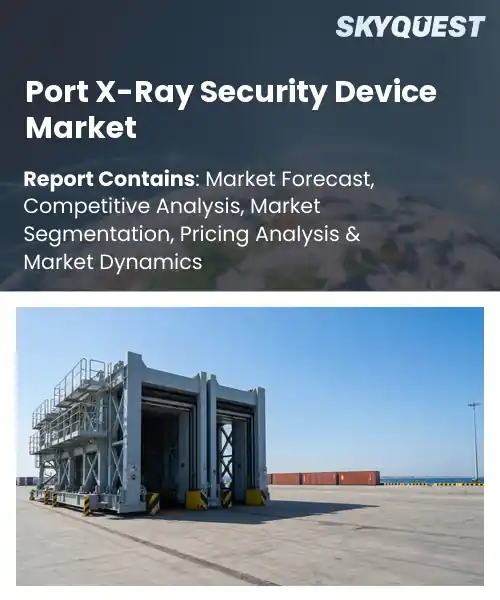
Port X-Ray Security Device Market
Report ID: SQMIG45J2810
Report ID: SQMIG45J2810
[email protected]
USA +1 351-333-4748
Report ID:
SQMIG45J2810 |
Region:
Global |
Published Date: August, 2026
Pages:
157
|Tables:
143
|Figures:
78


Global Port X-Ray Security Device Market size was valued at USD 3.86 Billion in 2024 and is poised to grow from USD 4.13 Billion in 2025 to USD 7.16 Billion by 2033, growing at a CAGR of 7.1% during the forecast period (2026-2033).
The Port X-Ray Security Device market growth is pushed forward by all that rising international container traffic, along with bigger worries around smuggling, narcotics, weapons explosives, and other questionable radioactive stuff… plus the clear need for faster non-intrusive checks. Port authorities are rolling out mobile , fixed and drive-through X-ray scanners so they can look inside containers without unloading cargo. That cuts down the inspection time and helps customs move more efficiently. The more advanced units can swallow high container volumes while still producing very detailed images for spotting hidden threats. On top of that, government security rules and ongoing investments in port modernization keep giving this space momentum.
For instance, JNPA put out a 2025 tender for three mobile X-ray container scanning systems, so it looks like they’re still investing in automated cargo screening infrastructure. And when integration with radiation detection, material discrimination, and automated analysis is added, demand gets an extra lift too.
AI is changing the port X-ray security device market outlook by embedding deep learning models that can read cargo images in real time. The models learn the difference between ordinary items and contraband, which helps reduce false alarms and speeds up inspections. Newer scanners pair high-resolution imaging with neural networks that bring out suspicious shapes and materials. Operators then get clear visual cues, like focusing attention on high-risk zones, which lets them make quicker calls. The market is leaning more toward systems that mix tough, reliable hardware with software that can adapt. Ports want to handle growing freight volumes, but without lowering safety margins. In the end, these improvements create a steadier detection environment, and that also boosts overall throughput.
Market snapshot - (2026-2033)
Global Market Size
USD 3.86 Billion
Largest Segment
Baggage Scanners
Fastest Growth
Vehicle Scanners
Growth Rate
7.1% CAGR
To get more insights on this market click here to Request a Free Sample Report
The global port x-ray security device market is segmented by device type, technology, application, end user, mobility and region. Based on device type, the market is segmented into Baggage Scanners, Cargo Scanners and Vehicle Scanners. Based on technology, the market is segmented into Single-View, Dual-View and Computed Tomography. Based on application, the market is segmented into Cargo Inspection, Passenger Screening and Vehicle Inspection. Based on end user, the market is segmented into Ports, Customs Authorities and Border Security Agencies. Based on mobility, the market is segmented into Fixed and Mobile. Based on region, the market is segmented into North America, Europe, Asia Pacific, Latin America and Middle East & Africa.
As per the port x-ray security device market analysis, the baggage scanners segment dominates simply because port operations want rapid passenger flow, but they must also keep security strict, not a lot of downtime and all that. These scanners give staff an immediate visual look at luggage, and in practice that means contraband can be spotted faster without creating those annoying backlogs. Also, they’re reliable; they are easy to plug into the existing conveyor setups, and false alarms stay low, so terminals keep choosing them again and again. So, investment and procurement tilt toward this tech, which keeps the leadership going and supports steady growth.
At the same time, Cargo Scanners are building the strongest growth momentum, mostly since global trade keeps expanding, and ports need more serious container inspection to reduce smuggling risks. The newer imaging options provide a three-dimensional view of what’s inside, which helps with stricter rules that demand higher detection accuracy. That then translates into fresh deployments and also creates market expansion openings, quite meaningfully.
According to the port x-ray security device market forecast, computed tomography leads because it produces volumetric imaging, showing hidden dangers inside heavier cargo and luggage, and it clearly goes beyond what planar scans can do. With 3D reconstruction, detection confidence goes up, and operators rely less on manual reinspection. Because of that, ports treat CT as more precise for high risk shipments, so budgets end up shifting toward CT solutions, and that supports its market dominance. On top of that, it scales across different throughput levels, and it fits into existing workflows smoothly, so adoption keeps moving.
Still, Dual View systems are emerging as the high-growth segment, because they use two orthogonal angles, so the device can separate threats better, even though it avoids the full CT cost. Ports like the trade-off: improved discrimination with a lower capital outlay, and as a result adoption can happen quickly, then the market expands across ports worldwide.
To get detailed segments analysis, Request a Free Sample Report
As per the port x-ray security device market regional forecast, North America benefits from an integrated maritime setup, leaning hard on security, and also operational efficiency, not in a small way either. Basically, robust regulatory frameworks tend to push the adoption of newer scanning technologies, while the top manufacturers plus research institutions keep feeding continuous innovation. There’s also this extensive chain of major ports, which supports big scale deployment, and the region keeps insisting on supply chain resilience, so there is ongoing investment in detection capabilities. When government agencies, port authorities, and technology providers work together, it makes a supportive ecosystem, and that ecosystem speeds up implementation while keeping consistent performance benchmarks. In turn this helps reinforce the market leadership of North America, which is a big deal.
United States Port X-Ray Security Device Market
The Port X-Ray Security Device Market outlook in the United States is shaped by a proactive security posture and meaningful spending on port modernization. Federal guidance pushes stringent cargo inspection , which in turn encourages operators to adopt high resolution imaging solutions. With leading technology firms nearby, plus a skilled workforce, integration of next generation devices happens faster, and collaborative research programs help improve detection accuracy. Industry participants also lean into a mindset of continuous refinement, which makes the United States feel like a benchmark for operational excellence in maritime security.
Canada Port X-Ray Security Device Market
The Port X-Ray Security Device sector in Canada shows a clear focus on protecting trade corridors through advanced screening technologies. National security strategies prioritize upgrading port facilities, so demand rises for sophisticated X-ray systems. Partnerships between government bodies and technology providers are close, and they enable tailored solutions for logistical realities that don’t look the same everywhere. Even environmental stewardship plays a role here, because energy efficient equipment is often preferred, which supports more sustainable operations while still keeping strong security standards.
Europe’s port x-ray security device market penetration is fueled by strict customs regulations, along with a more unified border security approach that pushes harmonized technology adoption across member states. There’s strong emphasis on trade facilitation plus risk based inspection practices, so it becomes this favorable setting for deploying high resolution X-ray devices. Collaborative research initiatives and a dense group of specialized engineering firms speed up innovation , and public private partnerships help simplify procurement and on-site rollout. The overall idea is improving cargo throughput without dropping safety, and that positions the region like a dynamic hub for advanced port security solutions.
Germany Port X-Ray Security Device Market
The Port X-Ray Security Device industry in Germany is anchored in a long engineering heritage and rigorous safety standards. Federal directives require the integration of cutting edge imaging tools , so ports end up upgrading older systems. Close cooperation between industry associations and research institutes helps develop highly accurate detection algorithms, while a steady supply chain enables swift deployment. German ports tend to follow a culture of precision and reliability, reinforcing their reputation as leaders in secure maritime operations.
United Kingdom Port X-Ray Security Device Market
The Port X-Ray Security Device Market in the United Kingdom is seeing faster growth , largely due to proactive policy frameworks that put trade security first. Strategic investments in port digitalization make it easier to integrate advanced X-ray scanners, and cargo visibility improves as a result. Customs agencies collaborating with technology innovators helps drive adoption of intelligent imaging solutions, which sharpens threat identification. The United Kingdom also keeps balancing efficient port throughput with elevated security measures, so it stays in this fast moving lane across Europe.
France Port X-Ray Security Device Market
The Port X-Ray Security Device Market in France reflects a forward leaning approach that mixes regulatory discipline with technological openness. National security initiatives encourage ports to adopt sophisticated scanning equipment, supporting both national needs and European compliance objectives. Partnerships with emerging technology providers allow pilots of novel imaging concepts , and operational sustainability is a recurring theme in equipment choices. France’s evolving market momentum is essentially about boosting cargo inspection strength, while not compromising environmental considerations either.
Asia Pacific is accelerating its role through a bit of a mix between rising trade volumes and more intense security awareness over the bigger maritime gateways. In many places Governments are putting in place broader safety mandates that push for the spread of high‑performance X‑ray solutions. At the same time rapid urbanization, plus infrastructural upgrades around key ports, creates good “soil” for quicker tech uptake, while regional collaborations help share knowhow and align on standardization in practice. The main strategy feels like it’s about stitching smart detection systems into existing logistics networks so the region can improve throughput and also better manage risk. That’s what makes the area feel more important in the global market.
Japan Port X-Ray Security Device Market
The Port X-Ray Security Device Market in Japan is propelled by a strong focus on accuracy and dependability in cargo examinations. National security policies motivate the installation of state‑of‑the‑art imaging technologies at top terminals, which also matches Japan’s image for technical excellence. There are also close connections between port operators and domestic manufacturers, this means equipment can get customized faster for specific operational needs. Japan keeps leaning into constant refinement, and strict testing too, so ports stay secure without slowing down trade.
South Korea Port X-Ray Security Device Market
The Port X-Ray Security Device Market in South Korea tends to show an assertive adoption of inventive scanning solutions, mainly to protect its crowded shipping routes. Government-backed programs promote the modernization of port infrastructure, encouraging advanced X‑ray systems that improve detection precision. Joint work between technology companies and logistics providers helps speed up the deployment of intelligent imaging platforms. South Korea’s broader push toward digital transformation in its maritime sector is strengthening its ability to handle higher cargo volumes with tighter protection, more or less.
To know more about the market opportunities by region and country, click here to
Buy The Complete Report
Growing Threat Landscape is Accelerating Demand
Regulatory Standards are Prompting Adoption
High Installation Costs are Limiting Uptake
Complex Integration Requirements are Hindering Deployment
Request Free Customization of this report to help us to meet your business objectives.
The Port X-Ray Security Device market is moderately consolidated, where the competition is mostly ruled by large global security-screening and cargo-inspection firms. Names that come up a lot are Smiths Detection , Rapiscan Systems (OSI Systems), Nuctech, Leidos, Astrophysics, VMI Security Systems, LINEV Systems, CGN Begood, Adani Systems, and Gilardoni. These groups tend to go after the same stuff, like high-energy X-ray penetration capability, scanning throughput and also image clarity, plus automated threat recognition. They also push mobile or fixed setups, then smooth integration with customs workflows and port-management tools, the usual stuff. More recent industry research points out OSI Systems, Nuctech, Leidos, Smiths Detection, Begood, Adani, Astrophysics and VMI as the key makers for cargo-container X-ray inspection.
Top Player’s Company Profile
Recent Developments in the Port X-Ray Security Device Market
SkyQuest’s ABIRAW (Advanced Business Intelligence, Research & Analysis Wing) is our Business Information Services team that Collects, Collates, Correlates, and Analyses the Data collected by means of Primary Exploratory Research backed by robust Secondary Desk research.
As per SkyQuest analysis, the global port X‑ray security device market is being propelled mainly by the expanding threat landscape, which basically pressures ports to adopt quicker and more accurate scanners to deal with smuggling and terrorism. There’s also another solid driver, which is the tightening of regulatory requirements, those rules tend to call for continuous cargo and passenger inspection, with no gaps. Still, high installation costs are the primary restraint, so adoption can slow down, especially in regions that are more cost-sensitive. North America keeps leading, mostly due to its integrated maritime infrastructure, strong and advanced regulations, and the presence of major manufacturers. In the product mix, baggage scanners hold the largest share, since they provide fast passenger screening with low false alarm rates, which keeps them at the front of the market.
| Report Metric | Details |
|---|---|
| Market size value in 2024 | USD 3.86 Billion |
| Market size value in 2033 | USD 7.16 Billion |
| Growth Rate | 7.1% |
| Base year | 2024 |
| Forecast period | (2026-2033) |
| Forecast Unit (Value) | USD Billion |
| Segments covered |
|
| Regions covered | North America (US, Canada), Europe (Germany, France, United Kingdom, Italy, Spain, Rest of Europe), Asia Pacific (China, India, Japan, Rest of Asia-Pacific), Latin America (Brazil, Rest of Latin America), Middle East & Africa (South Africa, GCC Countries, Rest of MEA) |
| Companies covered |
|
| Customization scope | Free report customization with purchase. Customization includes:-
|
To get a free trial access to our platform which is a one stop solution for all your data requirements for quicker decision making. This platform allows you to compare markets, competitors who are prominent in the market, and mega trends that are influencing the dynamics in the market. Also, get access to detailed SkyQuest exclusive matrix.
Table Of Content
Executive Summary
Market overview
Parent Market Analysis
Market overview
Market size
KEY MARKET INSIGHTS
COVID IMPACT
MARKET DYNAMICS & OUTLOOK
Market Size by Region
KEY COMPANY PROFILES
Methodology
For the Port X-Ray Security Device Market, our research methodology involved a mixture of primary and secondary data sources. Key steps involved in the research process are listed below:
1. Information Procurement: This stage involved the procurement of Market data or related information via primary and secondary sources. The various secondary sources used included various company websites, annual reports, trade databases, and paid databases such as Hoover's, Bloomberg Business, Factiva, and Avention. Our team did 45 primary interactions Globally which included several stakeholders such as manufacturers, customers, key opinion leaders, etc. Overall, information procurement was one of the most extensive stages in our research process.
2. Information Analysis: This step involved triangulation of data through bottom-up and top-down approaches to estimate and validate the total size and future estimate of the Port X-Ray Security Device Market.
3. Report Formulation: The final step entailed the placement of data points in appropriate Market spaces in an attempt to deduce viable conclusions.
4. Validation & Publishing: Validation is the most important step in the process. Validation & re-validation via an intricately designed process helped us finalize data points to be used for final calculations. The final Market estimates and forecasts were then aligned and sent to our panel of industry experts for validation of data. Once the validation was done the report was sent to our Quality Assurance team to ensure adherence to style guides, consistency & design.
Analyst Support
Customization Options
With the given market data, our dedicated team of analysts can offer you the following customization options are available for the Port X-Ray Security Device Market:
Product Analysis: Product matrix, which offers a detailed comparison of the product portfolio of companies.
Regional Analysis: Further analysis of the Port X-Ray Security Device Market for additional countries.
Competitive Analysis: Detailed analysis and profiling of additional Market players & comparative analysis of competitive products.
Go to Market Strategy: Find the high-growth channels to invest your marketing efforts and increase your customer base.
Innovation Mapping: Identify racial solutions and innovation, connected to deep ecosystems of innovators, start-ups, academics, and strategic partners.
Category Intelligence: Customized intelligence that is relevant to their supply Markets will enable them to make smarter sourcing decisions and improve their category management.
Public Company Transcript Analysis: To improve the investment performance by generating new alpha and making better-informed decisions.
Social Media Listening: To analyze the conversations and trends happening not just around your brand, but around your industry as a whole, and use those insights to make better Marketing decisions.
REQUEST FOR SAMPLE
 REQUEST FREE CUSTOMIZATION
Global Port X-Ray Security Device Market size was valued at USD 3.86 Billion in 2024 and is poised to grow from USD 4.13 Billion in 2025 to USD 7.16 Billion by 2033, growing at a CAGR of 7.1% during the forecast period (2026-2033).
Top Player’s Company Profile 'Smiths Detection Group Ltd.', 'Rapiscan Systems', 'Leidos Holdings, Inc.', 'Nuctech Company Limited', 'Astrophysics Inc.', 'OSI Systems, Inc.', 'VOTI Detection Inc.', 'Gilardoni S.p.A.', 'Autoclear LLC', 'ADANI Systems, Inc.', 'LINEV Systems', 'Vidisco Ltd.', 'Scanna MSC Ltd.', 'L3Harris Technologies, Inc.', 'Teledyne ICM', 'Westminster Group Plc', 'CEIA S.p.A.', 'Rohde & Schwarz GmbH & Co. KG', 'EAS Envimet Analytical Systems GmbH', 'Analogic Corporation'
Port X‑ray security devices are increasingly valued as critical layers of defense that can rapidly detect concealed weapons and contraband, thereby strengthening operational readiness. As terrorist incidents and organized smuggling activities intensify globally, authorities prioritize proactive inspection solutions that minimize human exposure while preserving throughput. This heightened awareness drives procurement programs across airports, seaports, and border checkpoints, prompting manufacturers to expand product portfolios and accelerate technology rollouts. Consequently, the expanding threat environment directly fuels market expansion by creating persistent demand for higher‑performance imaging capabilities.
Ai‑Driven Threat Detection: Port operators are increasingly adopting AI‑driven threat detection systems that analyze X‑ray imagery in real time, pinpointing concealed contraband and hazardous materials with higher accuracy than traditional rule‑based scanners. Machine learning models continuously improve by learning from vast image datasets, reducing false alarms and accelerating cargo release. This capability enhances operational efficiency, supports compliance with evolving security regulations, and builds stakeholder confidence, driving demand for next‑generation X‑ray devices equipped with integrated AI analytics through seamless network integration and predictive maintenance.
Why does North America Dominate the Global Port X-Ray Security Device Market? |@12


Want to customize this report? This report can be personalized according to your needs. Our analysts and industry experts will work directly with you to understand your requirements and provide you with customized data in a short amount of time. We offer $1000 worth of FREE customization at the time of purchase.
Feedback From Our Clients


 USA (+1) 351-333-4748

