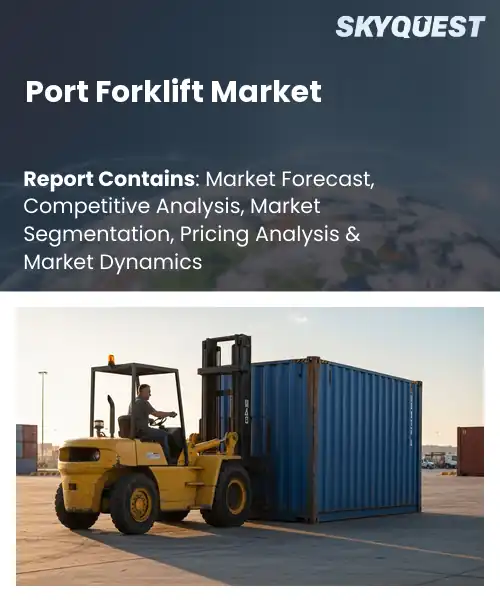
Port Forklift Market
Report ID: SQMIG20T2035
Report ID: SQMIG20T2035
[email protected]
USA +1 351-333-4748
Report ID:
SQMIG20T2035 |
Region:
Global |
Published Date: February, 2026
Pages:
157
|Tables:
151
|Figures:
78


Global Port Forklift Market size was valued at USD 4.4 Billion in 2024 and is poised to grow from USD 4.7 Billion in 2025 to USD 7.95 Billion by 2033, growing at a CAGR of 6.8% during the forecast period (2026-2033).
The growth in containerized trade is the biggest influence on the port forklift market, leading to an increased demand for heavy-duty material handling solutions for terminals and yards. This market is made up of specialized lift trucks, reach stackers and terminal tractors designed for moving containers, breakbulk and oversized products. The ability to quickly handle these materials decreases the amount of time a ship spends in port and lowers the costs associated with logistics for the carrier and shipper. The port forklift industry has evolved over several decades from simple diesel-powered forklifts to forklifts that are equipped with telematics and electric powertrains. Some examples of that evolution may be seen with the Port of Rotterdam doing tests with autonomous equipment and DP World implementing electric fleets to reduce emissions and enhance the resilience of their operations.
A key driving force shaping the global port forklift market are regulatory requirements related to lowering emissions that are forcing terminal operators to retire legacy diesel-powered machines in favor of electric and autonomous alternatives. As ports implement an electric fleet with a focus on meeting air quality standards, they will experience reduced fuel costs, quiet operations, and predictable maintenance schedules. Thereby encouraging continued capital investments and driving aftermarket services such as battery swapping and telematics.
How is IoT Enhancing Port Forklift Fleet Management?
The Internet of Things is rapidly changing the way port forklift fleets are managed as they become connected between vehicles, people and terminal systems via sensors and telematics. The primary functions of these new technologies are to track asset location, perform predictive maintenance, monitor driver behaviour and manage energy use. With the current marketplace continuing to shift toward retrofitting existing equipment versus new OEMS with digital services providing real-time visibility and integrating with yard control systems. Some examples of solutions are geofencing using GPS to properly manage vehicle traffic and onboard sensors that can detect wear on parts before they fail. These solutions reduce idle time and improve the efficiency of shift changes; they are also enabling the adoption of electric forklifts and the ability to provide automated alerts for safer operation and remote diagnostics.
Market snapshot - (2026-2033)
Global Market Size
USD 4.4 Billion
Largest Segment
Diesel Port Forklifts
Fastest Growth
Electric Port Forklifts
Growth Rate
6.8% CAGR
To get more insights on this market click here to Request a Free Sample Report
Global port forklift market is segmented into product type, load capacity, application, end-use industry, distribution channel and region. Based on product type, the market is segmented into electric port forklifts, diesel port forklifts, gas/lpg port forklifts and hybrid port forklifts. Based on load capacity, the market is segmented into <5 ton, 5–10 ton, 10–20 ton and >20 ton. Based on application, the market is segmented into container handling, bulk material handling, palletized goods handling, heavy cargo handling and yard & warehouse operations. Based on end-use industry, the market is segmented into shipping & ports, logistics & warehousing, manufacturing, construction and other industries. Based on distribution channel, the market is segmented into direct OEM sales, dealers & distributors, rental & leasing companies and online sales channels. Based on region, the market is segmented into North America, Europe, Asia Pacific, Latin America and Middle East & Africa.
The electric port forklifts segment is leading the market because ports are committed to running low emission and low noise operations, and owners want vehicles that provide low complexity in fuel handling and minimal time spent on maintenance. Electric port forklifts also align with the existing electrified yard infrastructure and telematics, resulting in much better integration between the automated gate and warehouse systems, providing greater efficiency of operations and lifecycle cost savings. Manufacturers provide modular battery swap/charging solutions, which allow for uninterrupted operations to continue to position electrics as the best option for modern fleets.
On the other hand, hybrid port forklifts are the fastest growing segment in the marketplace leading the industry because they provide a solution to range limitations while also reducing fuel consumption and emissions. Advances in hybrid powertrains and regenerative systems, when coupled with the familiarity of the operator with a traditional internal combustion platform, has accelerated fleet utilization as a viabletransitional choice.
The 10-20 ton segment dominates the market due to its ability to provide an ideal solution for lifting, whether it be for container transshipments or heavy pallets. This segment is versatile enough that you don't need to have a separate machine for each application, which then makes it easier for port fleet owners to plan their fleets as well as maintain them. Manufacturers make these 10-ton machines for durability and downtime optimization such that operators can use these as their main source of equipment for day-to-day yard work and intermediate-heavy loads; thus, forming the backbone of port handling fleets.
On the other hand, >20 ton forklifts are the most rapidly expanding area as ports handle larger, denser cargo and specialized heavy lifts become more common. Improvements in the chassis design and powertrain technology, coupled with improved safety systems will allow for the largest payloads to be lifted while keeping the machine stable. The increased demand for heavy lifting capabilities has prompted manufacturers to create innovative equipment, creating new niches for the handling of specialized heavy merchandise.
To get detailed segments analysis, Request a Free Sample Report
Asia Pacific's global port forklift market dominance is attributed to concentrated port activities, as well as dense industrial clusters and strong innovation-focused development of heavy material handing methods and technology. There is also strategic investment in port infrastructure, integrated logistics facilities, and collaboration between equipment manufacturers and ports which bolster fleet modernization and specialization. There are regional equipment suppliers that provide customer-specific solutions to high throughput environments, with the services they provide focusing on operational efficiency, safety and flexibility in accommodating multiple cargo types.
The port forklift market in Japan targets compact design with high precision functionality that support higher throughput operations in highly congested locations, which have complex cargo handling requirements. Additionally, local manufacturers are finding ways to generate equipment reliability via human factors design and by integrating equipment with automated sorting and distribution systems through collaborative relationships with port operators, OEM services facilities and conservative maintenance practices. Regular operator training programs that focus on preventive maintenance also contribute to maximizing fleet uptime.
The port forklift market in South Korea is very much focused upon electric and hybrid powered equipment capable of handling heavy containers with ease within busy terminals and shipyards. Local manufacturers produce modular forklift designs that provide maximum versatility and rugged capabilities. Supporting the development of this type of equipment are vehicle service representatives that provide quick parts support. Therefore, customers benefit from manufacturer-customized solutions for operators and operator safety, as well as integration opportunities between port management and terminal operations.
Rapid expansion in Europe’s port forklift market is a consequence of modernization of terminals, government regulations to reduce emissions, and increased intermodal freight movement, creating a need for adaptable material handling solutions. Investment in charging infrastructure, and automation-ready platforms combined with connectivity to terminal operating systems positions forklift equipment within the larger picture of digitized global supply chains. Manufacturers in the region and aftermarket service networks are working to satisfy the needs of diverse quay and yard settings while the service models they utilize are focused on maximizing uptime and total cost of ownership for their equipment. Cross-border trade dynamics and specialization of ports are driving the adoption of customized forklift configurations, and collaborative test pilots between manufacturers and end-users are expediting practical use in many of Europe's largest metropolitan ports. Investment financing and rental agreements mitigate adoption barriers, and the after-sale parts and service ecosystem is enabling responsive maintenance activities.
As per port forklift industry analysis, Germany is characterized by heavy duty, highly engineered equipment used at industrial ports and complex supply chain logistics. Manufacturing companies in Germany are focused on providing customized solutions, utilizing durable components, and offering a level of integration that is appropriate for the automation and digital controls used in today’s port environments. The capabilities of the aftermarket and support service level contracts will provide operational reliability for equipment used in German port operations. Collaboration between terminal owners/operators and manufacturers will support test initiatives, and the refinement of product offerings to meet the specific needs of German ports and exports-oriented supply chains.
In the UK port forklift market, there is a dynamic adoption of new industrial equipment based on flexibility and the reduction of emissions in various types of ports. The changes in trade patterns and the related investments in the modernization of terminals continue to drive this dynamic change. Rental and fleet management business models are becoming increasingly popular with operators, which is also leading to an increase in the number of trials and the number of different types of technology that will be adopted in the future. OEMs and service suppliers are working closely together to provide operators with the required training and the ability to get parts quickly. Building interconnected logistics solutions and turnarounds is supported by a continued focus on interoperability with the rail and road networks.
In France port forklift market, the development of new technology continues as ports are modernized and operators look for ways to reduce their emissions from all forms of handling equipment used for regional trade. Manufacturers both domestically and internationally continue to develop products that are specifically designed for medium-sized ports and specialized cargo handling, placing a strong emphasis on balancing electric and diesel, modular designs and ergonomics for the operator. Service networks throughout France and working with the port authorities to develop trial/ pilot deployments are growing, and with a continued focus on maintaining and training locally, an operator's capability and growth in this market will continue to develop.
Targeted investments into terminal modernization, growing integration of automation and telematics, and a more sophisticated ecosystem of rental and lifecycle service providers are all contributing to North America's growing stake in the port forklift sector. Emphasis on emissions reductions and operator safety are leading to the uptake of lower emission and electrified platforms, while strong collaboration between port authorities, terminal operators, and OEMs allows for customized solutions across a range of quay and yard profiles.
As per port forklift market regional outlook, US market is largely influenced by the large size of container terminals, intermodal connectivity, and the use of electrified and automation-friendly equipment. Operators prefer flexible procurement methods, rental agreements, and lifecycle service contracts to manage variable throughput volume. Aftermarket support and parts logistics are available to ensure uptime, while pilot programs involving remote operation and predictive maintenance will both guide fleet device selection and promote market tailored solutions.
As per port forklift market regional forecast, Canada market places an emphasis on durable equipment that meets both coastal and varied weather environment challenges, while also offering an interest in lower emission and electrified platforms. Through joint efforts by port authorities and OEMs to promote trials of automation and telematics, fleet management and rental programs will assist operators in balancing operational flexibility with lifecycle considerations.
To know more about the market opportunities by region and country, click here to
Buy The Complete Report
Growing Demand for Electrification
The increasing move towards more electric port equipment is resulting in higher demand for electric port forklifts, which are being designed to operate on electrical power and produce low levels of emissions. This has encouraged manufacturers to increase their rangeof electric models and to invest in developing technologies related to electric forklifts and other equipment. Ports that are trying to minimize their carbon footprint and to comply with regulatory and environmental requirements are favoring the adoption of electric material handling solutions, which are resulting in increased procurement and aftermarket services. The preference for electric material handling solutions has also provided opportunities for suppliers to develop and build supporting infrastructure, such as charging stations, battery management systems, and service networks, which will help sustain the growth of the market and create synergy with product development that aligns with environmental concerns as well as cost-per-operating basis concerns.
Higher Infrastructure Investments
Modernization projects and investment in port infrastructure are now driving the procurement of more technologically advanced material handling equipment, including specific forklift suitable for operation in automated environments and at higher throughput levels. Upgrades to berths, storage yards, and logistics systems are creating demand for machines that are more maneuverable, safer, and have greater integration capabilities. As terminals work towards increasing efficiencies and optimizing throughput, they are also placing a higher priority on the procurement of quality, dependable forklifts to complement other modernization efforts. Thus creating a need for manufacturers to provide innovation and expand their respective portfolio of products to meet evolving operational requirements and continue to assist in the assessment of future port forklift market growth.
High Initial Acquisition Costs
The upfront capital needed to purchase advanced port forklifts is harmfully high for smaller terminals and operators with budget limitations, leading to hesitancy in adopting these new models. High prices result in decision-makers delaying and/or scaling back on fleet renewals, choosing instead to extend the lives of their current fleets through maintenance rather than upgrading to newer models. This port forklift market trend leads to decreased near-term demand as manufacturers are faced with longer sales cycles and need to demonstrate TCO benefits.
Limited Skilled Operator Availability
The limited availability of skilled operators constrains adoption of advanced port forklifts as operators require special skills training before they can operate advanced port forklifts safely and efficiently. Without adequate training programs, operators may not feel comfortable deploying advanced port forklifts due to the perceived increased risk associated with their operation. Additionally, the additional time and costs associated with providing the necessary training and certification extend the installation timeframe and impose significant operational overhead; the limited availability of in-house expertise creates additional apprehension about utilizing advanced features of these forklifts. Consequently, terminal operators may either delay the procurement of advanced port forklifts or choose to procure simpler models, thereby reducing demand for technologically advanced forklifts.
Request Free Customization of this report to help us to meet your business objectives.
Competitive pressures in the global port forklift industry are being driven by OEM consolidation efforts, operator-based technology partnerships, and fast-moving electrification and autonomy adoption. In addition to this recent scrutiny of a proposed merger between Konecranes and Cargotec affirms the risks associated with M&A activity. Additionally, OEMs and start-ups have made the most progress in pilot programs and low-emission solutions, as shown for example by Hyster’s completion of hydrogen-powered reach stackers at a key terminal and DriveU.auto’s development of retrofitting teleoperation kits to automate brownfield operations.
Automation and Autonomy: Port forklift fleets are becoming more automated and autonomous to improve safety and throughput in terminals. To support coordinated movements among multiple forklifts and provide predictive maintenance, vendors are developing modular retrofit solutions that integrate with terminal operating systems and combine Sensor Fusion technologies. This will also provide remote monitoring of terminal operations and enable human-machine collaboration, so multiple assets can be operated by one human operator with the ability to intervene when required.
Sustainability and Energy Transition: The trend is toward low-emission port forklifts using energy efficiencies and lifecycle sustainability as the bases of procurement and operational strategies, increasing demand from fleet operators for low or no-emissions forklifts. Forklift manufacturers are diversifying their product lines by offering electrics and other alternatives, offering battery-as-a-service, developing scalable charging infrastructure, and developing circular designs to support refurbishment. Ports are working with their local utility providers so they can provide the necessary energy management resources, while simultaneously seeking renewable energy sources. The push toward sustainability/energy transition creates a major influence on the decisions made by terminal operators and suppliers regarding vendor selection, long-term maintenance models, and regulatory compliance planning; in addition to creating opportunities for providing value-added services that reduce environmental footprints and improve brand perception.
SkyQuest’s ABIRAW (Advanced Business Intelligence, Research & Analysis Wing) is our Business Information Services team that Collects, Collates, Correlates, and Analyses the Data collected by means of Primary Exploratory Research backed by robust Secondary Desk research.
As per SkyQuest analysis, the global port forklift industry is being driven primarily by expansion of containerized trade, which increases demand for versatile heavy-duty handling solutions, while a key restraint remains high initial acquisition costs that slow fleet upgrades for smaller operators. Asia Pacific emerges as the dominating region due to concentrated port activity and manufacturing clusters, and electric port forklifts are the dominating segment as ports prioritize low-emission, low-noise operations and integration with telematics. The second major driver to electrify forklift trucks at ports is the regulatory push towards reduced emissions. This means there's pressure on manufacturers and service providers to increase electrified fleets, which has resulted in greater adoption of both charging infrastructure and aftermarket service solutions for this emerging industry segment. The global forklift market at ports consists of many of the major equipment manufacturers we consider to be "big box" brands as well as a growing number of regional manufacturers using a price-based competitive strategy.
| Report Metric | Details |
|---|---|
| Market size value in 2024 | USD 4.4 Billion |
| Market size value in 2033 | USD 7.95 Billion |
| Growth Rate | 6.8% |
| Base year | 2024 |
| Forecast period | (2026-2033) |
| Forecast Unit (Value) | USD Billion |
| Segments covered |
|
| Regions covered | North America (US, Canada), Europe (Germany, France, United Kingdom, Italy, Spain, Rest of Europe), Asia Pacific (China, India, Japan, Rest of Asia-Pacific), Latin America (Brazil, Rest of Latin America), Middle East & Africa (South Africa, GCC Countries, Rest of MEA) |
| Companies covered |
|
| Customization scope | Free report customization with purchase. Customization includes:-
|
To get a free trial access to our platform which is a one stop solution for all your data requirements for quicker decision making. This platform allows you to compare markets, competitors who are prominent in the market, and mega trends that are influencing the dynamics in the market. Also, get access to detailed SkyQuest exclusive matrix.
Table Of Content
Executive Summary
Market overview
Parent Market Analysis
Market overview
Market size
KEY MARKET INSIGHTS
COVID IMPACT
MARKET DYNAMICS & OUTLOOK
Market Size by Region
KEY COMPANY PROFILES
Methodology
For the Port Forklift Market, our research methodology involved a mixture of primary and secondary data sources. Key steps involved in the research process are listed below:
1. Information Procurement: This stage involved the procurement of Market data or related information via primary and secondary sources. The various secondary sources used included various company websites, annual reports, trade databases, and paid databases such as Hoover's, Bloomberg Business, Factiva, and Avention. Our team did 45 primary interactions Globally which included several stakeholders such as manufacturers, customers, key opinion leaders, etc. Overall, information procurement was one of the most extensive stages in our research process.
2. Information Analysis: This step involved triangulation of data through bottom-up and top-down approaches to estimate and validate the total size and future estimate of the Port Forklift Market.
3. Report Formulation: The final step entailed the placement of data points in appropriate Market spaces in an attempt to deduce viable conclusions.
4. Validation & Publishing: Validation is the most important step in the process. Validation & re-validation via an intricately designed process helped us finalize data points to be used for final calculations. The final Market estimates and forecasts were then aligned and sent to our panel of industry experts for validation of data. Once the validation was done the report was sent to our Quality Assurance team to ensure adherence to style guides, consistency & design.
Analyst Support
Customization Options
With the given market data, our dedicated team of analysts can offer you the following customization options are available for the Port Forklift Market:
Product Analysis: Product matrix, which offers a detailed comparison of the product portfolio of companies.
Regional Analysis: Further analysis of the Port Forklift Market for additional countries.
Competitive Analysis: Detailed analysis and profiling of additional Market players & comparative analysis of competitive products.
Go to Market Strategy: Find the high-growth channels to invest your marketing efforts and increase your customer base.
Innovation Mapping: Identify racial solutions and innovation, connected to deep ecosystems of innovators, start-ups, academics, and strategic partners.
Category Intelligence: Customized intelligence that is relevant to their supply Markets will enable them to make smarter sourcing decisions and improve their category management.
Public Company Transcript Analysis: To improve the investment performance by generating new alpha and making better-informed decisions.
Social Media Listening: To analyze the conversations and trends happening not just around your brand, but around your industry as a whole, and use those insights to make better Marketing decisions.
REQUEST FOR SAMPLE
 REQUEST FREE CUSTOMIZATION
Global Port Forklift Market size was valued at USD 4.4 Billion in 2024 and is poised to grow from USD 4.7 Billion in 2025 to USD 7.95 Billion by 2033, growing at a CAGR of 6.8% during the forecast period (2026-2033).
Competitive intensity in the global port forklift market is driven by OEM consolidation attempts, operator tech partnerships, and rapid electrification and autonomy adoption. Recent antitrust scrutiny of a proposed Konecranes and Cargotec merger illustrates M&A risk. OEMs and startups advance pilots and low emission solutions, for example Hyster’s hydrogen reachstacker trials at a major terminal and DriveU.auto’s retrofit teleoperation kits enabling brownfield automation. 'Hyster-Yale Materials Handling', 'Toyota Material Handling', 'Konecranes', 'Terex Corporation', 'Crown Equipment Corporation', 'Liebherr', 'Clark Material Handling Company', 'Mitsubishi Logisnext', 'Yale Materials Handling Corporation', 'Doosan Industrial Vehicle', 'Hyundai Heavy Industries', 'Nissan Forklift Corporation', 'Forklifts & More', 'Manitou Group', 'Gehl Company', 'Combilift', 'Palfinger AG', 'Barloworld Handling', 'TCM Forklifts', 'Kalmar Global'
The increasing shift toward electric port equipment is driving demand for port forklifts designed for battery power and low emissions, encouraging manufacturers to expand electric model ranges and invest in related technologies. Ports aiming to reduce carbon footprints and comply with environmental policies prefer electrified handling solutions, which stimulates procurement and aftermarket support services. This preference opens opportunities for suppliers to develop charging infrastructure, battery management systems, and service networks, reinforcing market momentum by aligning product development with environmental objectives and operational cost considerations.
Automation And Autonomy: Port forklift fleets are increasingly integrating automation and autonomy to enhance terminal throughput and safety. Vendors focus on modular retrofit kits, sensor fusion, and seamless integration with terminal operating systems to enable coordinated movements, predictive maintenance, and remote supervision. Adoption emphasizes human machine collaboration, allowing operators to oversee multiple assets and intervene when necessary. This trend drives partnerships across logistics providers, standardization efforts for interoperability, and workforce upskilling programs to shift roles toward system monitoring, maintenance, and exception management practices.
Asia Pacific's global port forklift market dominance is attributed to concentrated port activities, as well as dense industrial clusters and strong innovation-focused development of heavy material handing methods and technology.


Want to customize this report? This report can be personalized according to your needs. Our analysts and industry experts will work directly with you to understand your requirements and provide you with customized data in a short amount of time. We offer $1000 worth of FREE customization at the time of purchase.
Feedback From Our Clients


 USA (+1) 351-333-4748

